
Chargeback management is the set of jobs that keeps card disputes from costing you more than they have to: stopping them where you can, catching them early where you cannot, answering the ones that land and learning from every one. Some businesses do all of it in-house, some hand part of it to their processor and some hire a dedicated dispute firm. This guide explains what each job involves, what handling it yourself really costs in time and risk, and the signs that it is time to get help.
The short answer
- It is a routine, not a single task. It covers prevention, early alerts, watching your dispute numbers, answering each case before its deadline and fixing the cause afterward.
- The cost you feel most is internal. Besides the disputed amount and the chargeback fee, you spend staff time, lose merchandise and take on monitoring risk.
- Management cannot promise wins. The cardholder’s bank decides most disputes, and some in-person losses cannot be won at all.
- Getting help is a sliding scale. It runs from questions to your processor, to alert tools, to a dispute firm that handles cases at scale.
- Ask what is included. Monitoring, alerts, response letters and reporting are separate pieces, and providers bundle them differently.
What chargeback management means
A chargeback is a forced reversal of a card payment. The customer disputes the charge with their own bank, called the issuing bank, instead of asking you for a refund. The bank takes the money back, assigns a reason code (a short label for the type of claim) and passes the case to your processor, which debits your account for the amount plus a chargeback fee. Our complete guide to chargebacks walks through that path step by step.
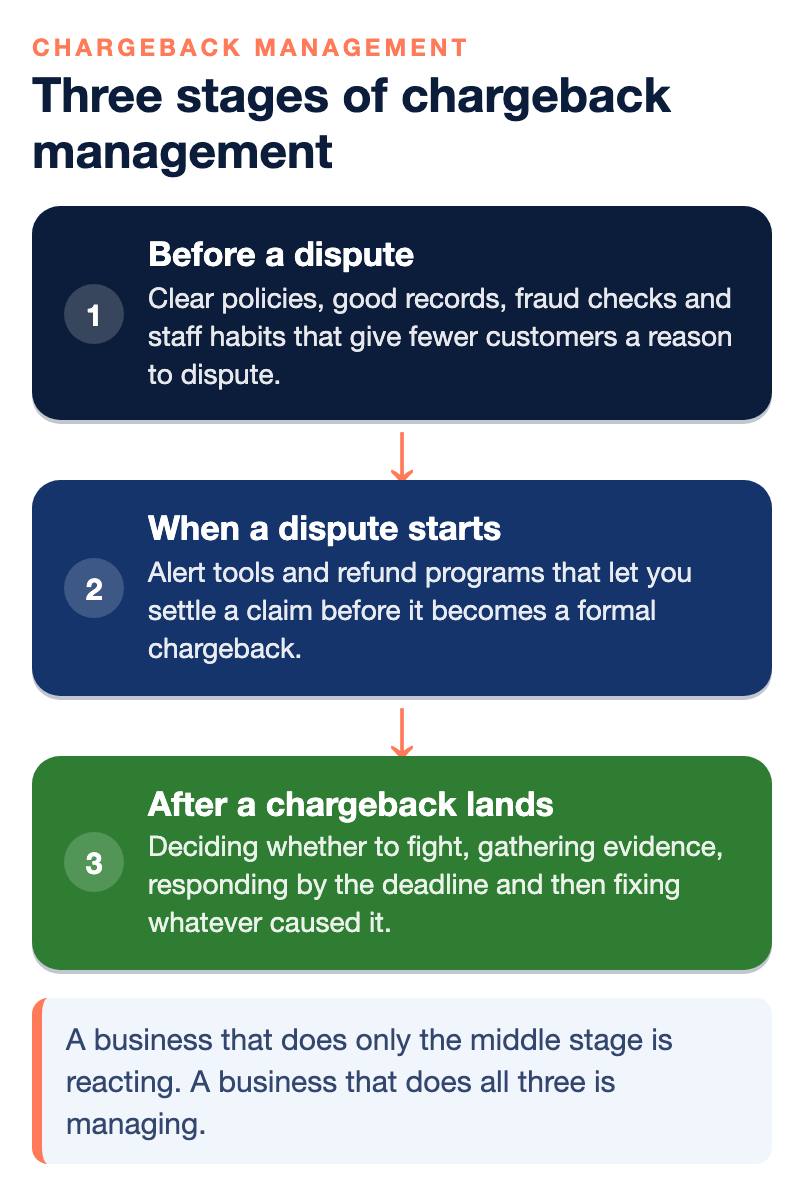
Chargeback management is everything you do around that path. A useful way to see it is as three stages:
- Before a dispute. Clear policies, good records, fraud checks and staff habits that give fewer customers a reason to dispute.
- When a dispute starts. Alert tools and refund programs that let you settle a claim before it becomes a formal chargeback.
- After a chargeback lands. Deciding whether to fight, gathering evidence, responding by the deadline and then fixing whatever caused it.
A business that does only the middle stage is reacting. A business that does all three is managing. Nationwide Payment Systems (NPS) describes chargebacks as compliance events, not only disputes, because the way you handle them affects your standing with your processor and the card networks.
Stage one: preventing the dispute
Most of the work that reduces chargebacks happens before any dispute exists. NPS lists a short set of prevention steps in its chargeback survival guide:
- Clear policies. Refund and cancellation terms should be easy to find and shown on receipts.
- Documentation. Keep signed receipts, order details and records of what you told the customer.
- Fraud tools. Address verification, card security code checks, device fingerprinting and velocity checks (limits on how many attempts can come from one source).
- Staff training. Employees should know how to verify identification and follow strict transaction procedures.
For an online business, the website itself is part of this stage. A refund policy the customer cannot find, a cancellation process buried in the terms or a billing name the customer does not recognize all weaken your position before a dispute begins. Our article on e-commerce policies as your first line of defense covers what those pages should say, and our guide to balancing fraud screening against customer friction covers how strict your checks should be.
Prevention is also where the line between fraud and chargebacks blurs. A stolen-card order and a legitimate customer who forgot a subscription both end up as disputes, but they need different fixes. Our articles on telling friendly fraud from a real complaint and on first-party fraud in your chargeback data explain why the label on a dispute does not always tell you who is really behind it.
Stage two: catching the claim early
Some tools let you act when a cardholder first contacts their bank, before a formal chargeback exists. NPS names Visa’s Rapid Dispute Resolution (RDR) and chargeback alert services such as Ethoca and Verifi among the options to consider, especially for businesses with high volume or digital products.
With RDR, an alert is generated when the cardholder contacts their bank. The merchant can refund the transaction automatically, and the case does not become a chargeback. NPS notes that a dispute handled this way does not count against the monitoring ratios. The trade-off is plain: an early refund costs you the sale, but for a small sale with weak evidence it may be a better deal than fighting. Deciding which alerts to answer with a refund and which to ignore is itself a management decision, and it is easier to make with a written rule than case by case.
Early tools are not free of judgment. If you refund every alert, you pay for disputes that you could have won. If you ignore every alert, you give up the chance to keep a formal chargeback off your record. Good management sets a rule based on the size of the sale, how strong your evidence is and how your ratios look this month.
Stage three: answering a chargeback that lands
Once a chargeback is filed, the clock is running. NPS’s guides say the response deadline is typically 7 to 21 days, and that under 2026 guidelines you may have as little as 9 days for certain disputes. If you miss the deadline, you lose automatically. Because deadlines differ by card network and dispute type, confirm the exact dates with your processor for any live case.
Answering well involves several separate tasks:
- Intake. Someone has to notice the notice. A chargeback email that sits unread is a lost case.
- Reading the reason code. The code tells you which evidence the bank expects to see. Our guide to how reason codes work explains what the code tells you and what it hides.
- Deciding whether to fight. Accepting a chargeback you cannot win saves time. Fighting one you can win with clear evidence is worth the effort.
- Gathering evidence. NPS lists proof of the transaction, a signed receipt, a timestamp, proof of delivery or service and customer communication logs. For online sales it also points to details such as IP addresses and device information.
- Writing the response. A short cover letter that states the reason code, says in a few sentences why the sale was valid and points to each piece of evidence does more than pages of frustration.
- Following the case. A win can be challenged, so keep the full file until the case is clearly closed.
Our article on what happens after your processor submits your response describes why representment is a response and not a ruling, and why a case marked as won can sometimes come back.
Stage four: learning from every case
The last part of chargeback management is the part most businesses skip. Each closed case tells you something: which product, which sales channel, which time of day, which staff member or which policy produced it. Sorting disputes into groups such as fraud, forgotten purchases and real complaints shows you where to spend effort. A pattern of real complaints points at fulfillment or service. A pattern of unrecognized charges points at your billing name or your receipts. A pattern of fraud points at your screening.
It also means watching the numbers. A dispute ratio is a count, not a dollar figure, so a ten-dollar dispute weighs the same as a thousand-dollar one. Visa’s monitoring counts fraud reports as well as chargebacks. Our guide to the chargeback ratios that get a merchant’s attention explains who sets each line and how the ratio is counted. NPS says it monitors dispute ratios for its merchants, and you can also work out your own number each month.
For businesses in higher-risk categories, this stage matters even more. Subscription billing, delayed or digital delivery and free-trial funnels all raise dispute volume. Our high-risk chargeback guide and our article on subscription and free-trial chargebacks cover those patterns.
What handling it yourself costs you internally
Chargeback costs go well beyond the disputed amount. NPS lists several: the chargeback fee, operational time, lost merchandise, higher monitoring risk, potential fines and possible account termination. This guide does not quote fees, because they vary by processor and by contract. What you can do is count the internal costs that never show up on a statement.
- Staff time. Someone reads each notice, finds the order, pulls the receipt, collects messages and writes the response. Multiply that by the number of disputes in a month.
- Attention taken from selling. If the person who handles disputes is also the owner, the time comes out of the work that grows the business.
- Missed deadlines. A case you did not get to is a case you lose, even if your evidence was strong.
- Lost goods and revenue. You lose the money and often the merchandise or the service you delivered.
- Weak records. If receipts, logs or delivery proof live in different places, every case takes longer to build.
- Risk you do not see. Because each chargeback counts against your account, a run of disputes can lead to higher processing costs, required action plans, larger reserves or a closed account.
The last item is the one to take seriously. An account closed for excessive chargebacks can lead to the business and its owners being added to a list that other banks check on new applications. Our article on the 14 reasons merchants end up on the MATCH list explains how that happens and why it is hard to undo.
A simple way to estimate your own internal cost is to track, for one month, how many disputes you received, who worked on each and how long each took. You do not need exact figures. A rough count is enough to show whether the work is a small side task or a recurring job that deserves a plan.
What chargeback management cannot do
A good program lowers your risk and gives you a better chance. It does not guarantee outcomes, and anyone who promises otherwise is selling something. Keep these limits in mind:
- The issuing bank decides most disputes. The card networks write the rules, and your processor passes your response along. Neither one decides the ordinary case.
- Some losses cannot be won. NPS says restaurants and bars lose stolen-card and chip liability disputes even when the card was approved and the receipt was signed, and that video and photos have not changed the outcome. Prevention is the only defense there.
- Evidence cannot fix a missing policy. If a customer never saw your cancellation terms, you cannot create that proof after the fact.
- Winning does not erase the dispute. The chargeback has already been filed. Recovering the funds does not remove it from your account’s record.
For hospitality and retail, NPS’s Chargeback Rescue page describes one example of a service built around monitoring, dispute management and a review of your sales process, including tip authorization to reduce over-tipping disputes.
When to get help
Many small businesses handle chargebacks well on their own for years. Help becomes worth considering when the work stops fitting the time you have or the risk starts to grow. Common signs include:
- Your ratio is rising from month to month, or your processor has contacted you about it.
- You have missed a response deadline, or you are not sure you could meet the next one.
- You bill on a schedule, run free trials or deliver digital goods, where disputes run higher.
- Your online volume has grown to the point where cases arrive faster than you can read them.
- You keep losing the same kind of case and do not know why.
- One person handles everything and there is no backup.
NPS says high-volume e-commerce merchants often benefit from dedicated dispute specialists, who manage disputes at scale. That is NPS’s view, and it is a company that connects merchants with such firms, so weigh it accordingly. A smaller business may need only alerts and a clear internal rule. If you are starting from scratch, our guide to simple fraud controls for retail and POS businesses is a good first read.
Levels of help, from light to heavy
- Your processor. Many processors check that a response is complete, and some offer help with response letters. Ask yours what it provides.
- Alert and refund tools. Services such as RDR and chargeback alerts catch disputes early.
- Monitoring and advice. Someone watches your ratios and website for risk and tells you when to act.
- Full dispute handling. A specialist firm gathers evidence and files responses for you.
You do not have to jump to the top of the list. Start with the lightest option that solves the problem you actually have.
Questions to ask any provider
- What exactly is included: monitoring, alerts, response letters, evidence collection, reporting?
- Which alert services do you support, and are they included or an add-on?
- Who reviews my account if my disputes start to rise, and how fast will I hear from them?
- Do I send the evidence or do you collect it from my systems?
- What will I see each month about my disputes and ratio?
- What happens if a response deadline is at risk?
- What does the contract say about fees, reserves and termination if my ratio climbs?
Ask for the answers in writing. A provider that explains what its service does not cover is easier to trust than one that promises to win everything.
Who wrote this, and where NPS fits
Nationwide Payment Systems publishes this guide. We are a payments company based in South Florida, in business since 2001, and we sell merchant accounts, gateways and point-of-sale systems, so we are not neutral. We work with merchants on chargebacks before and after they happen. That includes reviewing your website for compliance risk, helping structure refund and cancellation policies, assisting with representment strategy, helping set up RDR where it fits, offering chargeback alert tools and monitoring dispute ratios. For high-volume e-commerce merchants we also connect you with professional chargeback management firms. We do not publish prices in this guide, and no provider can promise to win your disputes. You can browse our full library of payments guides.
We are not the right fit for everyone. If you are a hobby seller with very low volume, if you only want an instant self-service sign-up or if the lowest advertised flat rate is the only thing that matters to you, a simpler platform will probably suit you better.
Bottom line
Chargeback management is the routine of preventing disputes, catching them early, answering the ones that land and learning from each. Doing it yourself costs staff time, attention and risk that never appear on a statement, and no program can promise wins because the cardholder’s bank decides. Start by counting how much time disputes take today, set written rules for alerts and responses, and add help in steps as your volume or risk grows. If you would like a second opinion on how your disputes are handled, you can contact our team, and if another approach fits you better, we will say so.
Frequently asked questions
What is chargeback management?
It is the routine of preventing disputes, catching them early with alerts, answering chargebacks before their deadlines and learning from each case. It can be done in-house, with help from a processor or with a dedicated dispute firm.
What does chargeback management usually include?
It typically includes policy and website review, fraud checks, alert and refund tools such as RDR, dispute ratio monitoring, evidence gathering, response letters and reporting. Providers bundle these differently, so ask what is included.
What does it cost to handle chargebacks myself?
Beyond the disputed amount and the chargeback fee, you spend staff time, lose merchandise or revenue, risk missing deadlines and take on monitoring risk. Tracking disputes and the hours spent for one month gives you a rough view of your own internal cost.
Can chargeback management guarantee I will win disputes?
No. The cardholder’s bank decides most disputes, and some in-person losses, such as certain stolen-card and chip liability cases, cannot be won even with strong evidence. Management improves your odds and lowers your risk.
How long do I have to respond to a chargeback?
NPS’s guides say the deadline is typically 7 to 21 days and may be as short as 9 days for certain disputes. Missing it means you lose automatically. Confirm the exact date for each case with your processor.
When should a small business get help with chargebacks?
Consider help when your ratio is rising, your processor contacts you, you have missed or nearly missed a deadline, you bill on a schedule or deliver digital goods, or disputes arrive faster than one person can handle.
Do I need a dispute firm, or are alerts enough?
It depends on volume and risk. A smaller business may need only alert tools and a written rule for responding. NPS says high-volume e-commerce merchants often benefit from dedicated specialists.





