
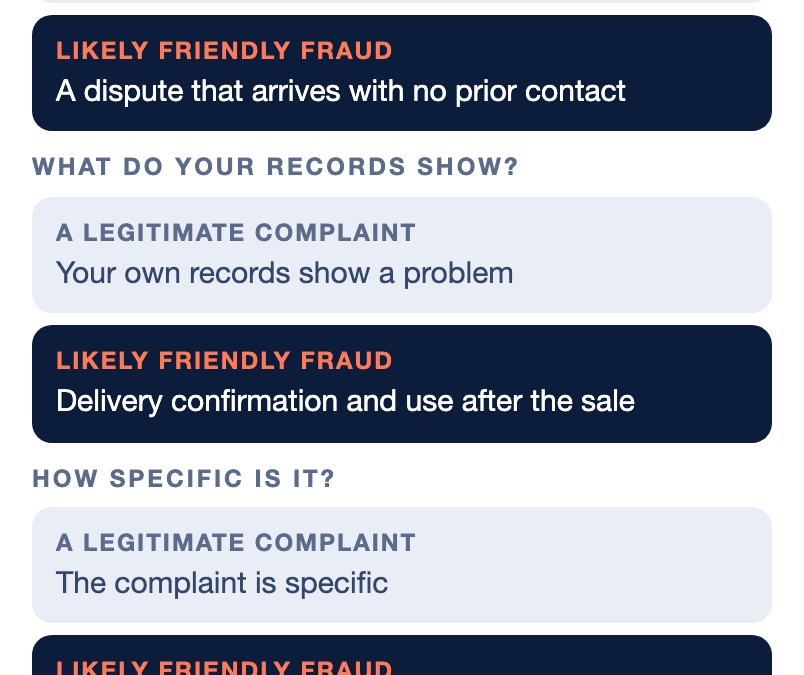
The fastest way to tell friendly fraud from a legitimate complaint is to look at what the customer did before the dispute. A real complaint usually leaves a trail: a message to you, a return request, a delivery problem or a billing mistake you can find in your own records. Friendly fraud usually skips you entirely, arrives as a bank dispute with a vague reason, and comes from a customer whose purchase history, delivery confirmation and account activity all say they got what they paid for. This guide shows the signals that separate the two, how to check them in about fifteen minutes, and why the answer changes what you should do next.
The short version
- Friendly fraud is when a customer disputes a purchase they made, received and used, either by mistake, out of forgetfulness or on purpose.
- A legitimate complaint is when something really went wrong: the item did not arrive, it was not as described, the customer was charged twice, or a cancellation was ignored.
- The best single signal is whether the customer contacted you first. Real problems tend to show up in your inbox before they show up as chargebacks.
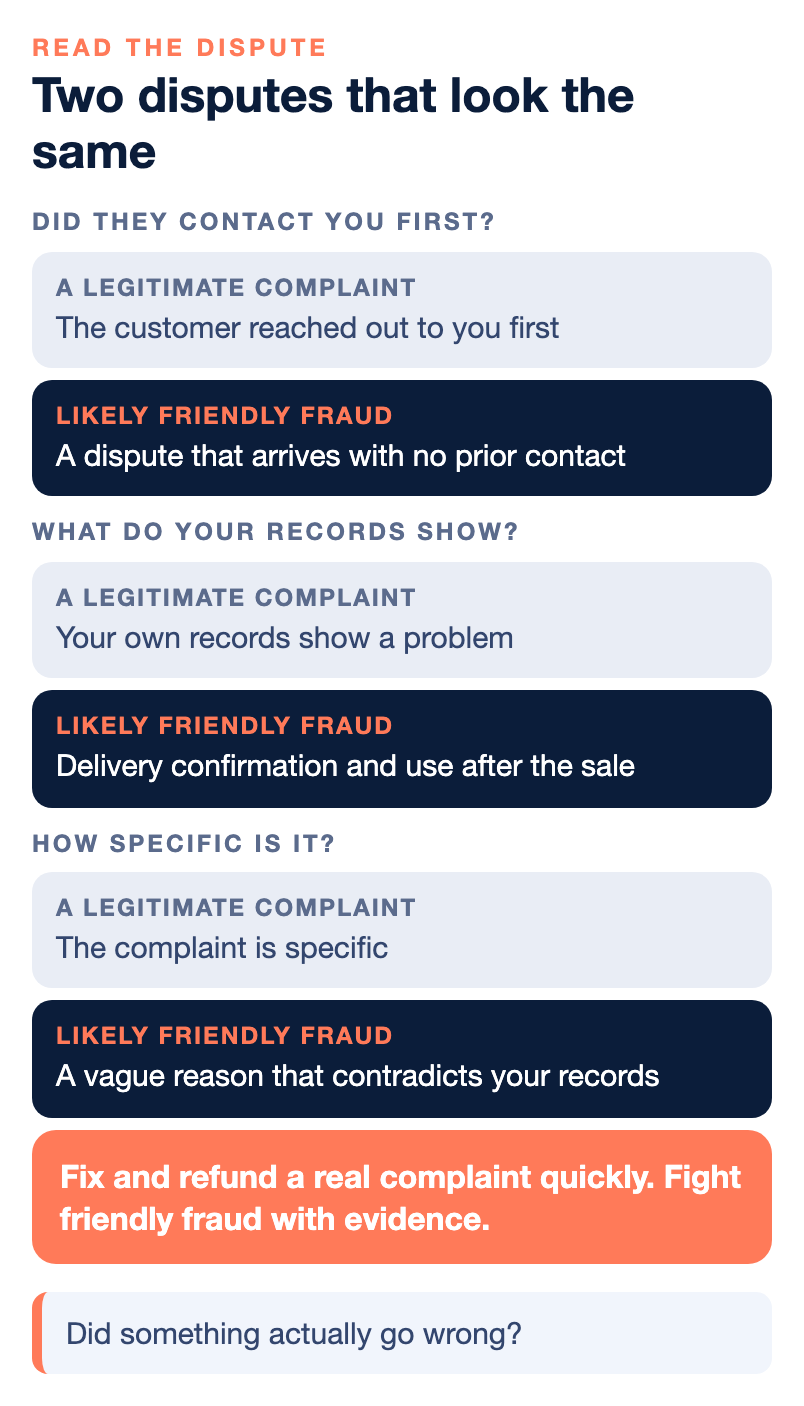
- The response is different. Fix and refund a real complaint quickly. Fight friendly fraud with evidence, and change the process that let it happen.
Why the difference matters
Treating every dispute the same way is expensive in both directions. If you fight a customer who had a real problem, you lose the dispute, lose the customer and often get a bad review on top of it. If you refund every dispute without looking, you teach a small group of customers that a call to their bank is a free return policy, and your dispute ratio keeps climbing.
That ratio matters more than most business owners realize. Card networks run monitoring programs that watch how many disputes a merchant receives compared with its sales, and a merchant that crosses their thresholds can face fines, required action plans, reserves and, in the worst case, a closed account. We explain how those programs work in our guide to chargebacks, RDR and VAMP. Every dispute counts toward the ratio whether you win it or not, which is why the goal is fewer disputes, not just more wins.
What friendly fraud actually looks like
The term covers a range of behavior, and not all of it is dishonest. In our article on digital shoplifting and friendly fraud chargebacks, we list the claims merchants hear most often: “I never received the product,” “Someone else used my card,” “I paid another way,” “I don’t recognize this charge,” “This was charged twice” and “The amount was incorrect.” Behind those claims are a few different situations.
The forgetful customer
A customer sees a charge they do not recognize, often because the name on their statement does not match the name they know you by, or because a subscription renewed and they forgot about it. They call their bank instead of you. There is no bad intent here, but it still becomes a chargeback.
The family purchase
A spouse, a teenager or another family member uses the card, and the cardholder disputes it as unauthorized without knowing. The purchase was real and the goods arrived, but the person disputing it genuinely did not make it.
The buyer’s regret
A customer changes their mind after the return window, or after using the product, and finds that a bank dispute is easier than asking for an exception. They may claim the item was not as described, or never arrived.
The deliberate scheme
A smaller group disputes purchases on purpose to keep the goods and the money. Restaurants and bars see meals and bar tabs disputed after they have been consumed. Online stores see “item not received” claims on packages with confirmed delivery. Our friendly fraud article also describes the two-card scheme, where a customer makes two separate purchases on two different cards and later claims they were charged twice.
What a legitimate complaint looks like
Real problems happen at every well-run business. Packages get lost. A product ships in the wrong size. A staff member runs a card twice. A cancellation request sits in an inbox that nobody checks. A legitimate complaint usually has some of these features:
- The customer reached out to you first, by email, phone, chat or a return request, and did not get a resolution.
- Your own records show a problem: a duplicate transaction, an incorrect amount, a shipment with no tracking scan, or a cancellation that was received but not processed.
- The complaint is specific. The customer can tell you what was wrong, when and how.
- The customer has a normal history with you, without a pattern of disputes.
If you find a real problem, the right move is usually to fix it and refund it as quickly as you can, ideally before the dispute becomes a formal chargeback.
Eight signals that separate the two
No single signal proves anything on its own. Look at them together, and let the pattern decide.
1. Did the customer contact you first?
This is the strongest signal. A customer with a real problem usually tries the merchant first, because that is the fastest way to get their money or their product. A dispute that arrives with no prior contact is not proof of fraud, but it moves the needle.
2. Does delivery or service confirmation exist?
For shipped goods, look at the tracking record, the delivery address and any delivery photo or signature. For services, look at appointment records, signed work orders, check-in times and photos of completed work. For digital goods, look at download records, logins and usage after the purchase date.
3. Did the customer use what they bought?
Logins after the sale, a downloaded file, a redeemed booking, a consumed meal on a signed check or a product registered with the manufacturer all suggest the customer received value. That does not rule out a real complaint about quality, but it weakens a claim of non-receipt or no authorization.
4. Does the dispute reason match the facts?
A dispute coded as unauthorized from a customer who emailed you about sizing the week before does not add up. A dispute coded as not received on an order with a delivery photo at the customer’s front door does not either. When the stated reason contradicts your records, you are more likely looking at friendly fraud.
5. Does the customer have a history with you?
Look at earlier orders on the same card, the same email address, the same shipping address or the same device. A customer who has bought from you several times without trouble and suddenly disputes as unauthorized is often a forgotten purchase or a family member, not a stranger using a stolen card.
6. Could your own billing have caused the confusion?
Check how your business name appears on card statements. If it is a parent company name, an abbreviation or a payment platform’s name, customers may not recognize the charge. Recurring charges with no reminder email before renewal cause the same problem. If the confusion came from your side, fix the descriptor or the reminder before you blame the customer.
7. Was there a mistake in the transaction itself?
Look for duplicate authorizations, a sale that was voided but also settled, the wrong amount keyed in, or a tip changed after the fact. Our article on why void versus refund matters shows how a small processing mistake can look like a customer problem.
8. Is there a pattern?
Several disputes from the same customer, the same address, or the same type of order are a pattern worth investigating. So is a sudden cluster of disputes after a promotion or a change in your billing. A pattern points either to repeat friendly fraud or to a process problem on your side, and both are worth finding.
A fifteen-minute check for every new dispute
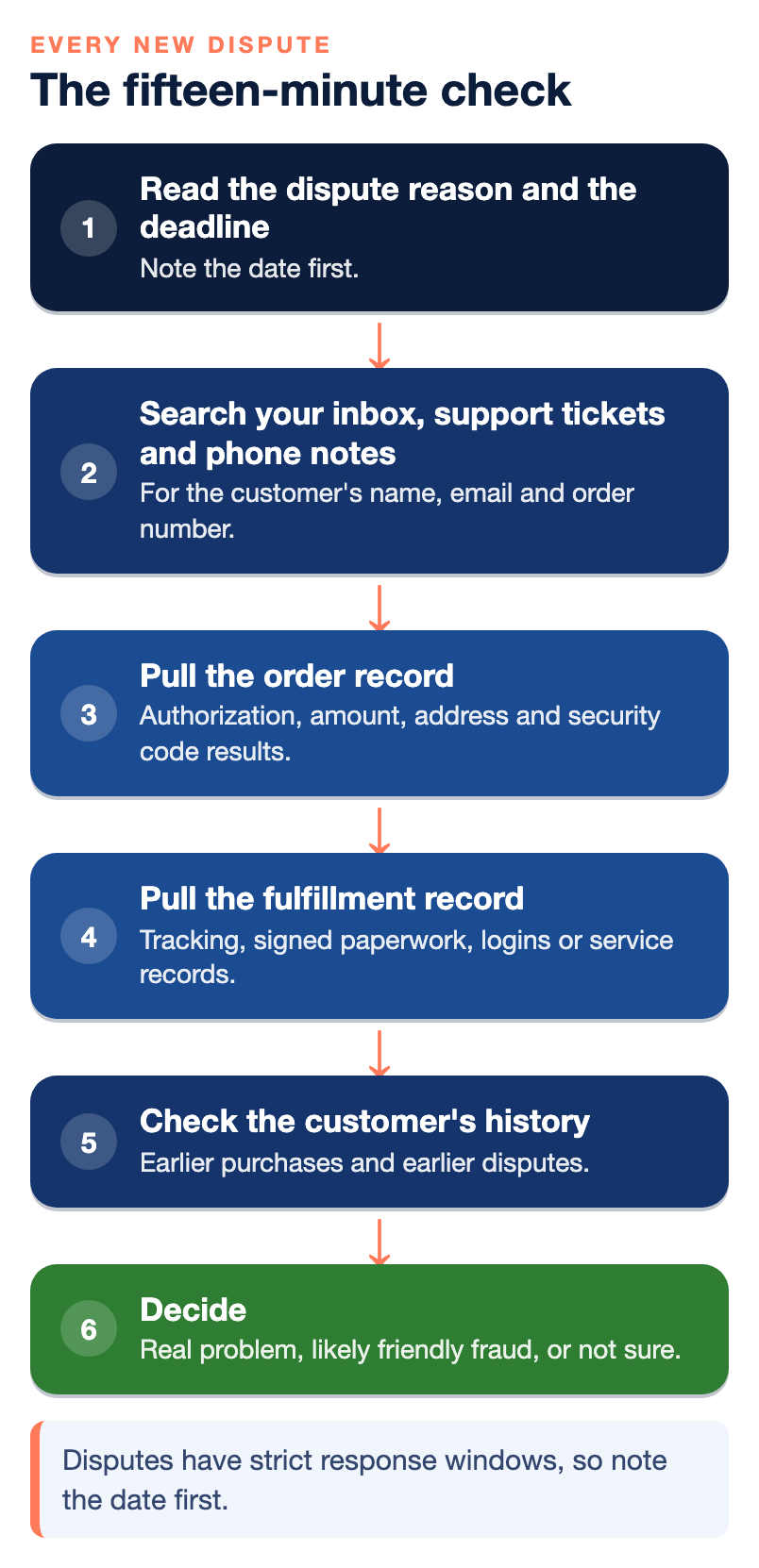
When a dispute notice arrives, work through the same short routine before you decide what to do. The point is to answer one question: did something actually go wrong?
- Read the dispute reason and the deadline. Disputes have strict response windows, so note the date first.
- Search your inbox, support tickets and phone notes for the customer’s name, email and order number.
- Pull the order record: the authorization, the amount, the address check and security code results, and whether there was a duplicate or a void.
- Pull the fulfillment record: tracking and delivery confirmation, signed paperwork, login or download history, or service records.
- Check the customer’s history for earlier purchases and earlier disputes.
- Decide: real problem, likely friendly fraud, or not sure. Write down why.
If you are not sure, lean toward the evidence. A customer who had a real problem and can show it will usually win the dispute anyway, and a refund you were going to lose regardless at least saves you the time of a response.
What to do once you know which it is
If it is a legitimate complaint
Fix the problem and refund it. If the dispute has not yet become a formal chargeback, a refund now may keep it off your ratio. Some processors offer tools, such as Rapid Dispute Resolution, that can refund qualifying disputes automatically before they turn into chargebacks, which is especially useful for subscription and online businesses. Then contact the customer, apologize plainly, and fix whatever process failed, whether that is a shipping partner, a cancellation inbox or a staff training gap.
If it looks like friendly fraud
Respond with evidence, not argument. Send the documents that answer the specific reason the customer gave: delivery confirmation for a not-received claim, proof of authorization and prior undisputed purchases for an unauthorized claim, your posted refund and cancellation policy for a cancellation claim, and the two separate receipts for a charged-twice claim. Keep the response short, organized and tied to the reason code. Card networks have increasingly given merchants ways to show that a customer has an established history of undisputed purchases, so ask your processor what evidence is accepted for your type of business.
Our chargeback survival guide covers how to build a response, and what to keep on file so you are ready before the next dispute arrives.
If you are not sure
Reach out to the customer directly, politely, and ask what happened. Many friendly fraud cases are honest confusion that a two-minute conversation clears up, and some customers will withdraw the dispute with their bank once they recognize the purchase. Keep a record of the conversation either way.
How to reduce both kinds of disputes
The best dispute is the one that never gets filed. A few habits cut down on real complaints and friendly fraud at the same time:
- Make your name recognizable on card statements, and include a phone number or website if your processor allows it.
- Send a reminder before every recurring charge and a receipt after it, with a clear way to cancel.
- Make your support easy to reach and answer quickly, so customers try you before their bank.
- Post your refund, return and cancellation policies where customers see them before they pay, and keep a copy of what they agreed to.
- Use delivery confirmation on shipped orders and keep signed paperwork for services.
- Check address and security code results on card-not-present sales, and review orders that fail them.
- Never alter a signed receipt after the customer leaves. Keep the original and the electronic record.
For large business invoices, it can also help to offer ACH bank payment, which follows different dispute rules from cards. Our guide to ACH optimization explains when that makes sense.
Where NPS can help, and where it cannot
We work with merchants on dispute prevention before it becomes an account problem. That includes reviewing your website for clear refund and cancellation disclosures, monitoring dispute ratios, helping set up Rapid Dispute Resolution when it is appropriate, providing chargeback alert tools, and connecting higher-volume online merchants with professional chargeback management firms. Our NPSONE platform keeps transaction, invoice and customer records together, which makes it easier to pull the evidence a response needs. We cannot promise that any dispute will be won, because the decision belongs to the card issuer, and we cannot make a real customer problem disappear. If your dispute rate comes from a product or fulfillment problem, the fix is in your operations, and we will tell you that.
Bottom line
Friendly fraud and real complaints look identical on a dispute notice and very different in your records. Check whether the customer contacted you, whether they received and used what they bought, and whether your own billing caused the confusion. Refund real problems quickly and fight friendly fraud with evidence tied to the reason code. Either way, fix the process that let the dispute happen, because every dispute counts against you, won or lost.
If disputes are starting to worry you, you can talk with our team about your account, or browse more topics in our payments guides.
Frequently asked questions
What is friendly fraud?
Friendly fraud is when a customer disputes a card purchase they made, received and used. Sometimes it is an honest mistake, such as a forgotten subscription or a family member’s purchase, and sometimes it is deliberate. Either way, it reaches the merchant as a chargeback.
How can I tell friendly fraud from a legitimate complaint?
Start with whether the customer contacted you before going to their bank, because real problems usually show up in your inbox first. Then check delivery or service records, whether the customer used what they bought, and whether the dispute reason matches your records. Look for mistakes on your side too, such as a duplicate charge or an unclear statement name.
Is friendly fraud illegal?
It depends on intent. A customer who forgot a purchase or did not know a family member used the card has made a mistake, not committed a crime. A customer who knowingly disputes a purchase to keep the goods and the money may be committing fraud, but merchants handle it through the dispute process, not by accusing the customer.
Should I refund a customer who files a chargeback?
If your records show a real problem, fixing it and refunding quickly is usually the right call, and doing it before a dispute becomes a formal chargeback may keep it off your ratio. If the evidence shows the customer received what they paid for, respond to the dispute with that evidence instead. Ask your processor how a refund interacts with an open dispute so you do not refund twice.
What evidence helps win a friendly fraud dispute?
Send the documents that answer the specific reason given. That can mean delivery confirmation, signed receipts or work orders, login or download records, prior undisputed purchases by the same customer, and your posted refund and cancellation policy. Keep the response short, organized and tied to the reason code.
Do chargebacks count against me even if I win?
Disputes generally count toward the ratios card networks monitor whether you win or lose them. That is why preventing disputes matters as much as winning them. Tools that resolve qualifying disputes before they become chargebacks can help keep the ratio down.
How do I reduce friendly fraud chargebacks?
Make your business name recognizable on card statements, send reminders before recurring charges, and make support easy to reach so customers try you first. Post clear refund and cancellation policies, use delivery confirmation, and check address and security code results on card-not-present sales.
Can NPS help with friendly fraud?
We help merchants review refund and cancellation disclosures, monitor dispute ratios, set up Rapid Dispute Resolution when appropriate and use chargeback alert tools. We cannot promise any dispute will be won, because the card issuer decides. If disputes come from a product or fulfillment problem, the fix is in your operations.





