
Representment is your one formal chance to answer a chargeback, and it is only one stage of the dispute, not the end of it. When you upload your evidence, your acquiring bank packages it and sends it through the card network to the cardholder’s bank, and that bank, not your processor and not the card network, decides whether the money comes back to you. If it disagrees, or if the cardholder brings new information, the case can move on to pre-arbitration and arbitration. This guide follows a chargeback response from your upload to the final decision, explains why a case marked “won” can come back, and shows which parts of the process you actually control.
The bottom line
- Representment is a response, not a ruling. You send evidence, your acquirer forwards it, and the cardholder’s issuing bank reviews it. Nothing is settled at the moment you click submit.
- The issuing bank decides most disputes. The card networks write the rules, but they only rule on a case themselves if it is escalated to arbitration.
- A reversal in your favor can still be challenged. Until the window for the next stage closes, the issuer can carry the case forward, so treat early wins as provisional.
- Your evidence has to answer the reason code. A thick file that proves the wrong thing loses to a thin file that proves the right one.
- Winning gets the money back, not the count. The chargeback has already been filed against your account, which is why preventing disputes is worth more than winning them.
Who wrote this, and what we will not claim
Nationwide Payment Systems (NPS) publishes this guide. We are a payment processing company in South Florida, in business since 2001, and we help merchants with chargeback alerts, dispute monitoring and representment strategy, so we have a point of view on how disputes should be handled. We do not quote fees, win rates or exact deadlines here, because they differ by card network, by processor and by the type of dispute, and the card networks revise their rules. Treat this as an explanation of how the process works, and confirm the specifics for any live case with your own processor.
Why the word “dispute” causes so much confusion
Most merchants hear “dispute resolution” and picture something like a small claims hearing, where each side tells its story and a neutral party decides who is right. Card disputes do not work that way, at least not at first. A chargeback starts when a cardholder asks their own bank to reverse a charge, and that bank, called the issuing bank or issuer, has already taken a side by the time you hear about it. It has accepted the cardholder’s claim, assigned a reason code, reversed the funds and sent the case to your acquiring bank, which in turn debits your account for the amount plus a chargeback fee and notifies you.
So when you respond, you are not opening a fair hearing. You are asking the bank that already sided with its own customer to change its mind, using evidence that fits the rules for that specific reason code. That is what representment means: you are presenting the transaction again, this time with the proof that it was valid. It is a structured, document-driven step inside card-network rules, and understanding that structure is most of the battle.
Our complete guide to chargebacks covers the reason codes, the monitoring programs and the full life of a dispute. This article zooms in on the part most merchants never see, which is what happens to your response after it leaves your hands.
The four parties in a representment
Every chargeback response passes through four parties, and each one has a different job. Mixing them up is the most common reason merchants misread what is happening to their case.
| Party | What it does in representment | What it does not do |
|---|---|---|
| You, the merchant | Decides whether to fight, gathers the evidence and writes the response before the deadline. | Talk to the issuing bank directly. Everything goes through your acquirer. |
| Your acquiring bank and processor | Receives the chargeback, debits your account, notifies you, collects your response and sends it through the card network. | Decide the outcome. It is your messenger, not your judge. |
| The card network | Sets the rules, the reason codes, the evidence requirements and the time limits, and carries the messages between banks. | Review the ordinary case. It rules only if the dispute reaches arbitration. |
| The cardholder’s issuing bank | Reviews your evidence against the reason code and decides whether to accept it or continue the dispute. | Owe you a detailed explanation beyond what the network rules require. |
Notice where the decision sits. The bank reviewing your evidence is the cardholder’s bank, and it is weighing your file against its own customer’s account of events. That is why tone, completeness and fit to the reason code matter so much more than volume.
What happens after you click submit
Here is the path a chargeback response takes once you send it, described in general terms. The card networks name the steps differently, and their rules have changed over the years, so your processor’s portal may use other labels for the same moments.
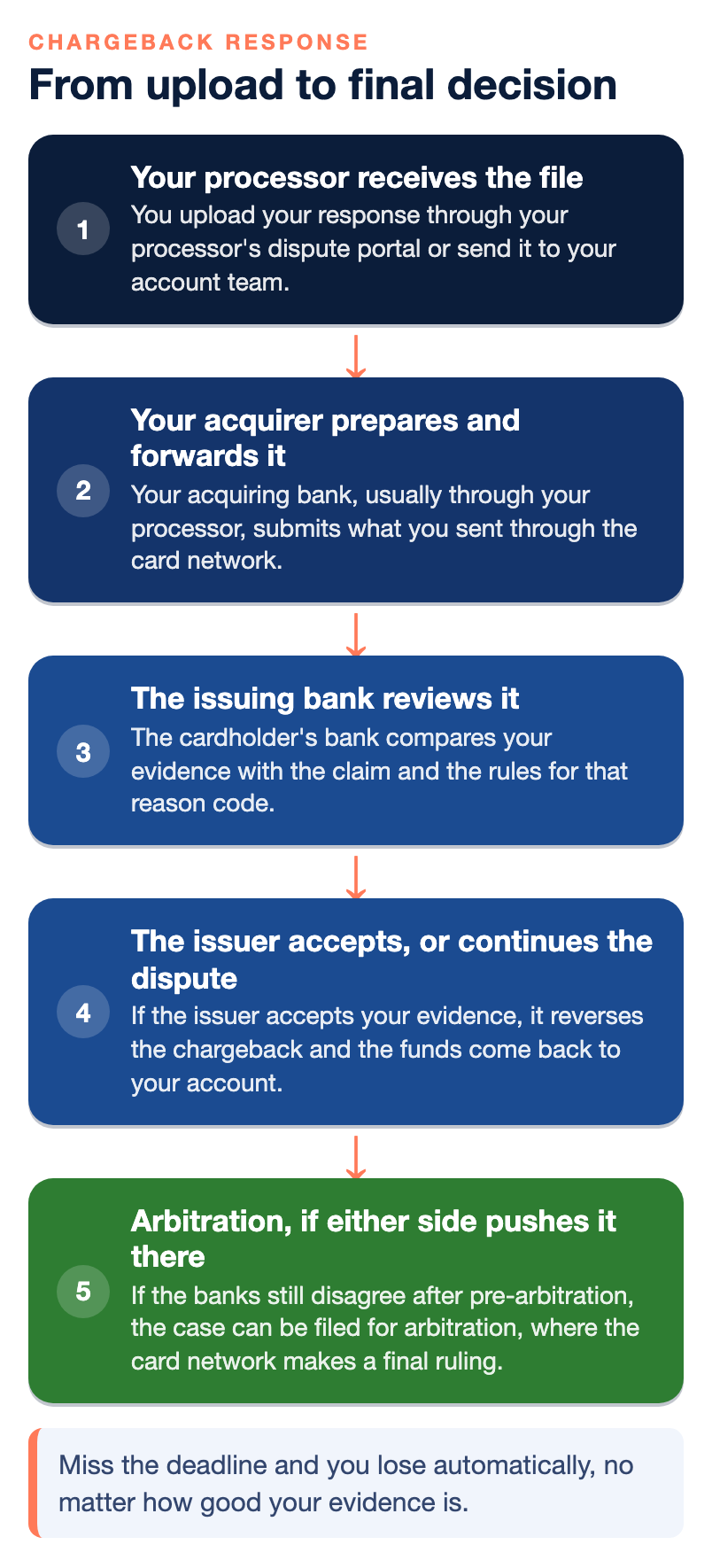
1. Your processor receives the file
You upload your response through your processor’s dispute portal or send it to your account team. At this point the clock matters more than anything else. Response windows are short and set by the card network and your processor, and our own pages describe them as a matter of days that varies by network and processor. Miss the deadline and you lose automatically, no matter how good your evidence is, so read the date on the notice the day it arrives.
2. Your acquirer prepares and forwards it
Your acquiring bank, usually through your processor, takes what you sent and submits it through the card network in the format the network requires. Many processors check that a response is complete before it goes out, and a good account team will tell you if something obvious is missing. They are not rewriting your argument, though. If the evidence does not address the reason code, it will travel to the issuer just as weak as it arrived.
3. The issuing bank reviews it
The cardholder’s bank compares your evidence with the claim and the rules for that reason code. For a fraud claim on an online order, it is looking for signs that the real cardholder made the purchase. For a “not received” claim, it wants delivery proof that matches the cardholder’s address. For a canceled subscription, it wants to see the terms the customer agreed to and when and how they canceled.
4. The issuer accepts, or continues the dispute
If the issuer accepts your evidence, it reverses the chargeback and the funds come back to your account. If it does not, it can continue the case to the next stage, often called pre-arbitration, where it tells your side why it still disagrees and the cardholder’s position is restated, sometimes with new information. You then decide whether to accept the loss or keep going.
5. Arbitration, if either side pushes it there
If the banks still disagree after pre-arbitration, the case can be filed for arbitration, where the card network itself reviews the file and makes a final ruling. Arbitration usually carries its own fees, and the side that loses generally pays them, so it is a decision to make deliberately and with your processor’s input, not by default.
Most disputes never get past the issuer’s review. That is the stage where your evidence does its work, which is why the rest of this article focuses on what the issuer is actually looking for.
Representment, pre-arbitration and arbitration are different stages
These three words get used as if they were interchangeable, and they are not. Each one is a separate stage with a different decision-maker and a different cost of continuing.
Representment is your first formal response. You present the transaction again with evidence, and the issuer reviews it. Mastercard, for example, calls this step a second presentment, which captures the idea well: the charge is being presented to the issuer a second time, now with proof attached.
Pre-arbitration is the issuer pushing back. It is not a retrial so much as a last exchange between the two banks before the network gets involved. The issuer may bring new information from the cardholder, such as a claim that the item arrived damaged or that the service was not what was described. Your job at this stage is to answer the new point, not to repeat your first response more loudly.
Arbitration is the only stage where the card network itself decides. Because it costs money and the loser typically bears the fees, it is reserved for cases where the amount and the evidence justify it. A merchant who escalates every lost case to arbitration usually ends up paying more in fees than it recovers.
The practical lesson is that “we are disputing it” can mean three very different things. When your processor tells you a case is in progress, ask which stage it is in, who is deciding, and what continuing would cost.
What the issuing bank actually reviews
An issuer reviewing a representment is not reading your whole relationship with the customer. It is checking whether your evidence answers the specific claim behind the reason code. Each network has its own reason codes and evidence requirements, so the details shift, but the questions the issuer is asking fall into a few broad groups.
- Fraud claims. Did the real cardholder make or authorize this purchase? Useful evidence includes address verification and CVV results, the IP address and device used, a delivery address that matches the cardholder’s, a signed authorization form for a large order, and any history of the same customer buying from you before without a dispute.
- Not received claims. Did the goods or service reach the customer? Tracking that shows delivery to the address on the order, proof of a digital download or login, and records of a completed service appointment do the work here.
- Not as described or defective claims. Did you deliver what you promised? The product page as it appeared at the time of sale, the order confirmation, your return policy, and any messages showing you offered a fix or a return carry the most weight.
- Canceled recurring and subscription claims. Did the customer agree to recurring billing, and did they cancel before the charge? The issuer wants to see the terms the customer accepted, the cancellation process you published, and the dates.
- Credit not processed claims. Did you owe a refund that you did not issue? Proof that the refund was issued, or that the return never arrived or fell outside your published policy, answers it.
- Processing errors. Was the customer charged twice, or for the wrong amount? Transaction records that show two separate, legitimate purchases, or the correct amount, settle it.
Notice what is missing from that list: how unfair the dispute feels, how long the customer has shopped with you, and how much you have already lost. Issuers decide on documentation. A calm, short cover letter that states the reason code, explains in two or three sentences why the transaction was valid and points to each piece of evidence will do more than five pages of frustration.
This is also where your website quietly helps or hurts you. A refund policy the customer could not find, a cancellation process buried in your terms, or a billing descriptor the customer did not recognize all weaken a response before you write a word. Our article on e-commerce policies as your first line of defense against chargebacks covers what those pages should say.
Why a “won” representment can come back
Few things frustrate merchants more than seeing a case marked as reversed in their favor, and then watching the same dispute reappear weeks later. It feels like the bank changed the rules. Usually it did not. A few things are going on.
First, a reversal at the representment stage is not necessarily final. The issuer can still continue the case into pre-arbitration within the time the network allows, often because the cardholder came back with something new. A customer who first claimed they never received an order may, once shown the tracking, say the box was empty or the item was wrong. That is a new claim, and you need new evidence to answer it.
Second, the status in your dashboard may not mean what you think. Some portals show a case as won when the funds have been credited back, even though the dispute is still open on the issuer’s side. Ask your processor what each status means, and do not spend recovered funds as if they were settled until the window for the next stage has closed.
Third, the same customer can sometimes dispute again for a different reason, or dispute a different charge on the same order. That is not the same case coming back, but it can look like it. Keep your evidence for every disputed order together, so you can respond quickly if a related claim arrives.
The way to protect yourself is simple and a little boring. Keep the full file for every dispute until it is clearly closed, answer each new claim on its own terms, and treat a first-stage win as a strong position rather than a finished case.
Winning gets the money back, not the count
Here is the part that changes how merchants should think about representment. When a chargeback is filed, it counts against your account in the dispute ratios that processors and card networks watch, and winning the representment later recovers your funds without making that original dispute disappear. Visa’s VAMP and the networks’ other monitoring programs track dispute and fraud activity, and a merchant whose ratios run high can face fines, higher processing costs, required remediation plans, larger reserves or the loss of its account.
That is why the strongest chargeback programs spend most of their effort before a dispute becomes a chargeback. Tools such as Visa’s Rapid Dispute Resolution, known as RDR, and other chargeback alerts let a merchant refund a disputed transaction when the cardholder first contacts their bank, so the case never becomes a formal chargeback and does not count against the merchant’s ratios. For a small sale with weak evidence, a quick refund through an alert is usually worth far more than a representment you might win.
If your ratios are already climbing, the risk goes beyond fees. A merchant account terminated for excessive chargebacks can lead to the business and its owners being added to the MATCH list, which acquiring banks check on new applications. Our article on the 14 reasons merchants end up on the MATCH list explains how that happens and why it is so hard to undo.
What you control, and what you do not
Once a chargeback lands, much of the process is out of your hands. The issuer decides, the network sets the rules, and the clock is already running. You still control more than you might think.
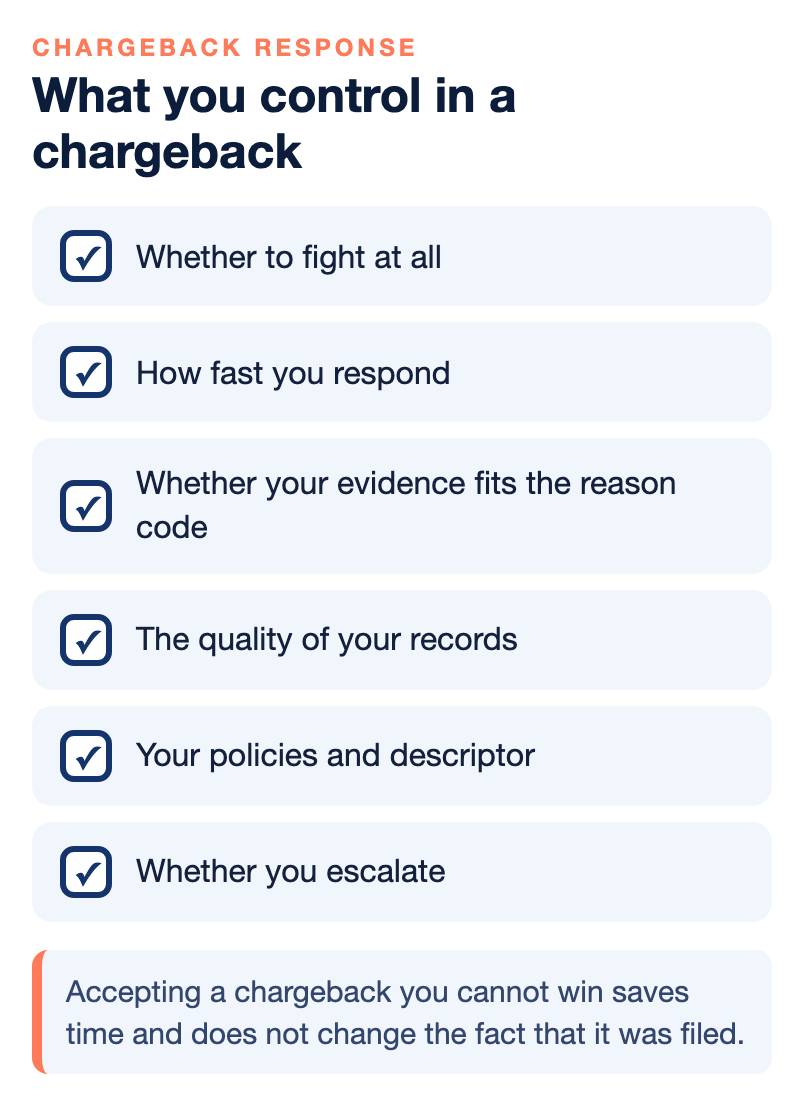
Things you control
- Whether to fight at all. Accepting a chargeback you cannot win saves time and does not change the fact that it was filed. Fighting one you can win with clear evidence is worth the effort.
- How fast you respond. Read the notice the day it arrives, find the reason code and the deadline, and start pulling evidence right away.
- Whether your evidence fits the reason code. Match each piece of evidence to the specific claim, and leave out what does not help.
- The quality of your records. Order confirmations, AVS and CVV results, IP addresses, delivery tracking, signed authorizations and customer messages only help if you kept them.
- Your policies and descriptor. Clear refund and cancellation terms and a billing descriptor customers recognize prevent many disputes and strengthen the rest.
- Whether you escalate. Pre-arbitration and arbitration are choices, and the cost of continuing should match what is at stake.
Things you do not control
- Who decides. The issuer reviews your case, and the network rules only in arbitration.
- The rules. Reason codes, evidence requirements and time limits come from the card networks and change from time to time.
- The cardholder’s next move. A customer can bring new information that reopens the conversation at pre-arbitration.
How a representment strategy looks in practice
A sensible approach to representment is less about winning every case and more about putting your effort where it pays. Most merchants who handle disputes well follow a similar routine.
- Sort every new chargeback by reason code and amount. Fraud, not received, not as described and canceled recurring each need different evidence.
- Decide quickly whether the evidence exists. If you have it, fight. If you do not, accept the loss and fix whatever let the dispute happen.
- Build a short, factual response. A brief cover letter that names the reason code and walks through the evidence, then the evidence itself, clearly labeled.
- Track the case through every stage. Note when the response was sent, what status the processor shows, and when the window for the next stage closes.
- Feed every loss back into prevention. A pattern of “not received” claims points to delivery confirmation. A pattern of subscription disputes points to clearer billing terms and reminders.
High-risk and high-volume merchants feel the stakes of this routine more sharply, because their ratios are watched more closely and their margin for error is smaller. Our guide to high-risk merchant chargebacks, RDR and VAMP goes deeper on that, and our chargeback survival guide covers prevention for every kind of business.
Where NPS fits, and where it does not
We work with merchants on chargebacks before and after they happen. We review websites for compliance risk, help structure refund and cancellation policies, assist with representment strategy and response letters, help set up RDR where it fits, offer chargeback alert tools and monitor dispute ratios. Our NPSONE platform lets merchants track and manage disputes as they come in. For merchants with significant online volume, we work with professional chargeback management firms and dedicated dispute specialists who handle representment at scale. You can read more about our Chargeback Rescue program.
Here is where we may not be the right choice:
- You want someone to promise you will win. No one can honestly promise that, because the issuer decides, and we will not pretend otherwise.
- You want an instant, self-service account. We underwrite each account, so we are not an instant-approval product.
- You are choosing only on the lowest advertised flat rate. We price each merchant individually and do not publish one universal rate.
- You sell something that cannot be sold lawfully. No processor and no dispute strategy can fix that.
Next step
Representment is a stage, not a verdict. Respond on time, answer the reason code with evidence that fits it, track the case until it is truly closed, and spend most of your energy keeping disputes from becoming chargebacks in the first place.
If you have a chargeback notice in front of you, or a dispute ratio that is starting to worry you, you can talk with our team. More guides on processing, pricing and risk are in our payments guides library.
Frequently asked questions
What is chargeback representment?
Representment is the merchant’s formal response to a chargeback. You send evidence that the transaction was valid, your acquiring bank forwards it through the card network, and the cardholder’s issuing bank reviews it. It is one stage of the dispute, not the final decision.
Who decides whether I win a representment?
The cardholder’s issuing bank decides most disputes. Your processor and acquiring bank carry your response, and the card network sets the rules, but the network only rules on a case itself if it is escalated to arbitration.
What is the difference between representment and arbitration?
Representment is your first formal response, reviewed by the issuing bank. If the issuer still disagrees, the case can move to pre-arbitration and then arbitration, where the card network makes a final ruling. Arbitration usually carries its own fees, so it is worth escalating only when the amount and the evidence justify it.
Why did a chargeback I won come back?
A reversal at the representment stage is not always final. The issuer can continue the case into pre-arbitration within the time the network allows, often because the cardholder brought new information. Keep your full file until the case is clearly closed.
How long do I have to submit a chargeback response?
The window is short and is set by the card network and your processor, so it varies. Read the deadline on the notice the day it arrives, because a missed deadline means an automatic loss no matter how strong your evidence is.
Does winning a chargeback remove it from my chargeback ratio?
Winning recovers your funds, but the dispute was already filed against your account. That is why tools that resolve disputes before they become chargebacks, such as RDR and chargeback alerts, matter so much for merchants whose ratios are watched closely.
Should I fight every chargeback?
No. Fight the ones where you have evidence that answers the reason code, and accept the ones you cannot win, then fix what caused them. Spending time on hopeless cases takes attention away from prevention.
Can my processor submit the response for me?
Your processor submits every response through the card network, but the evidence has to come from you. Many processors check that a response is complete, and some offer help with response letters or work with dispute specialists for high-volume merchants. Ask yours what support it provides.





