
An acquiring bank uses a reserve because it gives the bank a third answer between “yes” and “no”: approve the business, but keep some money nearby in case losses arrive later. When a bank looks at a merchant it has to guess how much could come back through chargebacks, refunds or undelivered orders, and a reserve is the tool that lets it say yes to a business it would otherwise turn away. This guide explains the choice from the bank’s side, why a reserve is often better for the merchant than a decline, what a reserve cannot do, and which questions to ask when one is on the table.
The short answer
- A bank has three basic answers. It can approve the account as it is, approve it with protection such as a reserve, or decline it.
- A reserve lets the bank say yes to real risk. The risk is not removed. It is covered, because money is held against losses that may arrive later.
- The risk comes from timing. Chargebacks and refunds can arrive weeks or months after a sale, and a business that is paid now for something delivered later has exposure the whole time.
- It is still your money. A reserve is held under conditions and released under conditions. It is not a fee.
- A reserve is not a promise. It does not guarantee approval, it does not guarantee a release date, and it does not replace a clean record.
What an acquirer is actually deciding
An acquiring bank, also called an acquirer, is the bank that lets a business accept card payments. When it approves a merchant account it takes on financial exposure connected with every payment that runs through that account. Nationwide Payment Systems (NPS) describes the exposure plainly: if customers dispute transactions, if products are not delivered, if refunds cannot be paid, if there are regulatory problems or if a merchant disappears after collecting money, the acquiring side of the payment can be left with the loss.
That means underwriting, the bank’s review of an application, comes down to one question: what is the risk of processing payments for this particular business? The answer is rarely a simple “safe” or “unsafe.” It is a question of how much money could come back, how soon, and whether the business could pay it back if it did.
Seen that way, a decline is only one of several ways to answer the question. It is the easiest one for the bank, because it takes the exposure to zero. It is also the answer that costs the bank a customer it might have wanted, and it costs the merchant a way to get paid by card. A reserve sits between those two outcomes.
The three answers a bank can give
Think of the application as a question the bank answers one of three ways.
1. Approve the account as it is
For a business with a long and clean processing history, small tickets, goods that ship right away and low disputes, there may be little to protect against. The bank may see no reason to hold anything back. Not every business that is treated as high risk gets a reserve either. NPS notes that the structure depends on the bank and on the individual business, and that two businesses in the same industry can get very different terms.
2. Approve the account with protection
When the exposure is real but manageable, the bank can approve the business and add a safeguard. A reserve is one such safeguard. The bank takes the deposits, pays the merchant, and keeps part of the money in the background, or sets some aside up front, to cover what might come back.
3. Decline the account
When the exposure is too large, too hard to measure or outside what the bank is willing to support, the bank says no. A decline can have nothing to do with whether the business is honest. NPS explains that a business can be completely legal and still be treated as high risk, and that one bank may decline an industry another bank actively wants.
A reserve makes the second answer possible for businesses that would otherwise land in the third. That is the main reason acquirers use it: it widens the set of merchants a bank can safely say yes to.
Why timing is the whole problem
The detail that matters most is the gap between the day a payment is taken and the day the bank knows the sale is finished. Chargebacks and refunds can arrive weeks or months after a sale. A chargeback is a dispute, filed by a customer’s bank, that takes the money back out of the merchant’s account.
Compare two sales. A customer buys a pair of shoes in a store and walks out with them. A different customer pays today for travel that happens six months from now. In the first sale, the product is in the customer’s hands and most of the risk has passed. In the second, the business has been paid for something it has not yet delivered, and if it fails to deliver, the customer’s bank may take the money back. The bank is exposed for the whole six months.
A reserve is the bank’s way of keeping enough money close at hand to cover what might come back during that window. If the bank had no such tool, its only protection against a long delivery window would be to refuse the business.
What pushes a bank toward a reserve instead of a yes or a no
NPS lists the situations where a reserve is more common and tends to be larger. Each one is a different way for money to come back later, or for the bank to lack a track record to judge by.
- Significant future delivery. Customers pay now and receive the product or service later, as with travel, ticketing, events, memberships, preorders and custom manufacturing.
- High chargebacks. A history of disputes, or an industry known for them, means more money is likely to come back.
- Rapid growth. A business processing far more than it did a few months ago has exposure the bank has not seen tested. NPS gives the example of going from $20,000 a month to $500,000 a month very quickly, which can trigger extra underwriting even when the business is legitimate.
- Limited processing history. A new business, or one new to card payments, has no record to judge.
- High average tickets. A single large dispute does more damage than many small ones.
- Subscription billing. Recurring charges that customers forget about are a frequent source of disputes.
Notice what these have in common. None of them says the merchant is dishonest. They say the bank cannot yet see how the account will behave. A reserve lets the bank wait and watch while the record builds.
Why a reserve can be better for the merchant than a decline
A reserve costs the merchant something real: cash flow. Part of each deposit, or a lump sum at the start, is not available to spend. That is a genuine burden, and it is fair to dislike it. Still, compare it with the alternatives.
- A decline means no card payments from that bank at all. For many businesses, that is the end of the plan, or the start of a search for another bank.
- An instant-approval account is not always a safe substitute. NPS points out that fast onboarding does not remove ongoing risk review. A processor can look again at a business’s website, products, volume, average ticket, chargebacks, refunds and complaints, and a business in a restricted or prohibited category can run into trouble after it has already started processing.
- A reserve can be a way into a bank that understands the business. NPS describes a dedicated high-risk account as one where the full business model is disclosed during underwriting, so the bank decides with the facts in hand before large volume begins.
The money held in a reserve is still the merchant’s. It is released back under the conditions in the merchant agreement. A decline offers no such return, because there is no account to hold it.
The kinds of reserves a bank can choose from
Because the bank is protecting itself against a specific kind of timing risk, it can pick a reserve structure that fits. NPS lists the common ones.
| Type | How it works | What to watch |
|---|---|---|
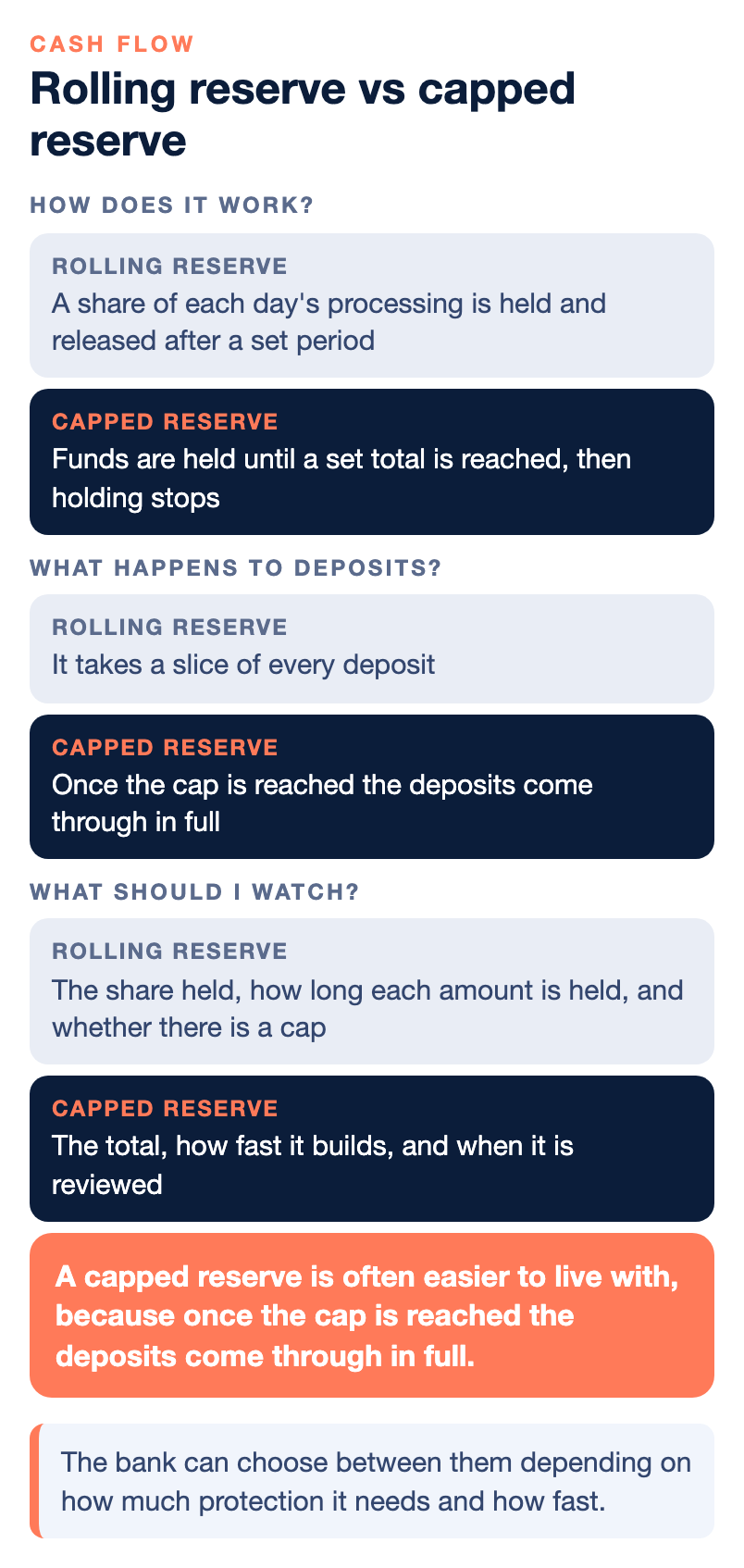
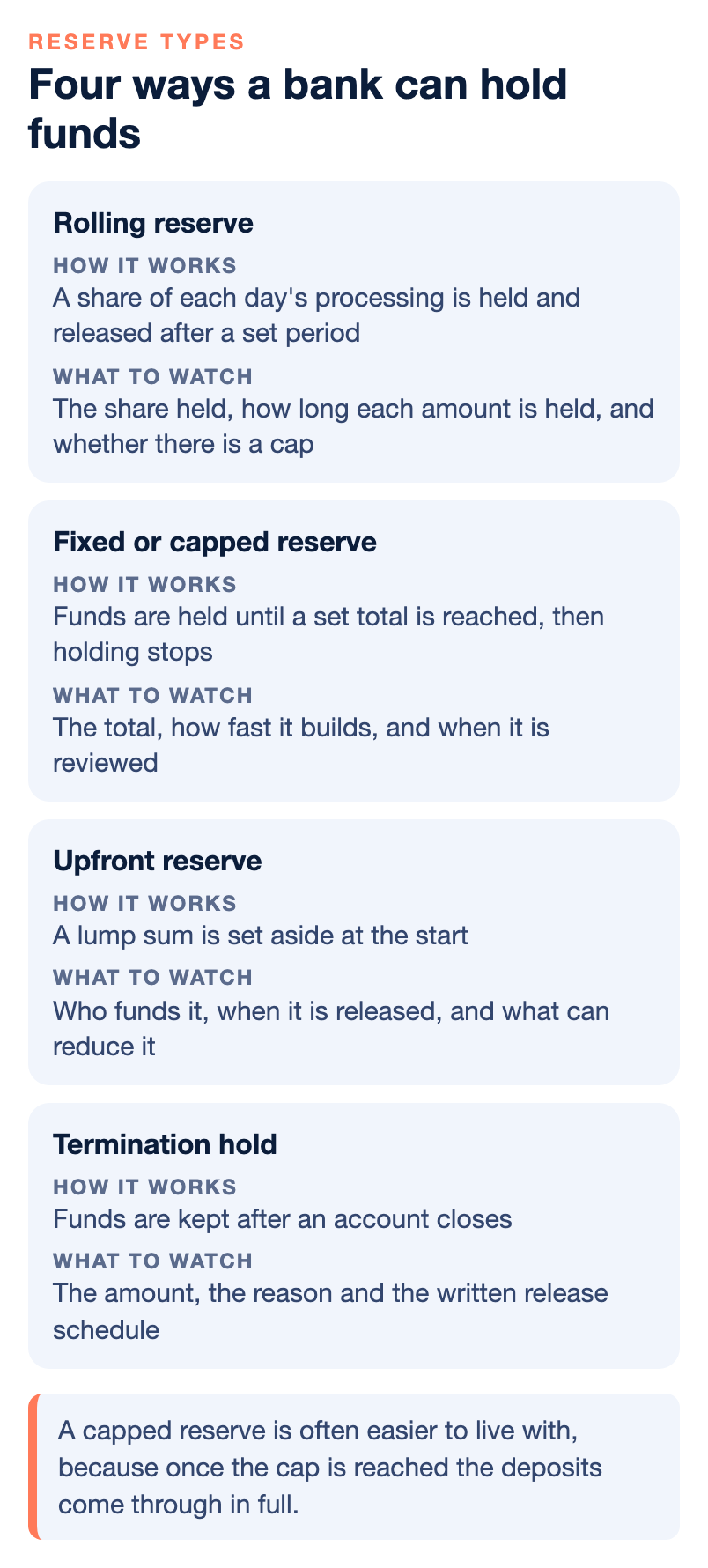
| Rolling reserve | A share of each day’s processing is held and released after a set period, on a rolling basis. | The share held, how long each amount is held, and whether there is a cap. |
| Fixed or capped reserve | Funds are held until a set total is reached, then holding stops. | The total, how fast it builds, and when it is reviewed. |
| Upfront reserve | A lump sum is set aside at the start, sometimes instead of withholding from deposits. | Who funds it, when it is released, and what can reduce it. |
| Termination hold | Funds are kept after an account closes, because chargebacks can arrive after processing stops. | The amount, the reason and the written release schedule. |
A rolling reserve is the structure most owners meet first, and it affects cash flow the most because it takes a slice of every deposit. A capped reserve is often easier to live with, because once the cap is reached the deposits come through in full. The bank can choose between them depending on how much protection it needs and how fast.
What a reserve cannot do
A reserve is a buffer, not a cure. It is worth being clear about its limits so no one expects more from it than it can give.
- It does not fix a high dispute rate. If customers keep disputing charges, the reserve only pays for the damage. The ratio still climbs. NPS explains in its guide to chargeback ratios and card network lines that processors act on ratios, and that they often do so well below the lines the card networks publish.
- It does not make an unlawful product acceptable. NPS says plainly that no processor can fix a business whose products cannot be sold lawfully.
- It does not guarantee the account stays open. If the numbers do not come back down, the bank can still end the relationship. For certain reasons it can also add the business and its owners to the MATCH list, which other banks check on new applications. NPS explains how that works in its guide to the MATCH list.
- It is not permanent by nature. It exists to cover a risk, and when the risk shrinks, the reserve can be reviewed.
What makes a reserve go up, and what brings it down
Since a reserve is a response to risk, it moves with risk. The factors that created it work in both directions.
It can rise after a spike in chargebacks, a sudden jump in volume, a much larger average sale than the merchant described, or products added to the website that the bank did not approve. NPS advises telling the processor before changing what you sell or how you sell it.
It can come down when the merchant shows, with records, that the risk the bank priced in has gone down. NPS suggests the following:
- Agree on a review date when you sign, so a review is expected rather than a favor.
- Build clean processing history with steady volume and low chargebacks and refunds.
- Keep disputes low and documented, with fraud tools, clear billing descriptors and easy-to-find refund policies.
- Shorten exposure by taking deposits closer to delivery and shipping faster with tracking.
- Bring records to the review, such as processing statements, chargeback ratios and proof of delivery.
- Ask for a specific change, such as a cap in place of an open rolling reserve, a shorter hold or a release of part of what is held.
Our full guide on what reserve requirements to expect and how to negotiate them down goes through each step. This page is about why the bank chooses a reserve at all.
Reserves, holds and terminations are not the same thing
Owners sometimes use the word reserve for any money a processor is not paying out. It helps to keep three situations apart, because the banks treat them differently.
- A reserve set at approval is part of the agreed terms and is the subject of this guide.
- A hold placed during a review is a reaction to something the processor noticed. It is usually resolved by answering the processor’s questions.
- A termination hold is money kept after an account closes, because chargebacks can arrive after processing stops.
If you are not sure which one you have, ask your processor in writing for the amount held, the reason, the release schedule and the conditions for release. For a broader look at the ways money can be delayed, see our guide to when you actually get paid and what can hold up your money.
Questions to ask when a reserve is offered
If a provider or bank tells you a reserve will apply, these are the questions that turn a vague condition into a clear one. Get the answers in writing before you sign.
- What is the method and amount? Is it rolling, capped, upfront or a combination, and how is the amount calculated?
- What in my file led to this reserve? The answer tells you what you would need to change.
- When are held funds released, in what amounts and on what dates?
- Is there a cap, and what is it?
- When will the reserve be reviewed, and what would it take to reduce or remove it?
- What happens to the funds if the account is closed, and for how long?
A reserve with a clear reason, a cap and a scheduled review is a very different thing from an open-ended holdback that can change at any time. If a provider will not explain reserve terms clearly, treat that as an answer. Our guide to what a high-risk merchant account is explains why a business can be perfectly legal and still need this kind of underwriting.
Who wrote this, and where NPS fits
Nationwide Payment Systems publishes this guide. We are a payment processing company based in South Florida, in business since 2001, and much of our work is with businesses that banks treat as high-risk, so we have a stake in the topic. We do not quote reserve percentages or holding periods on this page, and we do not promise that any reserve will be reduced or avoided. Reserves are set by the acquiring bank based on its own review of your business, and the terms are in your merchant agreement. You can browse more of our payments guides for related topics.
We work with low-risk and high-risk merchants, and we review the business and its website before an application goes to underwriting, so the file arrives complete. We explain reserves, holds and funding terms before you sign. Accounts come with live, U.S.-based support around the clock and a dedicated account manager.
We are not the right fit for everyone. If you want a guarantee of no reserve, no honest processor can give one before the bank has reviewed your file. If you would rather not provide underwriting documents, fair terms depend on them. If your products cannot be sold lawfully, no processor can fix that. And if you are a hobby seller with very low volume, a simpler platform will probably suit you better.
Bottom line
An acquirer uses a reserve because it turns some of its “no” answers into “yes, with protection.” The risk it is covering is mostly about timing: money that can come back after a sale, from chargebacks, refunds or undelivered orders. A reserve costs the merchant cash flow, but the money remains the merchant’s, it is released under written conditions, and it can usually be reviewed as the record improves. Before you sign, get the method, the reason, the release schedule, the cap and the review conditions in writing. If you would like a second opinion on terms you have been offered, you can contact our team, and if another setup fits you better, we will say so.
Frequently asked questions
Why would a bank use a reserve instead of just declining a risky merchant?
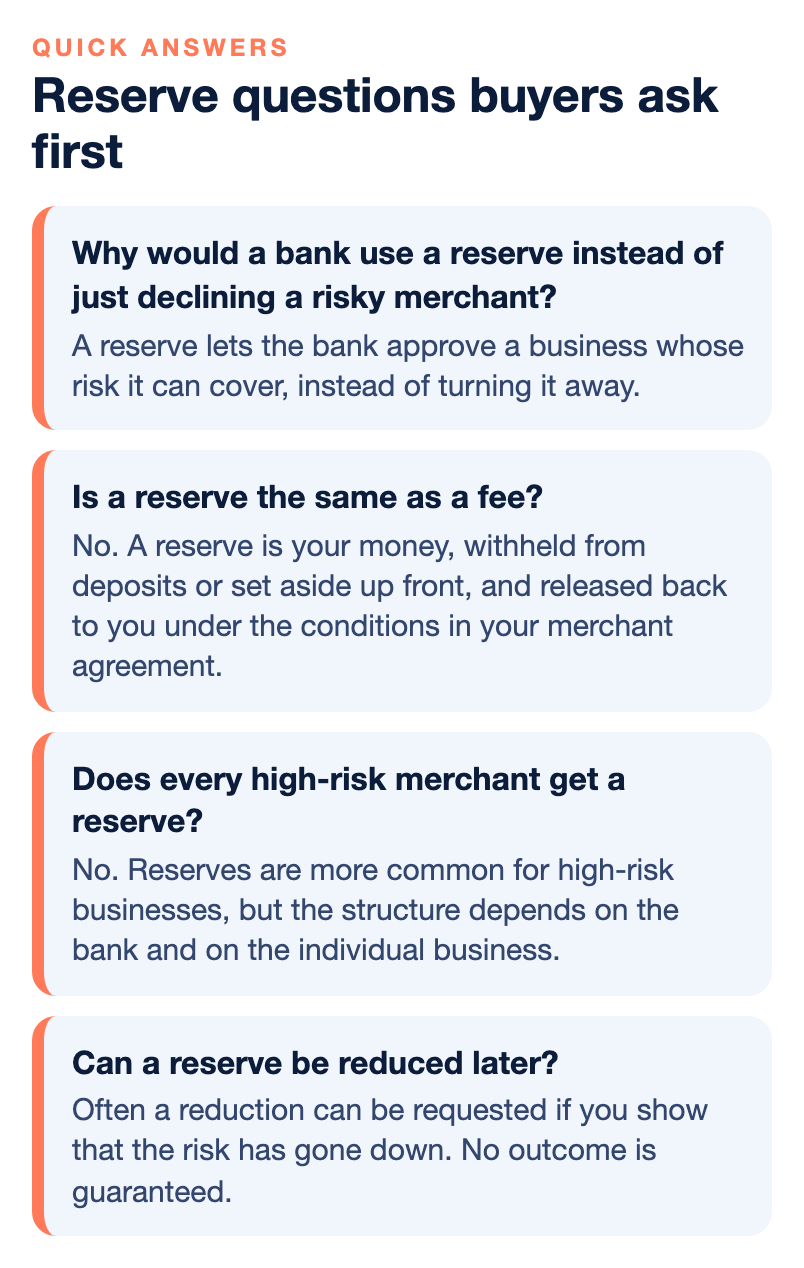
A reserve lets the bank approve a business whose risk it can cover, instead of turning it away. The bank holds some money against chargebacks, refunds or undelivered orders that may arrive later. That keeps its exposure within a range it accepts, and the merchant gets a way to take cards.
Is a reserve the same as a fee?
No. A reserve is your money, withheld from deposits or set aside up front, and released back to you under the conditions in your merchant agreement. A fee is a cost you do not get back.
Does every high-risk merchant get a reserve?
No. Reserves are more common for high-risk businesses, but the structure depends on the bank and on the individual business. Two businesses in the same industry can receive very different terms.
What kinds of businesses are more likely to be asked for a reserve?
Businesses with significant future delivery, high chargebacks, rapid growth, little processing history, high average tickets or subscription billing are more likely to see one. These are situations where more money could come back later or where the bank has no record to judge.
Can a bank still decline me even if I accept a reserve?
Yes. A reserve is one tool, and the bank makes the final decision. Some industries or business models fall outside what a given bank will support, and one bank may decline a category that another actively wants.
What is the difference between a rolling reserve and a capped reserve?
A rolling reserve holds a share of each day’s processing and releases it after a set period, so it takes a slice of every deposit. A capped reserve holds funds only until a set total is reached, after which deposits come through in full.
Can a reserve be reduced later?
Often a reduction can be requested if you show that the risk has gone down. Bring processing statements, chargeback and refund ratios and delivery proof to a scheduled review, and ask for a specific change. No outcome is guaranteed.
What happens to the reserve if my account is closed?
The processor may keep funds for a period after closure, because chargebacks can arrive after processing stops. Ask in writing for the amount held, the reason, the release schedule and the conditions for release.





