
A chargeback reason code is a short label, usually a number such as 10.4 or 4837, that the customer’s bank attaches to a dispute to say what kind of claim it is. The code tells you which evidence the bank expects to see, but it does not tell you why the customer really filed the dispute or who was behind it. This guide explains who assigns the code, what the common codes mean, what each one reveals and what it leaves out, and how to turn a list of disputes into data you can use to cut the next batch.
The short answer
- The customer’s bank picks the code, not you. The issuing bank accepts the dispute, assigns a reason code and sends the case down to your processor. The code reflects the customer’s claim, before your side has said anything.
- The code tells you what to prove. A fraud code calls for proof the real cardholder made the purchase. A “not received” claim calls for delivery proof. A canceled-subscription claim calls for the terms the customer accepted. Answer the code, not your frustration.
- The code does not tell you the motive. A stolen card, a family member’s purchase, a forgotten subscription and a deliberate false claim can all arrive under the same fraud code.
- Codes differ by card brand. Visa, Mastercard, Discover and American Express each use their own system, so the same problem carries a different label depending on the card.
- Your own dispute data is the real prize. A monthly tally of codes, products, campaigns and whether the customer contacted you first shows you which disputes you can prevent.
What a reason code is and who assigns it
A chargeback starts when a cardholder asks their own bank to reverse a charge instead of asking you for a refund. That bank is called the issuing bank, or issuer, because it issued the card. Your bank, which processes your card sales, is called the acquiring bank, or acquirer. When the issuer accepts the customer’s claim, it reverses the funds, assigns a reason code and notifies the acquirer, who tells you.
That order of events matters. By the time you see a reason code, the issuer has already taken the customer’s account of events at face value. The code is not a finding after weighing both sides. It is the issuer’s label for the claim it received. NPS describes the same sequence in its complete guide to chargebacks, and its explainer on what happens after your response is sent makes the same point: when you respond, you are asking a bank that already sided with its own customer to change its mind, using evidence that fits the rules for that code.
The code also starts a clock. The notice carries a response deadline, and NPS’s guide says merchants typically have 7 to 21 days depending on the network and processor. Miss it and you lose automatically. So the first thing to do with any new dispute is read the code and the date together.
The common codes, by family
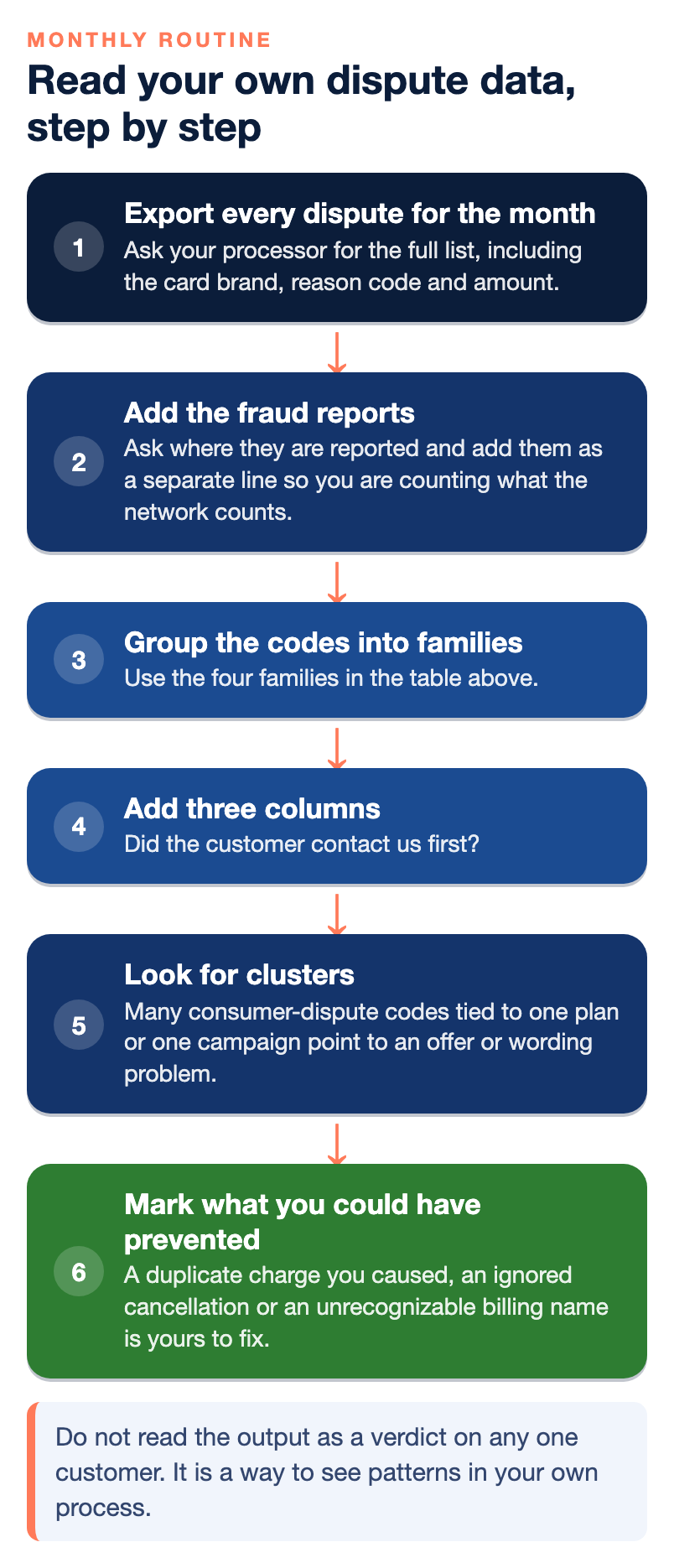
Every card network keeps its own list, and the lists change over time. The table below shows the common codes as NPS’s complete guide lists them, grouped into the four families you will see most. Treat it as a map, not a rulebook, and confirm current labels with your processor.
| Family | Visa | Mastercard | Discover |
|---|---|---|---|
| Fraud | 10.4 Fraud, card absent. 10.5 Fraud, card present. | 4837 No cardholder authorization | UA01 Fraud, card not present. UA02 Fraud, card present. |
| Authorization | 11.3 No authorization. 11.4 No authorization, card absent. | 4808 No authorization | UA05 No authorization |
| Processing errors | 12.6 Duplicate processing. 12.7 Invalid data. | 4834 Duplicate processing | DP Duplicate processing |
| Consumer disputes | 13.3 Not as described. 13.5 No show or cancellation. 13.8 Listed for canceled recurring. | 4855 Credit not processed. 4841 Cancelled recurring. | RG No show. RM Credit not processed. |
American Express uses categories instead of the numbers above. NPS’s guide lists fraud or no cardmember authorization, goods or services not received, not as described, no show or cancellation, and credit not processed, and notes that Amex often has shorter response windows. Two plain-word definitions help here. A “card-present” transaction is one where the card was in front of you, such as a chip read at a counter. A “card-absent” or “card-not-present” transaction is one made online, by phone or by keyed entry.
In NPS’s e-commerce chargeback guide, the most frequent reasons in online sales are “item not received,” “fraudulent transaction” and “product not as described.” Those three plain-word labels sit on top of many different codes, which is why reading your own list by family is easier than memorizing numbers.
What the code tells you
Used well, a reason code answers four practical questions before you open a single file.
Which network’s rules apply
A number like 13.3 points to Visa and 4855 points to Mastercard. Each network has different evidence requirements and different time limits, so the card brand on the transaction decides which playbook your processor follows.
What kind of claim you face
The family tells you whether the customer says they did not make the purchase, did not get what they paid for, were charged wrongly or were not refunded. That is the single most useful piece of information, because each family calls for different proof.
What evidence will carry weight
NPS’s representment guide breaks down what the issuer is looking for in each group:
- Fraud claims: did the real cardholder make or authorize the purchase? Address verification and security code results, the IP address and device used, a delivery address that matches the cardholder’s, a signed authorization form for a large order and any history of the same customer buying without a dispute all help.
- Not received claims: tracking that shows delivery to the address on the order, proof of a digital download or login, and records of a completed service appointment.
- Not as described or defective claims: the product page as it appeared at the time of sale, the order confirmation, your return policy and any messages showing you offered a fix.
- Cancelled recurring claims: the terms the customer accepted, the cancellation process you published and the dates.
- Credit not processed claims: proof the refund was issued, or that the return never arrived or fell outside your published policy.
- Processing errors: transaction records showing two separate, legitimate purchases, or the correct amount.
A thick file that proves the wrong thing loses to a thin file that proves the right one. The code is how you tell which is which.
Whether the case is worth fighting
Not every code is winnable. NPS’s chargeback survival guide says restaurants and bars lose stolen-card disputes and chip-and-PIN liability shift cases even when the card was approved and the customer signed, and that the banks do not bend no matter what evidence is presented. Knowing the family early lets you decide where to spend your time. Our guide to how to win chargeback disputes covers how to build a response letter once you decide to fight.
What the code hides
The limits of the code matter just as much, because most bad decisions about disputes come from treating the label as the explanation.
It hides motive
The fraud family is the clearest example. A real stolen card and a customer who made the purchase themselves can both end up coded as “fraud, card absent.” The label comes from what the cardholder told the bank. It says nothing about whether that statement was true, mistaken or deliberate. We cover the second half of this problem in our guide to telling friendly fraud from a legitimate complaint, and the separate page on first-party fraud goes deeper on the data side.
It hides whether the customer contacted you
The code does not say whether the customer tried to reach you first. That fact is the strongest single signal separating a real problem from a bypassed merchant, and you can only find it in your own inbox, chat log and support tickets.
It can hide your own mistake
A duplicate-processing code might mean the customer is confused or it might mean your staff ran the card twice. A “credit not processed” code might mean you owed a refund and never sent it. A canceled-recurring code might mean a cancellation request sat unanswered. Consumer-dispute and processing-error codes often point back at your process, and the code will not tell you which.
It hides disputes that never reach your list
Visa’s published ratio counts fraud reports as well as disputes. NPS’s chargeback ratio guide explains that a fraud report is filed by the issuing bank when a cardholder says a purchase was not theirs, and it counts even when the bank never files a dispute you can respond to. Those reports often sit on a separate report from your chargeback list, so a merchant who tallies only chargeback reason codes can be missing half of what the network is counting. Ask your processor where fraud reports appear.
It means different things on different cards
NPS’s guide answers the question directly: do all card brands use the same reason codes? No. Each network has its own system. A tally that mixes Visa and Mastercard codes without grouping them by family will give you noise.
It is not the same as a MATCH reason code
One more place the word shows up can cause panic. When a merchant account is terminated for certain reasons, the merchant and its principals can be reported to the MATCH list under a MATCH reason code. That is a separate code set with a separate purpose, covered in our guide to the MATCH list. A chargeback reason code on a customer dispute is not a MATCH listing.
How reason codes connect to your dispute ratio
Codes are labels, but the ratio is a count. NPS’s ratio guide explains that Visa’s ratio takes the count of fraud reports plus disputes on card-not-present Visa transactions in a month and divides it by the count of settled card-not-present transactions in that month. A ten-dollar dispute weighs exactly as much as a thousand-dollar one, and the family of the code does not change how much a dispute weighs.
Two exclusions are worth knowing. Disputes resolved through pre-dispute tools such as Visa’s Rapid Dispute Resolution, known as RDR, are left out of the count, and so are fraud reports that qualify for Compelling Evidence 3.0, a Visa rule that lets a merchant show a disputed purchase matches the same customer’s earlier, undisputed purchases. Winning a dispute later does not remove it, because on Visa’s published method the dispute was counted when it was filed. Read more about the thresholds in our guide on when card networks start threatening a merchant account.
The practical lesson: use reason codes to find the causes, and use the ratio to see how much room you have.
How to read your own dispute data, step by step
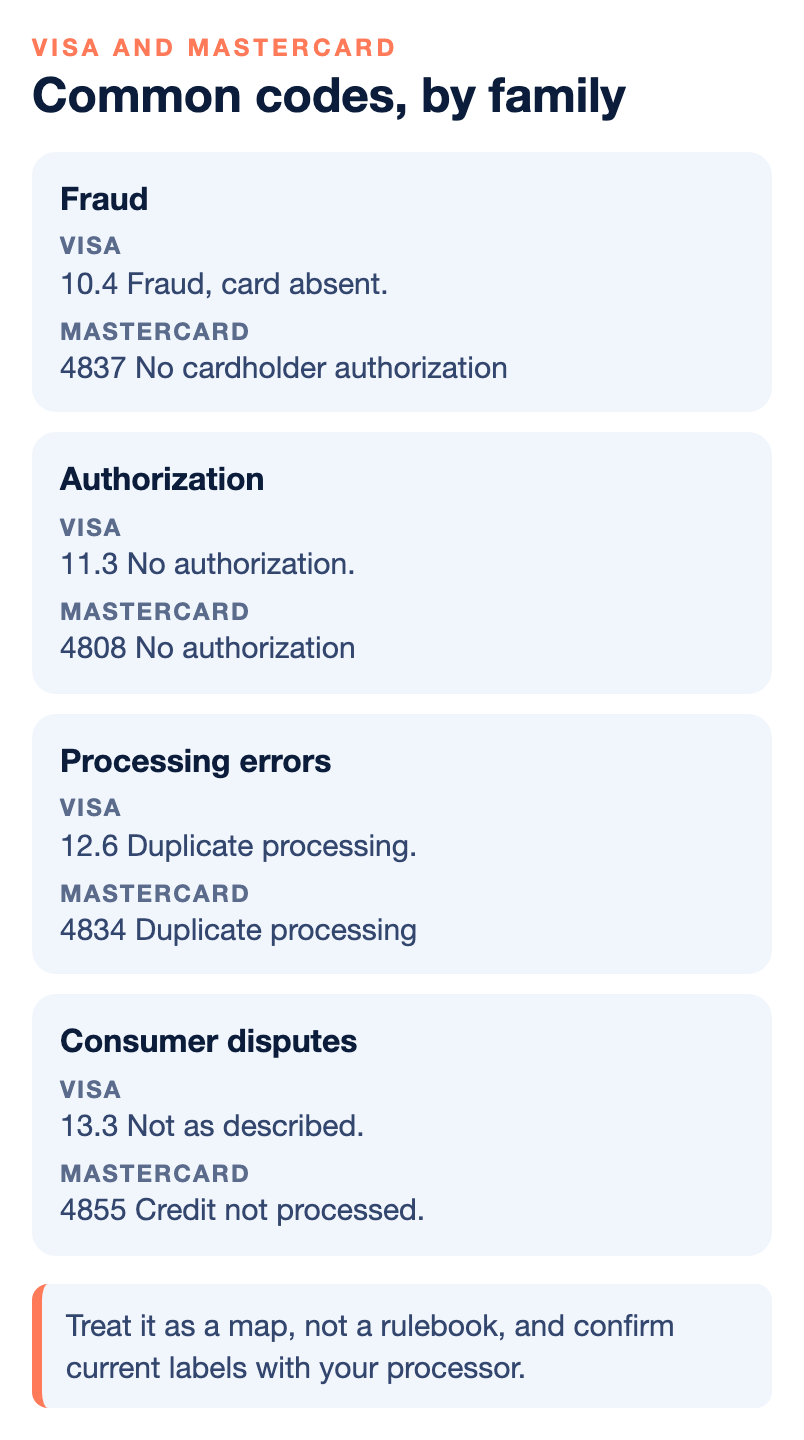
NPS’s Justt.ai podcast recap makes a useful point: chargebacks are data points. Separating true fraud from friendly fraud from confusion-driven disputes shows you where to fix fraud filters, the checkout flow and shipping policies. You can start with a spreadsheet. Here is a routine that takes less than an hour a month once set up.
- Export every dispute for the month. Ask your processor for the full list, including the card brand, reason code, amount, date of the transaction, date the dispute arrived and response deadline.
- Add the fraud reports. Ask where they are reported and add them as a separate line so you are counting what the network counts.
- Group the codes into families. Use the four families in the table above: fraud, authorization, processing errors and consumer disputes. Do it separately for each card brand, then combine the families.
- Add three columns you must fill in from your own records. Did the customer contact us first? Do we have delivery or service proof? Which product, plan, campaign or billing day was this tied to?
- Look for clusters. Many consumer-dispute codes tied to one plan or one campaign point to an offer or wording problem. Many “not received” claims on one carrier or product point to fulfillment. Many fraud-coded disputes with mismatched addresses or forwarding-service destinations point to a screening gap.
- Mark what you could have prevented. A duplicate charge you caused, an ignored cancellation or an unrecognizable billing name is yours to fix. A stolen card with a clean record is not.
- Compare against the last three months. A rising trend matters more than a single month because it shows where you will be next.
- Track the outcome. Note whether you responded, whether you won and which evidence you sent. Over time this shows which families you win and which you should refund early.
Do not read the output as a verdict on any one customer. It is a way to see patterns in your own process.
An example of what the data can show
Imagine an online seller reviews three months of disputes and finds that most consumer-dispute codes come from customers who bought during one promotion and never emailed support. The fraud-coded cases are mostly repeat customers whose earlier orders were fine. A handful of “not received” claims share one shipping method. This is an illustration, not NPS data, but the reading is typical. The promotion problem calls for clearer checkout wording and a billing name customers recognize. The repeat-customer fraud codes call for checking whether a family member or a forgotten purchase is behind them, and for sending prior undisputed purchase history when the card network accepts it. The shipping cluster calls for delivery confirmation. One list, three different fixes, and none of them visible from the code alone.
Seven questions to ask your processor about reason codes
- Which report shows fraud reports, and is it separate from the chargeback list?
- What response deadline applies to each card brand on my account?
- Can I get an export that includes the reason code, card brand and amount for every dispute?
- Which disputes can be refunded early through Rapid Dispute Resolution or an alert tool, and how do I turn that on?
- What evidence do you accept for each reason code family on my type of business?
- What ratio limit does my merchant agreement use, and how is it counted?
- Who decides whether to escalate a lost case, and what does continuing cost?
Common mistakes with reason codes
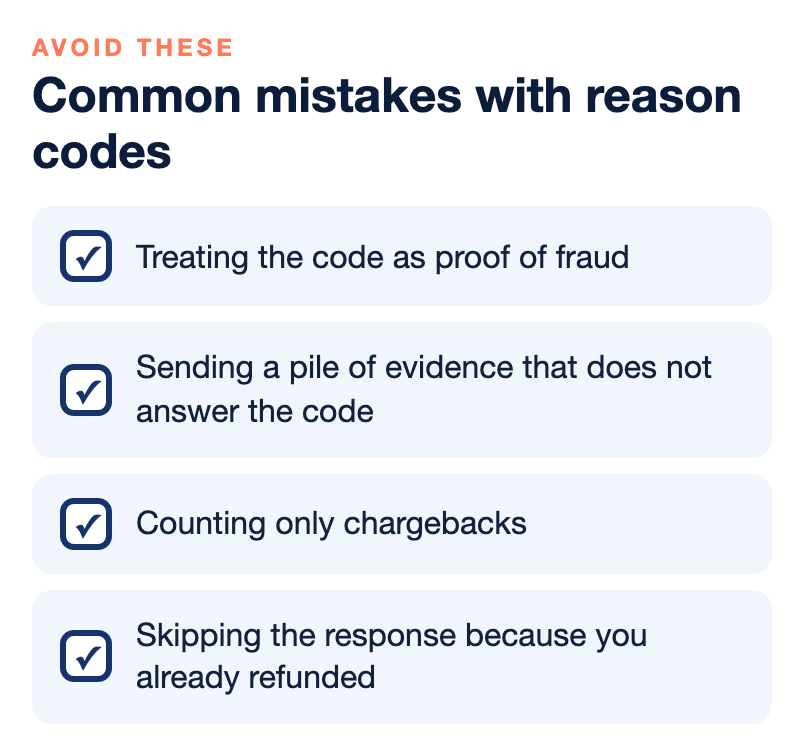
- Treating the code as proof of fraud. It is the customer’s claim as filed, not a conclusion.
- Sending a pile of evidence that does not answer the code. Match the evidence to the family.
- Counting only chargebacks. Fraud reports count toward the network ratio.
- Skipping the response because you already refunded. NPS’s e-commerce guide warns that if you do not respond with proof of the refund, the bank may assume it never happened, and you could lose the money twice.
Who wrote this, and where NPS fits
Nationwide Payment Systems publishes this guide. We are a payments company based in South Florida, in business since 2001, and we sell merchant accounts, so we are not neutral. We work with low-risk and high-risk merchants, review websites for compliance gaps, help structure refund and cancellation disclosures, monitor dispute ratios, help set up Rapid Dispute Resolution when it fits, offer chargeback alert tools and connect higher-volume online merchants with professional dispute management firms. You can read more in our chargeback survival guide, and browse the full library of payments guides.
We cannot promise that any dispute will be won, because the decision belongs to the card issuer, and card networks revise their codes and rules. If your disputes come from a product or fulfillment problem, the fix is in your operations, and we will tell you that. If you only want an instant self-service sign-up or the lowest advertised flat rate, a simpler platform will probably suit you better.
Bottom line
A reason code is the issuing bank’s label for the customer’s claim. It tells you which network’s rules apply, what kind of proof to send and how fast to move. It does not tell you why the customer filed, whether they contacted you or who was behind it. Treat the code as the start of the question, group your disputes by family each month, add the facts only your records can supply, and use the pattern to prevent the next batch. If you would like a second opinion on your dispute list, you can contact our team.
Frequently asked questions
What is a chargeback reason code?
It is a short label, usually a number, that the cardholder’s bank attaches to a dispute to describe the type of claim, such as fraud, no authorization, a processing error or a consumer dispute. The merchant’s response has to answer that specific code.
Who assigns the reason code?
The issuing bank, which is the cardholder’s bank. It accepts the dispute, reverses the funds, assigns the code and notifies the merchant’s acquiring bank. The code reflects the customer’s claim before the merchant has responded.
Do Visa and Mastercard use the same reason codes?
No. Each card network has its own system. Visa uses numbers such as 10.4 and 13.3, Mastercard uses four-digit numbers such as 4837 and 4855, and Discover and American Express use their own labels or categories.
Does the reason code tell me whether the customer committed fraud?
No. The code shows what the customer told the bank, not whether it was true. A stolen card, a family member’s purchase, a forgotten charge and a deliberate false claim can all carry the same fraud code.
How long do I have to respond once I see the code?
NPS’s guide says merchants typically have 7 to 21 days depending on the card network and processor, and a missed deadline is an automatic loss. Read the date on the notice the day it arrives and confirm the window with your processor.
Do fraud reports have reason codes I can see?
Fraud reports are filed by issuing banks when a cardholder says a purchase was not theirs. Visa counts them in its ratio even if no dispute follows. They often appear on a separate report, so ask your processor where to find them.
Is a MATCH reason code the same as a chargeback reason code?
No. A MATCH reason code is part of a separate listing system used when a merchant account is terminated for certain reasons. A chargeback reason code is the label on a customer dispute.
What should I do with my reason code data each month?
Group the disputes by card brand and family, add whether the customer contacted you and which product or campaign was involved, compare against prior months and look for clusters you can fix. Share the list with your processor if the trend is rising.





