
If you bill customers on a schedule, you will see more chargebacks than a business that sells one thing at a time, and the reasons are built into the model. Customers forget they signed up, a free trial turns into a paid plan, a renewal charge looks unfamiliar on a statement, and calling the bank feels easier than finding the cancel button. Left alone, those disputes push your chargeback ratio toward the limits that card networks watch, and a high ratio can mean fines, reserves and, in the end, a closed account. This guide explains why subscriptions attract disputes, how to tell a real complaint from friendly fraud, the website and billing habits that prevent most disputes, how Visa’s rapid dispute resolution tool helps, and the evidence to keep for the ones you cannot stop.
The short answer
- Subscriptions raise dispute risk by design. Recurring billing, free trials, promotions and digital delivery all increase the chance that a customer disputes a charge they forgot about or do not recognize.
- Not every dispute is fraud. A customer who contacted you first, asked to cancel or never received what was promised has a real complaint. Fix it fast. A dispute that skips you entirely and uses a vague reason is a stronger sign of friendly fraud.
- Prevention beats representment. Clear recurring-billing disclosure, a visible refund policy, easy cancellation and a recognizable billing descriptor stop more disputes than any evidence packet can win back.
- A refund before the dispute can protect your ratio. Visa’s rapid dispute resolution tool, known as RDR, lets a merchant refund automatically before a case becomes a formal chargeback, so it does not count toward Visa’s monitoring ratios.
- The ratio is what threatens the account. Networks track ratios automatically, and they do not weigh your intent. Staying well below the published thresholds is the safest position.
Why subscription and free-trial businesses get more disputes
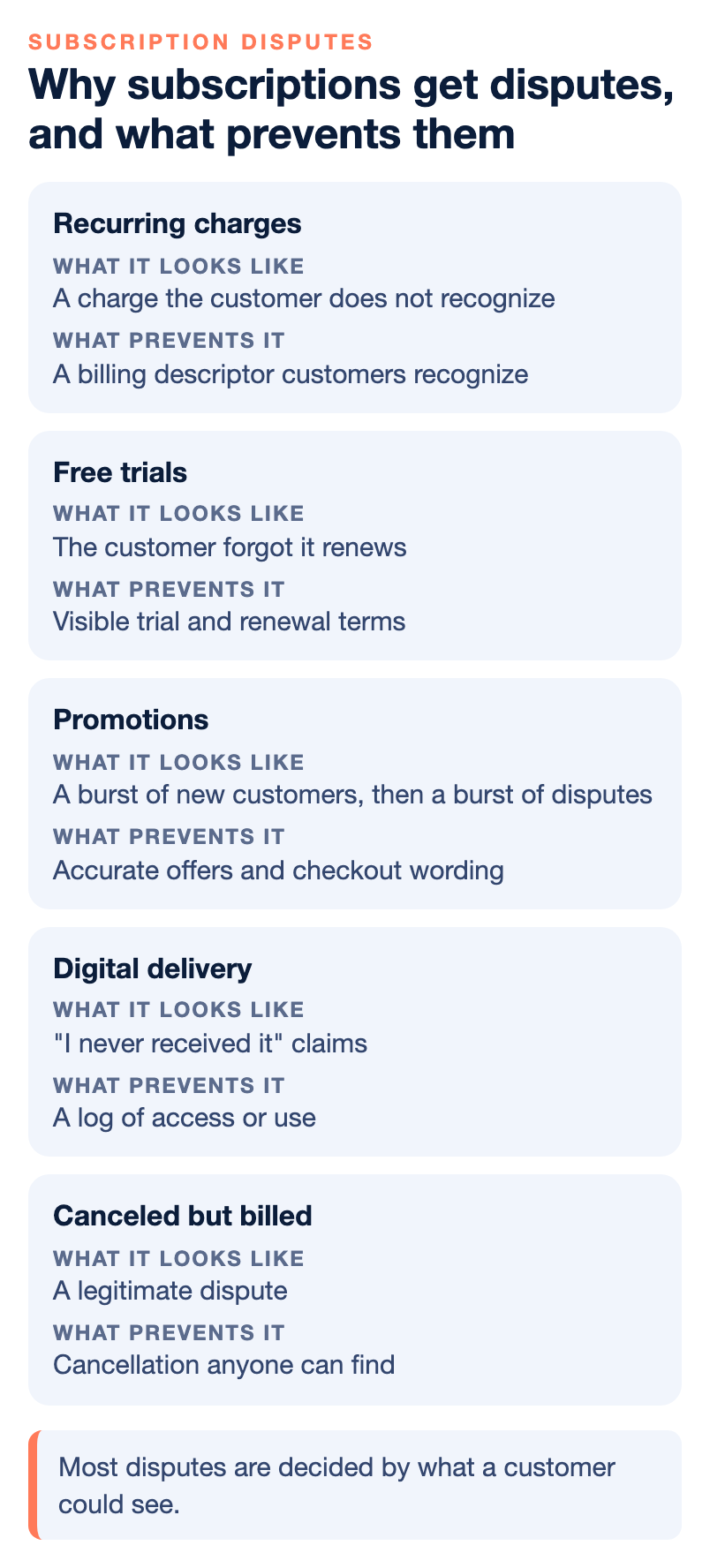
A single purchase is easy to recognize. A subscription charge is a purchase the customer agreed to weeks or months ago, often at a moment when they were focused on something else. That gap is where disputes grow. Several features of the model make it worse.
- Recurring charges. A monthly charge the customer does not expect is the most common trigger, and it often appears under a business name they do not recognize.
- Free trials that convert to paid plans. The customer remembers the free part, not the part where it renews. Free trial to paid conversion funnels are named as a high-chargeback model for good reason.
- Promotions. Campaigns that bring in a burst of new customers can trigger a burst of friendly fraud afterward.
- Digital or delayed delivery. When nothing physical arrives, “I never received it” claims become more likely.
- Canceled but still billed. If a customer thinks they canceled and a charge arrives anyway, the dispute is often a legitimate one, and each card network has its own reason code for a canceled recurring payment.
Memberships, supplements, continuity programs, digital education, coaching, software subscriptions and any free-trial funnel all share the pattern. The same pattern shows up wherever a card is charged on a schedule. For the failed-payment side of recurring billing, see our guide to subscription billing and failed payments, which covers declines that quietly cut revenue and are a separate problem from disputes.
Friendly fraud or real complaint? Ask one question first
Friendly fraud means a customer disputes a purchase they made, received and used, whether by mistake, forgetfulness or on purpose. A legitimate complaint means something really went wrong: the product did not arrive, it was not as described, the customer was charged twice, or a cancellation was ignored. The two need opposite responses.
The fastest sorting question is this: did the customer contact you first? A real problem usually leaves a trail in your inbox, such as a message, a cancellation request or a return. Friendly fraud tends to skip you and land as a bank dispute with a vague reason.
| What you see | What it usually means | What to do |
|---|---|---|
| The customer emailed to cancel, and you still charged them | A real complaint | Refund quickly, fix the cancellation process and thank the customer |
| The customer never emailed, and the dispute says “not authorized” on a charge tied to an account they created | Possibly friendly fraud or a forgotten sign-up | Check your sign-up and login logs, and send a reminder with the record of what they agreed to |
| The dispute arrives within days of a free trial ending | Often a surprise renewal | Look at whether your trial terms and renewal notice were clear. If not, refund and improve them |
| Several disputes from the same campaign | A promotion problem | Review the offer, the checkout wording and the billing descriptor |
Treating every dispute the same way costs you in both directions. If you fight a customer who had a real problem, you lose the dispute and the customer. If you refund everything without looking, you teach some customers that a call to the bank is a free return policy. Our guide to telling friendly fraud from a legitimate complaint goes deeper.
The ratio is what puts the account at risk
Individual disputes cost you the sale, a fee and some time. The bigger risk is the ratio of disputes to transactions. When it climbs, the sequence is predictable. Your acquirer flags the account, the account can enter a card-network monitoring program, fines can begin monthly, processing costs rise and termination becomes a risk. For a high-risk merchant, termination often means trouble finding a replacement processor, higher reserves and the chance of being listed on the MATCH list.
Visa runs a monitoring program called VAMP, the Visa Acquirer Monitoring Program. It looks at fraud rate, chargeback ratio and overall dispute volume, and it works in tiers: an early warning phase, then excessive monitoring, then high-risk monitoring. Each tier can bring monthly fines, mandatory action plans, pressure from your acquirer and termination risk. VAMP is automatic and data-driven, and it does not consider your intent, only your ratios. Mastercard runs a similar system for excessive chargebacks. We cover the thresholds in our guide to the chargeback ratio that puts a merchant account at risk.
Volume changes the math. As an illustration, 100 disputes on 100,000 transactions is manageable, while 100 disputes on 5,000 transactions is dangerous. A small subscription business can cross a line with a handful of bad days, which is why the ratio deserves a place on your weekly dashboard.
Prevention: what to fix on your website and in your billing
Most disputes are decided by what a customer could see before and after they paid. Issuers review merchant behavior patterns, and a weak website lowers your chance of winning later. Check each of these.
- Clear recurring-billing disclosure. State the price, the billing interval and the fact that it renews, at checkout and in the confirmation email.
- Visible trial terms. Say when a free trial ends, what it converts to and how to cancel before then.
- A transparent refund policy, posted at checkout, in the footer and on the contact or support page.
- Cancellation instructions anyone can find. If a customer has to hunt for the cancel link, expect disputes.
- Support contacts that are easy to see. A customer who can reach you quickly is less likely to reach their bank first.
- A billing descriptor customers recognize. A name on the statement that matches your brand prevents “I don’t know this charge” disputes.
- Accurate product descriptions, with no misleading marketing claims.
- Receipts sent right away, so the customer has a record in their inbox.
- Fraud tools at sign-up, such as address and security-code checks and device checks, so stolen cards fail before the first charge.
- Tracked delivery for anything physical, and a log of access for anything digital.
Rapid dispute resolution: a refund before the chargeback
RDR is a Visa program that lets a merchant automatically refund a transaction before it becomes a formal chargeback. When a cardholder contacts their bank, an alert is sent, a rule you set can trigger an automatic refund and the case never becomes a chargeback. Because it does not become a chargeback, it does not count toward VAMP ratios. RDR is not mandatory, but for subscription merchants it can be essential.
Consider RDR if you:
- Run recurring billing.
- Run free trials.
- Process significant online volume.
- Sell regulated or controversial products.
- See your dispute ratio approaching a threshold.
The trade-off is simple. An RDR refund costs you the sale, but it protects your ratio and your account, and for low-dollar disputes that can be the better deal than fighting. NPS can help set up RDR and chargeback alerts where they fit, and it connects high-volume e-commerce merchants with professional chargeback management firms.
When you do fight: keep the right evidence
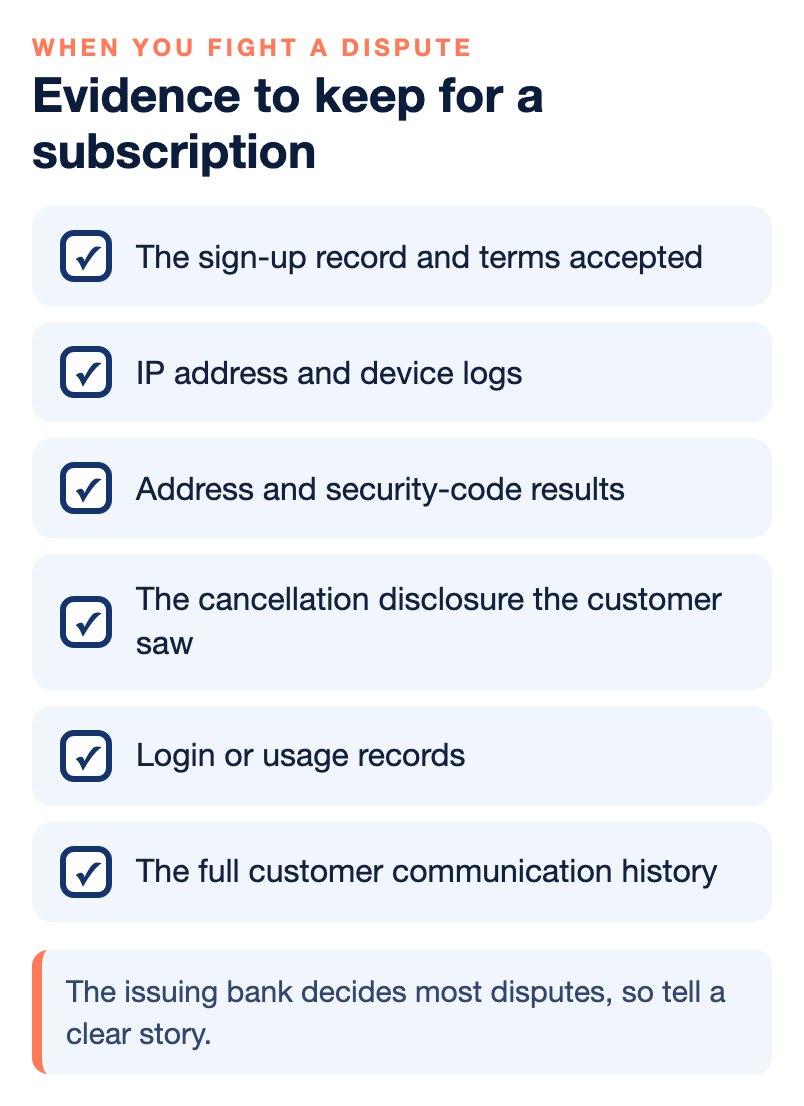
Some disputes are worth contesting. The issuing bank decides most of them, so the evidence has to tell a clear story. For a subscription, keep:
- The sign-up record, with date, time and the terms the customer accepted.
- IP address logs and device information.
- Address and security-code verification results, and 3D Secure authentication if you use it.
- Subscription acceptance logs and the cancellation disclosure the customer saw.
- Login or usage records that show the product was delivered or used.
- Delivery confirmation for physical goods.
- The full customer communication history.
Respond before the deadline. Typical response windows run from 7 to 21 days depending on the network and processor, and a missed deadline is an automatic loss. Weak documentation leads to rapid losses, especially for higher-risk merchants. For how the process works after you submit, see our explainer on what happens after your acquirer files a response.
A simple weekly routine
- Check your ratio. Disputes divided by transactions, tracked against the thresholds your processor shares with you.
- Sort new disputes. Real complaint, forgotten sign-up or likely friendly fraud.
- Refund real complaints right away, and fix the process that caused them.
- Respond to the rest with evidence, before the deadline.
- Read the pattern. If many disputes come from one campaign, one plan or one billing day, change the offer, the wording or the timing.
- Talk to your processor early. If the ratio is rising, a call now is easier than a call after a fine, and your provider may have monitoring or alert tools you are not using yet.
Who wrote this, and where NPS fits
Nationwide Payment Systems publishes this guide. We are a payments company based in South Florida, in business since 2001, and we work with high-risk and subscription merchants through underwriting, so we are not neutral. We review merchant websites for compliance risk, help structure refund and cancellation disclosures, monitor dispute ratios, help implement RDR where it fits and offer chargeback alert tools. You can read more in our guide to chargebacks for high-risk merchants and browse the full library of payments guides.
We are not the right fit for everyone. If you are a hobby seller with very low volume, if you only want an instant self-service sign-up, if you do not want to provide underwriting documents, or if the lowest advertised flat rate is the only thing that matters to you, a simpler platform will probably suit you better. And no provider can promise you will win every dispute. The goal is to manage your ratios and protect your processing stability, not to win every case.
Bottom line
Subscription chargebacks are mostly a design problem you can improve. Make the billing terms obvious, make canceling easy, use a billing name customers recognize, refund real complaints quickly and use RDR where it fits. Keep the right evidence for the disputes you decide to fight, and watch your ratio every week, because the ratio is what protects or threatens your account. If you would like help reviewing your website, your disclosures or your dispute numbers, you can contact our team, and if a simpler setup fits you better, we will say so.
Frequently asked questions
Why do subscription businesses get more chargebacks?
Recurring charges, free trials that convert to paid plans, promotions and digital delivery all raise the chance that a customer forgets, does not recognize or disputes a charge. Canceled-but-still-billed cases also produce legitimate disputes.
What is friendly fraud?
Friendly fraud is when a customer disputes a purchase they made, received and used, by mistake, out of forgetfulness or on purpose. It differs from a legitimate complaint, where something really went wrong, such as a double charge or an ignored cancellation.
How can I tell a real complaint from friendly fraud?
Ask whether the customer contacted you first. Real problems usually leave a trail in your inbox before they appear as disputes. Friendly fraud tends to skip you and arrive as a bank dispute with a vague reason.
What is RDR and how does it help?
RDR, or rapid dispute resolution, is a Visa program that lets a merchant automatically refund a transaction before it becomes a formal chargeback. Because it never becomes a chargeback, it does not count toward Visa’s monitoring ratios.
What is VAMP?
VAMP is the Visa Acquirer Monitoring Program. It tracks fraud rate, chargeback ratio and overall dispute volume, and exceeding its thresholds can bring monthly fines, action plans and termination risk.
How long do I have to respond to a chargeback?
Response windows typically run from 7 to 21 days depending on the network and processor. Missing the deadline means you automatically lose the dispute.
Can too many chargebacks close my merchant account?
Yes. A rising dispute ratio can lead to monitoring programs, fines, reserves, reduced processing limits and eventually termination, which can make it hard to find a replacement processor.





