
When a sub-merchant under a payment facilitator (PayFac) causes a loss, the bill does not stay with the sub-merchant. Under Visa and Mastercard rules, the acquiring bank answers for what its payment facilitators and their sponsored merchants do, the payment facilitator carries the losses its sub-merchants cannot cover, and a sub-merchant that goes wrong can put the whole portfolio under network scrutiny. That is why approving a sub-merchant is only the start of the job. This guide covers the part that comes after: where the liability sits at each level, which controls a payment facilitator needs to watch its portfolio, and the questions to ask if you plan to share that work with a partner.
The short answer
- Liability travels up the chain. The sub-merchant causes the loss, the payment facilitator is expected to stand behind it, and the acquiring bank answers to the card networks for both.
- Onboarding is not the finish line. The review of an application is one decision on one day. Monitoring is the daily work of noticing when a sub-merchant stops matching what you approved.
- Five things need watching: transactions, websites, disputes, reserves and the steps you take when something looks wrong.
- Write the controls down. An acquirer wants a policy that is written, applied the same way every time and explained to sub-merchants before they sign.
- You can share the work. Hybrid and white-label programs move much of the underwriting, risk and compliance work to a partner, but the contract decides exactly who carries what.
Who answers when a sub-merchant goes wrong
A payment facilitator, often called a PayFac, signs up businesses under its own relationship with an acquiring bank. Those businesses are called sponsored merchants or sub-merchants. Each one skips the work of applying for its own merchant account, which is the whole appeal for a software company. The trade is that the bank rarely meets most of those businesses. It meets the payment facilitator, and it relies on the payment facilitator’s judgment to keep fraud, prohibited products and unmanageable disputes out of the system.
The card networks make that reliance formal. Visa’s public risk guide for payment facilitators says an acquirer that contracts with one is responsible for what the payment facilitator and its sponsored merchants do. Mastercard describes a payment facilitator as a service provider registered by an acquirer to facilitate transactions on behalf of sub-merchants. In both cases the bank is the party that signs the contract and registers the payment facilitator with the network, so the bank is also the party that has to explain itself if something goes wrong.
Think of the liability as four layers, from the bottom up.
- The sub-merchant sells the goods or services. If it ships nothing, refunds nothing or closes after taking money, customers dispute the charges.
- The payment facilitator approved that sub-merchant and holds the relationship. If the sub-merchant cannot cover a refund or a chargeback, the payment facilitator is the next place the loss lands, which is one reason the acquirer reads its financial statements before it signs.
- The acquiring bank sponsors the payment facilitator. If the payment facilitator cannot cover a loss, the bank is exposed. The bank also answers to the card networks for the portfolio as a whole.
- The card networks run monitoring programs that count disputes and fraud reports. Those programs measure the bank’s whole portfolio against a much lower line than they use for a single merchant, so one hot sub-merchant can pull its payment facilitator and its bank into trouble together.
Our guide to the chargeback ratio that threatens a merchant account explains that acquirers are judged across their whole portfolio, so most act long before a single merchant reaches the network’s published line. The same logic applies one level up. A bank that sees a payment facilitator letting a few sub-merchants run hot has every reason to step in early.
Why monitoring is a different job from onboarding
Our guide to what an acquirer reads when you apply to become a PayFac follows the file a bank reviews before it signs. This guide picks up where that one stops. Approval is a snapshot. A sub-merchant is approved on the basis of what it said it sells, how much it expects to process and what its website looks like on one day. Everything after that is a question of whether the live business still matches the snapshot.
The acquirer cares because the gap between the two is where losses come from. Visa’s guide devotes a full chapter to risk monitoring, covering transaction monitoring, website monitoring and merchant reserves. The acquirer will ask how you watch transactions for fraud and unusual patterns, how you watch sub-merchant websites for changes in what they sell, how you track chargebacks and refunds, and what you do when a sub-merchant crosses a line. The sections below take those in turn.
Control 1: Watch the transactions
The first control is the simplest to describe and the hardest to run well. You compare what each sub-merchant processes against what it told you to expect. NPS guidance for merchants notes that when a business estimates a modest monthly volume and then processes many times that amount, the account may be reviewed, because the activity no longer matches what was approved. A payment facilitator should apply the same test to every sub-merchant it sponsors.
Useful signals to watch include:
- Volume against the approved estimate. A sudden climb is not always a problem, but it should always be a question.
- Ticket size. A sub-merchant approved on small sales that begins taking large ones has changed its risk, because a single large dispute does more damage than many small ones.
- Card-testing patterns. NPS describes card testing as small transactions, in the range of one to five dollars, with high decline rates and rapid-fire attempts, because fraudsters use a site as a testing ground for stolen cards. A sub-merchant can be hit by this even if it did nothing wrong, and the account can still face a rapid review.
The acquirer will ask who reviews alerts and how quickly, so name an owner for each one and write the answer down before you are asked.
Control 2: Watch the website and the story
Transactions show what is happening. A website shows what the sub-merchant says is happening. Comparing the two catches a problem that numbers alone often miss, which NPS describes as transaction laundering. That is a merchant processing payments for products or services different from what it disclosed during underwriting. It can mean a clean website shown to the processor while a hidden site sells something else, or an account used to process payments for another business altogether.
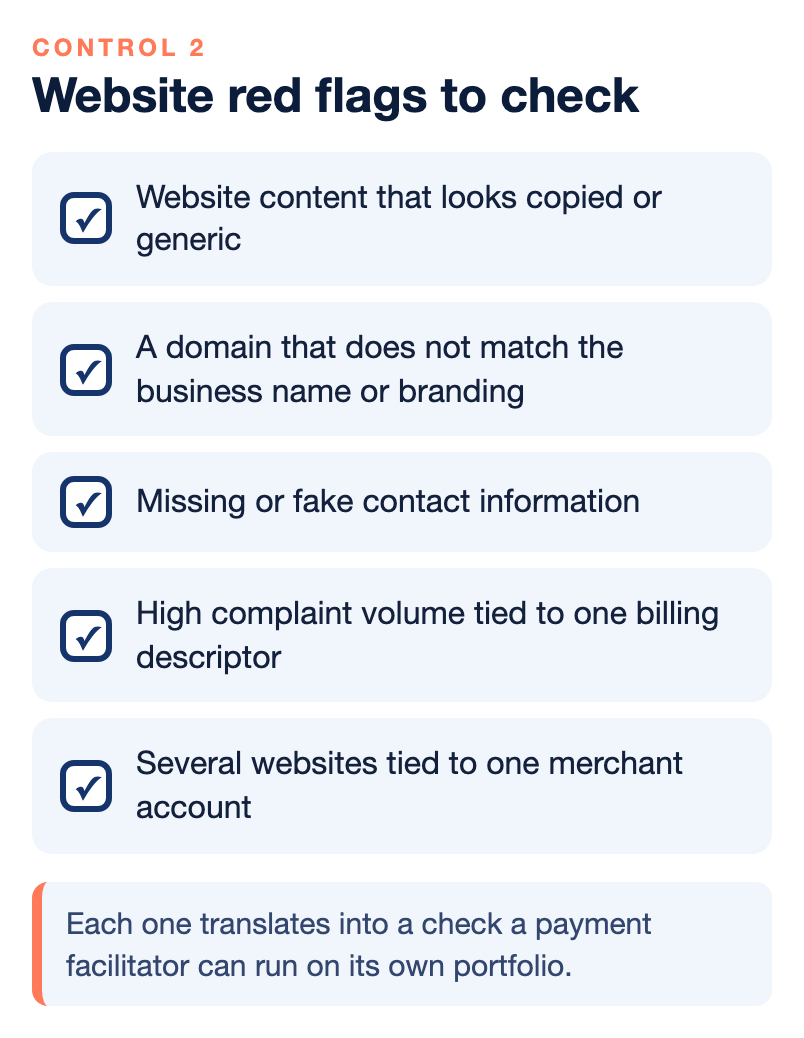
NPS lists several red flags that trigger reviews at processors, and each one translates into a check a payment facilitator can run on its own portfolio.
- Website content that looks copied or generic.
- A domain that does not match the business name or branding.
- Missing or fake contact information.
- High complaint volume tied to one billing descriptor, which is the name that shows on a cardholder’s statement.
- Several websites tied to one merchant account.
The networks care about this enough that Visa’s guide lists website monitoring as part of the monitoring a payment facilitator should be able to show. Plan to re-check each sub-merchant’s site on a schedule, not only at signup, and to compare what you see with what the application said. A sub-merchant that quietly adds a new product line has changed the risk you approved, whether or not the volume has moved.
If a sub-merchant changed what it sells tomorrow, how long would your team take to find out? If the honest answer is “when a chargeback arrives,” the control is missing.
Control 3: Track disputes the way the networks count them
Disputes are the clearest measure of whether a sub-merchant is a problem. The way they are counted matters, and many first-time payment facilitators calculate their numbers more kindly than the networks do. Three points from NPS’s guide to the ratio are worth building into your reports.
- It is a count, not a dollar figure. A ten-dollar dispute weighs the same as a thousand-dollar one, so small-ticket sub-merchants can climb fast.
- Fraud reports can count too. Under Visa’s program, a fraud report filed by a cardholder’s bank counts even if it never becomes a dispute you can fight.
- Disputes resolved before they become chargebacks are left out. NPS explains that Visa’s rapid dispute resolution tool lets a merchant refund automatically before a case becomes a formal chargeback, so it does not count toward Visa’s monitoring ratios.
Track the ratio for each sub-merchant every month, and for your whole portfolio as well, because your acquirer will look at the portfolio number. Set an internal warning line well below anything the networks publish, decide in advance what happens when a sub-merchant crosses it, and keep the action plan on file. NPS notes that your processor’s contract can set stricter limits than any network does, so ask your acquirer for its own lines in writing.
Memberships, supplements, continuity programs, digital education, coaching, software subscriptions and free-trial funnels all share a pattern of customers who forget a charge and dispute it. Our guide to subscription and free-trial chargebacks covers that pattern. If your platform serves that kind of sub-merchant, expect to watch it more closely.
Control 4: Decide when you will hold money
A reserve is money withheld from deposits, or set aside up front, to cover losses that arrive later, such as chargebacks, refunds or undelivered orders. Our guide to reserve requirements lists the common types: rolling, fixed or capped, upfront and termination holds. It also lists what usually drives them, which includes significant future delivery, high chargebacks, rapid growth, limited processing history, high average tickets and subscription billing.
For a payment facilitator, the question is two-sided. Your acquirer may hold a reserve against you. You, in turn, may decide to hold one against a sub-merchant. The acquirer is not looking for a specific number. It wants to see a policy that explains when you would hold a reserve, how you decide its size and how you release it. Four rules keep that policy fair.
- Write the triggers down before you need them, so two sub-merchants in the same situation are treated the same way.
- Explain the terms to the sub-merchant before it signs, including the reason, the release schedule and any cap.
- Review reserves on a schedule and reduce them when the risk shrinks. NPS notes that a reserve is not permanent by nature, because it exists to cover a risk.
- Remember that chargebacks can arrive after processing stops, which is why some holds continue after an account closes. Say so in the agreement.
Control 5: Have an escalation ladder, and an exit
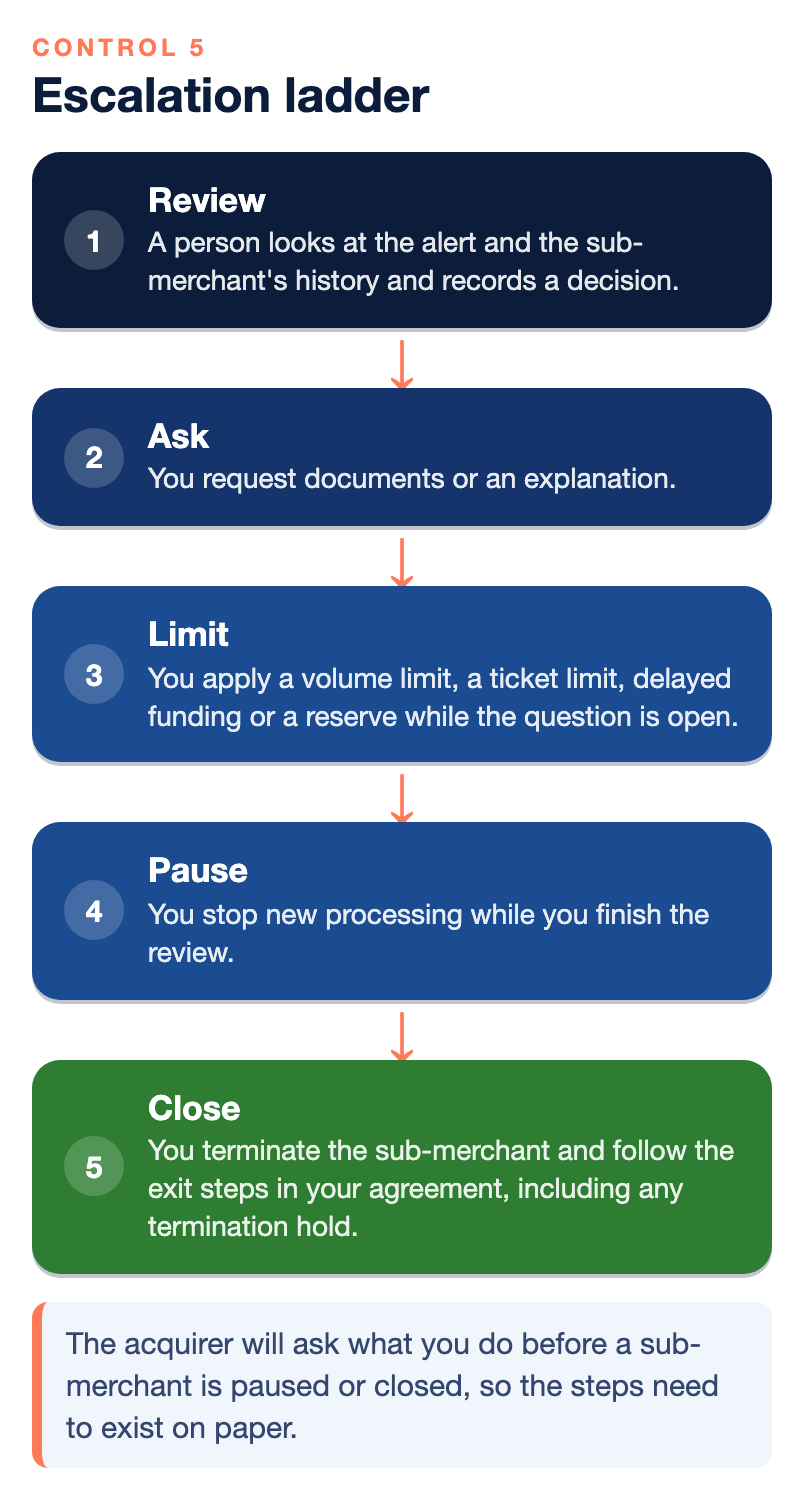
Alerts are only useful if they lead somewhere. The acquirer will ask what you do before a sub-merchant is paused or closed, so the steps need to exist on paper. A clear ladder usually runs like this.
- Review. A person looks at the alert and the sub-merchant’s history and records a decision.
- Ask. You request documents or an explanation. NPS notes that processors increasingly ask for proof of domain ownership, supplier invoices and authorization letters for branded goods.
- Limit. You apply a volume limit, a ticket limit, delayed funding or a reserve while the question is open.
- Pause. You stop new processing while you finish the review.
- Close. You terminate the sub-merchant and follow the exit steps in your agreement, including any termination hold.
The last step has consequences beyond your portfolio. Mastercard’s MATCH system lets acquiring banks share information about merchants terminated for specific high-risk reasons. NPS explains in its guide to the MATCH list that not every account closure results in a listing, that records generally remain for five years, and that the first step for a merchant is to ask the bank that closed the account whether it was submitted, under which reason code and by whom. As a payment facilitator, ask your acquirer how it decides what gets reported, so you know the stakes before you close an account.
Control 6: Build the identifiers and the limits into the platform
Some monitoring is a matter of how the platform is built. Two points from the card-network rules, as described in Visa’s guide and Mastercard’s switch rules, belong in your technical plan from the first day.
- Identifiers. Each sponsored merchant needs a unique identifier, and the transaction should carry the names of both the payment facilitator and the sub-merchant. Without clean identifiers you cannot see which sub-merchant is behind a number.
- Growth limits. Card-network rules set volume limits for sponsored merchants. Under Visa’s rules, once a sub-merchant passes those limits, the acquirer must be a party to that merchant’s agreement. Your monitoring should tell you when a sub-merchant is approaching the line, so the change is planned and not a surprise.
Data security belongs here too. A payment facilitator stores, processes or transmits card data, or controls systems that do, so the acquirer will ask about PCI compliance, whether card data touches your servers and how you use tokenization.
If you share the work with a partner
Many software companies do not want to run a risk department. Our guide to ISVs in payments compares the options by who carries four jobs: underwriting merchants, handling risk and chargebacks, supporting merchants and meeting card-network rules. In a hybrid arrangement, the software company registers as a payment facilitator with the card networks and works with an enabler that handles most of the compliance, risk management and underwriting. A white-label program puts your brand on the experience while the partner runs the back end. Our guide to earning from payments without becoming a PayFac covers the middle ground in more detail.
Sharing the work does not make the questions disappear. It makes them contract questions. Before you sign with any partner, get written answers to these.
- Who watches transactions and websites day to day, and who reviews the alerts?
- Who decides to pause or close a sub-merchant, and how fast do they tell you?
- Who covers a loss when a sub-merchant cannot, and under what conditions?
- What happens when a batch does not fund, a merchant is frozen or a chargeback lands?
- What reports will you see, and how often?
- If you outgrow the arrangement, what happens to your sub-merchants?
A partner that welcomes these questions is showing you what working with it will be like. A partner that answers in slogans is showing you something too. For the structure itself, see our page on PayFac as a service.
Who wrote this, and where NPS fits
Nationwide Payment Systems publishes this guide. Allen Kopelman started the company in 2001. We sell our own hybrid PayFac and white-label programs to software companies, so we are not a neutral party. We describe what card-network rules and acquiring banks ask for in general terms. We do not quote capital requirements, reserve amounts, fees, ratios or timelines here, because they depend on the acquirer, your volume, your merchant mix and the current network rules, and any number we printed could be wrong for you. Ask your acquirer for its requirements in writing. Nothing here is legal advice, and money movement can raise licensing questions that depend on your state and structure, so involve a payments lawyer before you take in money on someone else’s behalf.
We are probably not the right fit if you have already decided to run a fully independent payment facilitator with your own acquirer and no partner in between, or if you want a self-serve signup with no conversation at all. For software companies in between, our team can help with merchant underwriting, acquiring relationships, risk review and merchant support. You can read more on our ISV program page.
Bottom line
Liability runs up the chain, from the sub-merchant to the payment facilitator to the bank and then to the card networks, so every layer has a reason to watch the one below it. A payment facilitator needs controls on transactions, websites, disputes, reserves and escalation, all written down and applied the same way each time. If that list looks like more than you want to run, take that seriously, because a hybrid or white-label setup can carry much of it for you, provided the contract says exactly who does what. You can talk it through with our team, or browse more of our payments guides first.
Frequently asked questions
Who is liable when a PayFac’s sub-merchant causes a loss?
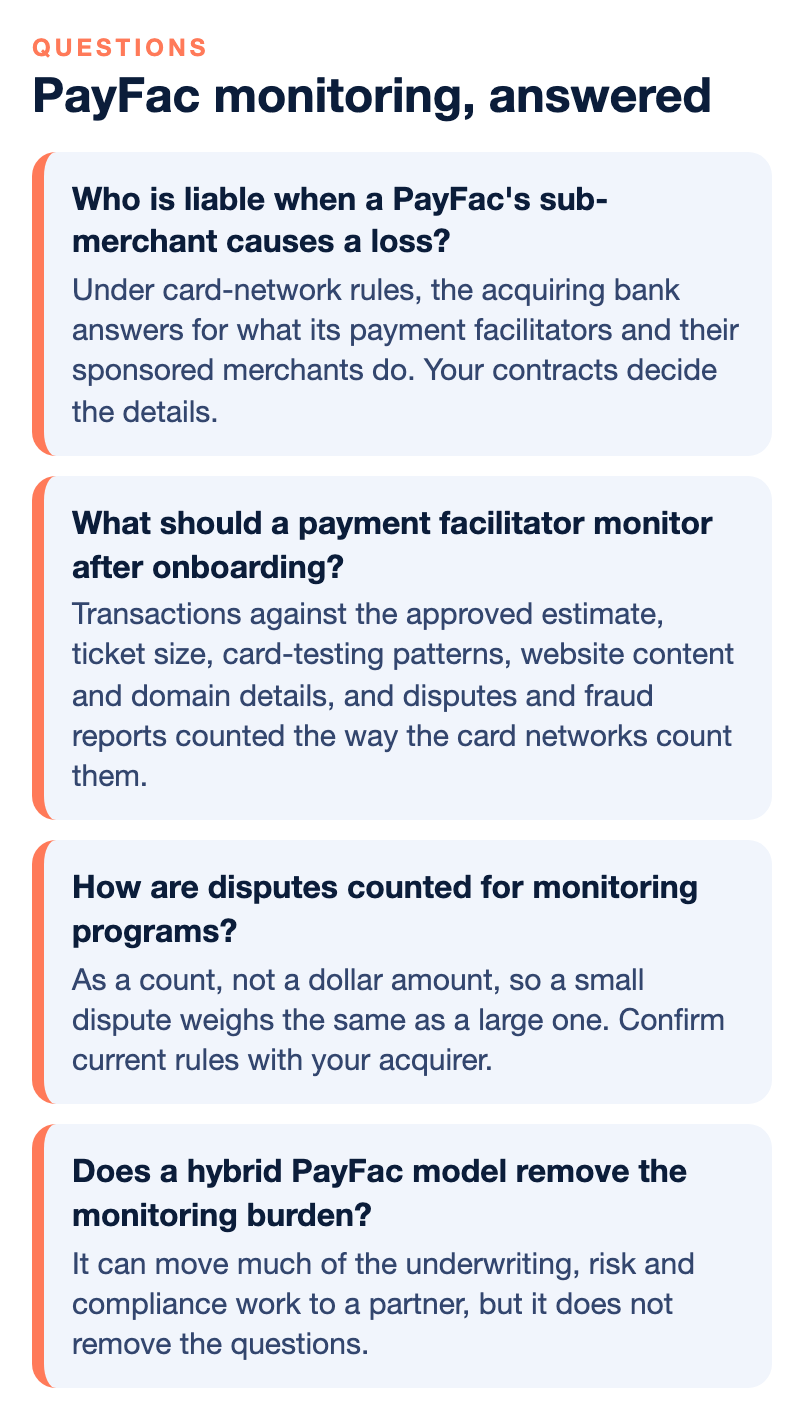
Liability runs up the chain. Under card-network rules, the acquiring bank answers for what its payment facilitators and their sponsored merchants do. In practice, the payment facilitator is expected to cover losses its sub-merchants cannot, and the bank is exposed if the payment facilitator cannot. Your contracts decide the details.
What should a payment facilitator monitor after onboarding?
Transactions against the approved estimate, ticket size, card-testing patterns, website content and domain details, and disputes and fraud reports counted the way the card networks count them. Also track complaints tied to one billing descriptor.
How are disputes counted for monitoring programs?
As a count, not a dollar amount, so a small dispute weighs the same as a large one. Under Visa’s program a fraud report can count even if it never becomes a dispute, while a refund made through a pre-dispute tool before a case becomes a chargeback is left out. Confirm current rules with your acquirer.
What is transaction laundering?
It is when a merchant processes payments for products or services different from what it disclosed during underwriting, for example by showing a clean website to the processor while a hidden site sells something else, or by running payments for another business.
Can a PayFac hold a reserve on a sub-merchant?
Often, yes, if its agreement and its acquirer allow it. The acquirer will want a written policy that explains when a reserve applies, how its size is decided and how it is released. Explain the terms to the sub-merchant before it signs.
Does a hybrid PayFac model remove the monitoring burden?
It can move much of the underwriting, risk and compliance work to a partner, but it does not remove the questions. Ask in writing who monitors, who decides to pause or close a sub-merchant, and who covers a loss when one cannot pay.





