
Visa’s published line for a single merchant in the United States is a VAMP ratio of 1.5 percent, counted on card-not-present fraud reports and disputes, and it only applies once a merchant has at least 1,500 of them in a month. Before April 1, 2026, that merchant line was 2.2 percent. Mastercard runs its own program with its own tiers and its own monthly thresholds. Those are the network numbers, but they are rarely where the trouble starts. Your acquiring bank is judged on its whole portfolio against a much lower line, so in practice the first warning usually comes from your processor, at a ratio well below anything the networks publish. This guide explains how each line is counted, who enforces it, what happens at each step, and how to keep your own number where nobody calls you about it.
The bottom line
- The network line for a merchant is not the line that gets you a phone call. Visa holds acquirers to 0.5 percent and 0.7 percent across their whole portfolio, so most processors act long before a merchant reaches 1.5 percent.
- The ratio is a count, not a dollar figure. A ten-dollar dispute weighs exactly as much as a thousand-dollar one, which is why small-ticket businesses can climb fast.
- Visa’s ratio includes fraud reports, not just chargebacks. A fraud report filed by a cardholder’s bank counts even if it never turns into a dispute you can fight.
- Disputes you resolve through a pre-dispute tool are left out of Visa’s count. That makes refund-before-dispute tools one of the most direct ways to protect the number.
- Track your own ratio every month, the same way the networks do. If you only learn it from a warning letter, you have already lost a month or two of room.
Who wrote this, and what we will not claim
Nationwide Payment Systems (NPS) publishes this guide. We are a payment processing company in South Florida, in business since 2001, and a large part of our work is with high-risk and high-volume merchants, so dispute ratios are a daily conversation for us. The Visa figures below come from Visa’s own published program summary. Card networks revise these programs, sometimes more than once a year, and your processor’s contract can set stricter limits than any network does, so confirm the current numbers with your processor before you plan around them. We do not quote fines here, because they are set by the networks and passed through by acquirers in ways that differ from bank to bank.
Three different lines, three different owners
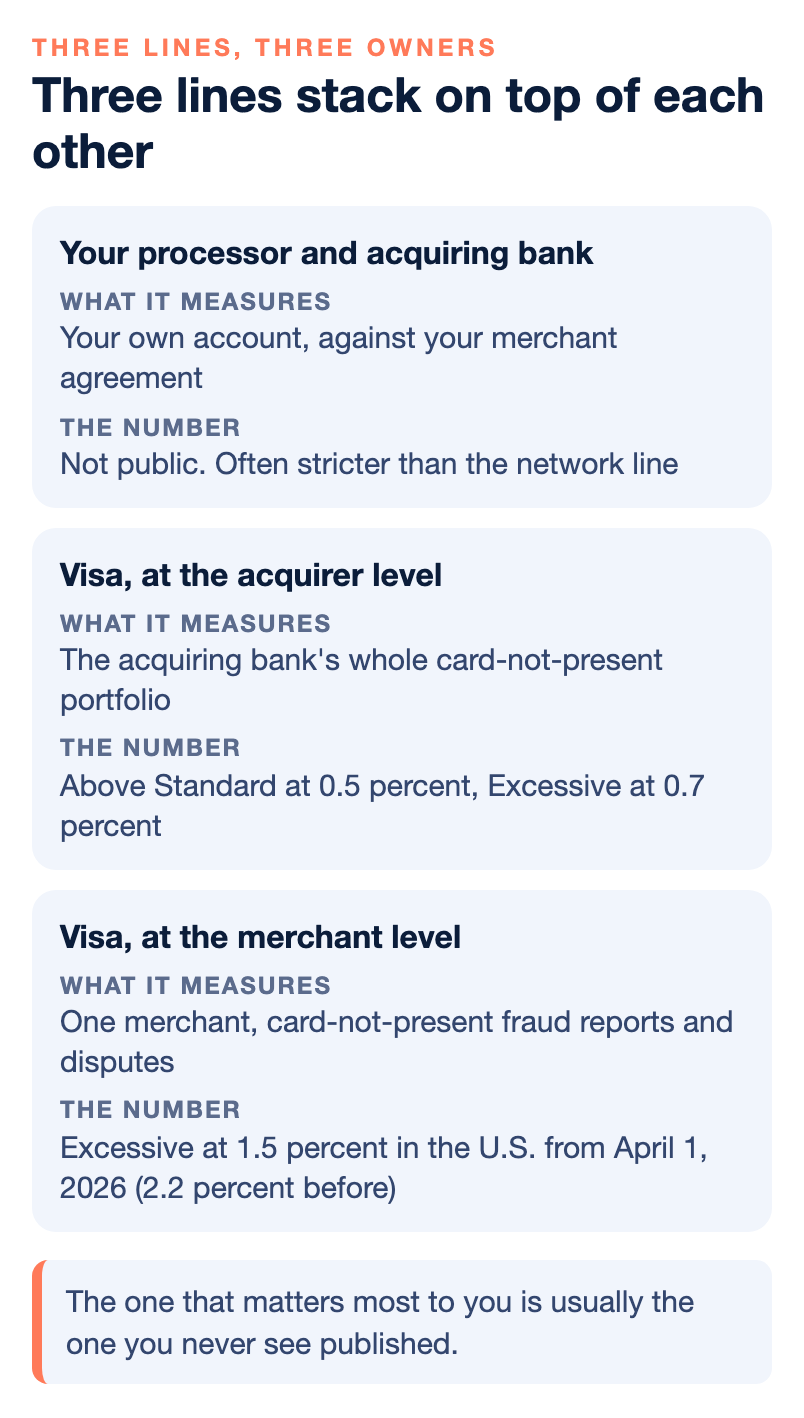
When people ask what chargeback ratio is too high, they usually picture one number set by Visa or Mastercard. There are really three lines stacked on top of each other, and the one that matters most to you is usually the one you never see published.
| Whose line | What it measures | What we can say about the number |
|---|---|---|
| Your processor and acquiring bank | Your own account, against the limits in your merchant agreement and the bank’s internal risk policy | Not public. Often stricter than the network line, and it can change with the bank’s own standing. |
| Visa, at the acquirer level | The acquiring bank’s whole card-not-present portfolio | Above Standard at a VAMP ratio of 0.5 percent, Excessive at 0.7 percent, per Visa’s program summary. |
| Visa, at the merchant level | One merchant, card-not-present fraud reports and disputes | Excessive at 1.5 percent in the U.S. from April 1, 2026 (2.2 percent before), with at least 1,500 fraud reports and disputes in the month. |
Visa applies the merchant-level line when the acquirer itself is not already Above Standard or Excessive. Think about what that means from the bank’s side. If a bank lets a handful of merchants run hot, its whole portfolio can cross 0.5 percent, and then the bank is the one in a remediation program. No acquirer wants that, so acquirers watch individual merchants closely and step in early, which is why a merchant at one percent can get a firm call from a processor even though Visa’s own merchant line is further off. Mastercard runs a parallel structure through its Excessive Chargeback Program, which places merchants in an Excessive Chargeback Merchant tier or a higher High Excessive Chargeback Merchant tier based on monthly chargeback thresholds, alongside a separate program for excessive fraud. The exact Mastercard thresholds and counting rules sit in its Security Rules and Procedures manual, which your processor can confirm for you.
How Visa counts the ratio
The single most useful thing you can do is calculate your number the way Visa does, because the way most merchants calculate it on their own is different and almost always looks better than the real one. Visa’s VAMP ratio, as published, takes the count of fraud reports plus the count of disputes on card-not-present Visa transactions in a month and divides it by the count of settled card-not-present transactions in that month. Fraud reports are the ones issuing banks file when a cardholder says a purchase was not theirs, and they count even when the bank never files a dispute you can respond to. So a fraud report and a chargeback on the same order can both land in the numerator.
Here is a simple worked example with round numbers. Say an online store settles 20,000 Visa card-not-present transactions in a month, and in the same month its issuing banks file 120 fraud reports and 90 disputes against it. The store’s ratio is 210 divided by 20,000, which is 1.05 percent. If that store only counted chargebacks, it would see 90 divided by 20,000, or 0.45 percent, and believe it was comfortably safe. The difference between those two numbers is the difference between a quiet month and a call from your risk team.
Visa’s summary also lists two exclusions. Disputes resolved through pre-dispute solutions are left out of the count, and so are fraud reports that qualify for Compelling Evidence 3.0, a Visa rule that lets a merchant show that a disputed purchase matches the same customer’s earlier, undisputed purchases. Both exclusions depend on the timing of Visa’s monthly data pull, so a case resolved late in the month may still be counted. Because the ratio is based on counts, a ten-dollar subscription renewal and a two-thousand-dollar order weigh exactly the same, which is why low-ticket, high-volume businesses can see their ratio swing hard from a single bad batch.
Why the 1,500 minimum does not protect a small business
The minimum count in Visa’s merchant line means a small online store with a few hundred orders a month will almost never be identified by Visa directly, even with a ratio far above 1.5 percent. It is tempting to read that as a free pass. It is not one. Your acquirer is still measured on the total, and a small merchant with a high ratio pulls the bank’s portfolio in the wrong direction just as surely as a big one, only more slowly. Processors handle that risk in their own agreements, with their own review triggers, reserves and termination rights, and those apply to you no matter how small your monthly count is. In other words, the count minimum decides who Visa names, while your contract decides who your processor acts on.
There is a second reason small merchants feel it. Processors price risk across their book. When a processor’s portfolio runs closer to the acquirer line, costs and scrutiny tend to rise for everyone in it, including merchants whose own numbers are clean. That is one more reason to work with a processor that manages the risk of its whole book carefully, not only yours.
What happens as the ratio climbs
Very few merchants go from a healthy account to a closed one overnight. The pressure usually builds in stages, and each stage gives you a little less room than the one before. The exact order depends on your processor, but the pattern looks like this.
- Your processor notices. Risk teams watch dispute and fraud trends daily or weekly. The first contact is often an email or a call asking what changed.
- You are asked for a plan. The processor wants to know the cause and what you are doing about it, often with documents such as refund policies, fulfillment records and fraud settings.
- Protection goes up. That can mean a reserve, delayed deposits, lower processing limits or a requirement to add fraud tools such as 3D Secure.
- A network identifies the account. If you cross a published line, the acquirer is notified, and it in turn requires remediation from you, with network fees and fines usually passed down under your merchant agreement.
- The account is closed. If the numbers do not come back down, the acquirer can terminate the account, and for certain reasons it can add the business and its owners to MATCH, the list other banks check on new applications.
The step that does the most lasting damage is the last one, because a MATCH record stays for five years and makes conventional processing much harder. We describe how that happens in our article on the 14 reasons merchants end up on the MATCH list. If your account has already been limited, our guide to what a restricted merchant account means walks through what to do the same day.
How to track your own ratio every month
Most of the merchants we talk to who are surprised by a ratio warning were not ignoring their disputes. They were measuring them in a way that left out half of what the networks count. A monthly routine that mirrors the network method takes less than an hour once it is set up, and it gives you the one thing a warning letter never does, which is time.
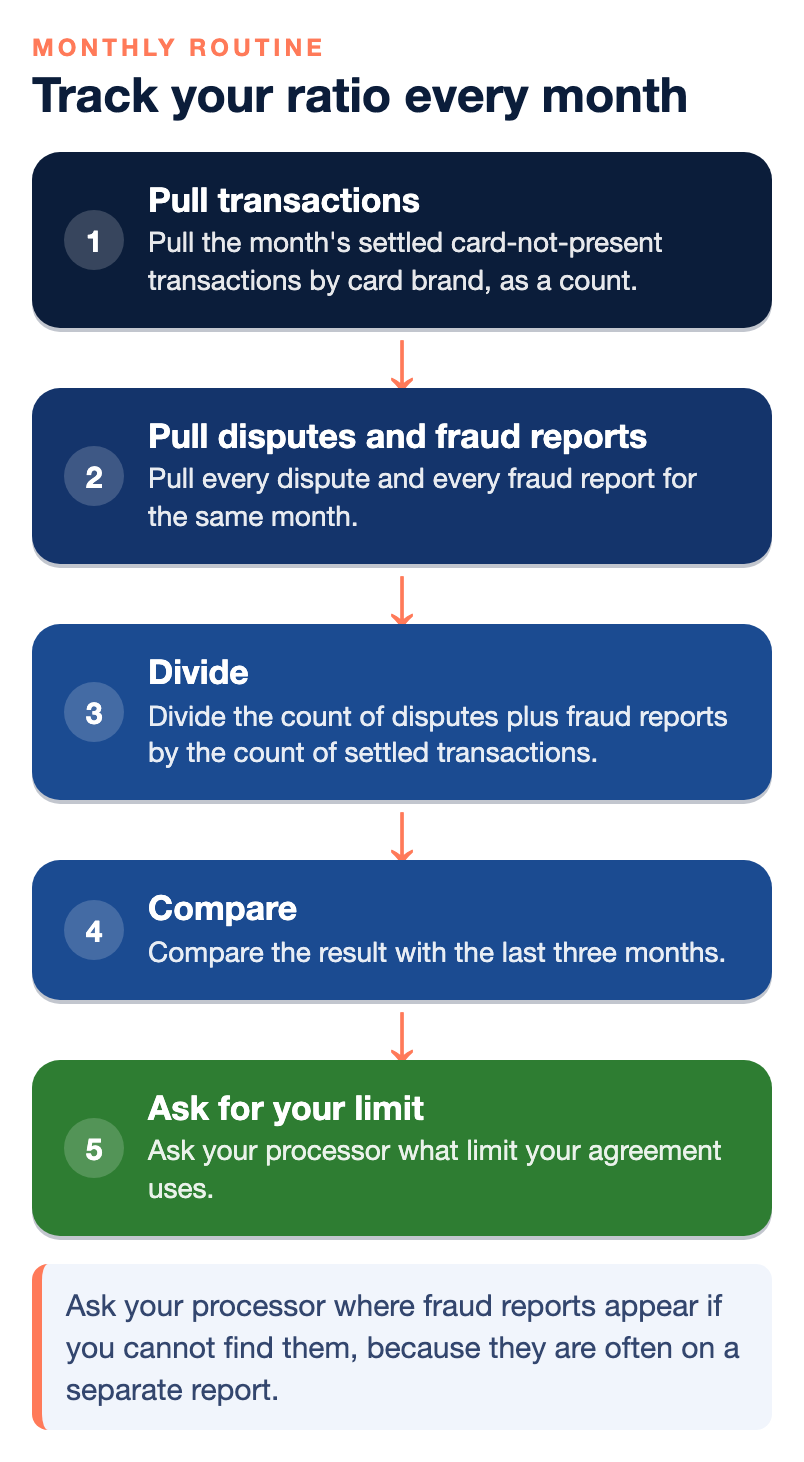
- Pull the month’s settled card-not-present transactions by card brand, as a count, from your processor’s reporting.
- Pull every dispute and every fraud report for the same month. Ask your processor where fraud reports appear if you cannot find them, because they are often on a separate report.
- Divide the count of disputes plus fraud reports by the count of settled transactions. Do it separately for Visa and Mastercard.
- Compare the result with the last three months. A rising trend matters more than any single month, because it shows where you will be next.
- Ask your processor what limit your agreement uses. That is the line that actually governs your account, and it is worth having in writing.
What actually moves the number
A ratio is a result, and the only way to change it for long is to change what produces it. Disputes and fraud reports come from a few places, and each one has a different fix.
True fraud
Stolen card numbers used on your site generate fraud reports first and disputes second. Address verification, CVV checks, velocity limits and 3D Secure on riskier orders cut this at the source. Watch for card-testing too, where criminals run many small authorizations to check stolen numbers. Visa tracks this pattern separately as enumeration, and an attack can damage your standing even when most of the attempts are declined.
Friendly fraud and buyer confusion
A large share of disputes come from real customers who do not recognize a charge, forgot a subscription or found it easier to call their bank than to ask you for a refund. A billing descriptor that matches the name on your website, a clear renewal reminder, an easy cancellation path and a contact phone number that a person answers will prevent more of these than any appeal letter ever wins back. Our article on why every website needs policies to avoid chargebacks covers the pages underwriters and customers both look for.
Problems with the order itself
Late shipping, items that do not match the description and refunds that never arrived all turn into disputes. These are the cheapest to prevent, because they are within your control, and the most expensive to ignore, because a customer who has already tried to reach you and failed will rarely back down.
Refunding before it becomes a dispute
Pre-dispute tools let you see a pending dispute and refund the customer before it becomes a formal chargeback. Visa’s own Rapid Dispute Resolution is one of them, and dispute alert services work in a similar way. Because Visa’s published ratio excludes disputes resolved through pre-dispute solutions, these tools protect the number directly, not just the revenue. They are not free and they do not fit every business, but for a merchant near a line they are often the fastest lever available. Our guide to high-risk chargebacks, RDR and VAMP explains when they make sense.
Winning the disputes you do get
Winning a chargeback gets your money back, but on Visa’s published method the dispute was still counted when it was filed. That is worth knowing, because many merchants focus all their effort on representment and very little on prevention. Fight the disputes you can win with good evidence, and put the rest of that energy into keeping the next one from being filed. Our complete guide to chargebacks covers reason codes, deadlines and who decides each case.
So what is a safe chargeback ratio?
There is no single safe number that applies to every business, and anyone who gives you one without asking about your industry, your processor and your volume is guessing. What we can say is that the published merchant lines are the outer edge of the road, not the middle of it. A merchant running near Visa’s line is already well above what its acquirer is held to across its portfolio, and the acquirer will usually act before Visa does. The healthier target is a ratio that stays well under your processor’s own limit with room to absorb a bad month, a holiday rush or a card-testing attack without crossing it. If you do not know your processor’s limit, that is the first question to ask.
Industry also matters. Subscriptions, travel, digital goods and other businesses that deliver later or bill repeatedly tend to run higher dispute rates than a store selling simple physical products, and underwriters price that in. A processor that underwrites your category on purpose will tell you up front what it expects, which is far better than learning it from a reserve notice.
Where NPS fits, and where it does not
We work with low-risk and high-risk merchants, and for merchants worried about their dispute numbers our work usually starts before a problem shows up. We review your website for compliance gaps, help structure refund and cancellation disclosures, help set up Rapid Dispute Resolution when it fits, provide chargeback alert tools and coordinate with our banking partners early, not after a warning arrives. For merchants doing significant monthly volume, we can connect you with dedicated dispute teams that handle representment at scale. Accounts come with live, U.S.-based support around the clock and a dedicated account manager.
Here is where we may not be the right choice:
- You want someone to promise a ratio will not trigger a review. Nobody can promise that, because the networks and banks set the lines.
- You want an instant, self-service account. We underwrite each account, so we are not an instant-approval product.
- Your disputes come from a product or practice you do not plan to change. Tools can buy time, but they cannot fix a business model that customers keep disputing.
- Very low volume or a side project. We may not be the best fit for hobby sellers with very low processing volume.
Next step
Work out your ratio the way Visa counts it, compare it with the last three months, and ask your processor for the limit in your agreement. If any of those three answers worries you, it is far easier to fix now than after a reserve or a closure notice. If you want a second opinion on your dispute numbers or a processing statement, you can talk with our team, and you can find more of our practical guides in the NPS payments guides library.
Frequently asked questions
What chargeback ratio triggers Visa’s monitoring program?
Visa’s published merchant line in the United States is a VAMP ratio of 1.5 percent from April 1, 2026, and it was 2.2 percent before that. It applies only when the merchant has at least 1,500 fraud reports and disputes in the month. Visa revises these programs, so confirm the current figure with your processor.
Is the chargeback ratio based on dollars or on number of transactions?
Visa’s VAMP ratio is based on counts, not dollars. It divides the number of fraud reports plus disputes by the number of settled card-not-present transactions in the month. A small charge counts exactly as much as a large one.
Why did my processor warn me when I am below Visa’s threshold?
Your acquiring bank is held to a lower line across its whole portfolio, 0.5 percent for Above Standard and 0.7 percent for Excessive in Visa’s program. Your merchant agreement can also set its own limits. Processors usually act early so their portfolio never reaches those lines.
Do fraud reports count even if the customer never files a chargeback?
Yes, in Visa’s ratio they do. The count includes fraud reports filed by issuing banks as well as disputes. That is why a merchant who only counts chargebacks often sees a lower number than Visa does.
Does winning a chargeback remove it from my ratio?
Not on Visa’s published method, because the dispute is counted when it is filed. Disputes resolved through pre-dispute tools such as Rapid Dispute Resolution are excluded, which is different from winning a dispute later. Prevention and early refunds protect the ratio more than representment does.
What is Mastercard’s excessive chargeback threshold?
Mastercard places merchants in an Excessive Chargeback Merchant tier or a higher High Excessive Chargeback Merchant tier based on monthly chargeback thresholds. The exact figures and counting rules are in Mastercard’s Security Rules and Procedures manual and can change. Ask your processor for the current numbers that apply to your account.
Can a high chargeback ratio get me on the MATCH list?
It can if your account is terminated for certain reasons, including excessive chargebacks. The acquiring bank can then add the business and its owners to MATCH, which other banks check on new applications. Mastercard’s rules keep a MATCH record for five years.
What is a safe chargeback ratio?
There is no single safe number for every business. The published network lines are the outer limit, and most processors act well before them. Aim to stay well under your processor’s own limit with room for a bad month, and ask your processor what that limit is.





