
ACH processing costs are built from several small lines, not one rate, and the line that looks cheapest on a quote is not always the one that decides what you pay. For a business that sells to other businesses online, the real cost of taking a bank payment includes the fee on each payment, what happens when a payment is returned, what the software around it charges and who ends up paying for the choice. This guide explains how those pieces fit together, which fee lines to ask a provider about, how to compare an ACH quote with what you pay for cards today and which questions to put in writing before you sign.
The short answer
- ACH is priced differently from cards. Cards usually charge a percentage of the sale. NPS describes ACH as typically a flat fee per transaction, and describes its optimized ACH as a small percentage with a fixed cap. Ask which structure you are being quoted.
- The fee per payment is only the start. Returned payments, setup, monthly charges, gateway or invoicing software and faster settlement can each add a line.
- Returns have a cost even when the fee looks small. A bank payment can come back for a closed account or a lack of funds, and your provider should tell you what each return costs and what happens to your account if returns climb.
- Someone pays the fee. You can absorb it, offer a discount for paying by bank, or charge a card fee where the rules allow it. Each choice changes what your buyers do.
- Compare totals, not rates. Add every ACH charge for a normal month, divide by the money moved and put that next to your card cost for the same buyers.
Why ACH costs are built differently from card costs
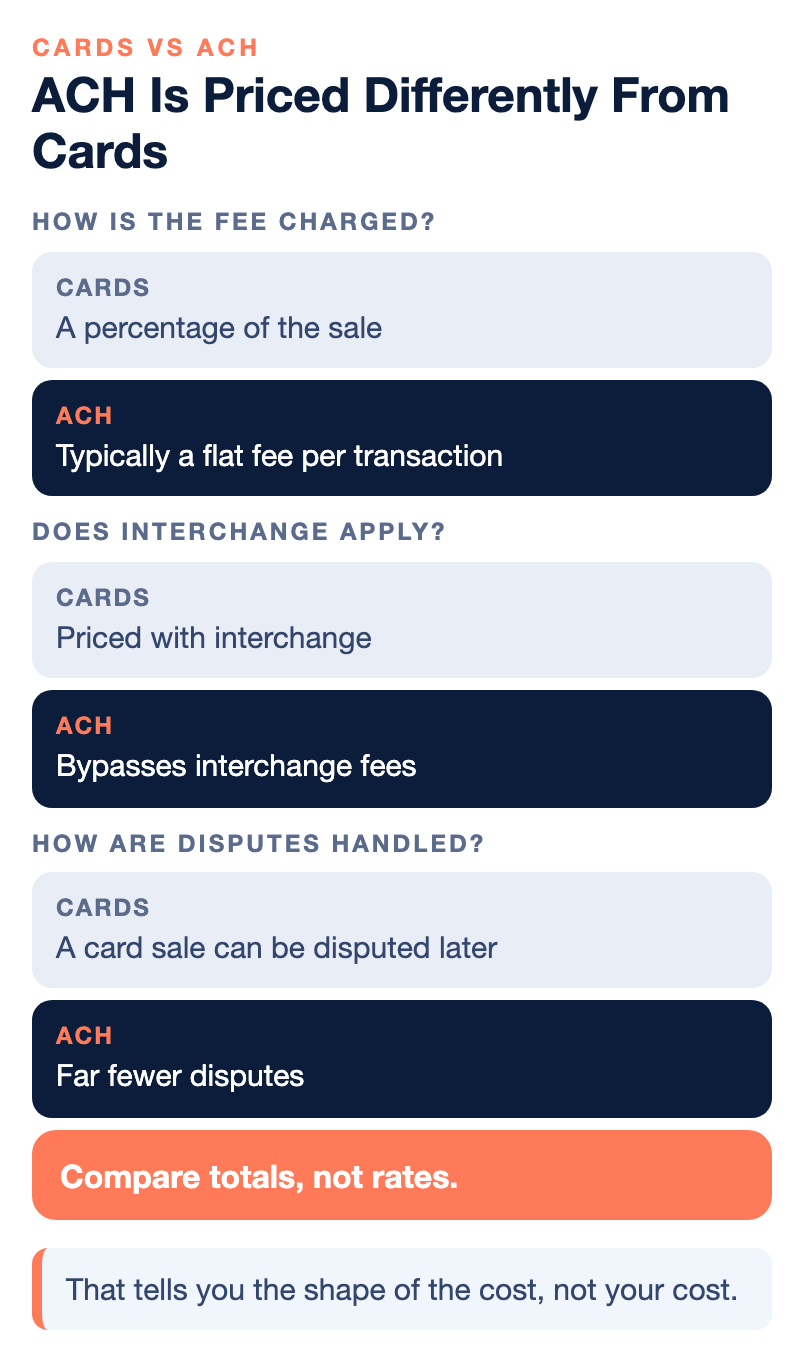
ACH stands for Automated Clearing House. It is the network that moves money directly between U.S. bank accounts, and the rules for it are written by an organization called Nacha. A card payment travels a different road. It goes through the card networks and is priced with interchange, which is the fee set by the networks and paid to the bank that issued the buyer’s card. NPS notes that ACH bypasses the interchange fees tied to credit cards, which is a large part of why it is often the preferred method for businesses that move high-dollar payments.
That difference in the road shows up in the price. A card fee is usually a percentage of the transaction value, so a larger invoice costs more to collect. NPS describes ACH costs as typically a flat fee per transaction, and elsewhere describes optimized ACH as a small percentage with a fixed cap. Both structures mean the cost of a very large invoice does not grow in step with the invoice. NPS says high-ticket B2B invoices benefit most from capped fees.
That tells you the shape of the cost, not your cost. Pricing depends on your volume, invoice sizes, how your buyers pay and your risk profile, so no page can give you the number. What a page can do is show you which lines to look for, so you know what is missing when a quote arrives.
What is different about a B2B ecommerce business
A B2B ecommerce business sells to other companies through a website, an ordering portal, emailed invoices or payment links. The buyer is often a purchasing or accounts payable team rather than one person with a card. Orders can be large, repeat on a schedule and be paid against an invoice instead of at the moment of checkout. Our guide to B2B payments describes the pattern: higher dollar amounts, invoice-based billing, recurring accounts and finance teams in the loop.
Those habits are why ACH fits so well, and also why its costs deserve a closer look. NPS says businesses get paid faster when customers can pay through a secure link, and that offering ACH next to cards is part of lowering the total cost of acceptance. Our guide to payment links and invoicing shows how that link works and how it settles.
The fee lines to ask about
Ask a provider to list every charge that touches an ACH payment, from the first setup to the last statement. Use the list below as a checklist. We describe each line in plain words and tell you what to ask. We do not know which of these your provider uses, and neither does any article, so the answer must come from the provider in writing.
- The fee on each payment. Is it a flat amount, a percentage or a percentage with a cap? If there is a cap, what is the amount it stops at, and does it apply to every payment or only to some? If it is a flat fee, is it the same for a small payment and a large one?
- The fee on a returned payment. A return happens when the buyer’s bank sends the payment back. Ask whether a return carries its own fee, whether you pay it again if you retry the payment and whether the original fee is refunded.
- Setup and onboarding. Is there a charge to turn ACH on, to verify your business or to connect it to your website or accounting software?
- Monthly or annual charges. Is there a monthly fee for the gateway, the invoicing software or ACH access, and is there a minimum you pay even in a slow month?
- Faster settlement. Standard ACH takes one to three business days, and NPS says same-day ACH is available in many cases. Ask whether same-day costs extra and whether any cutoff times apply. Our guide to real-time and same-day ACH explains what the speed does and does not change.
- Bank account verification. Ask how a buyer’s bank details are checked and whether each check has a charge. NPS says modern systems can verify bank accounts instantly, which can reduce returns for insufficient funds.
- Recurring and automated billing. If you bill the same buyer every month, ask whether recurring payments are priced like single payments.
- Reports and support. Ask whether reporting or support carries an extra charge.
A provider that answers each line clearly is giving you something useful. A provider that answers with one headline number and nothing else is telling you the quote is not finished. Our guide to transparent merchant pricing covers the same habit for cards.
What returns cost you
A card sale can be disputed later, and an ACH payment can come back too, just in a different way. Most business ACH payments are debits, which means you pull the money from the buyer’s account with their permission. If the account has no money, is closed or the bank says you did not have permission, the payment is returned. The bank sends back a short return code that tells you which of those happened. Our guide to ACH return codes explains the common ones in plain decisions.
Returns affect your cost in three ways, and each is worth a question.
- A fee. Ask what your provider charges for a return and whether it differs by reason. A return for lack of funds is a customer money problem. A return for an unauthorized payment can point to a problem in your process.
- The lost time. A payment you counted as received can come back after you have shipped the order. NPS stresses that fast access to money is not the same as safe access. Same-day ACH changes how fast money moves, not how long it can be returned.
- Your return rate. The ACH rules measure how often each business’s payments come back, and a business that crosses the review levels can be asked to explain and fix its process. Your processor will usually contact you long before that point. Ask what the provider does at that stage and whether it can hold or reserve funds.
One more point belongs here. NPS says ACH carries far fewer disputes than cards, because ACH payments do not follow the card networks’ chargeback rules and are harder to reverse without a valid banking reason. That is a real advantage for a seller, and it is a lower risk of disputes, not zero risk. Read the page on what happens inside an ACH batch for where the timing and the risk sit.
Who pays: absorb it, discount it or pass it on
Every fee has to land somewhere, and with B2B buyers the choice changes behavior. There are three common ways to handle it.
Absorb it. You pay the fee and the buyer pays the invoice. This is the simplest option, and with a flat or capped ACH fee on a large invoice it is often easy to live with. NPS says an ACH option with no surprise charge removes a common objection, because many buyers assume that paying electronically will cost them extra.
Reward it. You show a price for bank payments and a higher price for cards. NPS describes this as dual pricing, and describes a cash discount program as a related model that gives a discount for cash, ACH or check. Read how it sets this up on the dual pricing program page, and how to weigh it in our guide to a cash discount program or absorbing fees. Only the payments that move to the cheaper method save you money, so you cannot know the savings in advance.
Charge for the card. You offer ACH with no fee to the buyer, and the card option carries a convenience fee or compliant surcharge. NPS describes this as a hybrid model, where you promote ACH as the default and still allow cards for buyers who prefer them. NPS also says convenience fees can be set as a percentage or a flat amount, and that you should always check state and card brand rules before you add one.
The right choice depends on your buyers. If some want the float a card gives them, a card option with a clear fee may keep them. Our guide on why B2B buyers still pay by check shows how buyers react when the electronic option feels like a penalty.
The cost around the fee: software, matching and time
Many of the costs of taking ACH never appear as a processing fee. They appear as software charges and staff hours, and they decide whether a cheap payment is also a cheap process.
- Where the payment is taken. ACH has to be collected somewhere, such as a payment gateway, a hosted payment page or an invoicing tool. NPS describes its NPSONE platform as supporting card, ACH, virtual terminal payments, recurring payments, APIs and webhooks. Ask what the platform costs each month and what is included.
- Users and seats. NPS says its ClickBillR invoicing offers unlimited users at no extra cost, and compares that with QuickBooks Online, which it says charges per user.
- Matching payments to invoices. NPS says its ACH payments sync with QuickBooks Online, which can cut manual reconciliation. A payment that lands in your bank with no invoice attached still costs someone time to match. Ask how a payment is tied to an invoice and what happens to partial payments.
- Chasing late payers. NPS says its invoicing sends automatic reminders for past-due invoices, which replaces hours of writing emails.
Checks are the useful benchmark for this part. NPS lists their hidden costs as mail time, manual work to deposit and match them and exposure to fraud. If your ACH setup still leaves your team keying numbers by hand, you have moved the fee but kept much of the cost.
How to compare an ACH quote with what you pay for cards
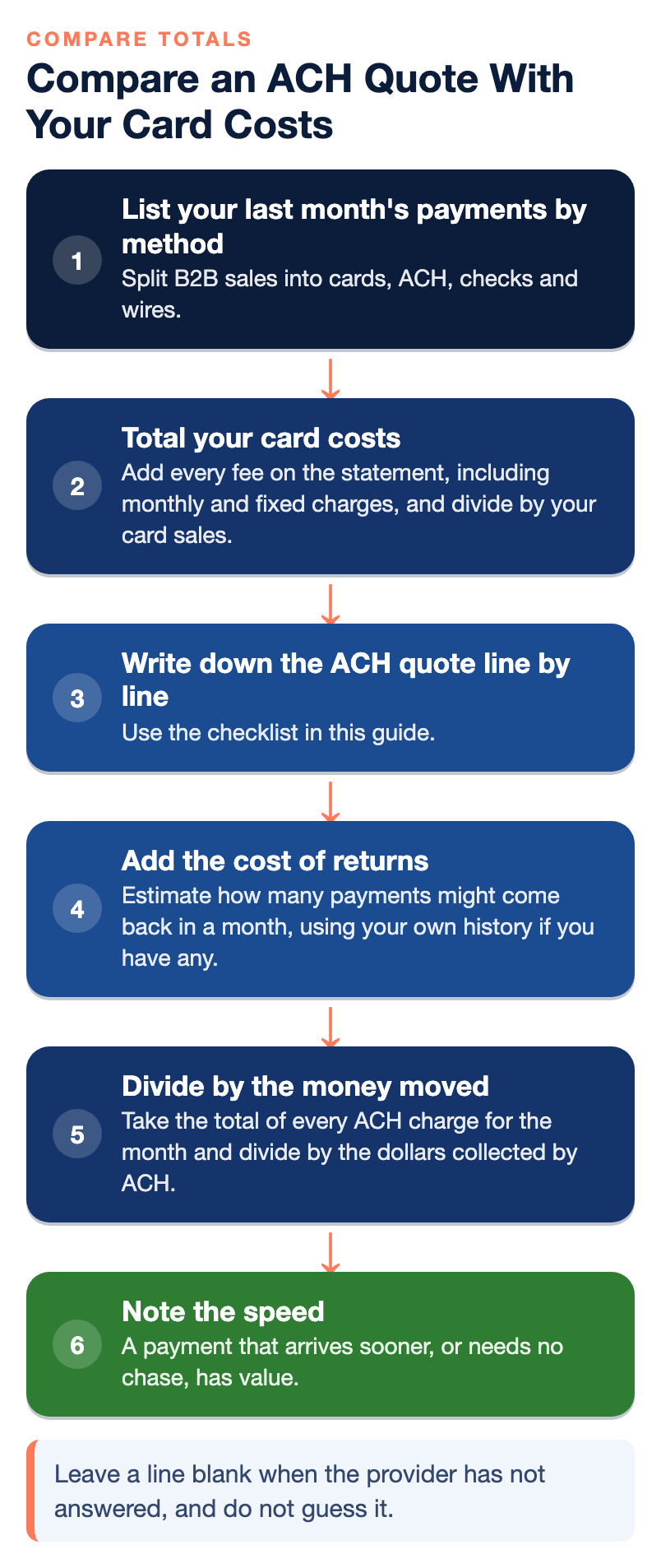
A rate next to a rate is a weak comparison, because the two rails are priced in different shapes. Compare the total cost of a normal month instead. This takes about an hour with a processing statement and an export of your invoices. Our guide to reading your merchant statement shows where the card numbers sit.
- List your last month’s payments by method. Split B2B sales into cards, ACH, checks and wires. If you do not know the split, your gateway, accounting software or bank deposits will show most of it.
- Total your card costs. Add every fee on the statement, including monthly and fixed charges, and divide by your card sales. This is your effective rate, as described in our guide to why your effective rate is higher than the quote. If you send Level 2 and Level 3 data on business cards, use the cost after it, not before.
- Write down the ACH quote line by line. Use the checklist in this guide. Put in the fee per payment, the return fee, setup, monthly charges and software. Leave a line blank when the provider has not answered, and do not guess it.
- Add the cost of returns. Estimate how many payments might come back in a month, using your own history if you have any. Multiply by the return fee and add the time your team spends on each.
- Divide by the money moved. Take the total of every ACH charge for the month and divide by the dollars collected by ACH. That is your effective ACH cost, and it is the number to put beside your effective card cost.
- Note the speed. A payment that arrives sooner, or needs no chase, has value. Put your own days-to-pay beside each quote as a note, not as a promise.
Run the same steps for each quote you receive. The answer is rarely the lowest headline fee. It is the quote with no blank lines.
Questions to ask before you sign
Put these in an email to each provider so the answers are in writing.
- What is the fee on each ACH payment, and is it flat, a percentage or a capped percentage?
- What do you charge for a returned payment, and is the original fee refunded?
- Are there setup, monthly, minimum or annual charges for ACH, the gateway or the invoicing software?
- Does same-day ACH cost extra, and what are the cutoff times?
- How are buyers’ bank accounts verified, and is there a charge for verification?
- What return rate triggers a review, and what do you do when returns rise? Can funds be held or reserved?
- Are fees taken from each deposit, or taken together at the end of the month?
- Can I pass the cost on with a discount or a card fee, and who checks that it follows the rules?
- How does an ACH payment connect to my accounting software, and what is charged for the connection?
- Can I leave without a penalty, and do I keep my customers’ payment information if I do?
The question about when fees are taken matters for budgeting. Net deposits mean fees come out of each deposit, while month-end discount means deposits arrive in full and fees are taken at once. Our page on when you actually get paid explains the difference.
Who wrote this, and where NPS fits
Nationwide Payment Systems publishes this guide. We are a payments company based in South Florida, in business since 2001, and we sell ACH, card processing and invoicing, so we have a stake in how this question is answered. We do not publish one price for ACH, because the cost depends on your volume, invoice sizes, return history and the software you use, and we do not promise savings here. Our ACH optimization guide and our page on ACH payments for B2B describe how we approach it, and you can browse the full library of payments guides.
We are not the right fit for everyone. If you take only a handful of payments a year, if you only want to pay a bank directly with no software or if the lowest advertised fee is all that matters to you, a simpler tool will probably suit you better. Whoever you choose, get the fee lines in writing.
Bottom line
ACH costs for a B2B online seller are a set of lines, not a single rate: the fee on each payment, the cost of returns, setup and monthly charges, software and the time it takes to match and collect. Cards charge a percentage of the sale, ACH is typically a flat or capped fee, and the real difference only shows up when you add every line and divide by the money moved. Ask each provider to fill in every line, decide who pays the fee, and compare totals. If you would like a second set of eyes on a quote, you can contact our team, and if another setup fits you better, we will say so.
Frequently asked questions
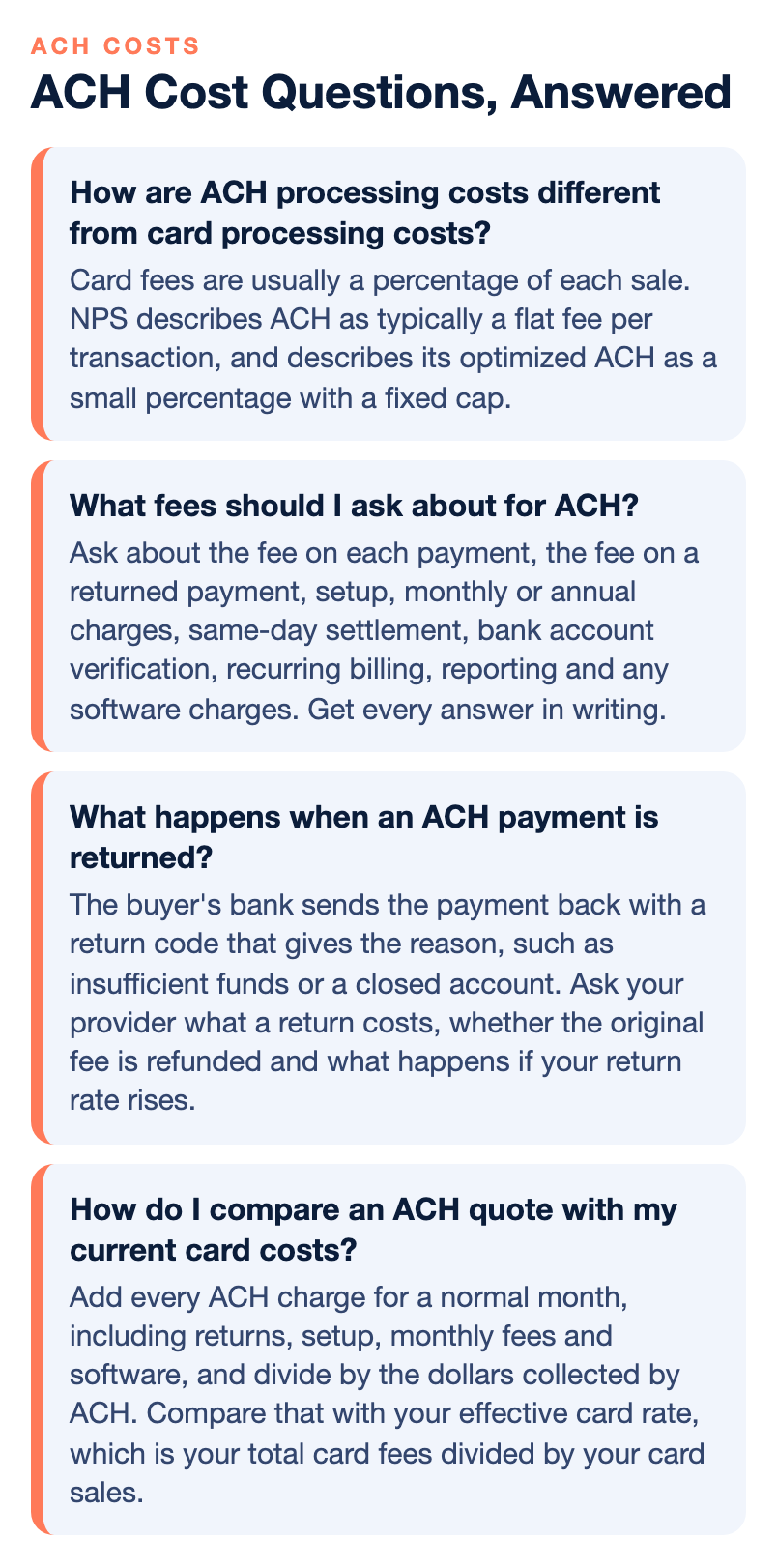
How are ACH processing costs different from card processing costs?
Card fees are usually a percentage of each sale. NPS describes ACH as typically a flat fee per transaction, and describes its optimized ACH as a small percentage with a fixed cap. ACH also avoids the interchange fees tied to credit cards.
What fees should I ask about for ACH?
Ask about the fee on each payment, the fee on a returned payment, setup, monthly or annual charges, same-day settlement, bank account verification, recurring billing, reporting and any software charges. Get every answer in writing.
What happens when an ACH payment is returned?
The buyer’s bank sends the payment back with a return code that gives the reason, such as insufficient funds or a closed account. Ask your provider what a return costs, whether the original fee is refunded and what happens if your return rate rises.
Is ACH safer than cards for a seller?
NPS says ACH has far fewer disputes because it does not follow card chargeback rules and is harder to reverse without a valid banking reason. A payment can still be returned, so lower dispute risk is not the same as no risk.
Who should pay the ACH fee, me or my buyer?
You can absorb it, offer a lower price for bank payments, or offer ACH with no fee and add a fee to card payments where the rules allow it. Check state and card brand rules before adding any fee, and think about how your buyers will react.
Does same-day ACH cost more?
It may. NPS says same-day ACH is available in many cases, but it does not publish what a provider charges. Ask whether same-day costs extra and what the cutoff times are. Same-day changes how fast money moves, not how long it can be returned.
How do I compare an ACH quote with my current card costs?
Add every ACH charge for a normal month, including returns, setup, monthly fees and software, and divide by the dollars collected by ACH. Compare that with your effective card rate, which is your total card fees divided by your card sales.





