
A residual split is calculated by taking a share of a base amount, and the base is the part that most often differs from what you were told. Two programs can advertise the same headline share and pay very different amounts, depending on whether the share applies to the provider’s gross revenue, its net revenue after costs, or a fixed amount per account. On top of that, fees, adjustments and setup errors can change what lands in your bank account each month. This guide explains what a residual is, what the split applies to, why the quoted number and the paid number drift apart, and how to read a residual report so you catch the gap early.
The short answer
- A residual is an ongoing share, not a one-time bonus. It keeps arriving each month for as long as the referred account stays active and the program terms say it should.
- The headline percentage is only half the formula. The other half is the base it applies to: gross revenue, net revenue or a flat amount per account.
- The quote and the payment can differ because of costs taken out first, fees and price changes, billing mistakes, missing accounts and chargeback treatment.
- The residual report is where the answers are. Compare it with your bank deposits and your list of referred accounts every month.
- Ask before you sign, and keep the answers in writing. The signed agreement is the only version of the terms that counts.
What a residual is
Every business that takes cards or bank payments pays for that service, usually through a mix of card network costs and the provider’s own markup and fees. When a provider signs a new merchant, part of what it earns on that account each month can be shared with whoever brought the account in. That share is usually called a residual, because it keeps arriving for as long as the account stays active, rather than being paid once at signup.
It helps to see the difference from other ways of being paid. A one-time referral bonus pays once. A residual pays on the activity of the account, month after month. A fixed amount per account pays the same each month whatever the account processes. Referral partners sometimes get one of these, sometimes a mix, and the paperwork should say which.
In this guide, an ISO means the company that pays the residual, and a merchant level salesperson, or MLS, means a person who brings in merchants and is paid residuals by that company. A referral partner is someone who introduces a client and lets the provider do the rest. A referral partner’s role is the introduction, while an agent or reseller handles more of the process and often carries more responsibility for the account. The math below applies to all of them, though the paperwork differs.
What the split is a share of
This is the single most important detail in any program, and the one most often left vague. The residual is calculated like this:
Your residual = your split x the base the split applies to.
The base can be defined in three common ways.
- Gross revenue. The provider’s revenue on the account before its own costs come out.
- Net revenue. The provider’s revenue after card network costs and its own expenses. Which costs come out, and in what order, is where programs differ.
- A fixed amount per account. A set payment for each active account, whatever it processes.
Two programs that advertise the same headline share can pay very different amounts depending on which of these the share applies to. A share of gross revenue and the same share of net revenue are not the same promise. That is why the first question to ask is not “what is the split” but “the split of what.”
It also pays to understand what the merchant is charged, because the two are connected. A card fee has three layers. Interchange goes to the bank that issued the customer’s card, assessments go to the card networks, and the processor’s markup is the part the processor keeps. The base you are paid on depends on how the agreement treats each layer. Our guide to what a merchant really pays for card processing shows the layers in plain words, and the same pieces show up, in some form, on every residual report.
We do not quote residual percentages here, and we do not describe any program’s split. Program terms change, and the only terms that count are the ones in your signed agreement.
Five reasons the quoted number is not the paid number
Even when the formula is clear, the number that arrives is not always the number you expected. These are the causes described in Allen Kopelman’s published experience with ISOs and acquirers.
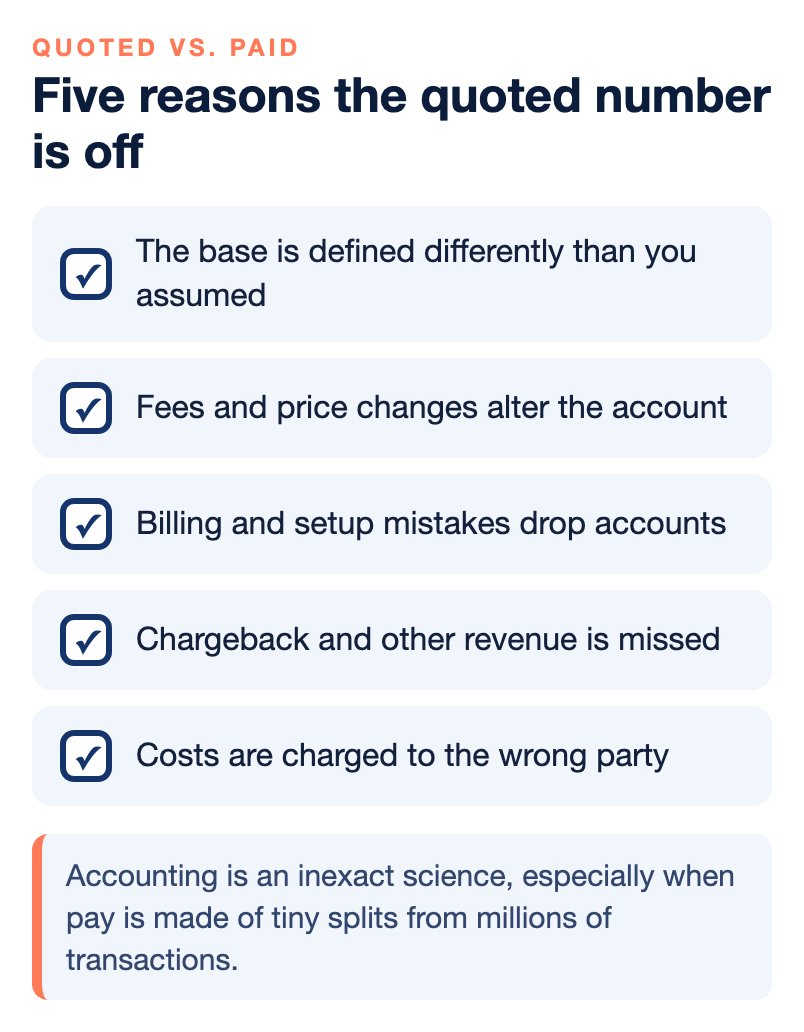
1. The base is defined differently than you assumed
If you were told “half” and the agreement says half of net revenue after costs, the gap shows up in month one. Ask for the definition in writing, with a sample residual report, before you sign.
2. Fees and price changes alter the account
A residual report can include line items such as statement fees, and prices can change after the account is set up. Allen Kopelman’s article on reading your residual report advises checking for price increases and line-item expenses and making sure you agreed in writing to the changes. If a fee you never heard of appears on the report, it is fair to ask where it came from.
3. Billing and setup mistakes drop accounts
Accounting is an inexact science, especially when pay is made of tiny splits from millions of transactions. In one example Allen describes, an ISO partner of more than 15 years moved to a new billing platform and left four or five new clients behind, so they were not paid on them. It took four months of appeals before a corrected report showed the overdue commissions paid for each account. It was a billing change that dropped accounts, and it was found because the partner kept checking its reports.
4. Chargeback and other revenue is missed
Another example in the same article: a partner asked why chargeback revenue was not being paid and was told “there weren’t that many.” The partner’s own records showed 50 chargebacks the previous month, and two days later the ISO acknowledged the error and paid. If your program shares chargeback fees, ask what is included and check that the column is filled in.
5. Costs are charged to the wrong party
Allen describes an acquirer debiting an account $100 for each merchant that fell below its monthly processing minimum. The agreement did not say who would be billed for a monthly minimum, and after the question was asked, the fees were refunded. If your agreement does not name who pays a charge, expect the question to come up.
Where else the gap comes from: terms you may not have read
Some differences are not mistakes at all. They are written in the agreement, and you only notice them when they apply. Read these parts of any partner agreement before you rely on the headline offer.
- How long residuals last. For the life of the account, for a fixed period, or only while you remain active in the program.
- Whether the terms can change. Whether the provider can change the split, the bonuses or the eligibility rules, and how much notice you get.
- Vesting. What happens to payments on accounts you already referred if you stop referring, close your firm or sell your practice.
- Clawbacks. Whether anything is taken back if a client leaves early or has chargebacks.
- Minimums, quotas and tiers. Whether you must refer a certain number of accounts to keep earning or to stay in the program.
- What happens if the portfolio is sold. Allen notes that portfolios get sold, and that one of the portfolios in his experience has been sold four times since 2001. The last sale was, in his words, a total nightmare.
Those last words matter more than they seem to. Allen’s advice from the same article is to always have a backup processor, because mergers and acquisitions are part of this business. A residual is a relationship with a company, and companies change.
How to read a residual report, step by step
You do not need special software to reconcile a residual statement. Allen’s checklist for salespeople and their ISOs works for referral partners of any kind, and it takes about 10 to 15 minutes a month. Here it is in order.
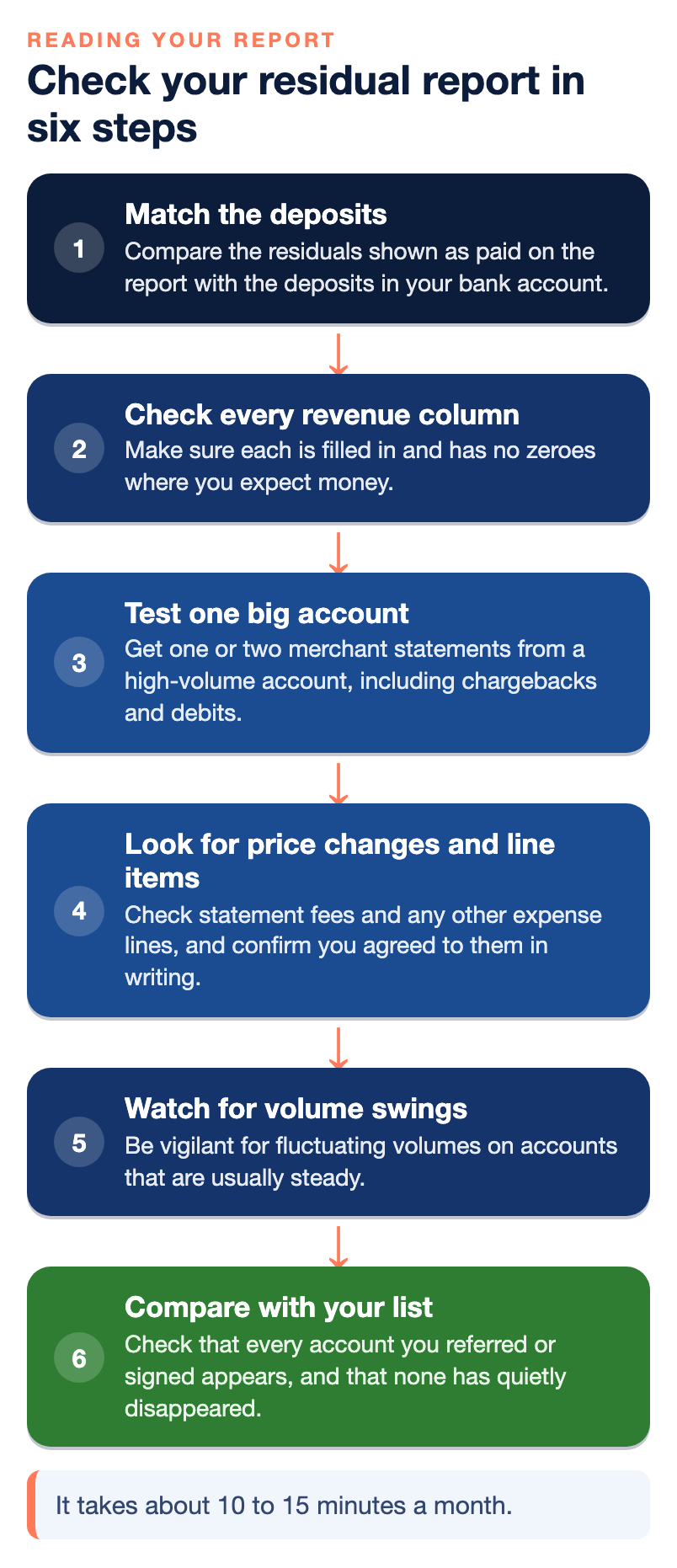
- Match the deposits. Compare the residuals shown as paid on the report with the deposits in your bank account. In one case Allen describes, the report showed amounts that the deposits did not match, month after month, until the partner sent screenshots of its bank deposits and the ISO paid the shortfall.
- Check every revenue column. Make sure each is filled in and has no zeroes where you expect money.
- Test one big account. Get one or two merchant statements from a high-volume account, including chargebacks and debits, and make sure you are being paid on those items.
- Look for price changes and line items. Check statement fees and any other expense lines, and confirm you agreed to them in writing.
- Watch for volume swings. Allen says to be vigilant for fluctuating volumes on accounts that are usually steady, as these could be red flags that an ISO is in financial trouble or possibly selling.
- Compare with your list. Check that every account you referred or signed appears, and that none has quietly disappeared.
It also helps to know what each merchant is paying overall. Our guide on why an effective rate is higher than the rate quoted explains how to divide total fees by total card sales to see the real cost. A residual that looks wrong against the merchant’s statement is a good reason to ask a question.
What to do when the numbers do not match
Most differences are honest mistakes, and most partners respond quickly when they are asked. Allen’s experience is that you rarely need to go beyond an email, but the order is worth knowing.
- Find the discrepancy and write down the account, the month and the amount.
- Follow the guidelines in your agreement and email the provider. Most contracts have a 30-day window for complaints, so do not wait.
- If there is no response, send a letter that details the issues you described in the email.
- Keep a record of every step. Handled calmly and professionally, these conversations can deepen the relationship rather than damage it.
The deeper point is the one Allen makes with a simple phrase: trust but verify. There is no exact science or AI software that can analyze your residual reports for you. Take a few minutes every month, and do not be the person who never checks the bank account. Not asking questions is the worst thing you can do.
Ten questions to ask before you join any program
If you are a firm, an adviser or an independent salesperson comparing programs, these are the questions that separate a program you can live with for years from one that causes problems later. Our guide to referral partner programs for accounting and bookkeeping firms goes through the same list with extra detail on disclosure and professional rules.
- What exactly is my share calculated on: gross revenue, net revenue or a flat amount per account? Which costs come out first?
- How long do residuals last?
- Can the terms change, and how much notice do I get?
- Are my residuals vested if I stop referring or sell my practice?
- Is there a clawback?
- Are there minimums, quotas or tiers?
- What does the monthly residual report show, per account, and how are disputes about it handled?
- Who supports my client when something breaks?
- What are my client’s terms? Is there a long contract, an early termination fee, and how is pricing shown on their statements?
- What happens to my accounts if the provider sells its portfolio or changes its billing platform?
Ask for a sample residual report with real column headings before you sign. If a provider will not show one, that is a signal in itself.
Who wrote this, and where NPS fits
Nationwide Payment Systems publishes this guide. Allen Kopelman started the company in 2001, and we run partner programs, including one for accountants, CPAs, bookkeepers and QuickBooks ProAdvisors, so we are not a neutral party. We do not quote residual percentages, bonuses or fees in this guide, and we cannot tell you what your professional rules allow. Our program page for accountants says there is no quota to hit and no tiered structure, and that partners earn every month a referred client stays active. You can read it on our page about the NPS One partner program, and you should still ask for the current terms in writing, from us or from anyone else. For the ideas behind this guide, see Allen’s article on understanding your residual report.
We are not the right fit for everyone. If the recommendation would not stand on its own without a fee, or if you want a program with no questions asked, another arrangement may suit you better. Nothing here is legal, tax or ethics advice.
Bottom line
A residual is your split multiplied by a base, and the base is what the quote usually leaves out. Ask what the share is calculated on, how long it lasts, what can change and how you will see what you are paid. Then read the report every month: match the deposits, check the columns, test a large account, look for new fees and make sure every account you referred is still there. A few minutes a month is the cheapest protection you have. If you want to talk through a program or a statement, you can contact our team, or browse more of our payments guides.
Frequently asked questions
How is a residual split calculated?
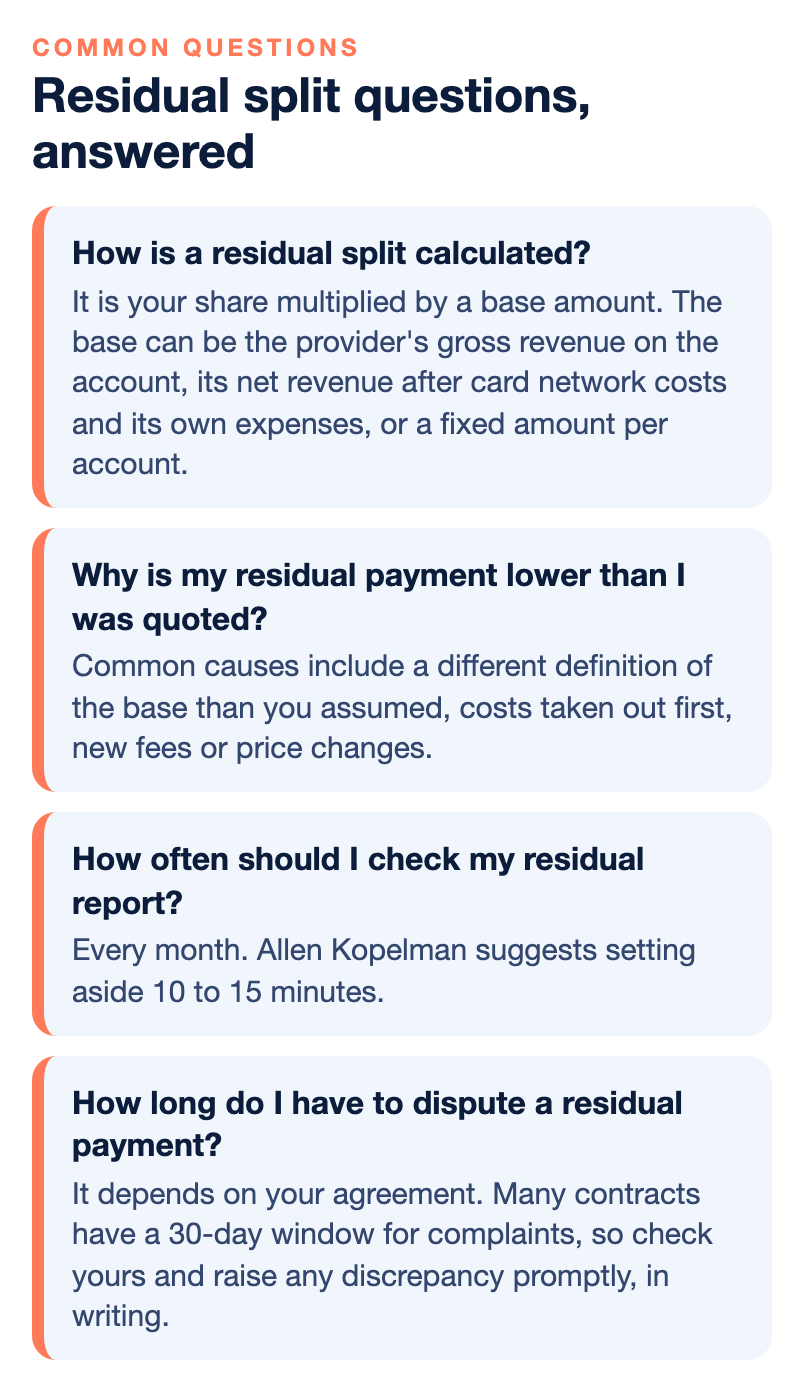
It is your share multiplied by a base amount. The base can be the provider’s gross revenue on the account, its net revenue after card network costs and its own expenses, or a fixed amount per account. The base matters as much as the percentage.
Why is my residual payment lower than I was quoted?
Common causes include a different definition of the base than you assumed, costs taken out first, new fees or price changes, accounts that were never set up or were dropped in a billing change, chargeback revenue that was not counted, and terms in the agreement such as clawbacks.
How often should I check my residual report?
Every month. Allen Kopelman suggests setting aside 10 to 15 minutes to compare the report with your bank deposits, your revenue columns and your list of referred accounts.
How long do I have to dispute a residual payment?
It depends on your agreement. Many contracts have a 30-day window for complaints, so check yours and raise any discrepancy promptly, in writing.
What is the difference between a referral partner and an ISO or agent?
A referral partner introduces a client and lets the provider handle the sale, application, underwriting, setup and support. An agent or reseller handles more of the process and often carries more responsibility for the account. The paperwork and rules can differ.
Should I give a residual back to the merchant?
That is a business decision for you and your agreement. Allen Kopelman’s article on lost sales lists giving away your own residual income to win accounts as one of the ways to lose a sale, so think about it before you offer it.





