
A merchant account is the account that lets a business accept card payments, and every business type uses the same basic one, but how you sell changes almost everything around it. A store with a counter, a restaurant with tabs and tips, an online shop, a company that sends invoices and a business that bills on a schedule each face different fees, different risks and different equipment. This guide goes through the common business types one at a time, says what changes for each, and gives you the questions to ask a provider before you sign.
The short answer
- The account is the same, the setup is not. The merchant account holds the approval to take cards. What differs by business type is the equipment, the pricing details, the dispute risk and what the bank wants to know.
- How you take the card matters most. Card in hand at a counter, card keyed in over the phone and card entered on a website are three different kinds of payment, and they are not priced or risk-rated the same.
- Your business description has to be true. The bank sets a category code for you from your application and website. A code that does not match what you really sell can cost money or end an account.
- Tell the provider before you add a new way of selling. An account approved for counter sales can be reviewed when it suddenly starts processing online orders.
- Compare your real cost, not the quoted rate. Whatever you sell, your effective rate is the number that counts.
What stays the same for every business
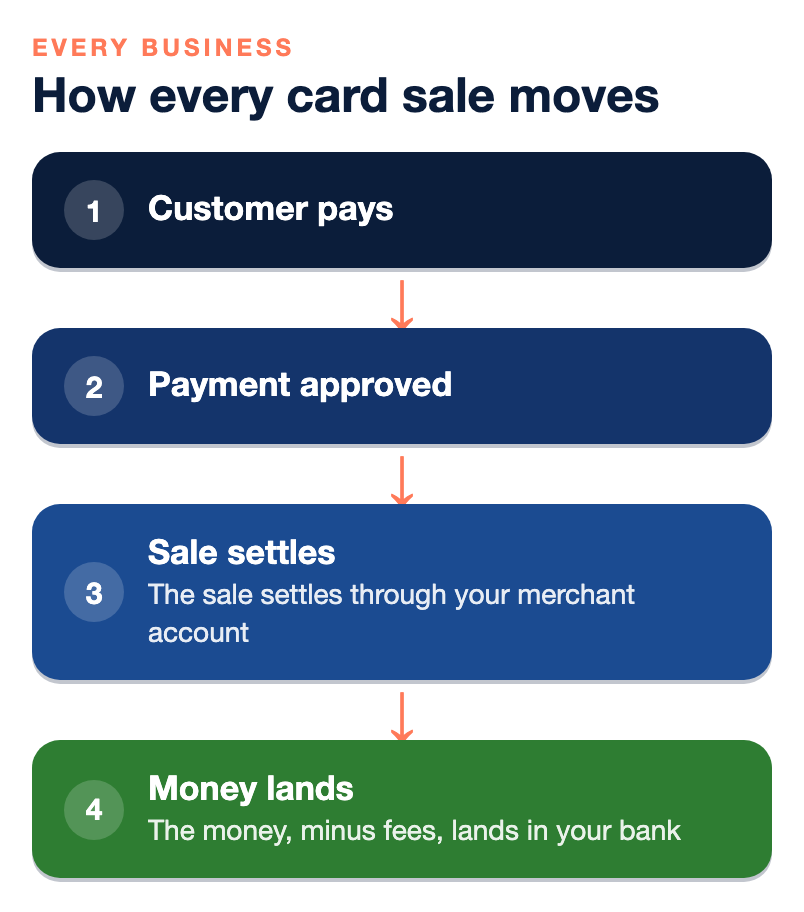
A merchant account is a specialized bank account that lets you process card transactions, hold the funds briefly and move them into your business bank account. It does not matter whether you sell coffee, consulting or auto parts. Every card sale you take moves through the same chain: the customer pays, the payment gets approved, the sale settles through your merchant account, and the money, minus fees, lands in your bank.
Three things also stay the same for every merchant. First, every card fee has layers. Interchange goes to the bank that issued the customer’s card, assessments go to the card networks, and the processor’s markup is the part the processor keeps. A transparent provider shows you all three, and our guide to transparent merchant pricing explains how to test a quote for that. Second, your real cost is your effective rate, which is your total processing fees divided by your total card sales. Our article on why your effective rate runs higher than the rate you were quoted shows how to find the gap on your own statement. Third, the bank underwrites you, which means it reviews your business before approving it. Our guide to who is eligible for a merchant account covers that review.
If you want the full picture of what the whole process costs, start with the merchant’s guide to what you really pay for card processing. The rest of this page is about what changes depending on how you sell.
Why the way you sell changes the picture
Card networks and banks care less about what you are called and more about how the money moves and what could go wrong afterward. Four questions shape most of the differences between business types.
- Is the card present? A chip card tapped or inserted at your counter is a different risk from a card number read over the phone or typed into a website. NPS lists card-present versus keyed-in as one of the factors in your rate.
- How big is the average sale? The size of your typical ticket often matters more to underwriters than your monthly total. A business that charges $50 a sale looks very different from one that charges $1,500.
- When does the customer get what they paid for? A customer who pays today for something delivered months from now creates more exposure for the bank than one who walks out with the product.
- How often do customers dispute? Some business models attract more chargebacks by design, and a high dispute ratio can lead to reserves or a closed account.
Keep those four questions in mind as you read about each business type below.
Retail and counter businesses
If customers stand at your counter and pay with a card, you are the simplest case for a merchant account. The card is present, the customer leaves with the product, and the risk of a dispute is lower than for most other models. What you need to decide is the equipment.
A basic card machine, also called a terminal, only takes the payment. It does not track sales tax, inventory or customers, and it does not connect to your accounting software. A point-of-sale system, or POS, runs the whole sale, with reporting by product, tax calculation, inventory counts, employee tracking, accounting links and, where it applies, age verification for regulated products. A shop with a short, fixed price list may be fine with a terminal. A shop that carries many items, tracks stock or sells age-restricted goods usually outgrows one. Our comparison of a credit card machine, a POS system and a virtual terminal goes through the differences side by side.
Questions to ask: Does the POS I want work with your processing, or am I locked into your hardware? Does it sync with my accounting software? What happens to my equipment and my data if I leave?
Restaurants, bars and nightclubs
Hospitality is still a card-present business, but it has quirks a retail counter does not. A restaurant POS handles tables, tips and menus rather than barcodes. Bars run multiple tabs for the same guest. Tips get added after the first authorization. Those habits are exactly what produces disputes.
NPS describes hospitality venues as common targets of what it calls friendly fraud, where a customer disputes a legitimate charge the next morning out of regret or confusion. The reasons it lists are a duplicate charge, a wrong amount and an item never received. Many of them trace back to tabs and tip adjustments. NPS suggests capturing the total with the tip upfront or using a pay-at-table system so there is no manual adjustment afterward. It also notes that the chip is not a guarantee, because even chip transactions can be disputed, but they are easier to defend when the sale is well documented. Our chargeback guide for bars, nightclubs and restaurants covers the evidence and the response letter in detail.
Questions to ask: Can I take payment at the table? How are tip adjustments handled and shown on the receipt? Who helps me respond to a dispute?
Online stores and home-based businesses
Selling online adds two parts to the account. A checkout page is where the customer enters card details, and a payment gateway is the secure connection that sends those details for approval. The merchant account still settles the money. Because the card is not present, online sales usually cost a bit more to process than in-person ones, since card-not-present payments carry more fraud risk. Read pricing carefully and compare written quotes.
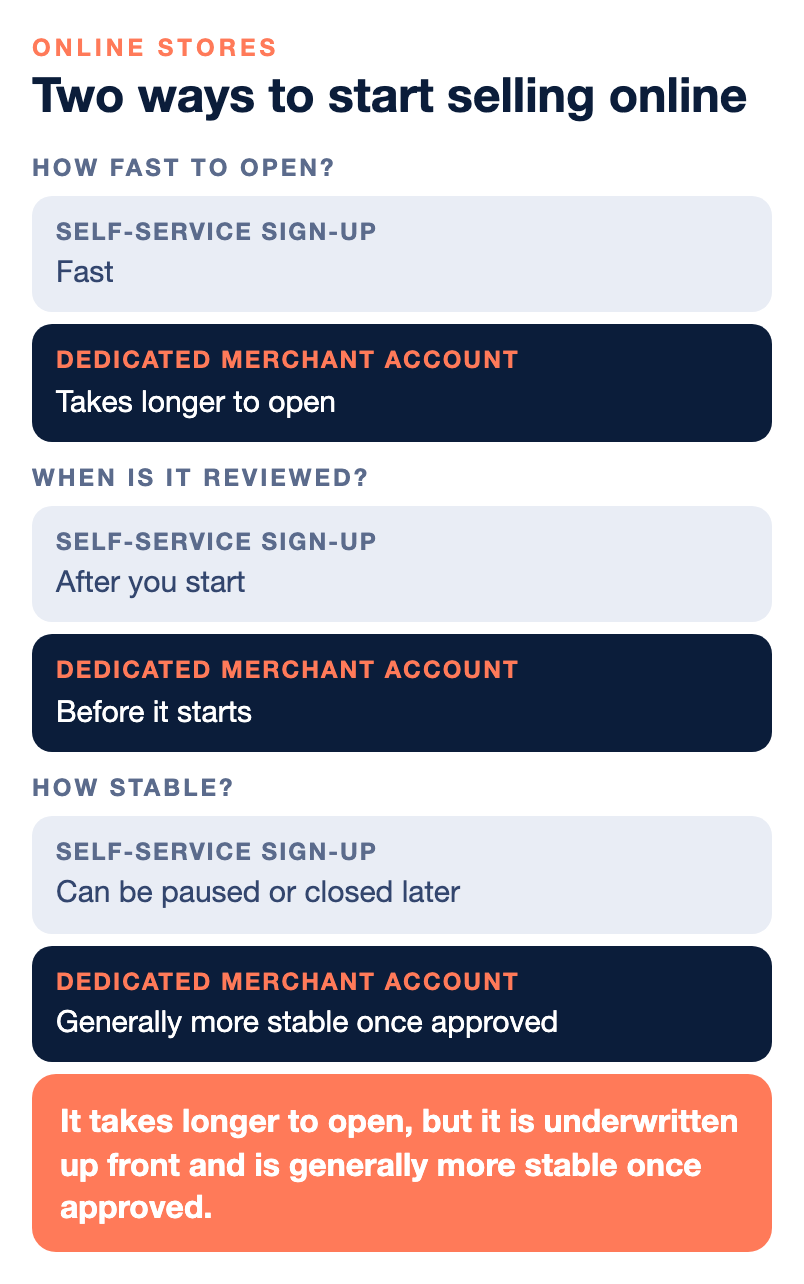
There are two common routes. Some providers bundle checkout, gateway and account into one self-service sign-up. That is fast, and it suits many very small sellers, but the review happens after you start, so an account can be paused or closed later if something looks unusual. The other route is a dedicated merchant account with a gateway, where the business is reviewed before it starts. It takes longer to open, but it is underwritten up front and is generally more stable once approved.
Being home-based does not make you high-risk. What changes is that your home address, your bank account and your website should line up, because underwriters check them. If your website shows one address, your state registration another and your application a third, expect questions. Our guide to e-commerce payment processing for a home-based small business walks through the details.
Questions to ask: Is my account reviewed before I sell or after? Which shopping carts connect to your gateway? What fraud settings come with it?
B2B sellers and invoice-based businesses
When customers are other businesses, the sale is often an invoice, not a counter transaction. Tickets are bigger, customers may pay with corporate or purchasing cards, and accounting teams are involved. That changes several things.
- Underwriting looks hard at ticket size. Be ready to explain large invoices, how you bill and when you are paid.
- Extra transaction data can lower card costs. Level 2 and Level 3 data add details such as sales tax, a customer code, line items and purchase order numbers. NPS says Visa requires accurate, dynamic data, so generic placeholder values no longer qualify.
- ACH belongs next to cards. For large and recurring invoices, bank-to-bank payment often costs far less than a percentage-based card fee.
- Invoicing is part of the account. Payment links, partial payments and accounting sync matter more than a counter terminal.
We cover all of this in our guide to B2B merchant accounts. If you invoice regularly, a payment link that opens a secure payment page for a set amount often does more for cash flow than any other change, and it spares your staff from reading card numbers over the phone.
Questions to ask: Do you support Level 2 and Level 3 data, and how is it generated? Can customers pay by card or ACH from the same link? Does it sync with my accounting software?
Service, field and mobile businesses
A contractor finishing a job in a driveway, a vendor at a weekend event and a professional who collects fees after the work all need a way to take payment away from a counter. Three tools cover most of it: mobile acceptance on a phone or tablet, a virtual terminal (a secure web screen for keying in a card payment, with no equipment), and invoices or payment links sent by email or text.
Anything keyed in is a card-not-present payment, so ask how keyed-in sales are priced. If you take payments in more than one of these ways, it is worth asking whether all of them settle into one merchant account. Otherwise you end up with several statements, several deposit schedules and several support lines. Our guide to omnichannel payment solutions explains how to count your providers and consolidate the ones that cause the most trouble.
Questions to ask: What are my deposit times for each channel? Who do I call when something breaks across two systems, and is it a live person?
Subscription and recurring-billing businesses
If you bill customers on a schedule, expect more disputes than a business that sells one thing at a time. The reasons are built into the model. Customers forget they signed up, a free trial turns into a paid plan, a renewal charge looks unfamiliar on a statement, and calling the bank can feel easier than finding the cancel button. Left alone, those disputes push your chargeback ratio toward limits the card networks watch, and a high ratio can mean fines, reserves and a closed account.
Prevention beats winning disputes afterward. Clear disclosure of recurring billing, a visible refund policy, easy cancellation and a billing name customers recognize stop more disputes than any evidence packet can win back. Visa’s rapid dispute resolution tool, known as RDR, also lets a merchant refund automatically before a case becomes a formal chargeback, so it does not count toward Visa’s monitoring ratios. Our article on subscription and free-trial chargebacks goes through the steps.
Questions to ask: How do you monitor my dispute ratio? Is RDR available to me? What happens to my funds if my ratio rises?
Niche and regulated businesses
Some businesses are labeled high risk even though they do nothing wrong. NPS describes a high-risk merchant account as one underwritten for a business with extra financial, regulatory, chargeback, fraud, fulfillment or compliance risk. It names industries such as tobacco and vape, nutraceuticals, telemedicine, travel, ticketing, subscriptions, online dating and precious metals as examples that may need an acquiring bank that understands them. A business can be completely legal and still be turned down by a given processor, because each payment company decides which industries it will support.
For these businesses, the most important step is to disclose the whole business model during underwriting, including your products, website, licenses, processing history and fulfillment practices. Hiding details leads to trouble later. NPS also points out that instant-approval platforms can be risky for niche businesses whose category is restricted or prohibited, so read the provider’s rules before you process transactions, not after an account-review notice arrives. Our high-risk merchant account guide has the full list of what banks review.
Questions to ask: Does your list of restricted businesses cover mine? What documents will you want up front? What reserve terms could apply?
Your business category code: the quiet detail
Whatever you sell, the acquiring bank or processor assigns your account a four-digit merchant category code, called an MCC, that tells the card networks what kind of business you run. You usually do not pick it. It affects your card costs, how issuers treat your transactions and how risk teams watch you. A code that does not match what you really sell can look like misrepresentation, even when the mistake was innocent. Our guide to how MCC codes are assigned explains how to check yours. Ask your provider which code is on your account and what it covers.
A side-by-side summary
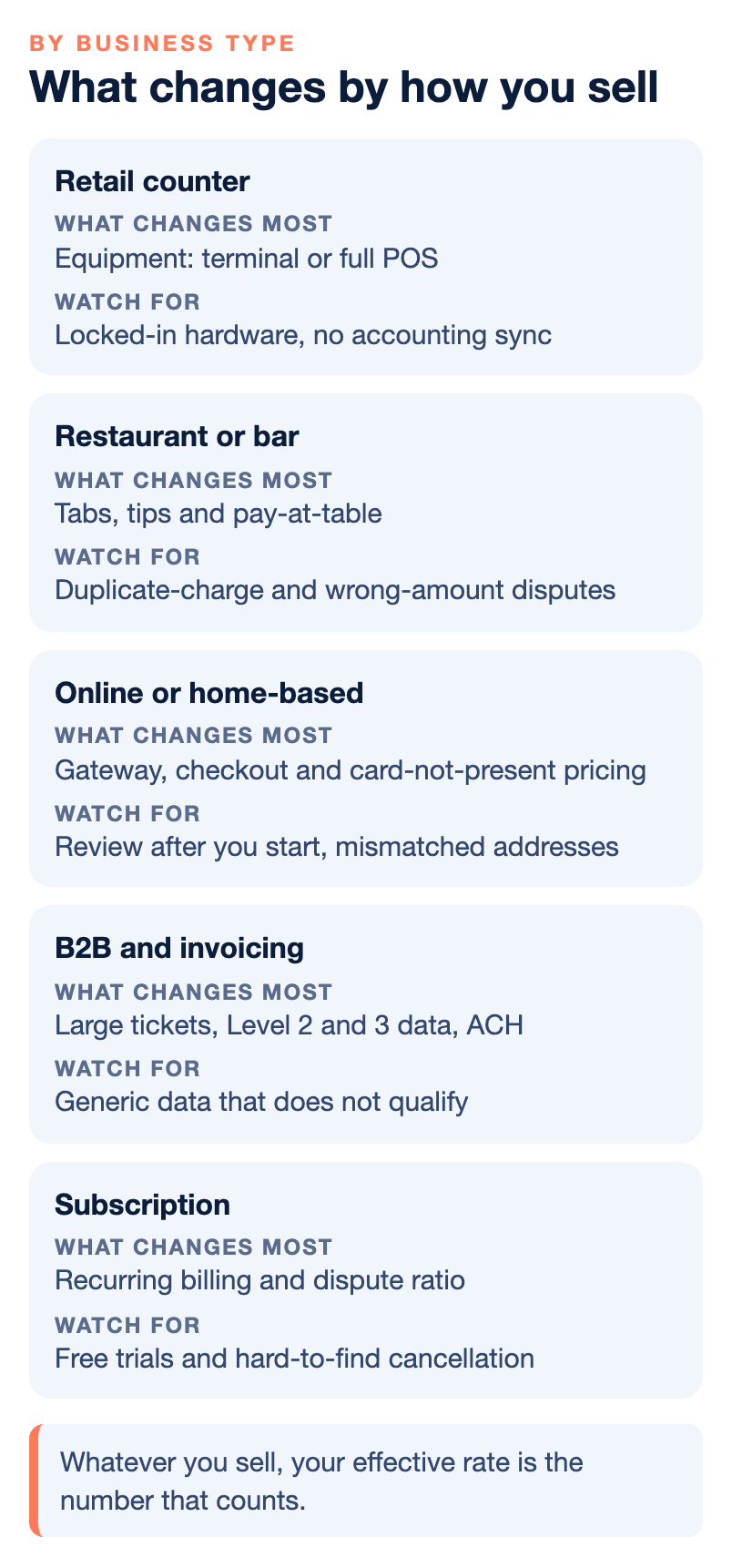
| Business type | What changes most | Watch for |
|---|---|---|
| Retail counter | Equipment: terminal or full POS | Locked-in hardware, no accounting sync |
| Restaurant or bar | Tabs, tips and pay-at-table | Duplicate-charge and wrong-amount disputes |
| Online or home-based | Gateway, checkout and card-not-present pricing | Review after you start, mismatched addresses |
| B2B and invoicing | Large tickets, Level 2 and 3 data, ACH | Generic data that does not qualify |
| Service and mobile | Virtual terminal, payment links, mobile acceptance | Several providers, several statements |
| Subscription | Recurring billing and dispute ratio | Free trials and hard-to-find cancellation |
| Niche or regulated | Specialized underwriting | Restricted-business rules, reserves |
Questions to ask any provider, whatever you sell
- Can you show me the three layers of every fee, in writing?
- What is priced differently for card-present, keyed-in and online payments?
- Which monthly, gateway, statement and compliance fees apply?
- What does underwriting need from me, and when do you decide?
- If I add a new way of selling, what do I tell you and when?
- What are my deposit times, and what could change them?
- Who do I call when something goes wrong, and do they pick up?
Who wrote this, and where NPS fits
Nationwide Payment Systems (NPS) publishes this guide. Allen Kopelman, who started the company in 2001, is the author. We sell payment setups of the kinds described here, so read us as a participant and not a referee. We do not quote rates on this page, because pricing depends on your industry, volume, average sale and how you take payments. NPS says it underwrites each account and prices each merchant individually, with live support around the clock and a dedicated account manager. That means we are not an instant sign-up product, and we may not be the right fit if you only need one card reader with no support, or if you choose only on the lowest advertised flat rate. If you want someone to look at your statements and tell you where your business type is costing you, you can talk with our team. More practical guides are in the payments guides library.
Bottom line
Every business type uses a merchant account, but the way you sell decides what you pay, what you risk and what you should ask for. Start with how you take the card, how big your average sale is, when the customer gets what they paid for and how often customers dispute. Tell your provider the truth about all four, ask for pricing on each channel in writing, and compare your effective rate instead of the quoted one.
Frequently asked questions
What is a merchant account?
It is a specialized bank account that lets a business process card transactions, hold the funds briefly and move them into its business bank account. Every business that takes cards needs one, directly or through a provider.
Does my business type change what a merchant account costs?
It can. Card-present, keyed-in and online payments are priced differently, and the size of your average sale, your card mix and your dispute history also matter. Ask for pricing on each channel you use, in writing.
Why does a restaurant or bar have different dispute risks than a store?
Hospitality runs tabs, adds tips after the first authorization and sees customers dispute a charge the next morning. Duplicate-charge and wrong-amount claims are common. Capturing the total with the tip upfront or using pay-at-table can reduce them.
Is an online business harder to get approved?
Not by itself. Online sales are card-not-present, which carries more fraud risk, so pricing is usually a bit higher. Being home-based is normal. Your address, bank account and website should match, because underwriters check them.
Why do subscription businesses get more chargebacks?
Customers forget they signed up, free trials convert to paid plans and renewal charges look unfamiliar. Clear billing disclosure, a visible refund policy, easy cancellation and a recognizable billing name prevent most disputes.
What does high-risk mean for a merchant account?
It means the bank sees extra financial, regulatory, chargeback, fraud, fulfillment or compliance risk in the business type. It does not mean the business is doing anything wrong. It often calls for a bank that understands the industry.
What should I tell my provider when I add a new way of selling?
Tell them before you start. An account approved for counter sales can be reviewed or limited when it begins processing online orders, invoices or subscriptions. Also confirm the category code on your account still fits what you sell.





