
First-party fraud is a dispute filed by the cardholder, or by someone using the cardholder’s own account, over a purchase that was real. In your chargeback data it looks almost identical to a stolen-card case, because the customer tells their bank “this was not me” or “I never got it” and the bank files a code that says exactly that. This guide explains why the data blurs the two, what in your own records can separate them, what it costs when you guess wrong, and how to set up a monthly review that shows who is likely behind your disputes.
The short answer
- First-party fraud and friendly fraud are the same thing. NPS’s chargeback survival guide defines first-party fraud as “friendly fraud,” where customers claim they did not receive a product or do not recognize a legitimate charge. It covers honest mistakes as well as deliberate claims.
- The dispute record shows the claim, not the claimant’s intent. The code and the bank’s label come from what the customer told the bank. Nothing in them says whether a stranger, a family member or the cardholder is behind the purchase.
- Your own records are the tiebreaker. Contact history, device and address data, delivery proof, past orders and your billing wording are what separate a stolen card from a purchase the customer made and later disputed.
- Guessing wrong costs money both ways. Treat first-party disputes as stolen-card fraud and you tighten filters on good customers. Treat stolen-card fraud as first-party and you chase cases you cannot win.
- The ratio does not care about intent. Card networks count disputes and fraud reports whether the cause is a thief, a forgetful customer or a mistake of yours.
Three people who can be behind a dispute
When a dispute lands, it helps to think of three possible sources, because each calls for a different response.
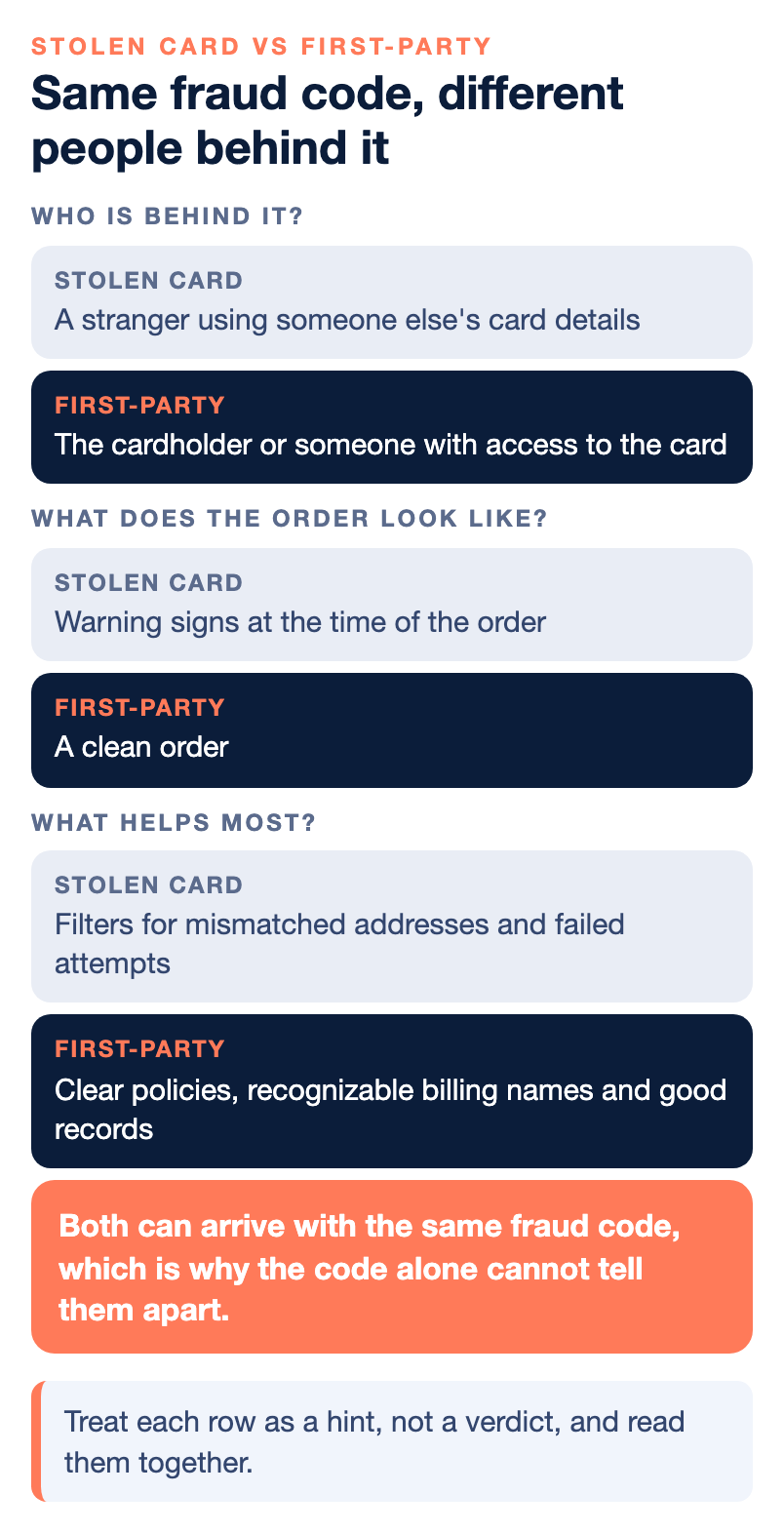
- A third party. Someone who is not the cardholder used stolen card details on your site or at your counter. This is what most people mean by card fraud.
- The first party. The cardholder, or a family member or other person with access to the card, made or benefited from the purchase and the cardholder disputed it anyway. Some of these are honest mistakes, such as a charge the customer does not recognize or a renewal they forgot. Others are deliberate.
- Your own process. A duplicate charge, an unanswered cancellation, a billing name nobody recognizes or an order that never arrived. The customer’s complaint is real, though it may reach you as a “fraud” dispute.
This page is about telling the first from the other two using data. If you want the customer-conversation side, including the signals that separate a legitimate complaint from friendly fraud, start with our guide to friendly fraud versus a legitimate customer complaint. If your business bills on a schedule, our guide to subscription and free-trial chargebacks covers the recurring-billing version. This guide is about the layer underneath both: what the numbers can and cannot tell you.
Why the data blurs the three sources
A chargeback starts when a cardholder disputes a charge with their own bank. The bank accepts the claim, assigns a reason code and sends the case down to you. NPS’s complete guide to chargebacks and its explainer on representment both stress the same point: the issuing bank decides most disputes, and it has already taken its customer’s side by the time you hear about it. The record you receive is therefore a record of what the customer said.
That has three consequences for your data.
- Different people can file the same claim. “Fraud, card absent” can be filed by a victim of stolen card details, by a spouse who did not know about a purchase, and by a customer who wants the goods free. Nothing in the label separates them. A reason code shows what the customer claimed and leaves out why, as the list of common codes by card network in our chargeback guide makes clear.
- The bank leans toward its customer. NPS’s survival guide says banks often favor the consumer to maintain loyalty, especially in online sales, and that the cardholder’s bank, not the card brand or the processor, decides who wins.
- Some counted events never reach your list. Visa’s ratio counts fraud reports, which issuing banks file when a cardholder says a purchase was not theirs, even if no dispute follows. Those reports can sit on a separate report from your chargeback list, so first-party and third-party fraud both can hide there.
The result is a list that looks tidy and tells you very little about who is behind it.
What first-party fraud tends to look like in your records
No pattern proves anything on its own, and many first-party disputes are honest mistakes. Still, NPS’s pages on friendly fraud and digital shoplifting describe the claims merchants hear most often, and they give you a starting list of patterns to look for.
- “I never received it” against confirmed delivery. Tracking shows delivery, sometimes with a photo or signature.
- Disputes after use. A digital product with logins or downloads after the sale, a meal or drinks already consumed, a service already completed.
- “I don’t recognize this charge.” Often the statement shows a company name the customer does not know, or a subscription renewed and was forgotten.
- “Someone else used my card.” Sometimes a family member made the purchase and the cardholder did not know.
- “I was charged twice.” NPS describes the two-card scheme, where a customer makes two separate purchases on two different cards and later claims a double charge. Different card numbers, authorization codes, timestamps and receipts settle it.
- Receipts changed after the fact. NPS notes that some customers scribble over totals or tip lines and later claim the merchant altered the receipt.
- A burst of disputes after a promotion. NPS’s subscription guide notes that campaigns bringing in a rush of new customers can cause a rush of friendly fraud afterward.
What stolen-card fraud tends to look like
For contrast, NPS’s e-commerce chargeback guide lists the warning signs of a risky online order. They tend to point to a third party, not the cardholder:
- Shipping and billing addresses that do not match.
- Orders going to freight forwarders, UPS Stores or mailbox stores, which NPS calls hubs for reshipping scams.
- Large purchases from brand-new customers with no history.
- Several failed payment attempts before one goes through.
- Requests for overnight or rush shipping on high-ticket items.
Card testing, where a bot runs many small authorizations to find working stolen card numbers, is a separate pattern described in NPS’s guide on balancing fraud screening against customer friction. There is no good customer in that pattern.
The key is the contrast. A stolen-card case tends to leave warning signs at the time of the order. A first-party case tends to leave a clean order and a dispute that does not match what happened afterward.
The records that separate them
The disputes you cannot sort by code you often can sort by the evidence you already hold. The table below pairs what you might find in your records with what it tends to suggest. Treat each row as a hint, not a verdict, and read them together.
| What your records show | It tends to suggest |
|---|---|
| Address and security code checks matched, delivery confirmed to the billing address | The real cardholder or someone close to them likely received the goods |
| Earlier undisputed orders on the same card, email or address | An established customer, so a forgotten purchase or family use is more likely than a thief |
| Logins, downloads or usage after the sale | Value was received, which weakens a “not received” claim |
| Mismatched addresses, forwarding-service destination or several failed attempts | A third party using someone else’s card |
| Customer emailed or called you first and got no answer | A real complaint, not first-party fraud |
| Dispute reason contradicts your records, such as “unauthorized” from a customer who emailed about sizing | A claim that does not match the facts |
| Statement name differs from the name on your website | Possible confusion caused by your billing, not intent |
One more entry on the list is worth a closer look. Visa’s Compelling Evidence 3.0, which NPS’s ratio guide describes, lets a merchant show that a disputed purchase matches the same customer’s earlier, undisputed purchases. Fraud reports that qualify are left out of Visa’s count. The rule exists because a clean history is one of the best signs that the cardholder is behind the purchase. If you keep records that let you show history, ask your processor whether it can use them.
What it costs when you guess wrong
Treating every dispute the same way is expensive in both directions, and the mistakes are different depending on which way you lean.
Reading first-party disputes as stolen-card fraud
If you assume a thief is behind every fraud-coded dispute, you may respond by tightening filters. NPS’s screening guide warns that strict screening feels safe but every good customer you decline or make jump through hoops is a sale you lost, and that loss never shows up as a chargeback, so it is easy to miss. The same guide notes that no screening setting stops every dispute: friendly fraud and “I did not get it” claims are handled with clear policies, billing names and records, not stricter filters. Stricter screening aimed at a first-party problem costs sales and does not fix it.
Reading stolen-card fraud as first-party
If you assume the customer is only being forgetful, you may refund or fight cases that were actually a thief using someone else’s card. NPS’s survival guide notes that restaurants and bars lose stolen-card and chip-and-PIN liability shift disputes even with signed receipts, and that no evidence changes the outcome. Spending a week on a case like that is time you do not get back. Knowing which cases are likely stolen-card lets you refund early, tighten the screening that let them through and save your effort for disputes you can win.
Missing your own process
The third source is the easiest to miss, because the code says “fraud” and you assume the customer is lying. If your billing name confuses people or your cancellation path is buried, that is the cause, and fighting the dispute does not fix it.
Accusing the customer
One more risk is tone. Many first-party cases are honest mistakes. NPS’s friendly fraud guide says merchants handle intent through the dispute process, not by accusing the customer. Keep your records factual and your language neutral. A neutral email asking what happened clears up many cases, and some customers withdraw the dispute once they recognize the purchase.
Why the ratio treats all three the same
Card networks do not weigh intent. NPS’s ratio guide explains that Visa’s ratio is a count of fraud reports plus disputes on card-not-present transactions divided by the count of settled card-not-present transactions in the month. A first-party dispute, a stolen-card dispute and a dispute you caused by your own mistake weigh the same. Winning later does not remove a dispute from the count, because on Visa’s published method it was counted when it was filed. Disputes resolved through pre-dispute tools such as Rapid Dispute Resolution, known as RDR, are left out.
This is why the goal is fewer disputes, not only more wins. Our guide to when card networks start threatening a merchant account explains the lines and how to track your own number.
How to build a data trail that can tell them apart
The best time to prove who made a purchase is before any dispute exists. NPS’s guides on subscriptions, disputes and digital shoplifting suggest keeping:
- Sign-up and checkout records with date, time and the terms the customer accepted.
- IP address logs and device information.
- Address verification and security code results, and 3D Secure authentication if you use it.
- Delivery confirmation for shipped goods and signed paperwork for services.
- Login or usage records for digital products.
- Signed receipts, kept in their original form. NPS advises never altering a signed receipt after the customer leaves.
- Itemized invoices and digital receipts sent right after the sale.
- The full customer communication history, including any message sent before a dispute.
- A clear refund, return and cancellation policy that customers could see before they paid.
Our NPSONE platform keeps transaction, invoice and customer records together, which makes the evidence easier to pull when a response is due.
A monthly review that shows who is likely behind your disputes
NPS’s recap of its conversation with the founder of Justt.ai makes a useful point: chargebacks are data. By separating true fraud from friendly fraud and from confusion-driven disputes, merchants can improve fraud filters, the checkout flow and shipping policies. Here is a simple way to do that each month.
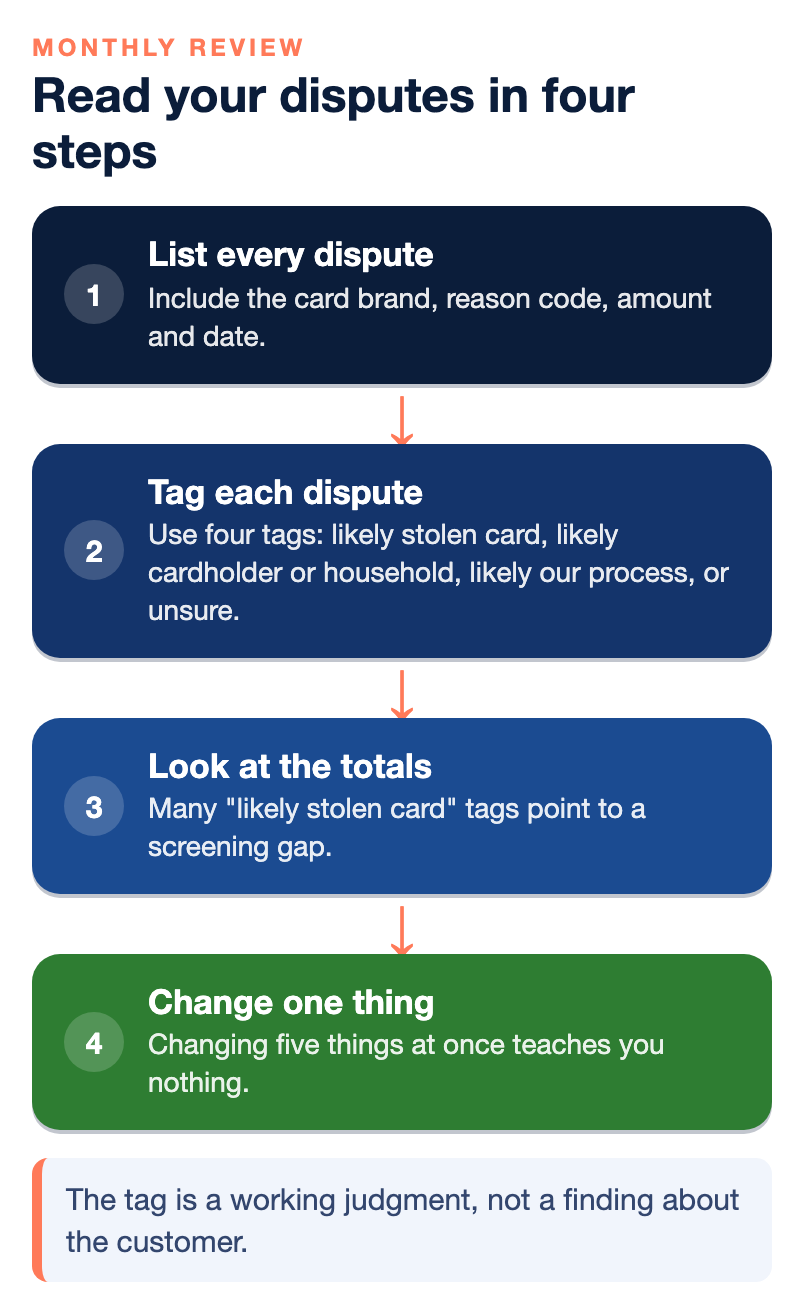
- List every dispute and fraud report for the month. Include the card brand, reason code, amount and date.
- Add a “contacted us first” column. Search your inbox, chat and support tickets for each customer.
- Add a “history” column. Note whether the card, email or address has earlier undisputed orders.
- Add an “order signals” column. Note any address mismatch, forwarding destination, failed attempts or rush shipping at the time of the order.
- Add a “proof of receipt” column. Note delivery confirmation, logins, downloads or signed paperwork.
- Tag each dispute with a likely source and the reason. Use four tags: likely stolen card, likely cardholder or household, likely our process, or unsure. Write one line explaining why. The tag is a working judgment, not a finding about the customer.
- Look at the tag totals and the clusters. Many “likely stolen card” tags point to a screening gap. Many “likely our process” tags point to billing names, cancellation or support. Many “likely cardholder or household” tags point to reminders, receipts and descriptors.
- Change one thing and watch the next month. Changing five things at once teaches you nothing.
The “unsure” tag is important. Some disputes cannot be sorted, and pretending otherwise skews the picture.
Questions to ask your processor
- Where do fraud reports appear, and can I get them in the same export as my disputes?
- Which of my disputes can be refunded early through Rapid Dispute Resolution or an alert tool?
- Does my processor use evidence of prior undisputed purchases, and what records does it need from me?
- What address, security code and device data does my gateway store, and for how long?
- What fraud tools can I turn on for risky orders without adding friction to every order?
- What ratio limit does my agreement use, and how do you tell me when I am approaching it?
- Who can review my dispute list with me and point out patterns?
Who wrote this, and where NPS fits
Nationwide Payment Systems publishes this guide. We are a payments company based in South Florida, in business since 2001, and we sell merchant accounts, so we are not neutral. We work with low-risk and high-risk merchants and help with dispute prevention before it becomes an account problem. That includes reviewing your website for clear refund and cancellation disclosures, monitoring dispute ratios, helping set up Rapid Dispute Resolution when it fits, providing chargeback alert tools and connecting higher-volume online merchants with professional chargeback management firms. You can read more in our chargeback survival guide and our podcast recap on beating friendly fraud with AI, and browse the full library of payments guides.
We cannot promise that any dispute will be won, because the decision belongs to the card issuer, and we cannot make a real customer problem disappear. If your disputes come from a product or fulfillment problem, the fix is in your operations, and we will tell you that. If you want an instant self-service sign-up or only the lowest advertised flat rate, a simpler platform will probably suit you better.
Bottom line
Chargeback data records what the customer told the bank, not who was really behind the purchase. A stolen card, a household member, a forgotten subscription and a deliberate false claim can all look the same on your dispute list. Your own records, such as contact history, matching address checks, delivery proof, past orders and billing wording, are what tell them apart. Tag disputes by likely source each month, fix the cause that shows up most and keep your language with customers neutral. If you would like a second opinion on your dispute data, you can contact our team.
Frequently asked questions
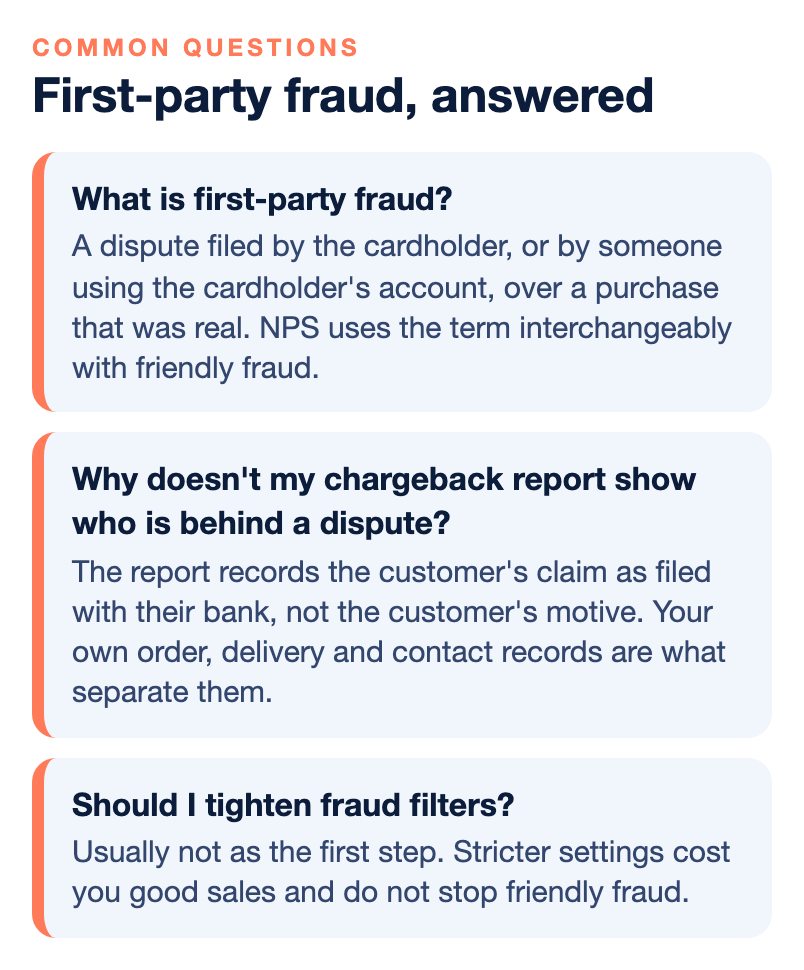
What is first-party fraud?
It is a dispute filed by the cardholder, or by someone using the cardholder’s account, over a purchase that was real. NPS uses the term interchangeably with friendly fraud. It includes honest mistakes, such as a forgotten subscription or a family member’s purchase, and deliberate claims.
How is first-party fraud different from stolen-card fraud?
In stolen-card fraud a stranger uses someone else’s card details. In first-party fraud the cardholder or someone with access to the card made or received the purchase and disputes it anyway. Both can arrive with the same fraud code, which is why the code alone cannot tell them apart.
Why does my chargeback report not show who is behind a dispute?
The report records the customer’s claim as filed with their bank, not the customer’s motive. Different people can file the same claim, so the label cannot separate a thief from a forgetful customer. Your own order, delivery and contact records are what separate them.
What records help show a purchase was first-party?
Matching address and security code results, delivery confirmation, logins or downloads after the sale, signed receipts, earlier undisputed orders from the same customer and your posted refund and cancellation policy. Ask your processor which of these it can submit with a response.
Should I tighten fraud filters if I think my disputes are first-party fraud?
Usually not as the first step. NPS’s screening guide says stricter settings cost you good sales and do not stop friendly fraud, which is better handled with clear policies, recognizable billing names and good records. Use filters for the signs of stolen-card fraud, such as mismatched addresses and failed attempts.
Do first-party disputes count toward my chargeback ratio?
Yes. Card networks count disputes and fraud reports without weighing intent, and a won dispute is still counted on Visa’s published method. Disputes refunded through a pre-dispute tool such as Rapid Dispute Resolution are left out of Visa’s count.
Is it fair to call a customer a fraudster if they dispute a real purchase?
Not by default. Many first-party disputes are honest mistakes, such as an unrecognized statement name or a forgotten renewal. NPS advises handling intent through the dispute process and not by accusing the customer. A polite message asking what happened often resolves the case.





