
The right balance is the one where you stop the orders that are actually fraud and let nearly everyone else through without an extra step, and you only find it by measuring both sides, not by turning every fraud setting to its strictest level. Strict screening feels safe, but every good customer you decline or make jump through hoops is a sale you lost and a customer who may not come back, and that loss never shows up as a chargeback, so it is easy to miss. Loose screening shows up quickly, as fraud chargebacks, card testing attacks and a processor asking questions about your dispute ratio. This guide explains where friction comes from, which tools catch what, how to set them so they bother as few real customers as possible, and how to tell when your balance has drifted.
The bottom line
- Screen by risk, not by default. Let low-risk orders through quietly, add a step such as 3D Secure only to the risky middle, and decline or review only the clearly bad.
- Measure the cost of friction as carefully as the cost of fraud. Track your approval rate and the good orders you turned away, not just your chargebacks.
- Block bots hard and people gently. Card testing attacks deserve strict velocity limits. A real customer with a typo in a ZIP code deserves a second chance.
- No screening setting stops every dispute. Friendly fraud and “I did not get it” claims are handled with clear policies, descriptors and records, not stricter filters.
Who wrote this, and what we will not claim
Nationwide Payment Systems (NPS) publishes this guide. We are a payment processing company in South Florida, in business since 2001, and we set up gateways and fraud tools for online merchants, so we are not neutral about whether your processor should help you with this. We do not quote fraud rates, approval rates or thresholds here, because they vary by industry, product and customer base, and the card networks change their programs. Use this as a way of thinking about your own numbers, and confirm any specific setting with your processor or gateway provider.
Why both sides of the scale cost you money
Fraud has an obvious price. When someone uses a stolen card on your site, the real cardholder disputes the charge, the bank takes the money back, you lose the product and the shipping, and you usually pay a chargeback fee on top. If it happens often enough, your dispute and fraud ratios climb, and card-network monitoring programs such as Visa’s VAMP can bring fines, higher costs or an account your processor wants to close. Our guide to chargebacks, RDR and VAMP explains how those programs watch your ratios and why they do not care about your intent.
Friction has a price too, and it is quieter. A legitimate customer whose order is declined by your own filter, held for a day in a review queue, or sent to an extra verification screen they do not understand may simply leave. Some come back and try again. Many do not, and some never return to the store at all. A decline you caused looks, from the customer’s side, exactly like a store that did not want their business.
The trap is that the two costs show up in different places. Fraud arrives as a chargeback notice with your name on it. A lost good customer arrives as nothing at all. That is why stores that only watch chargebacks tend to over-screen, and why the first step toward a real balance is counting what you are turning away.
Where friction actually comes from
When a good customer has trouble paying, owners tend to blame the bank. Sometimes that is right, but there are three different places a payment can be stopped, and only two of them are yours to change.
Your own fraud rules
These are the filters you or your developer set in your gateway or checkout: address verification rules, security code rules, velocity limits, country blocks, order value caps and any risk-scoring tool. They are entirely in your control, which makes them the first place to look when good customers complain.
The verification steps you add
Extra steps such as 3D Secure authentication, account creation requirements or a phone call before shipping are friction you choose. Each one stops some fraud and costs some conversions, and the trade is different for a store selling digital downloads than for one selling furniture.
The customer’s card issuer
The bank that issued the card makes its own approval decision, using its own fraud models. You cannot change those, but you can affect them: clean, complete transaction data, a recognizable billing descriptor and avoiding rapid repeat attempts on the same card all help. Our guide to credit card decline codes explains which codes come from the issuer and what to tell the customer for each one.
The tools, what they catch, and how to set them gently
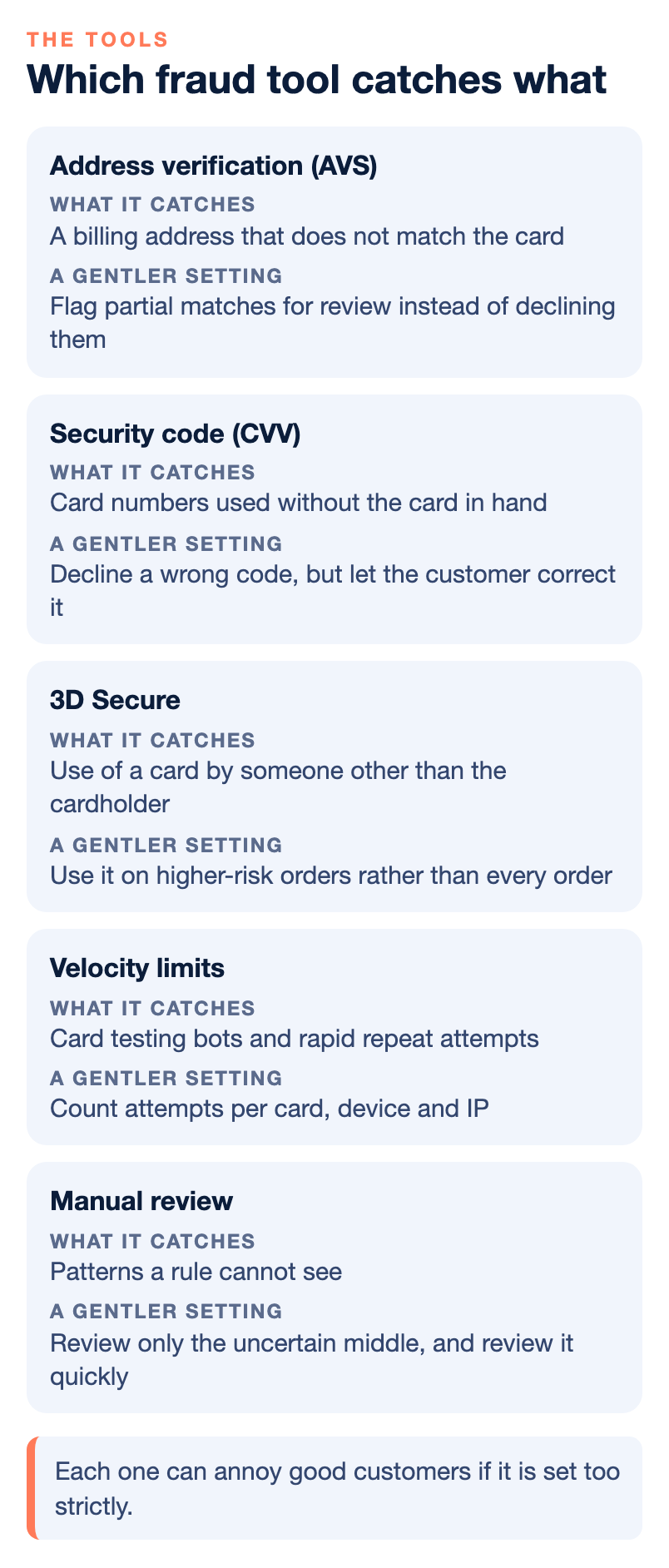
Most online stores have access to the same handful of fraud tools. Each one catches a specific kind of problem, and each one can annoy good customers in a specific way if it is set too strictly.
| Tool | What it catches | How it annoys good customers | A gentler setting |
|---|---|---|---|
| Address verification (AVS) | A billing address that does not match the card | Customers who moved, use an apartment number, or mistype a ZIP code | Flag partial matches for review instead of declining them |
| Security code (CVV) | Card numbers used without the card in hand | A mistyped three or four digits | Decline a wrong code, but let the customer correct it |
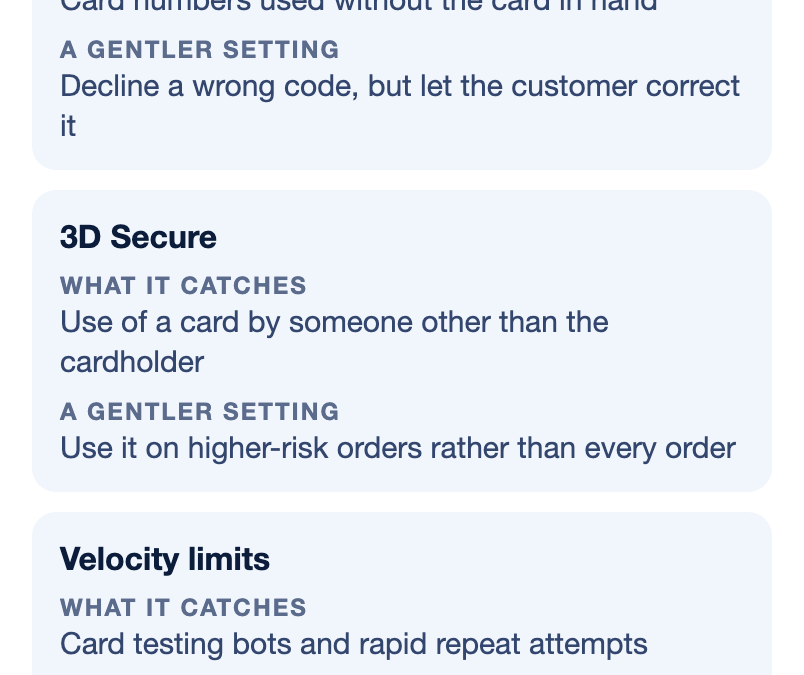
| 3D Secure | Use of a card by someone other than the cardholder | An extra screen at checkout that some customers abandon | Use it on higher-risk orders rather than every order |
| Velocity limits | Card testing bots and rapid repeat attempts | A real customer who retries after a typo | Count attempts per card, device and IP, and keep limits strict for bots |
| Manual review | Patterns a rule cannot see | Delayed shipping while an order waits | Review only the uncertain middle, and review it quickly |
Address verification
AVS compares the billing address the customer typed with the one the card issuer has on file. A complete mismatch on a high-value order is a real warning sign. A partial match, where the street number matches but the ZIP code does not, is often just a person who moved recently or typed carelessly. If your gateway declines every partial match automatically, you are turning away real customers to stop a kind of fraud that a review would catch anyway.
Security codes
The CVV check confirms that the person typing has the physical card, or at least its back. It is one of the most useful checks for card-not-present sales, and a wrong code is a fair reason to decline. The friction comes from treating one typo as a final answer. Let a customer fix it, while keeping a velocity limit in place so a bot cannot use the same chance to guess.
3D Secure
3D Secure sends the customer to their card issuer to confirm the purchase, usually in an app or by a code. It can stop unauthorized use, and in many cases a properly authenticated transaction shifts the liability for a fraud chargeback away from the merchant. It is also an extra step, and some customers give up at it. That is why many stores use it selectively, on first-time customers, large orders, risky shipping addresses or products that fraudsters resell easily, and let a repeat customer with a normal order go straight through.
Velocity limits and card testing
Card testing is when a bot runs dozens or hundreds of stolen card numbers through your checkout with small amounts to see which ones work. It is the clearest case for strict screening, because there is no good customer in the pattern. Limits on attempts per card, per device and per IP address, along with tools that slow down automated traffic, stop most of it. Turn these on before you need them, because a card testing attack can run up fees and declines in a single night. Our Forbes article on staying ahead of payment fraud explains how gateway velocity settings limit these attacks.
Manual review
Some orders are neither clearly good nor clearly bad, such as a large first order shipping to a different state from the billing address. A person looking at the order, the email address, the shipping speed and the customer’s history can often tell in a minute what no rule can. Manual review works when it is limited to that uncertain middle and done the same day. It fails when every order over a certain amount waits two days for someone to get to it.
How to set your rules, step by step
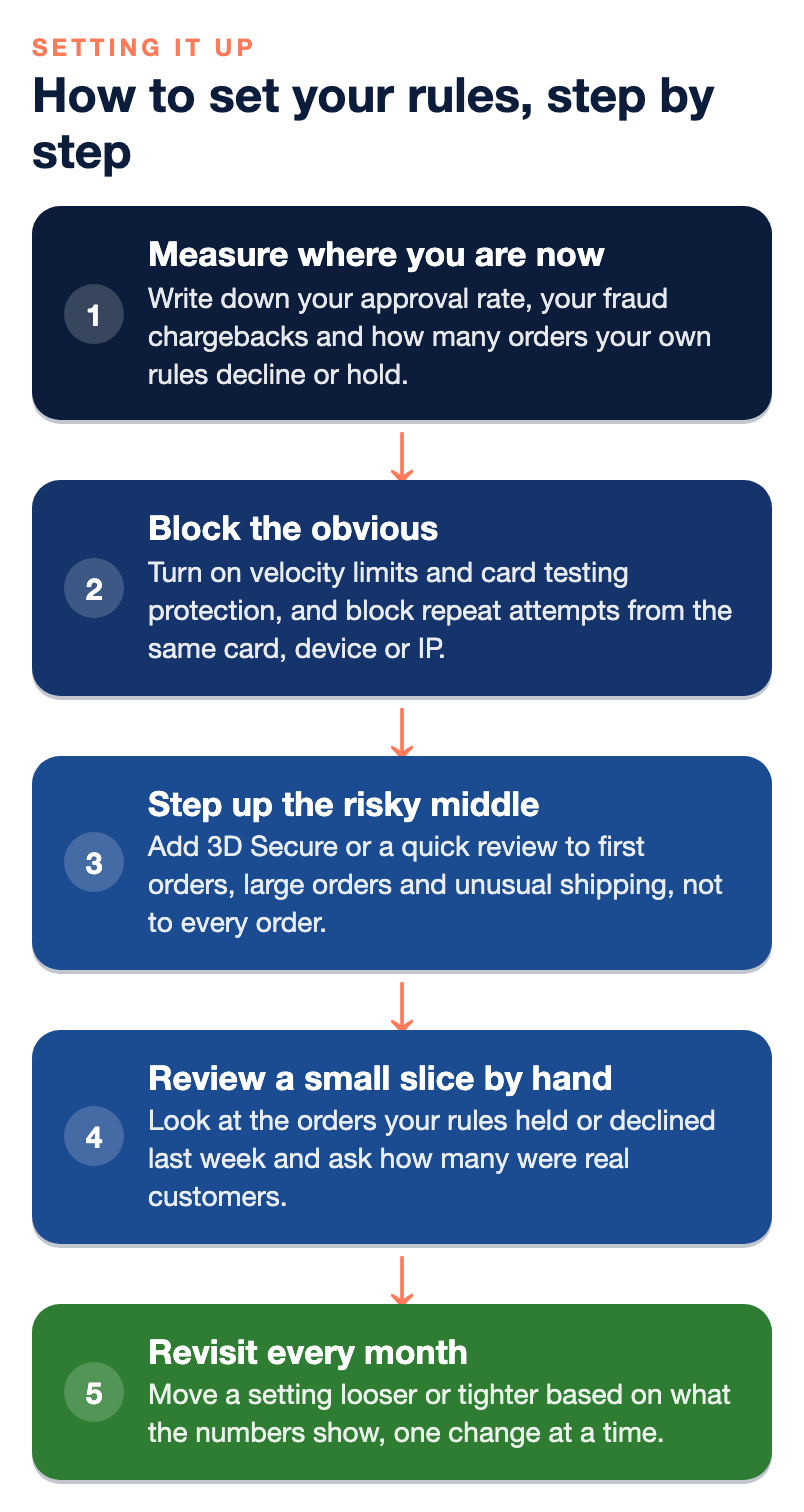
The order matters more than the settings. Start from your own numbers, block what is obviously automated, and add friction only where the risk justifies it.
- Measure where you are now. Write down your approval rate, your fraud chargebacks and how many orders your own rules decline or hold.
- Block the obvious. Turn on velocity limits and card testing protection, and block repeat attempts from the same card, device or IP.
- Step up the risky middle. Add 3D Secure or a quick review to first orders, large orders and unusual shipping, not to every order.
- Review a small slice by hand. Look at the orders your rules held or declined last week and ask how many were real customers.
- Revisit every month. Move a setting looser or tighter based on what the numbers show, one change at a time.
Our advice to merchants has been the same for years: keep AVS, ZIP and CVV checks in place for web orders, and set your filters so you still get your approvals, with someone reviewing batches every day. The daily review is what keeps a filter from quietly drifting into blocking good business, and it catches suspicious orders while there is still time to cancel them before they ship. If an order looks like fraud and you cannot confirm it, void it rather than gambling on it. Our article on how to prevent fraud in your business covers the in-store side of the same discipline, from staff training to policies.
Signs your balance is off
You do not need a data science team to notice drift. These signs usually show up first.
- You are screening too hard if customers call or email to say their card “keeps getting declined” on your site, if your review queue is backing up, if your approval rate dropped after a rule change, or if repeat customers are being stopped.
- You are screening too lightly if fraud chargebacks are climbing, if you see bursts of small declined attempts in your gateway reports, if orders ship to freight forwarders or reshipping addresses you do not recognize, or if your processor asks about your dispute ratio.
- Your problem is not screening at all if most of your disputes are customers who bought the product and then disputed it, say they did not recognize the charge or say it never arrived. That is friendly fraud and service disputes, and stricter filters do not stop either one.
What screening cannot fix
A large share of chargebacks are not stolen cards at all. They come from customers who forgot a subscription, did not recognize the name on their statement, never received a package, or decided they did not want something and called their bank instead of you. Tightening your fraud rules will not stop those disputes. It will only add friction for everyone else.
Those disputes are handled with the ordinary disciplines: a billing descriptor customers recognize, refund and cancellation policies that are easy to find, order confirmation emails, tracking numbers, fast answers to complaints, and refunds made back to the original card. Tools such as Visa’s Rapid Dispute Resolution can refund a dispute automatically before it becomes a formal chargeback, which can keep it out of your ratios. Our guide to chargebacks for ecommerce covers those steps in detail.
Different stores, different balance points
There is no single right setting, because the cost of a mistake differs so much from one business to the next. A store selling instant digital downloads or gift cards loses the product the moment the order is approved, so it can justify more screening. A store selling bulky goods that ship in a few days has time to review an uncertain order before anything leaves the building. A subscription business has to think about the whole relationship, since the first charge is only the start of the risk. A high-ticket seller with few orders can afford to look at every one, while a store with thousands of small orders a day needs rules that work without a person.
Your customers matter as much as your products. If most of your buyers are repeat customers, you can let known accounts through with very little screening and focus your attention on new ones. If you sell to a lot of first-time buyers from ads, more of your orders sit in the uncertain middle, and selective verification earns its keep there.
Where NPS fits, and where it does not
We set up merchant accounts and gateways for online businesses, including our own NPSONE gateway. Our fraud tools include address verification, CVV checks and velocity filters to stop bot attacks, and our team helps merchants set them so they stop fraud without blocking good orders. We also review websites and checkout pages for the gaps that cause disputes, help implement Rapid Dispute Resolution and chargeback alerts where they fit, and can connect high-volume merchants with professional chargeback management firms. Every account comes with live, U.S.-based support and a dedicated account manager.
Here is where we may not be the right choice:
- Very low volume or a side project. We may not be the best fit for hobby sellers with very low processing volume.
- You want an instant, self-service account. We review each business before approval, so we are not an instant-signup product.
- You would rather not provide underwriting documents. We ask for them, as any processor that underwrites properly will.
- You are choosing only on the lowest advertised flat rate. We price each merchant individually and do not publish one universal rate.
- You want a tool that promises zero fraud and zero friction. No one can honestly sell that, and we will not.
If you are still choosing how to take payments online, our guide to online credit card acceptance covers gateways, checkout and security from the start, and our payments guides library collects the rest of our guides in one place.
Next step
The right balance is not a setting you choose once. It is a habit: measure both what you stop and what you lose, keep strict rules for bots, give real people a gentle path, and look at the results every month.
If you want a second opinion on your gateway’s fraud settings or your decline and chargeback numbers, you can talk with our team. If your current setup is already working, we will tell you that too.
Frequently asked questions
What is the right balance between fraud screening and customer experience?
The right balance stops the orders that are actually fraud and lets nearly every good customer through without an extra step. In practice that means screening by risk: let low-risk orders through, add verification to the risky middle, and decline or review only the clearly bad. You find it by measuring both your fraud chargebacks and the good orders you turn away.
What is a false decline?
A false decline is a legitimate purchase that gets declined, either by your own fraud rules or by the customer’s card issuer. It costs you the sale and sometimes the customer. Because it never shows up as a chargeback, it is easy to overlook.
Should I decline every order with an AVS mismatch?
Usually not. A full mismatch on a large order is a real warning sign, but partial matches often come from customers who moved or mistyped a ZIP code. Many stores flag partial matches for a quick review instead of declining them automatically.
Does 3D Secure hurt conversions?
It can, because it adds a step and some customers abandon it. It can also stop unauthorized use and, in many cases, shift fraud chargeback liability away from the merchant. Many stores use it on higher-risk orders rather than on every order.
How do I stop card testing without blocking real customers?
Use velocity limits on attempts per card, per device and per IP address, along with tools that slow down automated traffic. Card testing is a pattern no real customer makes, so these limits can be strict. Turn them on before an attack, not during one.
Will stricter fraud filters reduce all my chargebacks?
No. Many chargebacks come from friendly fraud, unrecognized charges and delivery disputes, which filters cannot stop. Those are reduced with a clear billing descriptor, easy-to-find policies, tracking, quick customer service and refunds to the original card.
How often should I review my fraud settings?
Look at the orders your rules held or declined every day, and review the settings themselves every month. Change one setting at a time so you can see its effect. Revisit them sooner if your approval rate or fraud chargebacks move suddenly.





