
You can handle most chargebacks and fraud yourself if you treat it as a small, steady routine instead of an emergency. That means a written set of rules, one place where every dispute is logged, an evidence folder for each kind of sale, a calendar for deadlines and a short monthly review of your numbers. This guide builds that routine for a small online store, a shop or restaurant, or a mix of both. It does not repeat our detailed guides on controls and dispute stages. It shows how to organize the work, and where doing it alone stops making sense.
The short answer
- Write down your rules once. Which alerts you will refund, which disputes you will fight and which you will accept.
- Keep one dispute log. A simple sheet with the same columns for every case shows patterns you cannot see from memory.
- Build evidence as you sell. It is far easier to save a signed receipt or delivery proof at the time of sale than to hunt for it later.
- Protect the calendar. A missed deadline is an automatic loss, however good your evidence is.
- Know your limits. Some in-person losses cannot be won, and some situations need your processor or a specialist.
What “without a specialist” really means
A chargeback specialist or dispute firm takes over work such as collecting evidence and filing responses. Many small businesses do not need that on day one. What they need is the same set of jobs done by someone on the team, in a repeatable way. Our guide to chargebacks from start to finish explains the path a dispute takes: the cardholder disputes the charge with their bank, the bank reverses the funds and assigns a reason code, your processor debits your account and you have a short window to respond with evidence.
The cardholder’s bank decides most of these cases, not the card brands and not your processor. That is why the routine below leans on records and timing, not on arguing. You are giving a bank a document-based reason to side with you. If you want to understand what happens to your response after you send it, read our article on what happens after your processor submits it.
Doing it yourself does not mean doing it alone. Your processor is part of the picture. Many processors check that a response is complete, and some offer help with response letters, so ask yours what support it gives. Nationwide Payment Systems (NPS) also offers chargeback alert tools and review help, described later.
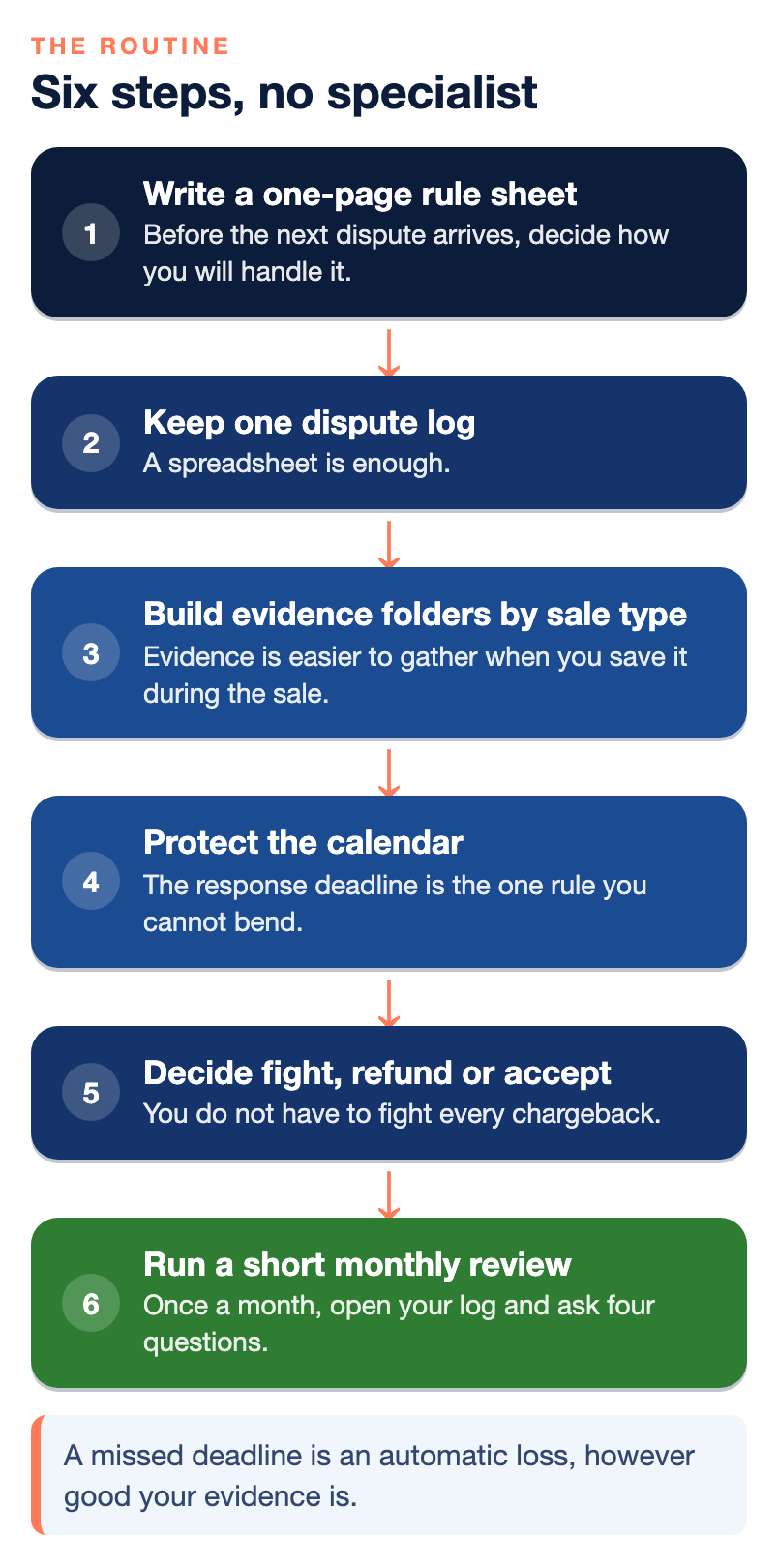
Step one: write a one-page rule sheet
Before the next dispute arrives, decide how you will handle it. A single page that anyone on your team can read is enough. It should answer these questions:
- Who reads chargeback notices, and who is the backup when that person is away?
- How soon after a notice must a case be opened in your log?
- When an early alert arrives, do you refund it? Many owners set a rule by sale size and by how strong their evidence is.
- Which kinds of cases will you always fight, and which will you usually accept?
- Who approves a refund over a set amount?
- Who do you call at your processor for questions?
The point of the page is to remove guessing under pressure. A disputed sale that arrives on a busy Friday should not depend on who happens to see it.
Step two: make your policies easy to find
Your policies are your first defense, and they cost nothing to fix. NPS says clear refund and cancellation terms should be shown on receipts, and notes that adding wording such as “All Sales Final” to a footer is one option where it fits your business. For online stores, the policies should also be easy for a customer to see before paying. NPS lists these as helpful for winning disputes: a clear refund policy, transparent cancellation terms, accurate product descriptions, shipping timelines, visible customer service contact details and a billing name customers recognize.
Take ten minutes to look at your own site as a customer would. Can you find the refund policy in two clicks? Does your billing name on a card statement match the name on your storefront? Our article on e-commerce policies as a first line of defense covers what each page should say.
Step three: keep one dispute log
A spreadsheet is enough. The value comes from using the same columns for every case. A useful log has these columns:
- Date the notice arrived and date the response is due.
- Order or receipt number, sale amount and sales channel (in-store, website, phone).
- The reason code or the reason as your processor describes it.
- Your first read: fraud, forgotten purchase or real complaint.
- Decision: fight, refund or accept, and who decided.
- Date the response was sent and the outcome.
- What caused it, in a few words, and what you changed afterward.
The “first read” column matters because the same dispute label can hide different situations. A stolen-card claim and a customer who bought something and later denied it look nearly the same in your data. Our articles on telling friendly fraud from a legitimate complaint and on first-party fraud explain how to read the trail of events behind a dispute, such as a message to you, a return request or a delivery problem. Our guide to how reason codes work explains what the code means and what it leaves out.
Step four: build evidence folders by sale type
Evidence is easier to gather when you save it during the sale. NPS’s guides name the core items: proof of the transaction, a signed receipt, a timestamp, proof of delivery or service and customer communication logs. Missing records, such as IP addresses, device information or delivery proof, make winning very hard. Set up a standard folder or checklist for each kind of sale you make.
In-store or at the table. Keep the signed receipt, the transaction record with its time and the order details. Keep any note about an ID check where your procedure calls for one. For restaurants and bars, remember that tips matter. NPS’s Chargeback Rescue page explains that a tip above roughly 20 to 25 percent of the bill can be open to dispute, and it suggests tip authorization at the time of sale so the full amount is approved upfront.
Online, shipped goods. Keep the order record, the timestamp, the customer’s messages, tracking and delivery confirmation, and your policy as it appeared at the time of the order. Where your platform records them, save IP and device information too.
Online, services or digital goods. Keep proof that the service was provided or that the item was accessed, along with the terms the customer accepted.
Recurring or free-trial billing. Keep the sign-up record that shows the customer agreed to recurring billing, your published cancellation steps and the dates. Our article on subscription and free-trial chargebacks explains why this kind of billing draws more disputes.
Name the folder after the order number and keep every file for a disputed order together until the case is clearly closed. A first-stage win is not always final, and the same customer can dispute again for a different reason.
Step five: protect the calendar
The response deadline is the one rule you cannot bend. NPS’s guides say the deadline is typically 7 to 21 days, and that some disputes may allow as little as 9 days. If you miss it, you lose automatically. Deadlines differ by card network and dispute type, so confirm the exact date with your processor for each case.
Three habits keep you safe:
- Put the due date on a shared calendar the day the notice arrives, with a reminder several days ahead.
- Set a fixed weekly time to work cases, so disputes do not wait for a quiet moment that never comes.
- Name a backup for vacations and sick days.
Step six: decide fight, refund or accept
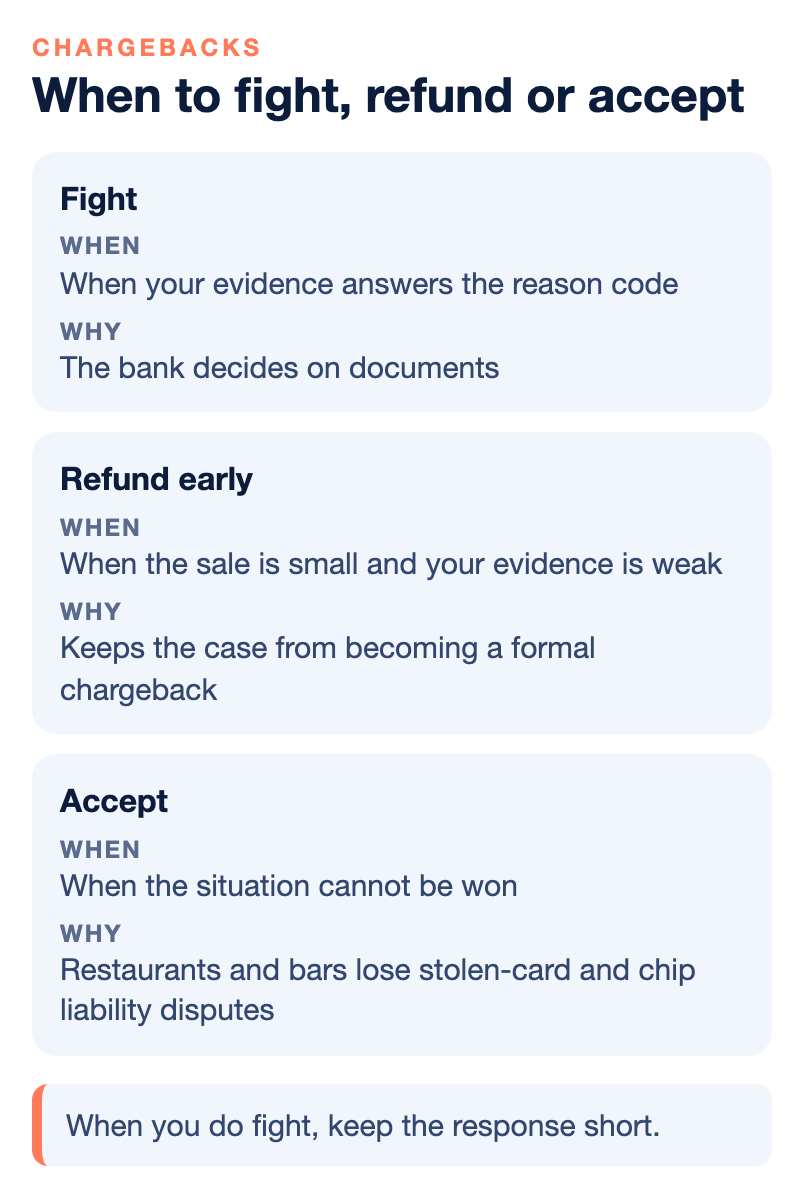
You do not have to fight every chargeback. Accepting one you cannot win saves time. Fighting one you can win with clear evidence is worth the effort. A simple decision rule looks like this:
- Fight when your evidence answers the reason code. The bank decides on documents, and a thin file that proves the right thing beats a thick file that proves the wrong one.
- Refund early through an alert or RDR when the sale is small and your evidence is weak. NPS notes this keeps the case from becoming a formal chargeback and from counting against your ratios.
- Accept when the situation cannot be won. NPS says restaurants and bars lose stolen-card and chip liability disputes even with approved cards and signed receipts, so the real defense there is prevention.
When you do fight, keep the response short. State the reason code, explain in two or three sentences why the sale was valid and point to each piece of evidence. Frustration does not help a bank decide, and facts do.
Step seven: run a short monthly review
Once a month, open your log and ask four questions. Which sales channel produced the most disputes? Which reason or cause shows up most? Which cases did you lose and why? What is one thing you will change before next month?
Also work out your own ratio. It is a count, not a dollar amount, so one ten-dollar dispute weighs the same as one for a thousand dollars. Our article on the chargeback ratios that get a merchant’s attention explains how Visa counts it and why your processor may call you well before a network does. If you only learn your ratio from a warning letter, you have lost a month or two of room.
Where fraud controls fit
Fraud and chargebacks overlap, but the controls themselves are covered in other guides, so we will not repeat them in full. In brief, the in-store basics are chip-only acceptance, trained staff and a written rule that nobody keys in a card on request without a manager’s check. The online basics are address and security code checks, velocity filters, daily limits, real-time alerts and calling the customer on large or odd orders. Our guide to simple fraud controls for retail and POS businesses lists them with a first-hour response plan, and our article on balancing fraud screening against customer friction helps you avoid turning away good customers. Whenever you tighten a control, note it in your log so you can see whether disputes fall.
What a small team can and cannot do alone
You can do the routine above with no special software and no outside help. You cannot change the rules of the card networks, the decisions of issuing banks or the way a stolen-card case is judged in person. You also cannot tell a processor’s internal limits from the outside. That is why it helps to have a processor that answers questions plainly.
Signs that the do-it-yourself approach is running out of room include:
- Your ratio is rising, or your processor has contacted you about it.
- You missed a deadline, or it was close.
- You started billing on a schedule or selling digital goods.
- Your online volume grew and cases arrive faster than you can read them.
- You keep losing the same kind of case.
At that point, light help is usually enough: alert tools, a review of your policies or a monitoring partner. NPS says high-volume e-commerce merchants often benefit from dedicated dispute specialists. If your volume or category is on the higher-risk side, our high-risk chargeback guide covers the programs involved, and our article on the MATCH list explains what is at stake if disputes get out of hand.
Who wrote this, and where NPS fits
Nationwide Payment Systems publishes this guide. We are a payments company based in South Florida, in business since 2001, and we sell merchant accounts, gateways and point-of-sale systems, so we are not neutral. We work with merchants on disputes before and after they happen. That includes reviewing your website for compliance risk, helping structure refund and cancellation policies, helping set up RDR where it fits, offering chargeback alert tools and fraud filters, and monitoring dispute ratios. We can connect you with professional chargeback management firms if your volume calls for it. We do not publish prices here, and no provider can promise to stop every fraud attempt or win every dispute. You can browse our full library of payments guides.
We are not the right fit for everyone. If you are a hobby seller with very low volume, if you only want an instant self-service sign-up or if the lowest advertised flat rate is the only thing that matters to you, a simpler platform will probably suit you better.
Bottom line
You do not need a specialist to manage chargebacks and fraud on a small scale. You need a one-page rule sheet, easy-to-find policies, a dispute log, evidence saved at the time of sale, a protected calendar, a fight-refund-accept rule and a short monthly review. Know where the work becomes too much and get light help first. If you would like a second opinion on your setup or your current disputes, you can contact our team, and if another approach fits you better, we will say so.
Frequently asked questions
Can a small business handle chargebacks without a specialist?
Often yes. A written rule sheet, a dispute log, saved evidence for each sale type, a deadline calendar and a monthly review cover most of the work. Help becomes worth considering when your ratio rises, deadlines slip or volume grows.
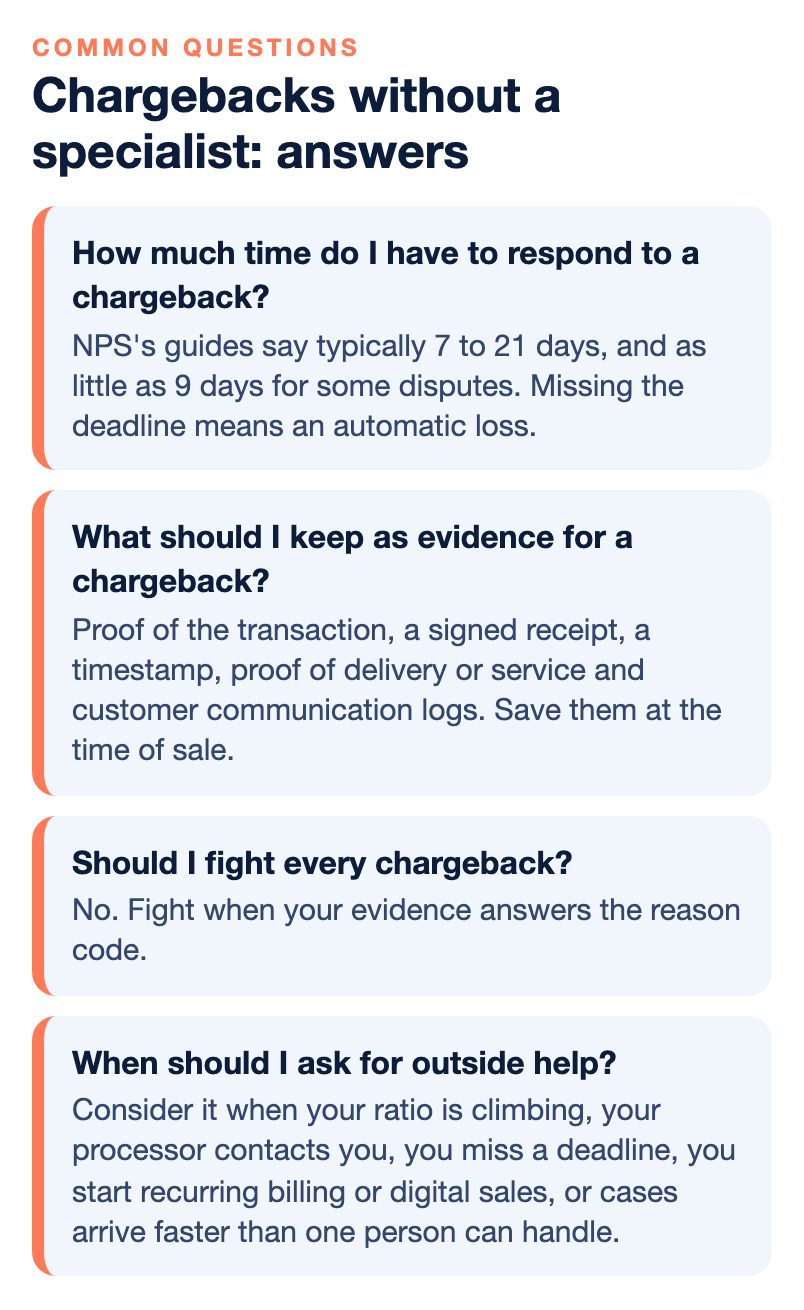
What should I keep as evidence for a chargeback?
NPS’s guides name proof of the transaction, a signed receipt, a timestamp, proof of delivery or service and customer communication logs. For online sales, IP address and device information help too. Save them at the time of sale.
How much time do I have to respond to a chargeback?
NPS’s guides say typically 7 to 21 days, and as little as 9 days for some disputes. Missing the deadline means an automatic loss. Confirm the exact date for each case with your processor.
Should I fight every chargeback?
No. Fight when your evidence answers the reason code. Consider an early refund through an alert or RDR when a sale is small and your evidence is weak. Accept cases that cannot be won, such as certain in-person stolen-card and chip liability disputes.
What should go in a chargeback log?
Record the dates, order number, amount, sales channel, reason code, your first read, your decision, the response date, the outcome and what caused the dispute. The same columns for every case make patterns visible.
Can I stop all fraud myself?
No provider or tool stops everything. Chip-only acceptance, address and security code checks, velocity filters, staff training and calling customers on large orders lower the risk. Keep refining based on what your log shows.
When should I ask for outside help?
Consider it when your ratio is climbing, your processor contacts you, you miss a deadline, you start recurring billing or digital sales, or cases arrive faster than one person can handle.





