
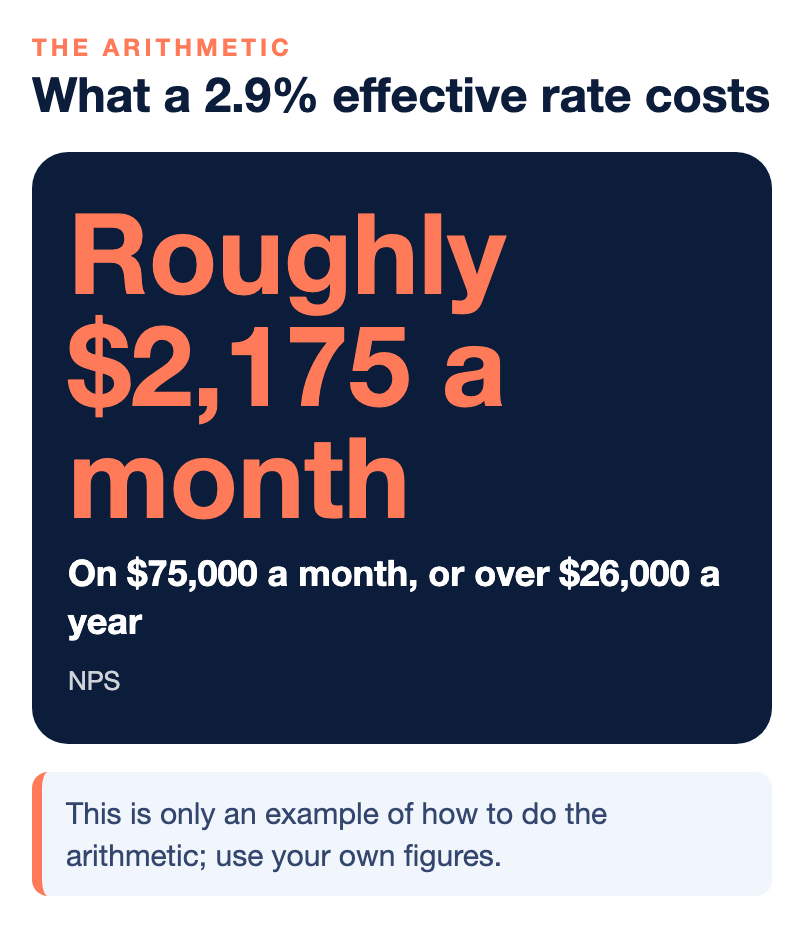
Neither a cash discount program nor absorbing card fees is automatically cheaper, and the answer can only come from your own numbers, because it depends on how your customers pay. For example, a business that processes $75,000 a month at a 2.9% effective rate pays about $2,175 a month in card fees (arithmetic only, not a quote). This guide gives you a method: find what card acceptance costs you today, see how your sales split across payment types, price both options with the same worksheet, and then ask your provider the questions that fill in the gaps. No rates are quoted here, because your rate, your mix and your customers decide the outcome.
The short answer
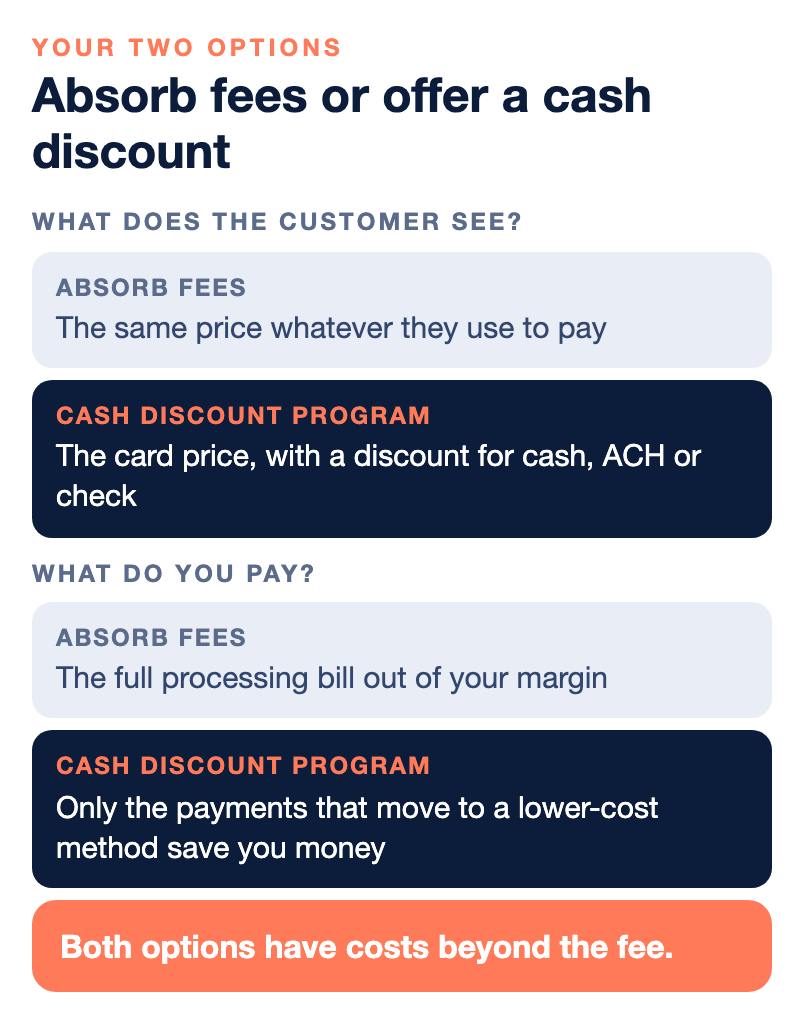
- Absorbing fees is a choice with a known cost. You keep prices simple, and you pay the full processing bill out of your margin.
- A cash discount program tries to recover part of that bill. It posts the card price and gives a discount to customers who pay with cash, ACH or a check.
- How much it recovers depends on customer behavior. Only the payments that move to a lower-cost method save you money, and you cannot know that share in advance.
- Both options have costs beyond the fee. Look at setup, signs, receipts, training, customer reaction and compliance, not just the processing line.
- There is a third path. You can absorb fees and still cut them, by fixing pricing structure and removing junk charges.
The two options, defined
Absorbing processing fees means you charge the same price whatever the customer uses to pay, and you accept that card payments cost you money. NPS calls this the “no fee to customer” option: your business pays standard merchant rates and keeps things simple.
A cash discount program works differently. NPS describes it as displaying a standard price, which is the card price, and offering a discount for cash, ACH or check. It does not add a fee at checkout. It is built as a pricing model, not a penalty. A close cousin is dual pricing, where the business shows both a card price and a cash price. You can read how NPS sets both up on our dual pricing program page, and our guide to dual pricing, cash discounts and surcharging covers how they compare to a surcharge.
Rules for these programs come from card networks and from states, and both can change. Where this guide touches on rules, the advice is the same: check current card network and state rules with your provider.
Step 1: Find what card acceptance costs you today
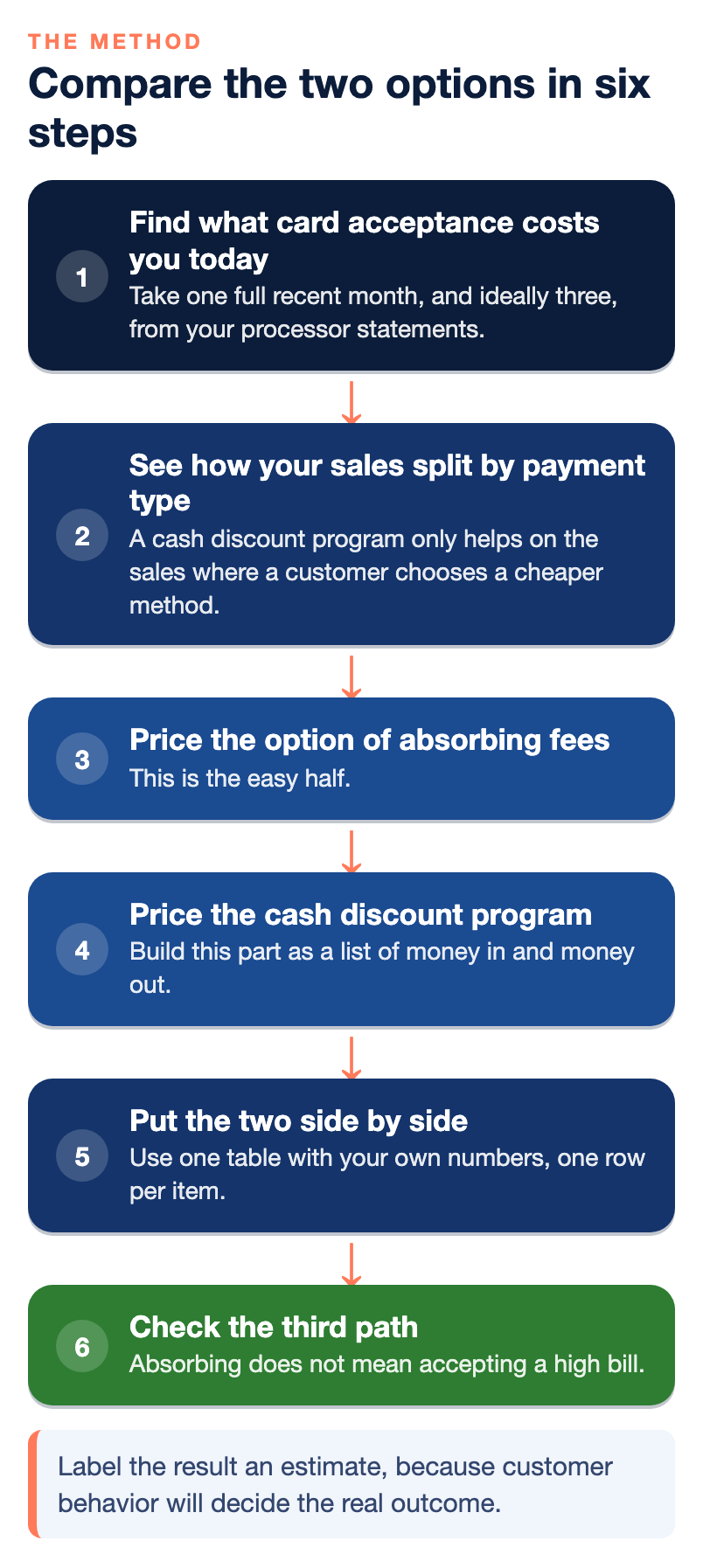
You cannot compare options until you know the starting point. Take one full recent month, and ideally three, from your processor statements.
- Total card volume. Add up what customers paid by card.
- Total fees. Add every processing charge, including monthly fees, statement fees, PCI fees and per-transaction charges, not just the rate.
- Effective rate. Divide total fees by total card volume. This is the real percentage you pay.
NPS uses a simple illustration of why this matters: a business processing $75,000 a month at a 2.9% effective rate pays roughly $2,175 a month, or over $26,000 a year. That is only an example of how to do the arithmetic. Use your own figures. Our guide on reading your merchant statement shows where each line sits, and our piece on why your effective rate is higher than your quote explains common reasons the real number is larger than the advertised one.
That number is the cost of absorbing. It is the ceiling on what any fee program can recover.
Step 2: See how your sales split by payment type
A cash discount program only helps on the sales where a customer chooses a cheaper method. So you need to know your mix. For the same month, split your sales into:
- Cash.
- Checks.
- ACH or bank transfers.
- Debit cards.
- Credit cards.
- Online, phone and in-person sales, if the way people pay differs by channel.
Your point-of-sale reports, invoicing software or bank deposits will show most of this. Ask your provider for a report if you cannot find it. If most of your sales are already cash, checks or ACH, the savings from a discount program may be small because there is little card volume to recover. If nearly all customers pay by credit card, a discount program has a lot to work on, but only if customers respond to the discount.
If you invoice other businesses, the picture is different. B2B sales are larger, and a bank payment can cost less than a card. Our ACH optimization guide explains how offering ACH next to cards can lower overall cost and speed up payment, and our guide to B2B payments covers the wider setup.
Step 3: Price the option of absorbing fees
This is the easy half. The annual cost of absorbing is your total yearly processing fees. Write it down as a single number, and then ask four follow-up questions:
- What share of that bill is interchange, which the card brands set, and what share is your provider’s markup?
- Which line items are not tied to your volume, such as monthly or statement charges?
- How much of the bill is avoidable, such as junk fees or downgraded transactions?
- What does that total look like as a percentage of your profit, not your sales?
The last question matters most. A fee that looks small next to revenue can be large next to profit. NPS notes that even partial cost recovery can improve margin meaningfully, because the money goes straight to cash flow.
Absorbing also has real advantages. Prices stay the same for everyone, there is nothing new to explain at checkout, and you carry no extra compliance duties from a fee program. Many owners choose it on purpose, especially when customers are price-sensitive or when their competitors do not pass fees on.
Step 4: Price the cash discount program
Build this part as a list of money in and money out.
Money you might recover
Start with the card volume from Step 1. Decide what share of those customers might switch to cash, ACH or check when offered a discount, and treat the answer as a range, not a promise. For each payment that moves, you save the processing cost on that sale and give up the discount you offered. The program only helps when the cost you save is larger than the discount you give, so compare those two numbers for your own prices.
NPS also lists side benefits. Encouraging cash payments can improve liquidity, and fewer card payments can mean fewer chargebacks and less fraud exposure. Treat those as possible extras, and put a dollar figure on them only if your own history supports it.
Money you will spend or risk
- Setup and tools. Ask whether your terminal, POS or invoicing system applies the discount automatically.
- Signs and receipts. The pricing must be shown clearly at the point of sale and on the receipt.
- Staff time. Your team needs to explain the program and handle questions.
- Customer reaction. Some customers may like it, some may not. Watch your sales, not just your fees.
- Compliance work. Programs must be structured properly. NPS warns that mistakes can bring complaints, audits or forced changes to the program.
- Changing rules. A program that fits today may need an update later.
If the way a program is displayed worries you, read our guide to dual pricing for small businesses before you decide, and ask your provider to walk you through exactly what your customers will see.
Step 5: Put the two side by side
Use one table with your own numbers, one row per item. Keep the columns simple.
- Annual processing cost, if you absorb: your total fees from Step 1.
- Annual processing cost, with a discount program: the fees you still pay, plus program costs.
- Discounts you give away: the value of discounts taken by customers who pay another way.
- Net result: absorbed cost on one side, remaining fees plus discounts plus program costs on the other.
Then run the comparison three times: once if few customers switch, once if a moderate share switch, and once if many switch. If the program only wins in the most optimistic case, treat that as a warning. If it wins even in the cautious case, it deserves a closer look. Whatever you find, label the result as an estimate, because customer behavior will decide the real outcome.
Step 6: Check the third path, which is cutting the bill you absorb
Absorbing does not mean accepting a high bill. Before you pass anything on, check whether the bill itself is too large. NPS points to several levers:
- Pricing structure. The way markup is applied changes what you pay. Our guide to the four main pricing models and our comparison of flat-rate versus cost-plus processing explain the differences.
- Junk fees. Look for monthly minimums, compliance fees and statement charges you may not need.
- Statement audits. Review your statement on a regular schedule, because markups can change.
- Daily batching. Closing out each day helps avoid late fees and downgrades.
- Extra data on business cards. B2B sellers may qualify for lower card costs by sending the right invoice data. See our guide to Level 2 and Level 3 processing.
- Bank payments. Offering ACH next to cards can pull large invoices off the card network.
If you reduce the bill first, the case for a fee program gets smaller, and the case for absorbing gets stronger. If you do both, you will know the program is being measured against a fair baseline.
Questions to ask your provider
- Can you pull my last three months of statements into one effective rate, with each fee on its own line?
- Which of my fees are tied to volume, and which are fixed?
- How would a cash discount program work on my terminal, POS, website and invoices?
- What do the current card network and state rules require for my business?
- Who prepares the signs, receipts and checkout wording, and who updates them if rules change?
- What does the program cost me to start, to run and to leave?
- How do refunds, returns and partial payments work with the discount?
- Can you show me examples from similar businesses, including cases where it did not help?
- What happens if a customer complains or a card network asks questions?
- If I keep absorbing fees, what would you change in my account to lower the bill?
A good provider answers all ten, even the last one. If a provider only talks about the savings and skips the costs and the rules, keep looking. Our transparent pricing checklist can help you judge a quote.
Fit by type of business
NPS notes that no program wins everywhere. Retail stores and restaurants often lean toward a cash discount or dual pricing, because customers see posted prices on shelves and menus and can pick how to pay. Professional services and B2B companies sometimes lean toward other tools for invoices, since a buyer paying a large invoice is already choosing between card, ACH and check. Some businesses mix approaches, such as an ACH incentive on invoices and a cash discount in the store.
Before you decide, ask three plain questions about your own customers. Do they see prices before they buy, or only at the end? Do they pay once, or on a repeating schedule? And do they have another easy way to pay, such as a bank transfer? The answers show which option your customers are most likely to accept, and that often matters more than the fee math.
Who wrote this, and where NPS fits
Nationwide Payment Systems publishes this guide. We are a payments company based in South Florida, in business since 2001, and we sell merchant accounts and dual pricing programs, so we are not neutral. We also offer other fee structures, including a no-fee-to-customer option, along with POS systems, invoicing tools and ACH. We do not publish one universal rate, because pricing depends on your volume, ticket size, card mix and industry. You can browse more in our payments guides.
We do not give legal advice, and we are not the right fit for everyone. If a simpler setup suits you better, we will say so. If you would like a second opinion on your statement or on a program quote, you can contact our team.
Bottom line
Absorbing fees costs exactly what your statements say. A cash discount program might recover part of that cost, but only on the sales where customers pick a cheaper method, and only after you subtract the discounts, the setup and the risk. Find your real effective rate, split your sales by payment type, price both options on one worksheet using cautious, moderate and optimistic cases, and check whether you can cut the bill first. Then confirm current card network and state rules with your provider before you change a single price.
Frequently asked questions
How do I compare a cash discount program with absorbing fees?
Find your effective rate from recent statements, split your sales by payment type, price the cost of absorbing, then price the program with its discounts and costs. Run cautious, moderate and optimistic cases for how many customers switch.
What is my effective rate?
It is your total processing fees divided by your total card volume for the same period. Include every charge on the statement, not just the quoted rate.
What is a cash discount program?
It posts the standard card price and gives a discount to customers who pay with cash, ACH or check. It does not add a fee at checkout.
Does a cash discount program always save money?
No. It only helps on payments that move to a cheaper method, and you subtract the discounts you give and the cost of running the program. Customer behavior decides the result.
Can I lower my fees without passing them on?
Often yes. Look at your pricing structure, remove junk fees, audit your statement regularly, batch daily, send the right data on business cards and offer ACH next to cards.
Do rules apply to these programs?
Yes. Card network rules and state rules both apply and both can change. Check current card network and state rules with your provider.
What should I ask a provider?
Ask for your effective rate by line item, how the program works on your systems, who prepares signs and receipts, what it costs to start and stop, and how refunds are handled.
Is absorbing fees a reasonable choice?
Yes. It keeps prices simple and avoids extra compliance work. The cost is your full processing bill, so pair it with a review of your pricing and fees.





