
When a customer pays you with buy now, pay later (BNPL), a third-party provider approves the customer, pays you for the sale and then collects from the customer over time. You do not wait for the customer’s installments. That is the biggest difference from a card payment, where the money comes from the customer’s card account in one piece and you carry the risk of a later dispute. This guide follows one financed sale from checkout to your bank statement, shows how settlement differs from a card sale, explains what you owe and what the provider reviews before it says yes.
The short answer
- There are three parties, not two. The customer, the financing provider and you. The provider, not the customer, is the one that pays you.
- Approval is not the same as payment. A customer can be approved and your funding can still wait on checks, so ask when you are funded and what can delay it.
- You usually pay a merchant fee on each financed sale. It is set by your program, so it is a line to find in the contract and on your statement, not a number to guess.
- Refunds and disputes follow the provider’s rules, not only your card processor’s rules. Read who carries the loss if an approved customer never pays.
- The provider reviews the customer, the sale and you. It is judging whether this customer can repay, whether this sale is real, and whether your business is one it wants to support.
Three parties instead of two
A simple cash sale has two parties: you and the customer. A card sale adds the machinery in between: the payment gateway (the service that encrypts and sends the card details), the processor (the company that moves the money), the card network and the bank that issued the customer’s card. Even so, the customer’s card account is the source of the money, and the sale is finished in a day or two.
BNPL replaces that chain with a different one. Here is who does what.
- The customer asks to pay over time and applies for the plan. Nationwide Payment Systems (NPS) describes this as a digital application, not a paper form.
- The financing provider reviews the application, approves or declines it, funds the sale and collects the customer’s repayments. In most third-party programs it takes on the repayment and you are paid for the sale.
- You deliver the product or service, hold up your end of the sale, and receive money from the provider rather than from the customer.
That last line is the point of the whole product. NPS describes the difference between offering a program and running your own informal payment plan this way: in the first case the customer works through a financing path and you do not create a long-term receivable, which is money a customer still owes you. In the second case you deliver the work and then chase the balance. Our guide to faster customer financing for high-ticket sales explains why becoming your customer’s bank is a trap.
Following one financed sale from checkout to your bank
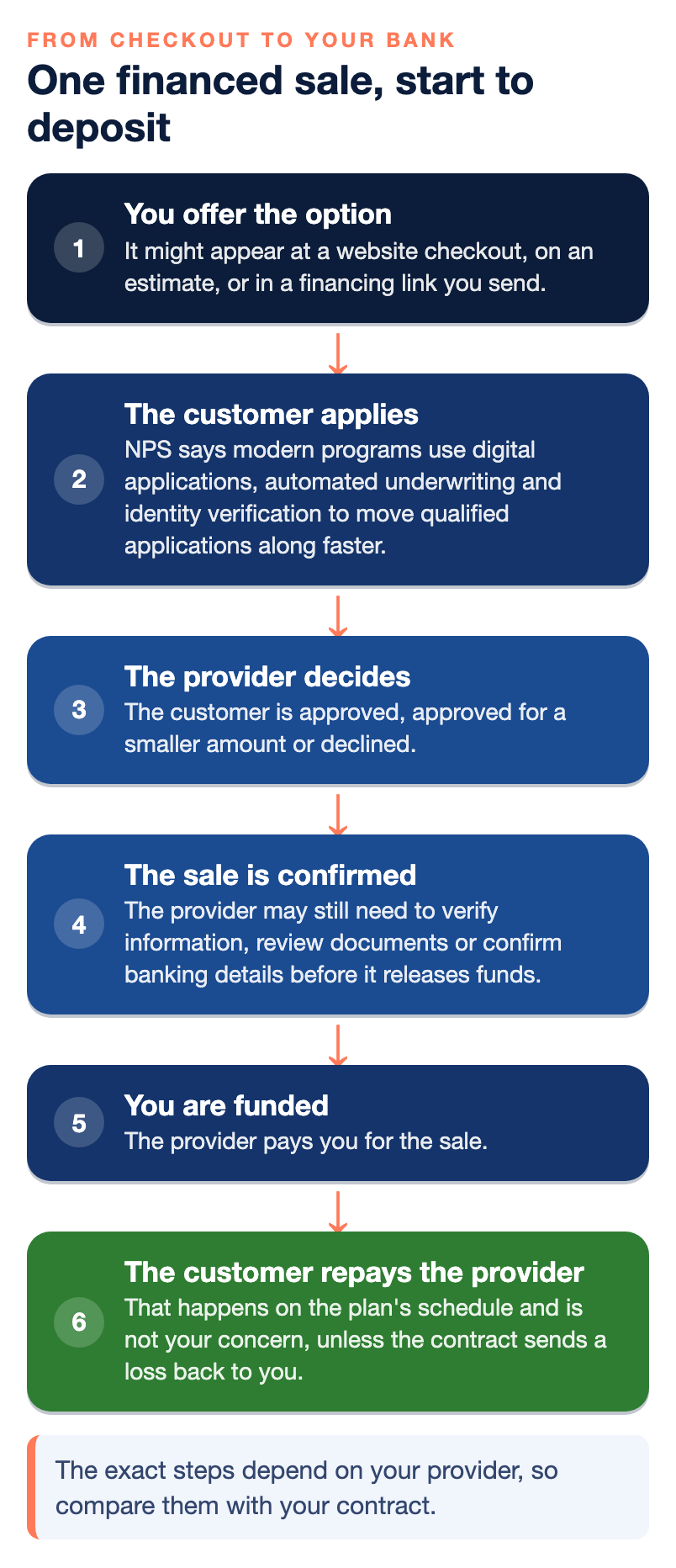
The exact steps depend on your provider, so treat this as a map to compare with the contract in front of you. The order is the same in most programs.
- You offer the option. It might appear at a website checkout, on an estimate, or in a financing link you send. NPS suggests mentioning financing before the customer objects to price, as a normal way to pay rather than a rescue plan.
- The customer applies. NPS says modern programs use digital applications, automated underwriting (a computer-based review of the application), identity verification, bank-account validation and document processing to move qualified applications along faster.
- The provider decides. The customer is approved, approved for a smaller amount or declined. A decline is not your decision, and you should ask how it is shown to the customer.
- The sale is confirmed. This is the step people skip over. The provider may still need to verify information, review documents or confirm banking details before it releases funds. NPS describes approval that did not always mean payment as the old problem faster funding is meant to fix.
- You are funded. The provider pays you for the sale. NPS’s own page for auto repair shops says the shop gets paid immediately while the customer pays over time. Treat “immediately” as the program’s description and ask for the actual funding date in writing, including anything that can hold it, such as waiting for delivery or completion.
- The customer repays the provider. That happens on the plan’s schedule and is not your concern, unless the contract sends a loss back to you.
Compare steps four and five with your own business. If you do the work after the sale, funding that waits for completion can still leave you paying for materials and labor before the money arrives. If you ship a product, funding that waits for delivery confirmation is a different wait. The program’s rules decide which one you have.
How settlement differs from a card payment
Settlement is the movement of money from the paying side to your bank after a sale is approved. Our guide on when you will actually get paid follows a card payment through four links: authorization, batching, settlement and deposit. Authorization takes seconds. The approved sales are grouped into a batch, usually once a day, and NPS says funds are typically deposited within one to two banking days, with next-day funding available to qualified merchants. Those are NPS program statements, not a promise for every account.
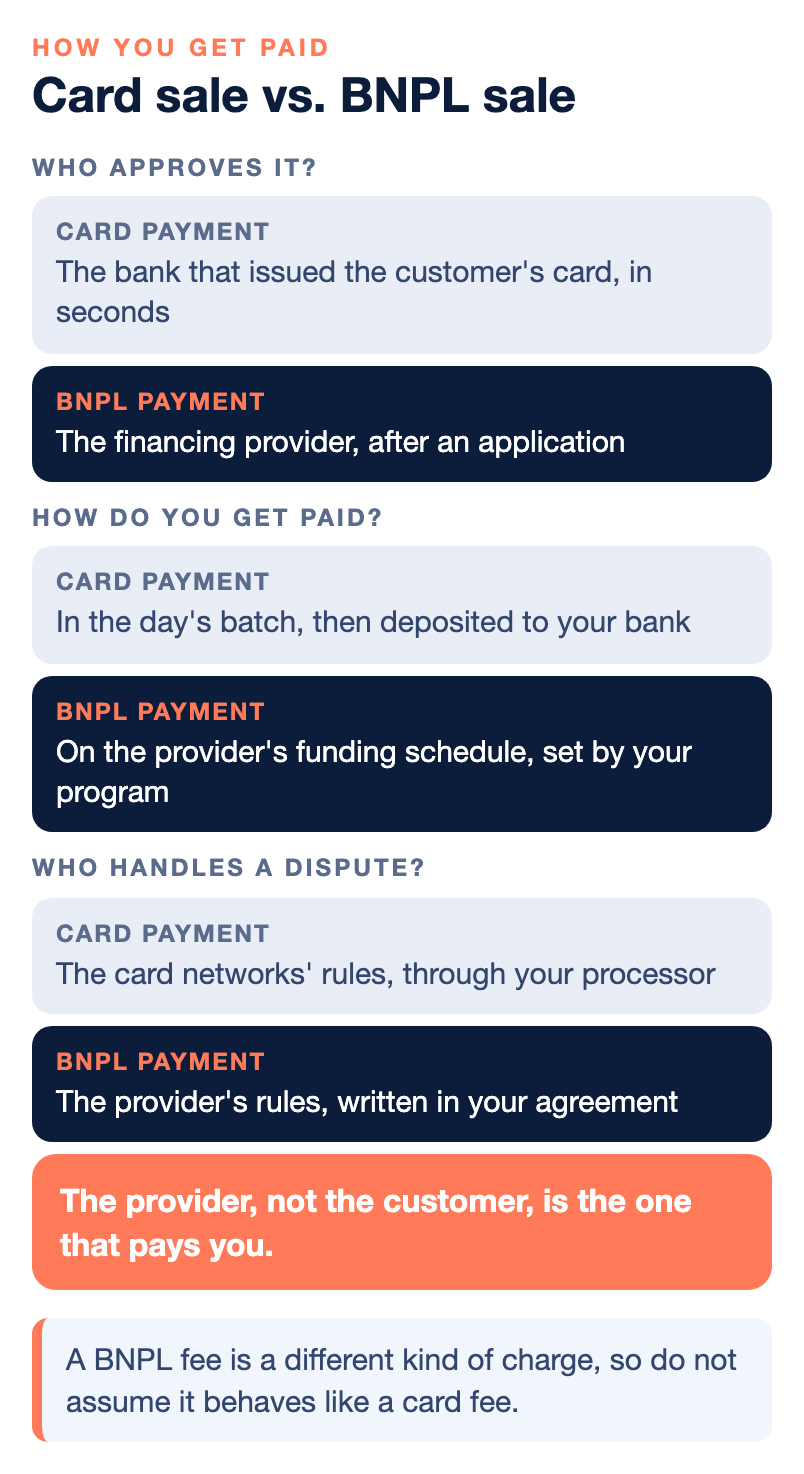
A financed sale does not follow that path. Here is the difference side by side.
| Question | Card payment | BNPL payment |
|---|---|---|
| Who approves it? | The bank that issued the customer’s card, in seconds | The financing provider, after an application |
| Where does the money come from? | The customer’s card account | The provider, which collects from the customer later |
| How do you get paid? | In the day’s batch, then deposited to your bank | On the provider’s funding schedule, set by your program |
| What do you pay? | Interchange, network assessments and the processor’s markup | A merchant fee set by the program, often named in the contract |
| Who handles a dispute? | The card networks’ rules, through your processor | The provider’s rules, written in your agreement |
| Who collects from the customer? | The bank that issued the customer’s card | The provider, on the plan’s schedule |
Two points stand out. First, a BNPL sale does not travel through your card batch, so a deposit on your merchant statement and a deposit from a provider are different events that arrive on different days, probably from different names. Second, the fee structures do not match. A card fee has three layers: interchange, paid to the bank that issued the card, assessments, paid to the card networks, and the processor’s markup, which the processor keeps. Our guide to what you really pay for card processing shows where each sits. A BNPL fee is a different kind of charge, and you should not assume it behaves like a card fee.
What you owe
The merchant fee is the main cost, but it is not the only line. Here is what to find in the agreement.
- The merchant fee on each financed sale. We do not quote one, because programs differ. NPS notes that on interest-free plans this fee is often higher than what a merchant pays to accept a card, so measure it against your real card cost. Our guide to how buy now, pay later changes your average order value walks through that math.
- How the fee is collected. Some arrangements send you the sale amount minus the fee. Others bill the fee separately. Ask which one, because it changes the number you see on a deposit.
- What happens to the fee on a refund. A refunded financed sale usually runs back through the provider, and the provider’s rules decide whether you get the fee back.
- Any other charges. Ask whether there are any charges beyond the per-sale fee, and ask for every fee in writing, itemized.
The comparison that matters is not the fee in isolation. If the customer would have paid by card anyway, the fee is an extra cost on a sale you already had. If the customer would have walked away, the fee is the price of a sale you would not have made. You can only know which by measuring your own sales.
Refunds, returns and cancellations
With a card, a refund goes back to the customer’s card through your processor. With a financed sale, the refund usually has to run back through the provider, because the provider paid you and is collecting from the customer. Ask these questions before you offer it.
- If the customer returns the product or cancels the job, how do you refund, and how fast does the customer see it?
- Do you pay the money back to the provider, or does the provider reverse the funding from your next deposit?
- For a partial refund, is the fee returned in proportion, in full or not at all?
- What if the customer cancels after funding but before delivery?
Write your return and cancellation policy first and keep it in plain words. The same habits that help with card disputes help here: clear terms, tidy delivery records and a paper trail of what was agreed.
Disputes and who carries the loss
A card dispute has a published shape. A customer disputes a payment with the card-issuing bank, the funds can be pulled back from you while the dispute is reviewed, and you have a limited time, typically 7 to 21 days depending on the network and processor, to respond with evidence. Missing the deadline means you lose. Our guides on what a chargeback is and how to win disputes cover that process.
A financed sale is governed by the provider’s agreement, which can look different. The most important line is recourse. NPS describes it this way in its guide to pay-later options for business buyers. In a non-recourse arrangement the provider generally absorbs the loss if an approved customer does not pay. In a recourse arrangement the loss can come back to you, so you still carry the risk and pay a fee on top. Even in a non-recourse program, read the situations where the provider can still reverse a payment. NPS notes that some arrangements can charge back to the merchant in particular situations.
A customer paying over time is also still paying when something goes wrong, so a complaint can turn into a dispute weeks after the sale. Keep delivery proof, signed estimates and written approvals as you would for any large sale.
What providers look at
A financing provider is making two decisions: whether this customer can be approved for this purchase and whether you are a seller it wants to support. Here is what each review tends to touch.
The customer
The provider reviews the application. NPS describes digital applications, identity verification and bank-account validation in modern programs. NPS also says that most BNPL providers have higher approval rates than traditional credit cards and that some options do not require a hard credit check. Treat that as NPS’s description of the category, and ask your provider what it actually checks, because it differs between programs and between loan types. Because not every customer will be approved, ask how a decline is shown. A clumsy decline at checkout can lose a customer you would have invoiced on your own.
The sale
Ask what the provider needs for the sale to be funded. Third-party providers look at how you prove delivery, so ask whether it wants a signed estimate, an invoice, proof of shipment or proof the work was finished. The more you can show, the fewer reasons there are to delay funding.
You, the seller
Third-party providers typically want to understand your industry, your average order size, how often orders are returned or disputed and how you prove delivery. A seller with clear invoices, proof of shipment and a low dispute rate is easier to support than one whose orders change after the fact. Prepare what you would give to any underwriter: a description of the business, your pricing and ticket sizes, your refund policy and your records of past sales.
Keeping the books straight
A financed sale touches your records in three places: the sale, the provider’s fee and the provider’s deposit. Keep them separate so you can match them later.
- Record the full sale amount when the sale happens.
- Record the fee as its own line, not as a lower sale price.
- Record the provider’s deposit when it arrives, and match it to the sale it funds.
Do this in a different lane from card sales. If you book financed sales as card sales, your statement and your books will drift apart, and the effective rate you calculate, which is your total processing fees divided by your total card sales, will be wrong. Compare each provider’s deposit summary to your bank statement, as you would for card deposits, and ask promptly about a missing or short deposit, because it is easier to fix when it is recent.
Questions to ask before you turn it on
- When am I funded after a financed sale, and what can delay it?
- Does funding wait for delivery, completion or customer confirmation?
- What is the fee, itemized, and how is it collected: taken from the deposit or billed separately?
- Who carries the loss if an approved customer never pays? Get the recourse terms in writing.
- How do refunds, returns and partial refunds work, and what happens to the fee?
- What happens on a dispute, and who decides?
- Which of my customers can qualify, and how is a decline shown?
- Where do financed sales show up on my deposits and my reports?
Where this fits with the other pay-later pages
This page is about the money trail. Our other pages cover different questions. See buy now pay later financing for the programs NPS offers and who each one fits, the page on financing for healthcare, home services, auto repair and coaching for the industries, and how buy now, pay later transforms auto repair shops for a shop-level view. If you sell to other businesses, read the guide to pay-later options for business buyers, because consumer financing programs are usually the wrong tool when the buyer is a company paying an invoice.
Who wrote this, and where NPS fits
Nationwide Payment Systems publishes this guide. We are a payments company based in South Florida, in business since 2001, and we offer customer financing and buy now, pay later programs to the businesses we work with, so we are not neutral. We do not quote fees or funding times here, because they depend on the program, the industry and the provider, and any number we printed would be wrong for someone. Ask any provider, including us, for terms in writing. Nothing here is legal, tax or lending advice. You can browse the full library of payments guides.
We are not the right fit for everyone. If you are a hobby seller with very low volume, if you only want an instant self-service sign-up, if you do not want to provide underwriting documents, or if the lowest advertised flat rate is the only thing that matters to you, a simpler platform will probably suit you better.
Bottom line
With buy now, pay later, a third-party provider approves the customer, pays you for the sale and collects from the customer over time. That moves the waiting and the credit risk off your desk, but it also moves your money onto the provider’s schedule, your fee into the provider’s contract and your disputes under the provider’s rules. Before you switch it on, find out when you are funded, what the fee is and how it is collected, who carries the loss and how refunds work. If you would like a second opinion on a program or your current setup, you can contact our team, and if another setup fits you better, we will say so.
Frequently asked questions
How does buy now, pay later work for a merchant?
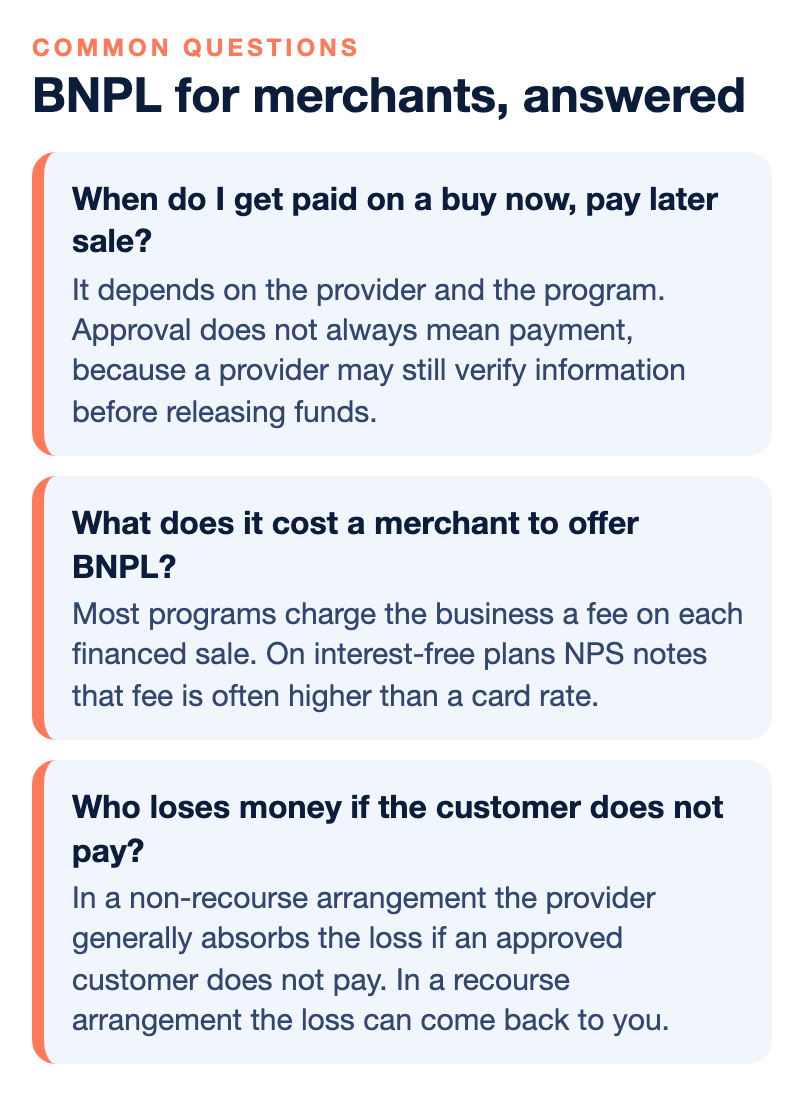
The customer applies for a payment plan, a financing provider approves or declines it, and the provider pays you for the sale. The provider then collects from the customer over time. You pay a merchant fee set by your program, and funding follows the provider’s schedule.
When do I get paid on a buy now, pay later sale?
It depends on the provider and the program. NPS describes some programs as paying the business up front, but approval does not always mean payment, because a provider may still verify information before releasing funds. Ask for the funding date in writing and what can delay it.
How is BNPL settlement different from a card payment?
A card sale is approved by the customer’s bank, batched and deposited to you, typically within one to two banking days at NPS. A financed sale is approved by the provider and funded on the provider’s own schedule, and the provider collects from the customer.
What does it cost a merchant to offer BNPL?
Most programs charge the business a fee on each financed sale. On interest-free plans NPS notes that fee is often higher than a card rate. Programs differ, so ask for every fee itemized and in writing.
Who loses money if the customer does not pay?
It depends on the agreement. In a non-recourse arrangement the provider generally absorbs the loss if an approved customer does not pay. In a recourse arrangement the loss can come back to you. Get the terms in writing.
What happens to a financed sale when I issue a refund?
The refund usually has to run back through the financing provider, and the provider’s rules decide whether you get your fee back. Ask how refunds, returns and partial refunds work before you offer the program.
What do financing providers look at?
They review the customer’s application, the sale and the seller. For sellers, providers typically want to understand your industry, your average order size, how often orders are returned or disputed and how you prove delivery.
Is buy now, pay later the same as customer financing?
It is similar. Buy now, pay later usually means flexible payment options at or near the point of sale. Customer financing can also include lender-based, application-based monthly payment programs for higher-ticket purchases.





