
Your merchant category code, or MCC, is assigned by the acquiring bank or processor that boards your account, based on what it understands your main business to be, and the wrong code can quietly cost you money or, in the worst cases, end your account. The code shapes your card costs, how card issuers treat your transactions and how risk teams watch you. A code that does not match what you really sell can look like misrepresentation, even when the mistake was innocent. This guide explains how MCCs are assigned, what they control, how they go wrong and how to check and fix yours.
The short answer
- An MCC is a four-digit code that tells the card networks what kind of business you are. It is a classification of your primary activity, not a description of everything you do.
- You usually do not pick it. The acquiring bank or processor assigns it when your account is set up, based on your application, your website and what underwriting learns about you.
- It affects your costs. Some card programs and lower card rates are available only to certain codes, so a wrong code can mean paying more than you should.
- It affects your risk profile. Some codes are watched more closely by the card networks and banks, and some card issuers decline certain categories outright.
- A mismatch is the dangerous part. Selling something your code does not cover can be treated as misrepresentation, which can lead to holds, termination and, in serious cases, a listing on the MATCH file.
Who wrote this
Nationwide Payment Systems (NPS) publishes this guide. We have worked with merchants since 2001, including many high-risk and hard-to-place businesses, and we review merchant category codes as part of setting up and fixing accounts. We are a seller of merchant services, so read this with that in mind. Card-network rules change and differ by network, so treat this as a general guide and confirm details with your processor.
What an MCC is
A merchant category code is a four-digit number attached to your merchant account. It travels with every card transaction you run, and it tells the card networks, and through them the bank that issued your customer’s card, what type of goods or services your business provides. Restaurants, grocery stores, doctors, schools, software sellers, insurance agencies and thousands of other business types each have their own codes.
The code is a classification, and it is deliberately simple. As our guide on merchant underwriting when your business does not fit the box puts it, an MCC is a classification, not a business plan. Two businesses with the same code can carry completely different risks, and one business can do several things that each would have a different code on its own.
How an MCC gets assigned
Most owners never see this step, which is part of why mistakes go unnoticed. Here is how it usually happens.
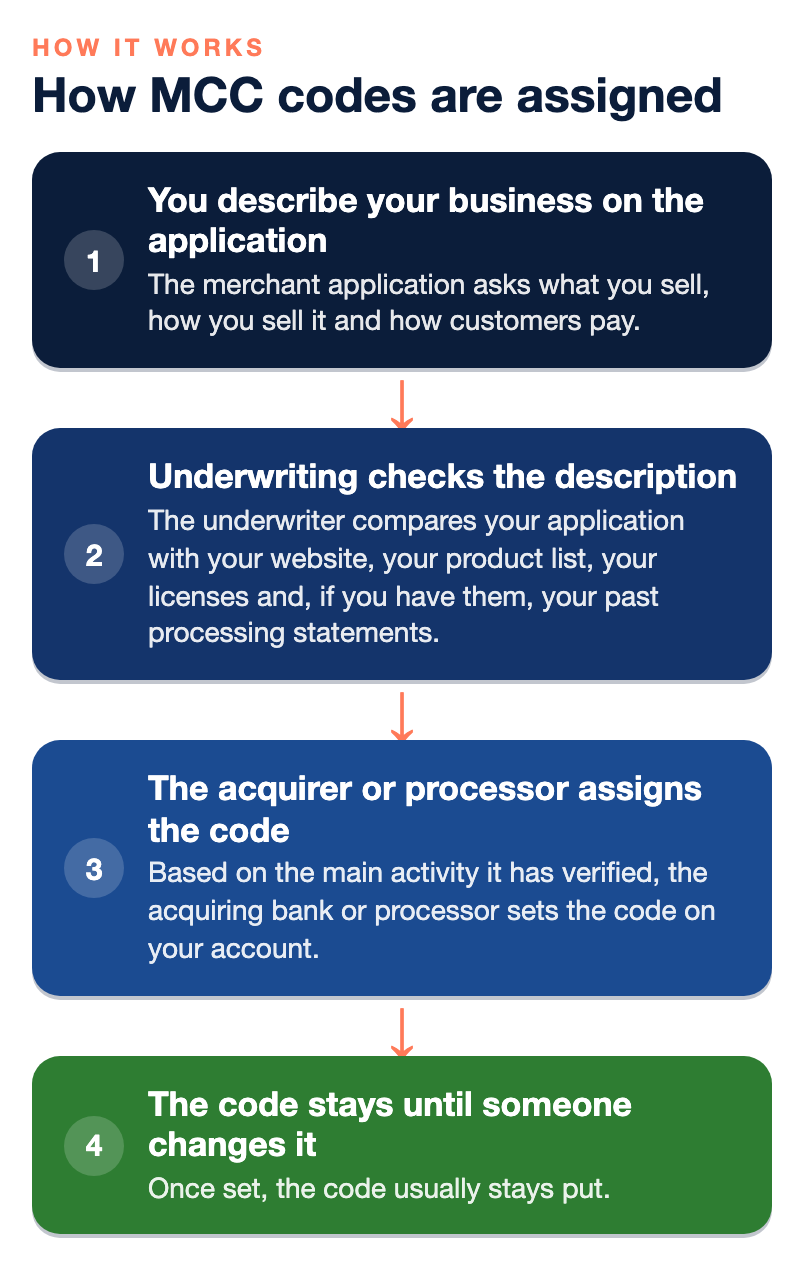
1. You describe your business on the application
The merchant application asks what you sell, how you sell it and how customers pay. The words you choose matter. “Consulting”, “services” or “technology” give the underwriter very little to work with, while “bookkeeping services for small businesses, billed monthly” points to a clear category.
2. Underwriting checks the description against everything else
The underwriter compares your application with your website, your product list, your licenses and, if you have them, your past processing statements. If the website sells something the application does not mention, the underwriter has to decide which story is true. The same goes for policies, invoices and supplier documents. All of them should describe the same business.
3. The acquirer or processor assigns the code
Based on the main activity it has verified, the acquiring bank or processor sets the code on your account. The card networks publish the code lists and the rules for using them, and the acquirer is responsible for classifying its merchants accurately. A processor cannot simply choose whichever code produces the lowest cost. As our guide to special interchange rates explains, the code must accurately represent the merchant’s actual business activity, and some industries need supporting documents, such as licenses, nonprofit paperwork or contracts, before a specialized code is used.
4. The code stays until someone changes it
Once set, the code usually stays put. If your business changes, nobody updates it automatically. A shop that began as a retail store and later added online sales, subscriptions or a new product line can be running under a code that fit the business it used to be.
What your MCC actually controls
The code is small, but a lot rides on it.
Your card costs
Card networks set interchange, the wholesale cost of a card transaction, across hundreds of categories. Some of those categories are available only to specific business types. Visa and Mastercard both run programs for certain industries, such as insurance, education, healthcare, real estate, charities, government, child day care and utilities, and eligibility depends on the code along with the card type, how the transaction is processed and the data sent with it. If your account sits under the wrong code, your eligible transactions may never qualify. On a flat-rate plan you may not see this directly, because the underlying card cost is hidden inside one blended percentage.
Whether cards are approved at all
Card issuers can use the code when deciding whether to approve a transaction. Some issuers decline certain categories, and many companies set their employee and purchasing cards to work only at certain kinds of merchants. A business coded in a category that a buyer’s company has blocked will see declines that have nothing to do with the customer’s balance. When that happens, the decline reason rarely says “wrong MCC”, which is why it is easy to miss.
How closely you are watched
Some codes carry higher risk in the eyes of the card networks and banks, because those industries tend to have more disputes, more regulation or more fraud. Merchants in those categories can face extra registration requirements, closer monitoring and stricter thresholds. That is not a judgment that the business is doing anything wrong. It is the category the banks assign. Our page on high-risk merchant services explains how those accounts are underwritten.
What your customer sees
The code also influences how a purchase is categorized on a customer’s card statement and in budgeting tools, and it can decide whether a purchase earns category rewards on the customer’s card. A mismatch can confuse a customer who does not recognize the charge, and a confused customer is more likely to dispute it.
How the wrong MCC happens
In our experience, wrong codes are almost never the result of a merchant trying to cheat. They come from a few ordinary situations.
- A vague application. A description such as “services” or “retail” leaves the underwriter to guess, and a guess can land on a generic code that is wrong for you.
- A business with several lines. A company that sells physical products, software subscriptions and consulting through one account has one code that fits only part of what it does.
- A business that changed. New products, a new website or a move into online sales can drift away from the code set on day one.
- A quick sign-up. Instant-approval platforms often classify a merchant from a few answers and review the details later, after transactions start flowing.
- Someone choosing a code because it looks easier. Describing a vape store as a convenience store, or an online pharmacy as general retail, to avoid scrutiny is not a shortcut. It is the kind of mismatch that gets accounts closed.
Why the wrong code can end an account
A wrong code that only costs you a little extra is a pricing problem. A wrong code that hides what you sell is a compliance problem, and it is the second kind that can kill a merchant account.
Banks approve a merchant to sell specific things under a specific code. If transactions, a website or customer complaints show the business is really selling something else, the bank sees a merchant processing outside what it was approved for. Depending on what is found, the response can range from a document request to a hold on funds, a reserve, processing limits or termination. When a termination is for serious reasons, the acquiring bank may add the business to Mastercard’s MATCH file, a shared list that other banks check before approving new accounts. Our article on the 14 reasons merchants end up on the MATCH list explains how that list works and why staying off it matters so much.
The rule that protects you is the same one we give every merchant: only sell what you were approved to sell, and get approval before you expand. If you add a product line, start selling online or begin billing subscriptions, tell your processor first and ask whether your code and your approval still fit. If your account has already been flagged, our guide to what the restricted merchant label means covers what to do next.
How to check your MCC
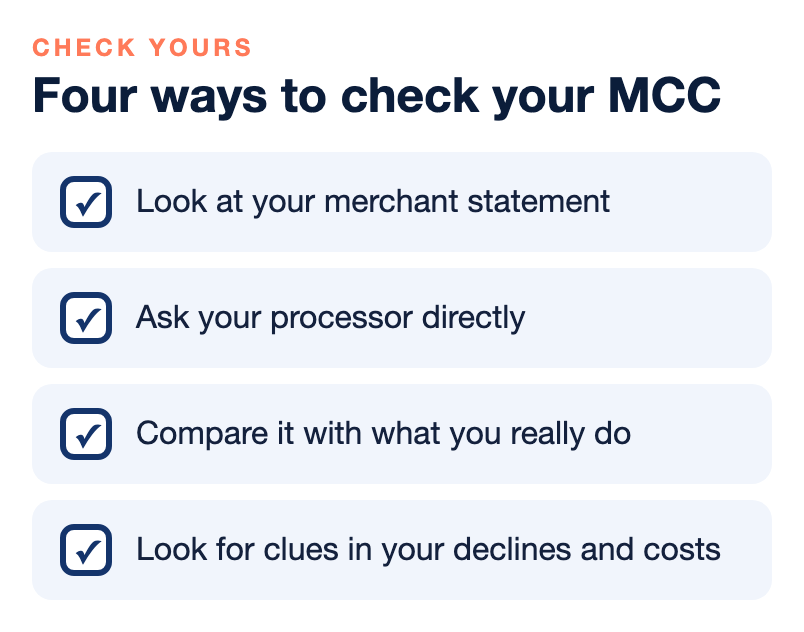
- Look at your merchant statement. Many processors print the code on the statement or in the online portal, sometimes near your merchant ID.
- Ask your processor directly. Request the code in writing, along with the business description it was based on.
- Compare it with what you really do. Does the code describe the activity that brings in most of your card revenue? Does it cover everything your website sells?
- Look for clues in your declines and costs. Declines from business cards for no clear reason, or card costs that never seem to reflect your industry, can both point to a classification issue.
How to fix a wrong MCC
If the code looks wrong, ask your processor to review it. Expect to explain your business clearly and to back it up with documents such as your business license, articles of incorporation, product list, invoices or contracts, and any industry license or nonprofit paperwork that applies. The processor or acquiring bank decides, and it may agree, propose a different code or ask more questions.
Sometimes the right answer is not a different code but a different structure. A business with very different lines, such as retail products and a subscription service, may be better served by separate merchant accounts, each with a code that fits. The goal is not to disguise anything. It is to make each activity easy to understand and properly underwritten. If you are not sure what your business should be classified as, our explainer on what a merchant account is covers the basics of how accounts are set up.
Questions to ask before you apply
- Which MCC do you expect to assign my business, and why?
- Does that code cover every product and service I sell, including online and recurring sales?
- Are there card programs for my industry, and will my account be set up to qualify for them?
- Is my category monitored more closely, and are there extra registrations or limits I should know about?
- What do you need from me before I add a new product line or sales channel?
A provider that answers these clearly, in writing, is a provider that has thought about your classification instead of guessing.
Where NPS fits, and where it does not
When we set up or review an account, we look at the business model, the website, the flow of funds, the products and services and the merchant category code, and we work with processors, sponsor banks and underwriting teams to explain business models that do not fit a standard box. We hold direct contracts with multiple banks and processors, and we are not brokers. For businesses with eligible transactions, we look at whether the account is categorized and configured to qualify for the right card programs.
We may not be the right fit if:
- You want a code chosen to lower your rate rather than to describe your business. We will not do that, and no responsible provider should.
- You want instant, self-service sign-up. We underwrite each account.
- You would rather not provide documents. Accurate classification depends on them.
- Your products cannot be sold lawfully. No code fixes that.
Bottom line
Your MCC is a four-digit code with outsized weight. It is assigned by the bank or processor that boards you, based on what they understand your main business to be, and it shapes your card costs, your approval rates and how closely you are watched. Most wrong codes come from vague applications and businesses that changed without telling anyone, not from bad intent. Check yours, make sure it describes what you actually sell, and tell your processor before you expand. A correct code costs you nothing. A wrong one can cost you the account.
If you want us to look at your current classification, you can talk with our team. For more guides, see our payments guides.
Frequently asked questions
What is an MCC code?
A merchant category code is a four-digit number attached to your merchant account that tells the card networks what type of business you are. It travels with every card transaction. It classifies your primary activity, not everything you do.
Who assigns my merchant category code?
The acquiring bank or processor that sets up your account assigns it, based on your application, your website and what underwriting verifies. The card networks publish the code lists and rules. You usually do not choose it yourself.
Can I choose the MCC that gives me the lowest rate?
No. The code must accurately describe your actual business activity. Some industry codes also require documents such as licenses or nonprofit paperwork before they are used.
How does a wrong MCC affect my processing costs?
Some card programs and lower interchange categories are available only to certain codes. If your account is coded wrong, eligible transactions may never qualify. On a flat-rate plan you may not notice, because the underlying cost is blended into one percentage.
Can the wrong MCC get my merchant account closed?
It can if the code hides what you really sell. Processing outside what you were approved for can lead to holds, reserves, limits or termination. Serious terminations can lead to a listing on the MATCH file, which other banks check before approving new accounts.
How do I find my MCC?
Check your merchant statement or online portal, where many processors show it near your merchant ID. You can also ask your processor for the code in writing, along with the business description it was based on.
How do I change my merchant category code?
Ask your processor to review it and be ready to explain your business with documents such as licenses, invoices or contracts. The processor or acquiring bank makes the decision. For very different business lines, separate merchant accounts may be the cleaner answer.





