
Transparent merchant pricing means you can see what every part of a card payment costs, who gets each part and exactly what the processor keeps for itself. Almost every processor says it is transparent. Very few prove it before you sign. The test is simple: can you see the processor’s markup as its own line, can you read every fee in writing, and can someone explain your statement to you when it arrives. This guide explains the three layers of a card fee, shows which pricing models make them visible and which hide them, and gives you a seven-point test to run on any quote before you agree to it.
The short answer
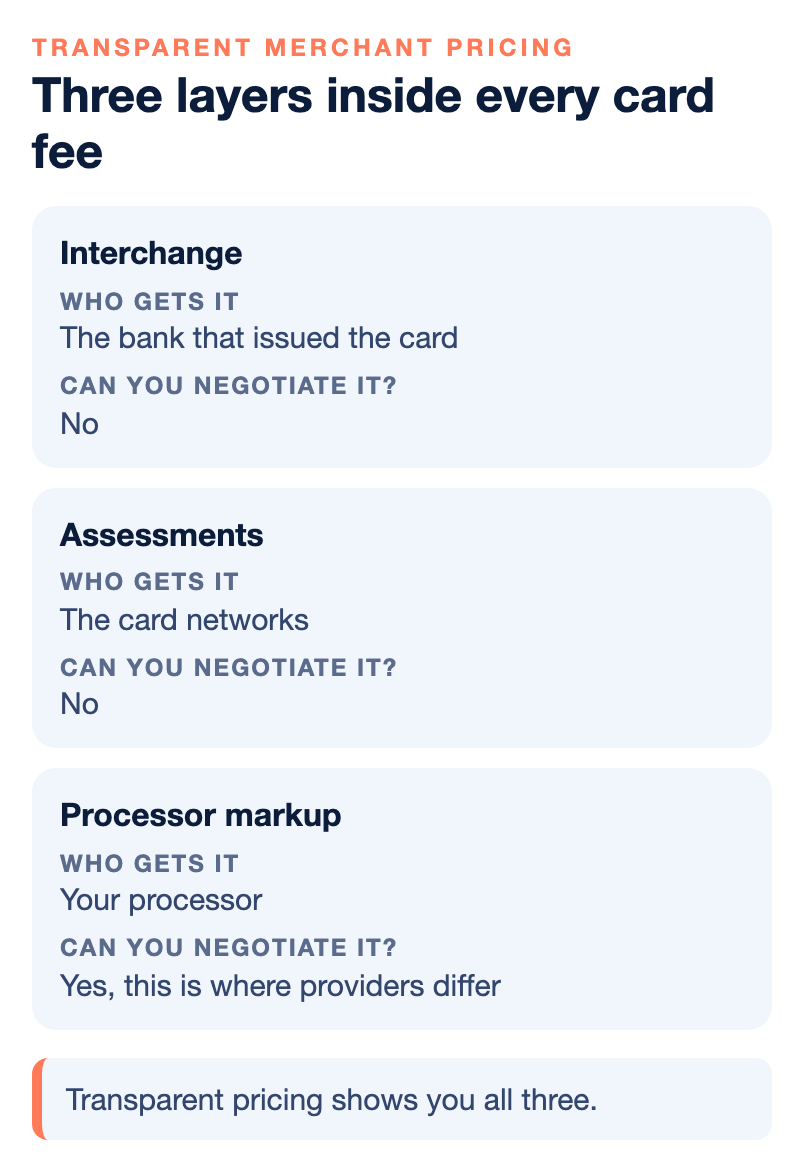
- A card fee has three layers. Interchange goes to the bank that issued the customer’s card, assessments go to the card networks, and the processor’s markup is the part the processor keeps. Transparent pricing shows you all three.
- Pricing models differ in how much they show. Interchange-plus, also called cost-plus, shows the most. Flat-rate and tiered pricing show less, and tiered pricing is the easiest place to hide markup.
- The advertised rate is not the whole price. Monthly, gateway, statement, batch and compliance fees, plus downgrades, can push your real cost above the number you were quoted.
- Transparent does not always mean cheapest. A simple flat rate can make sense for a very small business. Transparency matters more as volume and ticket size grow.
- Ask for proof. A provider that welcomes a look at your statements, explains its markup and puts every fee in writing is showing you what transparency looks like.
The three layers inside every card fee
When a customer pays with a card, the fee you see on your statement is made of three parts. Knowing them is the key to judging any quote.
- Interchange. This is paid to the bank that issued the customer’s card. It varies with the type of card, whether the card was present, the industry, the size of the ticket and the risk level. Rewards cards cost more, and PIN-based debit tends to cost less. Interchange is set by the card networks and issuing banks, not by your processor.
- Assessments. These are smaller charges paid to the card networks themselves, such as Visa, Mastercard, Discover and American Express. They are pass-through costs, and they are not negotiable.
- Processor markup. This is what your provider charges for moving the transaction, supporting your account and earning its margin. It can be a percentage, a per-transaction fee, a monthly platform fee, a gateway fee, a compliance fee or a mix. This is the layer where prices truly differ between providers.
The difference between pricing models is how clearly they separate these three layers. Transparent pricing shows interchange and assessments as the true costs and puts the processor’s markup on its own line. Opaque pricing blends the three into one number or a few buckets, so you cannot tell how much of the price is cost and how much is margin.
Which pricing models show you what you pay
Most merchant accounts follow one of a handful of structures. Here is how each one handles visibility.
| Model | What you see | Visibility | Usually suits |
|---|---|---|---|
| Flat rate | One advertised percentage, often with a per-transaction fee | Low. The three layers are blended and the processor’s margin is hidden inside. | Very small or new businesses that value simplicity |
| Tiered | Three buckets, called qualified, mid-qualified and non-qualified | Low to medium. Transactions often fall into the costlier buckets, and the buckets make markup easy to hide. | Merchants who prefer perceived simplicity and who check statements closely |
| Interchange-plus (cost-plus) | The real interchange and assessments plus a fixed processor markup | High. You can see exactly what the processor adds. | Growing businesses, B2B sellers and multi-location merchants |
| Membership | A flat monthly fee, with interchange passed through at cost | High. The fee is fixed and the costs are visible. | High-volume merchants who want predictable overhead |
| Dual pricing or cash discount | A program where the card price is shown separately from the cash price | High for the merchant, because the card cost is carried by the customer. It has to be set up correctly and used only where allowed. | Merchants whose customers will pay a displayed card price |
No model is always right. A flat rate can be a fair price for simplicity when volume is small. The point is that you should know which model you are on and be able to see what you are paying for. The longer your statements get, the more it matters.
Why the advertised rate is only part of the price
Two processors can both advertise the same percentage and charge you very different totals. The reason is everything that sits outside that headline number. Fees to look for include:
- Monthly minimums. If your volume dips, some providers charge the difference. New and seasonal businesses feel this most.
- Gateway and platform fees. Some providers charge separately for the payment gateway, the virtual terminal, recurring billing, API access and reporting tools.
- PCI compliance fees. Some processors charge a monthly fee when PCI validation has not been completed, even if your actual risk is low.
- Batch and statement fees. Small per-batch and per-statement charges that appear every month.
- Annual fees. A yearly charge that is easy to miss on a monthly statement.
- Downgrades. A transaction that does not meet the criteria for the lowest interchange category costs more, and the extra shows up in your fees, not in your quote.
- Chargeback and retrieval fees. A dispute often carries a fee even if you win it.
Pricing also depends on you, not only on the provider. Monthly volume, average ticket, card-present versus card-not-present sales, debit and rewards card mix, commercial card use, chargeback risk, industry, the equipment or software you need and how much you use ACH all change what a fair price looks like. That is why a single advertised rate cannot describe every business, and why a coffee shop, an e-commerce store and a B2B distributor should not expect the same quote.
The seven-point transparency test
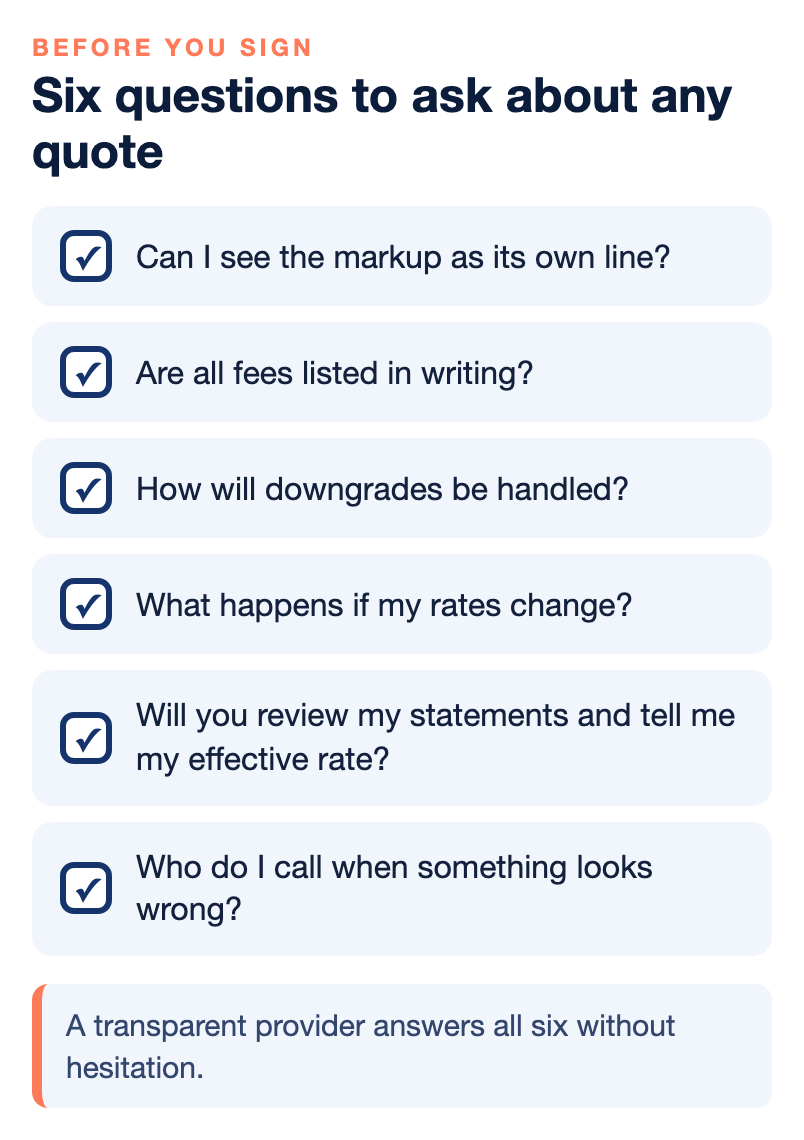
Run any quote through these seven questions before you sign. A provider that is truly transparent will answer all of them without hesitation.
- Can I see the processor’s markup as its own line? If the quote is a single blended number, ask what part is interchange, what part is assessments and what part is markup.
- Are all fees listed in writing? Ask for every fee, including monthly, gateway, statement, batch, PCI, annual and early-termination charges, before you sign. A fee that is not on paper can appear later.
- Which pricing model is this, and why? A good answer ties the model to your volume, ticket size and card mix, not to a sales preference.
- How will downgrades be handled? Ask how often transactions fall into higher categories and what you can do about it.
- What happens if my rates change? A provider should tell you in advance and explain why.
- Will you review my statements and tell me my effective rate? Your effective rate is your total fees divided by your total sales. A provider that will do this math for you in plain words is showing confidence in its pricing.
- Who do I call when something looks wrong? Transparent pricing helps you understand the cost. Reachable people help you fix a problem. Look for both.
How to check your effective rate in two minutes
Your effective rate is the single best number for cutting through marketing. To find it, take the total fees on a monthly statement and divide by the total sales processed that month. As an illustration only, if a business processed $20,000 in sales and paid $500 in total fees, its effective rate is 2.5 percent. Use your own figures, not those.
Then compare that rate with what you were quoted. If it is noticeably higher, the gap is made of the extras above. Our guide to reading your merchant statement walks through each section of a statement, and our explainer on hidden credit card processing fees covers the charges that most often hide in that gap. Keep in mind that your mix of card types, how you take payments and your industry code all affect the number, so compare like with like, and look at several months rather than one.
Do not skip the contract terms
A price is only as good as the agreement around it. Before you sign, read how long the agreement runs, what it costs to leave early, whether equipment is bought or leased and what happens to your pricing after the first year. Ask whether the markup is fixed or can be changed, and how much notice you get if it changes. These are questions, not accusations. A provider that is proud of its pricing will be glad to answer them, and a clear answer on paper is worth more than a promise on a call. If anything in the agreement does not match what you were told, ask for the change in writing before you sign, not after the first statement arrives.
Warning signs in a quote
- The quote is one rate with no breakdown of what is inside it.
- Equipment is described as free, and the pricing model is tiered.
- Fees appear on the first statement that were not on the quote.
- The provider will not review your existing statements.
- No one can explain why one pricing model was chosen for you over another.
- Support is a ticket form, with no phone number you can use.
None of these proves bad faith. Each one is a reason to slow down and ask for the answer in writing.
What transparent pricing does not promise
It does not promise the lowest possible number. A very small business that values a simple, predictable rate may be better off on a flat plan, and there is nothing wrong with paying for convenience as long as you know that is what you are doing. It also does not remove the need to read statements. Interchange-plus pricing, for example, gives you the most visibility, and it also asks you to understand more of what you see. And it does not mean every fee is negotiable. Interchange and assessments are fixed costs. The markup and the extra fees are where you can negotiate.
Who wrote this, and where NPS fits
Nationwide Payment Systems publishes this guide. We are a payments company based in South Florida, in business since 2001, and we sell merchant accounts, so we are not neutral. We offer several pricing models, including interchange-plus pricing, flat-rate pricing for select merchants, dual pricing programs and custom pricing for high-volume and B2B merchants, and we choose among them based on your business. We do not publish one universal rate, because pricing depends on volume, ticket size, card mix, risk and how you take payments. When we compare a flat-rate setup with cost-plus pricing, we start by reviewing about 90 days of your processing data. You can read more in our guide to four merchant account pricing models, our comparison of flat-rate and cost-plus processing, our note on the dual pricing program and why real support matters as much as pricing.
We are not the right fit for everyone. If you are a hobby seller with very low volume, if you only want an instant self-service sign-up, if you do not want to provide underwriting documents, or if the lowest advertised flat rate is the only thing that matters to you, a simpler platform will probably suit you better. Whatever you choose, get the pricing in writing, based on your own statements. The full library of payments guides covers pricing, fees and chargebacks in more depth.
Bottom line
Transparent merchant pricing is something you can test, not just something a provider claims. Look for the three layers, ask for every fee in writing, find out which pricing model you are being offered and why, and calculate your effective rate from real statements. A provider that welcomes those questions is giving you the best evidence it can that the pricing is honest. If you would like a second opinion on a quote or a statement you already have, you can contact our team, and if your current setup is the right one for you, we will tell you.
Frequently asked questions
What is transparent merchant pricing?
It is pricing that shows you each part of a card fee: the interchange paid to the card-issuing bank, the assessments paid to the card networks and the markup the processor keeps. You can see what the processor adds, rather than one blended number.
Which pricing model is the most transparent?
Interchange-plus, also called cost-plus, is generally the most transparent for growing businesses, because it shows the true interchange and assessments plus a clearly listed processor markup. Membership pricing and dual pricing programs are also clear, in different ways.
Is flat-rate pricing transparent?
It is simple, but it is not very transparent. It blends the three layers into one rate, so you cannot see how much of the price is cost and how much is the processor’s margin. That can be fine for a very small business and costlier as volume grows.
Why is my effective rate higher than the rate I was quoted?
The usual reasons are extra fees such as monthly, gateway, statement and compliance charges, plus downgrades into higher interchange categories. Your mix of card types and how you take payments also matter. Dividing your total fees by your total sales shows the real figure.
Can I negotiate merchant account fees?
You cannot negotiate interchange or card-network assessments, because those are set outside your processor. You can discuss the processor’s markup and its additional fees, so ask for every fee in writing and compare them before you sign.
How do I know whether a processor is hiding fees?
Ask for a full list of fees in writing, ask which pricing model you are on and why, and ask the provider to review your statements and explain your effective rate. A provider that will not do these things is giving you a reason to keep looking.
Does transparent pricing mean the lowest price?
No. It means you can see what you are paying for. The lowest price depends on your volume, ticket size, card mix and risk, and a simple flat rate can be the better choice for a very small business.





