
A B2B merchant account is a merchant account used by a company that sells to other companies, and it behaves differently from one built for a shop. The tickets are bigger, the sales are invoiced rather than rung up, buyers often pay with corporate or purchasing cards and the money you are waiting on can sit in a customer’s approval queue for weeks. Those differences change how the bank underwrites you, what you pay in fees, which payment types you should offer and what you should expect from a provider. This guide walks through each change, explains the extra data that can lower card costs on business sales, shows where ACH belongs next to cards and gives you a list of questions to ask before you open a B2B account.
The short answer
- Underwriters look hard at ticket size. Average sale and expected volume matter as much as monthly total, so be ready to explain large invoices, how you bill and when you are paid.
- Card costs on business sales depend on card mix and data. Sending the right invoice data on qualifying commercial card payments can lower the interchange you pay. This is called Level 2 and Level 3 processing.
- Cards are only one tool. For large invoices and recurring accounts, ACH usually belongs next to cards, and many B2B sellers steer customers toward it.
- Invoicing is part of the account. Payment links, partial payments, recurring billing and accounting sync matter more than a counter terminal.
- Ask for the whole workflow, not only a rate. A good B2B setup covers underwriting, cards, ACH, invoicing, data and support.
What makes B2B payments different
NPS describes B2B payments as transactions between companies for goods or services that are typically higher in dollar amount, invoice-based, recurring or contract-driven, and managed by accounting or finance teams. Compare a manufacturer selling $40,000 of equipment with a coffee shop selling a $6 latte. The needs are not the same, and yet many B2B companies still use systems designed around ordinary retail sales.
A typical B2B seller may deal with $5,000, $25,000 or $100,000 invoices, commercial cards, purchasing cards, purchase orders, several buyers and accounting contacts at one customer, net-30 or net-60 terms, recurring accounts and large receivable balances. For a business processing a $100 sale, a small pricing difference rarely gets attention. For a business processing millions of dollars a year, the structure of payments can have a big impact. That is why a B2B company should look at underwriting, card qualification, ACH, invoicing and processing strategy together.
How underwriting treats a B2B account
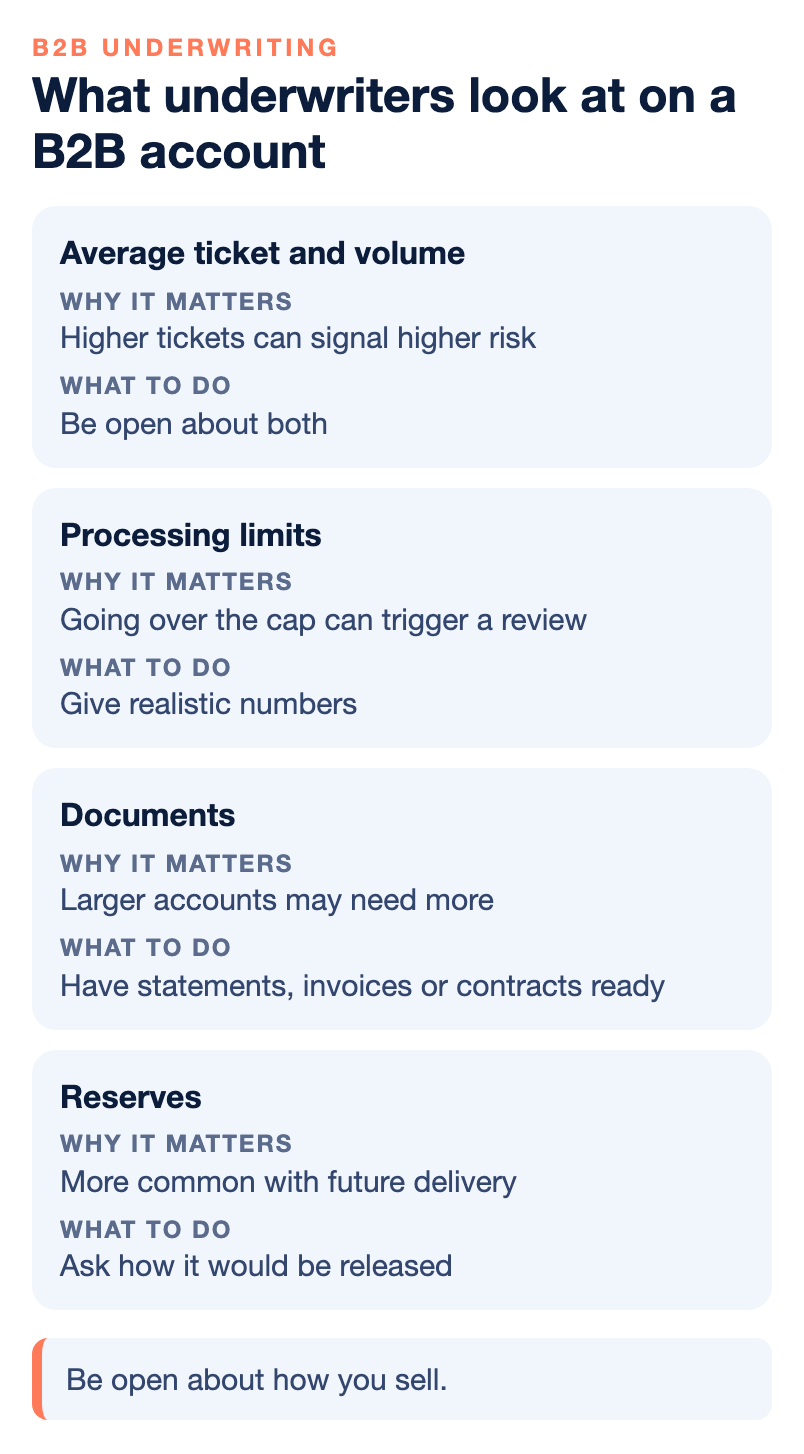
Underwriting is the bank’s review of whether it is comfortable carrying the risk of your business. It weighs the type of business, how long you have operated, your processing history, your chargeback history and your credit. For B2B sellers, a few points get extra attention.
- Average ticket and volume projections. Your average sale can matter more than your monthly total. A business that charges $50 a transaction looks very different from one charging $1,500 or more. Higher tickets can signal higher risk, especially when you key in transactions or charge cards before the service is delivered. Be open about both.
- Processing limits. An approved account will likely have a volume cap based on your projections. Exceeding it without approval can trigger a review, so give realistic numbers and tell the provider before a big order is paid.
- Documents. Most applications ask for a business bank account proof, the owner’s ID, registration papers, a website for online businesses and recent processing statements if you are switching. Larger or higher-risk accounts may also ask for financial statements, a business plan, and invoices or contracts.
- Reserves. A reserve is more common when a business has significant future delivery, high chargebacks, rapid growth or limited processing history. Many B2B sellers collect deposits for goods delivered later, so ask directly whether a reserve could apply and how it would be released.
- Honesty. Describe how you actually sell. Mismatches between the application and your real activity cause delays and can cause trouble later.
Our guide to what makes someone eligible for a merchant account explains how underwriters weigh each part.
What drives card costs on business sales, and how data can lower the bill
B2B sellers often take commercial and purchasing cards, so your card mix and the data you send affect what you pay. Interchange, the largest part of a card fee, depends on the card type, whether the card was present, the ticket size and the risk level, and business and commercial cards are part of that mix.
The offset is enhanced transaction data. Visa and Mastercard offer reduced interchange rates when the transaction carries extra detail, which is why Level 2 and Level 3 processing matters to B2B sellers who take corporate, purchasing, fleet or government cards.
- Level 1 is a basic consumer transaction with only standard details.
- Level 2 adds fields such as sales tax, a customer code and merchant information.
- Level 3 adds line-item detail, such as product descriptions, quantities, unit prices, tax and purchase order numbers, along with freight and duty where relevant.
There is one important catch. NPS reports that Visa’s Commercial Enhanced Data Program now requires accurate, dynamic data on each transaction. Generic or dummy values no longer qualify, and merchants may pay higher fees without realizing it if their system keeps sending placeholder data. A sale that is missing the data does not qualify for the lower rate. Ask your provider whether your invoices pass real data automatically, and how you can see which transactions qualified. Our guide to Level 2 and Level 3 processing goes through the details.
Where ACH fits next to cards
Cards are convenient for buyers, and they cost percentage-based fees that grow with the invoice. ACH moves money bank to bank, and NPS says ACH often costs far less than percentage-based card fees and describes a capped fee structure for high-ticket invoices, which is why it is favored for high-ticket invoices and recurring billing. A common approach is a hybrid one: promote ACH as the preferred payment method, accept credit cards for the buyers who want them and apply compliant surcharging to pass card costs to the buyer where it is allowed. That way, the customer chooses how to manage their own cash flow, and your margin is protected.
ACH has its own points to know. Standard ACH takes one to three business days, same-day ACH is available in many cases, and the process follows NACHA rules on authorization and security. ACH payments are also harder for a customer to reverse than card payments, which pushes a dispute back to a conversation between you and the customer. Our ACH optimization guide explains how to steer payments toward it.
Invoicing and cash flow are part of the account
Many B2B companies still wait on a process that runs from delivery to invoice to the customer’s accounts payable queue, an approval, a printed check, the mail, a deposit and finally clearing funds. Every step adds delay. Electronic invoices with a payment link let the customer pay the moment they approve the bill. NPS says smart invoicing can email or text a secure payment link, accept deposits and partial payments, set up recurring invoices and sync with QuickBooks, and that businesses are paid faster when customers can pay through a secure link.
When you evaluate a B2B merchant account, look at this side as closely as the rate. Ask whether invoices, deposits, partial payments, scheduled and recurring payments, and a customer payment portal are included, and how they connect to your accounting or enterprise resource planning system. Our guide to the best B2B payment gateway for manufacturers and distributors covers that workflow.
Disputes on large invoices
Chargebacks work the same way for B2B card payments as for any other card payment. A reversal is started by the buyer’s bank, funds are debited with a fee and you have a limited time to respond with evidence. On a large invoice, the loss is larger, so the evidence matters. Keep purchase orders, signed delivery confirmation, invoices, the buyer’s approvals and the full email history. Posting clear terms and refund policies helps too. Our chargeback survival guide explains what to collect.
Six questions to ask before you open a B2B account
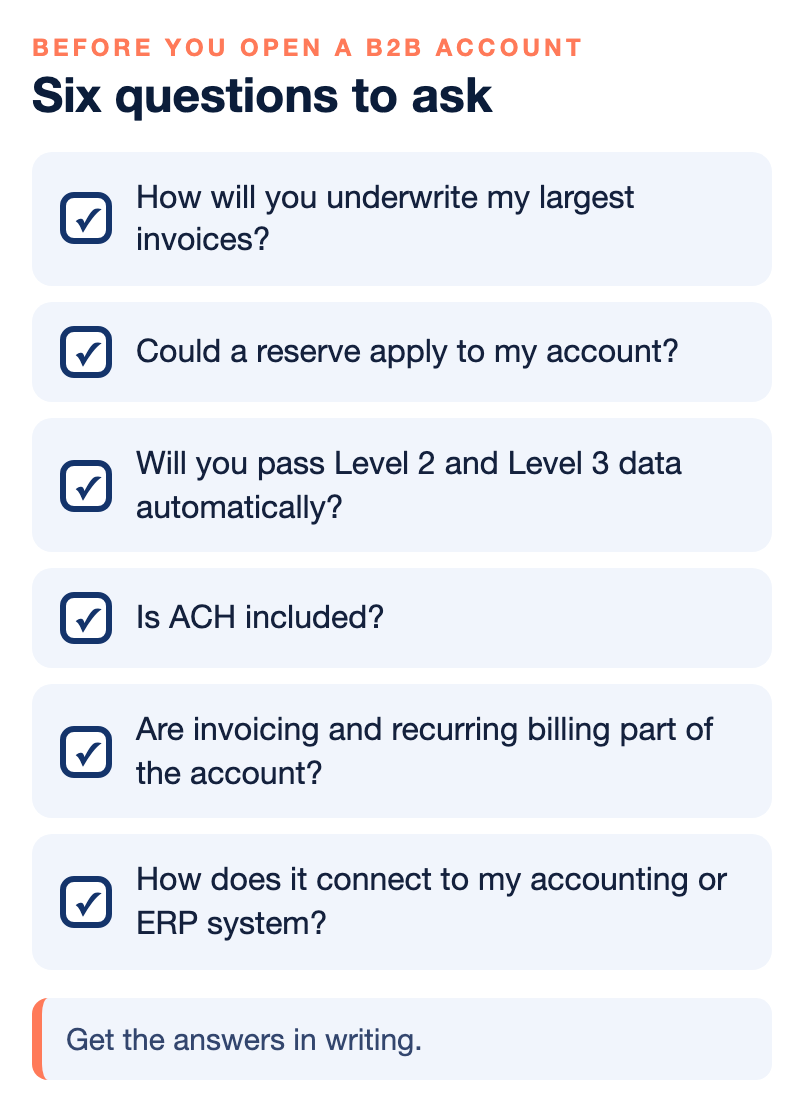
- How will you underwrite my largest invoices, and what do you need from me to approve my average ticket?
- Could a reserve apply to my account, and how would it be sized and released?
- Will you pass Level 2 and Level 3 data automatically, with real values on each invoice, and show me which transactions qualified?
- Is ACH included, and can I offer it alongside cards on the same invoice?
- Are invoicing, deposits, partial payments, recurring billing and a payment portal part of the account?
- How does the account connect to my accounting or ERP system, and who helps if the connection breaks?
Get the answers in writing. A provider that understands B2B will answer without trying to move you to a retail plan.
What to gather before you apply
A B2B application goes faster when the file is complete and easy to read. Have these ready.
- Your legal business name, tax ID, address and ownership details.
- Your expected monthly volume and average ticket, with a short explanation of how you bill and when you are paid.
- Proof of a business bank account, such as a voided check or bank letter.
- The owner’s identification and your business registration papers.
- Your website, if you sell or take payments online.
- Recent processing statements, if you are switching from another provider.
- For larger accounts, financial statements, a business plan, and sample invoices or contracts.
Common B2B mistakes
NPS points to a handful of patterns that cost B2B sellers money.
- Accepting only cards. For large and recurring invoices, ignoring ACH leaves savings on the table.
- Using a flat-rate processor with no automation. Flat-rate plans blend costs together and do not reward the extra data that business cards can qualify for.
- Assuming Level 3 data is being passed. NPS says many processors never set it up properly, and businesses can pay higher fees without realizing it.
- Acting as your customers’ bank. Waiting weeks for a check means you carry the float. A payment link and a clear way to pay by ACH or card shorten that gap.
Who wrote this, and where NPS fits
Nationwide Payment Systems publishes this guide. We are a payments company based in South Florida, in business since 2001, and we sell merchant accounts, so we are not neutral. We work with B2B companies, wholesalers, distributors and manufacturers, and we offer cards, ACH, Level 2 and Level 3 processing, smart invoicing and a gateway with accounting integrations and API tools. We do not publish one universal rate, because pricing depends on volume, ticket size, card mix, industry and risk. You can read more in our guide to B2B payments, and browse the full library of payments guides.
We are not the right fit for everyone. If you are a hobby seller with very low volume, if you only want an instant self-service sign-up, if you do not want to provide underwriting documents, or if the lowest advertised flat rate is the only thing that matters to you, a simpler platform will probably suit you better. Ask any provider for pricing and terms in writing, based on your own invoices.
Bottom line
A B2B merchant account is built around large invoices, commercial cards, accounting teams and long payment cycles. Underwriters look closely at ticket size and delivery timing, card fees can be lowered with accurate Level 2 and Level 3 data, ACH belongs next to cards for large and recurring payments, and invoicing is part of the product, not an add-on. Ask for the whole workflow, not just a rate. If you would like a second opinion on a quote or your current setup, you can contact our team, and if another setup fits you better, we will say so.
Frequently asked questions
What is a B2B merchant account?
It is a merchant account used by a business that sells to other businesses. B2B sales are typically larger, invoice-based, recurring or contract-driven, and managed by accounting teams, so the account needs to handle large tickets, commercial cards, ACH and invoicing.
How is underwriting different for B2B sellers?
Underwriters pay close attention to average ticket size, expected volume and how and when you are paid. Larger or higher-risk accounts may ask for financial statements, a business plan, and invoices or contracts, and a reserve can apply when there is significant future delivery.
What are Level 2 and Level 3 data?
They are extra transaction details that can qualify business, purchasing, fleet and government card payments for lower interchange. Level 2 adds items such as sales tax and a customer code, and Level 3 adds line-item detail, purchase order numbers and freight and duty.
Why might my B2B card fees stay high even though I send Level 3 data?
Visa now requires accurate, dynamic data on each transaction, so generic or repeated placeholder values no longer qualify. Ask your provider how data is generated and which of your transactions qualified.
Should a B2B seller accept ACH as well as cards?
Often yes. ACH is typically cheaper for large and recurring invoices and is harder for a customer to reverse than a card. Many sellers promote ACH as the default and accept cards for buyers who prefer them.
Can I add a surcharge to B2B card payments?
Where it is allowed and structured correctly, compliant surcharging is one way to pass card costs to the buyer. Mistakes can lead to network violations or complaints, so set it up with your provider.
What should a B2B payment setup include besides a rate?
Look for cards and ACH, Level 2 and Level 3 support, invoicing with payment links, partial and recurring payments, a way to connect to your accounting or ERP system, and real support when something breaks.





