
What you really pay for card processing is more than the percentage on your quote. It is the equipment you choose, the fees stacked inside every transaction, the add-ons that raise your effective rate, the days you wait for your money, and the cost of the disputes you lose. This guide follows a card payment through those five stops in the order it moves, says in plain words what to look for at each one, and links to a full article on each, so you can find where your own money is leaking.
The short answer
- Your real cost is your effective rate. Divide your total processing fees by your total card sales. If the result is higher than the rate you were quoted, there is a gap to find.
- A card fee has three layers. Interchange goes to the bank that issued the customer’s card, assessments go to the card networks, and the processor’s markup is the part the processor keeps. You should be able to see all three.
- Cost is not only the rate. The equipment you use, how fast the money lands and how many disputes you lose all change what a sale is really worth to you.
- Ask for everything in writing. A provider that welcomes a look at your statements and explains each fee is showing you what to expect.
Why the quote is not the whole story
When you sign up for card processing, the quote usually names one headline percentage. Your statement then shows something different, because the statement counts every dollar of fees against every dollar of sales. The two numbers measure different things, and the distance between them is where most surprises live. Some of that distance is fair: a keyed-in online sale costs more than a swiped one for a good reason. Some of it is fixable: a fee that appears with no explanation deserves a question.
The five stops below are the places the distance opens. You can read them in order, or jump to the one that hurts most. Each stop ends with a link to the full article, which goes into the steps, the questions to ask and the traps to avoid.
Stop 1: choose how you take the card
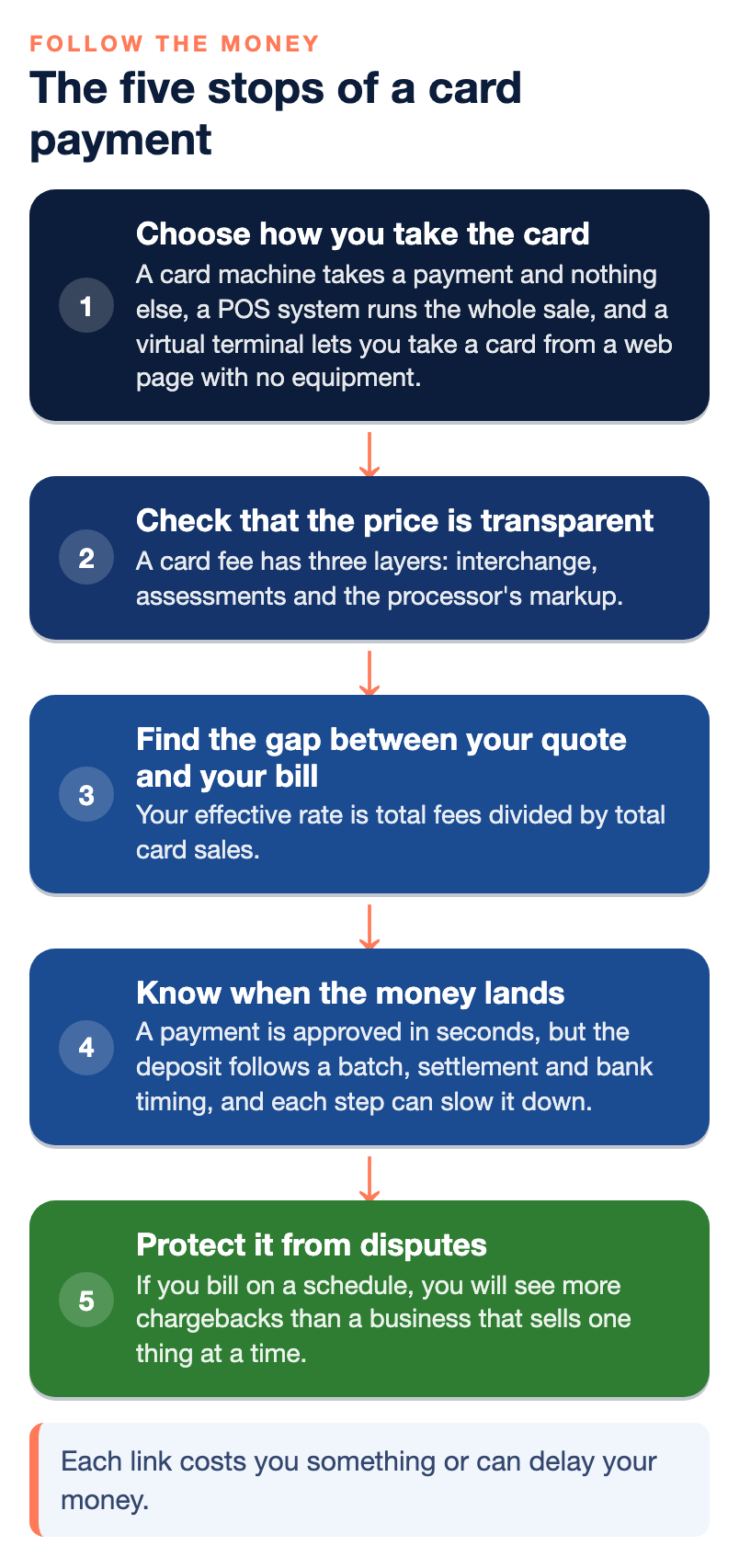
A credit card machine, also called a terminal, is built to accept payments. It does not do sales tax reporting, inventory tracking, customer data or accounting connections. A point-of-sale system, or POS, is an all-in-one business management hub: it handles reporting, tax, inventory, employees, accounting links and, where needed, age verification. A virtual terminal is a secure web portal for keying in card payments. You need no physical card reader, and it suits phone orders, mail orders, invoices and payments made away from the counter.
Many businesses combine them. A shop might run a POS at the counter and use a virtual terminal for phone orders, all under one merchant account. The right choice follows how you sell, not which device looks newest. It also changes your costs, because the equipment, the gateway and the way each card is taken all feed into what you pay later. The article compares the three side by side and gives five questions that point you to the right one. Read: credit card machine, POS system or virtual terminal.
Stop 2: check that the price is transparent
Inside every card fee there are three layers. Interchange is paid to the bank that issued the customer’s card. Assessments are paid to the card networks. The processor’s markup is the part the processor keeps. Transparent pricing means you can see each layer, including what the processor adds, instead of one blended number.
Pricing models differ in how much they show. Interchange-plus, also called cost-plus, shows the most. Flat-rate and tiered pricing show less, and tiered pricing is the easiest place to hide markup. Transparent does not always mean cheapest, though. A simple flat rate can make sense for a very small business, and transparency matters more as volume and ticket size grow. The advertised rate is also not the whole price: monthly, gateway, statement, batch and compliance fees, plus downgrades, can push your real cost above the number you were quoted.
The article gives a seven-point test you can run on any quote before you sign, and a list of warning signs. For a deeper look at the models themselves, see our guide to merchant account pricing models. Read: transparent merchant pricing and how to test a quote.
Stop 3: find the gap between your quote and your bill
Your effective rate is your total processing fees divided by your total card sales for the same period. For many businesses it comes out higher than the rate they were quoted. The gap is rarely one big surprise. Seven things cause most of it: downgrades, fixed monthly fees, compliance charges, monthly minimums, flat-rate markup above your real cost, dispute fees, and a card mix or industry code that does not match the quote.
You can find your own gap. Three months of statements, a calculator and a few steps are enough to see where the extra is coming from, and our guide to reading your merchant statement shows where each fee sits on the page. Once you know the gap, put your questions to your processor in writing. A processor that is confident in its pricing will walk through your statement line by line. The hidden fees that quietly drain a business are covered in this article. Read: why your effective rate is higher than your quote.
Stop 4: know when the money lands
Approval is instant. Deposit is not. Authorization happens in seconds, but the money you can spend arrives after the day’s batch settles, typically within one to two banking days at NPS, and sometimes sooner on a next-day funding arrangement. ACH is slower by default: a standard ACH payment takes one to three business days, and same-day ACH is available in many cases. Our ACH guide covers the options.
Your account type also changes what hits your bank. Some accounts collect fees daily from each deposit, and others deduct them once at the end of the month. Six things commonly delay a deposit: a missed batch, wrong bank details, an account review, a chargeback, a reserve and a platform hold. The practical advice is to ask before you sign. Funding speed, weekend deposits, reserves and hold rules are easy to ask about and hard to fix later. Read: when you actually get paid.
Stop 5: protect it from disputes
Subscriptions raise dispute risk by design. Recurring billing, free trials, promotions and digital delivery all increase the chance that a customer disputes a charge they forgot about or do not recognize. Not every dispute is fraud. A customer who contacted you first, asked to cancel or never received what was promised has a real complaint, and the right move is to fix it fast. A dispute that skips you entirely and uses a vague reason is a stronger sign of friendly fraud.
Prevention beats representment. Clear recurring-billing disclosure, a visible refund policy, easy cancellation and a recognizable billing descriptor stop more disputes than any evidence packet can win back. A refund before the dispute can also protect your ratio: Visa’s rapid dispute resolution tool, known as RDR, lets a merchant refund automatically before a case becomes a formal chargeback, so it does not count toward Visa’s monitoring ratios. The ratio is what threatens the account, because networks track it automatically and do not weigh your intent. For the wider picture see our complete guide to chargebacks. Read: subscription and free-trial chargebacks.
If you only have ten minutes
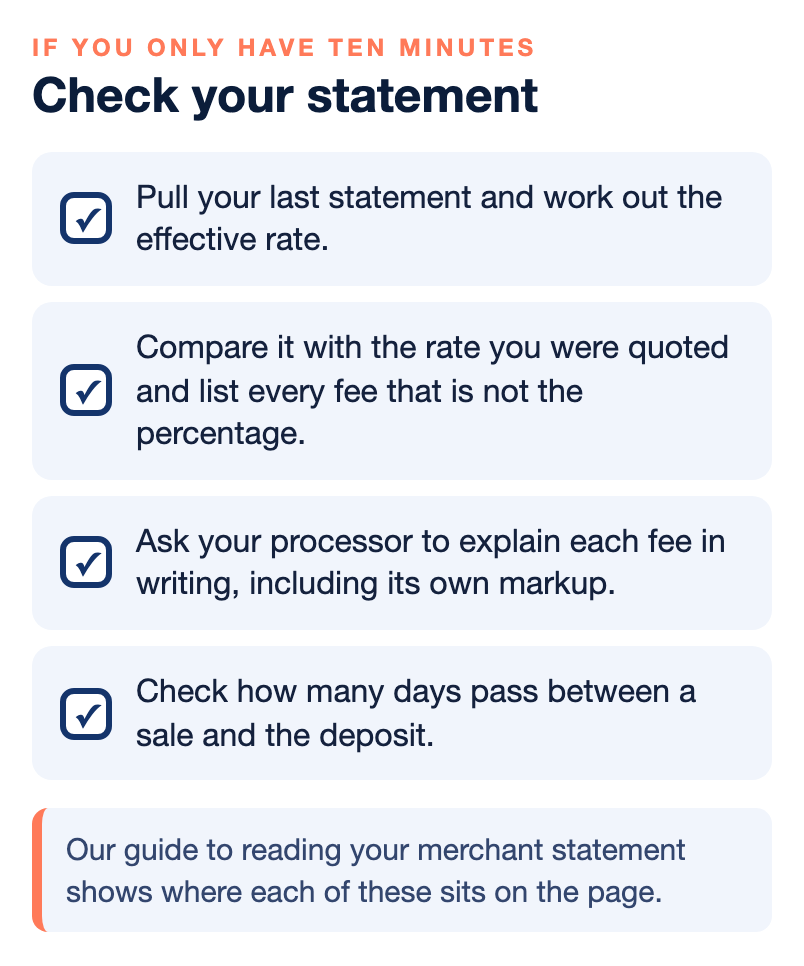
- Pull your last statement and work out your effective rate (total fees divided by total card sales).
- Compare it with the rate you were quoted and list every fee that is not the percentage.
- Ask your processor to explain each fee in writing, including its own markup.
- Check how many days pass between a sale and the deposit.
- If you bill on a schedule, check that your billing descriptor is recognizable and that cancelling is easy.
Who this guide is for
This guide is for owners and managers who accept cards and want to understand the bill without becoming experts in payments. It suits a shop with a counter, a business that takes phone and mail orders, an online seller, and a company that bills customers on a schedule. It is not a price list, and it does not quote rates, because the right price depends on your volume, your average ticket, your card mix and how you sell. It is a map of the places to look, in the order the money moves.
Questions to ask at every stop
You do not need to know the answers in advance. You need to ask the questions in writing, keep the replies, and compare them when your statements arrive. These are the ones that matter most.
Before you choose equipment
- How do I take most of my payments: at a counter, over the phone, online, on the road, or on a schedule?
- Do I need only to accept payments, or also inventory, reporting, tax and employee tools?
- Which pieces share one merchant account, so I do not pay for the same thing twice?
Before you sign a quote
- Which pricing model am I on, and why was it chosen for my business?
- Can I see the processor’s markup as its own line, apart from interchange and assessments?
- Can I have every fee in writing, including monthly, gateway, statement, batch and compliance charges?
- What happens to my price if a card is downgraded?
When your statement arrives
- What is my effective rate this month, and how does it compare with last month?
- Which fees are new, and which are the ones I was quoted?
- Will my provider walk through the statement with me line by line?
Before money moves
- How many banking days pass between a sale and the deposit?
- Are fees taken from each deposit, or once at the end of the month?
- What are the rules for reserves and holds, and what can trigger them?
- Are weekend and holiday deposits handled differently?
Before a dispute arrives
- Is my billing descriptor one a customer will recognize on a statement?
- Is cancelling as easy as signing up, and is my refund policy visible?
- Do I know my dispute ratio, and how far it sits below the published thresholds?
- Can I refund automatically before a case becomes a formal chargeback?
How the five stops connect
The stops are not separate problems. The equipment you pick at stop 1 shapes the fees at stops 2 and 3. A pricing model that hides markup at stop 2 is usually what produces the gap at stop 3. A reserve or a chargeback at stop 5 can delay the deposit at stop 4. Read together, they show a pattern: the businesses that get surprised are the ones that never put a question in writing. The businesses that are not surprised ask the same few questions at each stop, before they sign and again every few months.
A simple routine to keep the bill honest
Once you have walked the five stops, the habit that keeps your costs honest is small. Each month, when your statement arrives, work out your effective rate and write it down next to last month’s. Note any fee that is new. Check that your deposits arrived when you expected them to. Look at how many disputes came in and what reasons they gave. Ten minutes a month is enough to catch a creeping fee, a downgrade pattern or a rising dispute count while it is still cheap to fix. If a number moves and you cannot explain why, send the question to your processor in writing and keep the answer.
Review the whole picture again whenever something changes: a new way of selling, a new product, a change in average ticket, a jump in volume or a move from one-time sales to subscriptions. Pricing that suited a small shop may not suit a growing one, and a setup that worked for counter sales may not fit online or recurring billing.
Where to go next
See more topics in the Payments Guides. If you want someone to look at your own statements, contact Nationwide Payment Systems. We cannot promise a lower bill, and the right answer depends on your volume, your ticket size and how you sell, but we can show you where yours comes from.
Frequently asked questions
What is the effective rate on card processing?
It is your total processing fees divided by your total card sales for the same period. It shows what you really pay, and it can be higher than the rate you were quoted.
Why is my processing bill higher than the quote?
The usual reasons are extra fees such as monthly, gateway, statement and compliance charges, plus downgrades into higher interchange categories. Your card mix and how you take payments also matter.
What are the three parts of a card processing fee?
Interchange goes to the bank that issued the card, assessments go to the card networks, and the processor’s markup is the part the processor keeps. Transparent pricing shows all three.
How long does it take to get paid after a card sale?
Authorization takes seconds, but the deposit follows the day’s batch. It is typically one to two banking days at NPS, and holds or reviews can add more time.
Do I need a card machine, a POS system or a virtual terminal?
It depends on how you sell. A machine takes payments only, a POS system runs the sale and the business behind it, and a virtual terminal takes cards from a web page. Many businesses use more than one.
Why do subscription businesses get more chargebacks?
Customers forget they signed up, free trials turn into paid plans, and renewal charges can look unfamiliar. Clear billing descriptors, easy cancellation and a visible refund policy help.
Does transparent pricing mean the lowest price?
No. It means you can see what you are paying for. The lowest price depends on your volume, ticket size, card mix and risk.





