
Your effective rate is your total processing fees divided by your total card sales, and for many businesses it comes out higher than the rate they were quoted when they signed up. The gap is rarely one big surprise. It is usually a handful of smaller things stacked together: fixed monthly fees, transactions that fell into costlier interchange categories, a quote that was a starting point rather than a price, and a few charges that were never on the quote at all. This guide shows you how to calculate your effective rate, the seven most common reasons it runs high, and a step-by-step way to find the gap on your own statement before you call your processor.
The short answer
- The quoted rate and the effective rate measure different things. A quote usually names one headline percentage. Your effective rate counts every dollar of fees against every dollar of sales.
- Seven things cause most gaps: downgrades, fixed monthly fees, compliance charges, monthly minimums, flat-rate markup above your real cost, dispute fees and a card mix or industry code that does not match the quote.
- Some gaps are fair and some are fixable. A keyed-in online sale costs more than a swiped one for a good reason. A fee that appears with no explanation deserves a question.
- You can find the gap yourself. Three months of statements, a calculator and the steps below are enough to see where the extra is coming from.
- Put your questions in writing. A processor that is confident in its pricing will walk through your statement line by line.
What your effective rate is, and how to calculate it
Take the total fees shown on a monthly statement. Divide that number by the total sales volume for the same month. The result, shown as a percentage, is your effective rate. As an illustration only, if a business processed $20,000 in sales and paid $500 in total fees, its effective rate is 2.5 percent. Use your own figures, not these.
Do this for at least three months. A single month can mislead you, because a large refund, a run of keyed-in sales or a seasonal dip in volume can push the number around. Three months show the pattern.
Then set that number beside what you were quoted. The difference between them is the gap, and the rest of this guide is about what fills it.
The seven usual reasons the gap opens
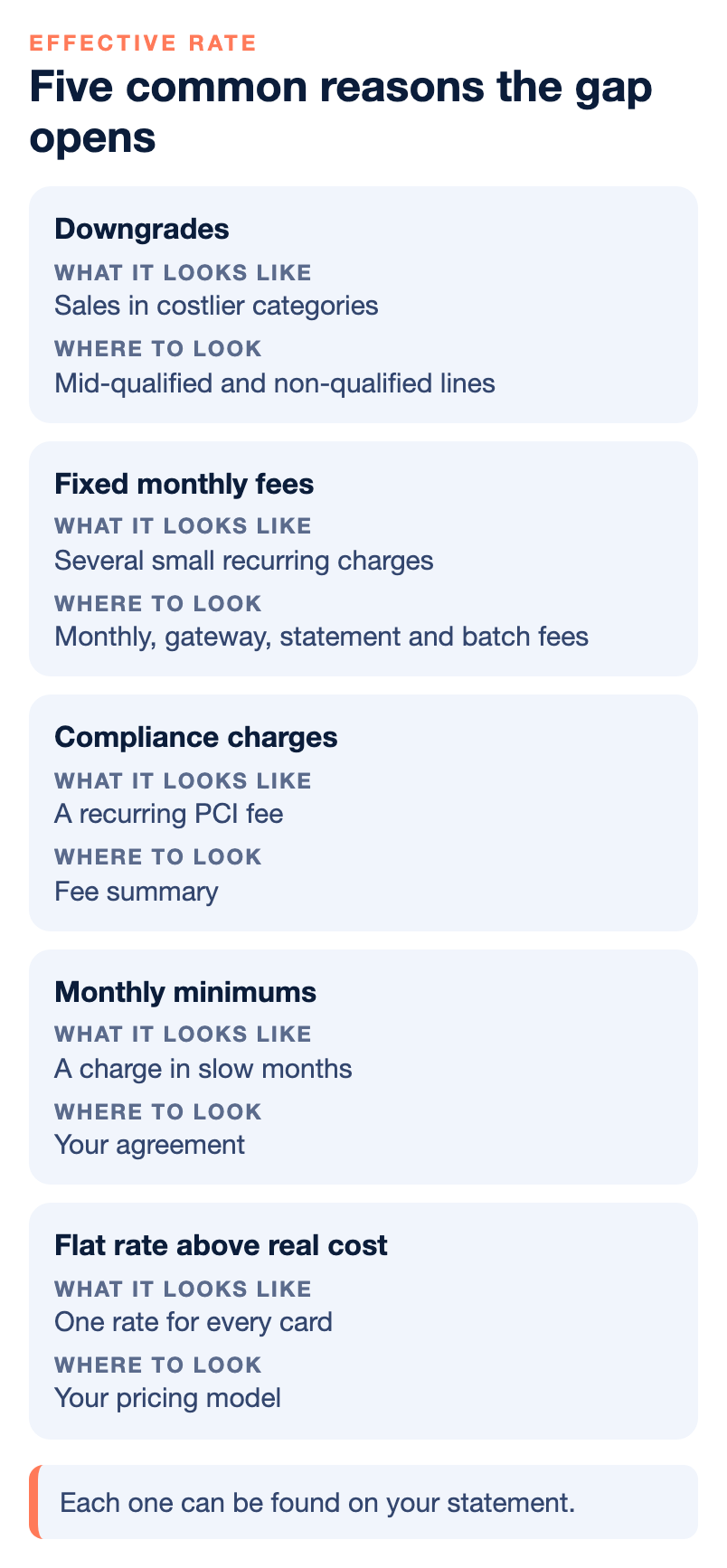
1. Downgrades
Every card transaction is placed into an interchange category. The lowest-cost category has requirements, and when a transaction does not meet them it is “downgraded” into a higher one. The extra cost lands in your fees, not in your quote. The common triggers are missing address verification data, not settling the day’s batch within 24 hours, a business-to-business sale that is missing a tax ID, and an industry code that does not match the business. On a tiered statement, downgrades show up as transactions in the mid-qualified or non-qualified buckets. If you see those words on your statement, you are likely on tiered pricing, and it is worth knowing how many of your transactions land outside the lowest bucket.
2. Fixed monthly fees
A percentage on every sale is only part of the bill. Many providers add a monthly account fee, a gateway fee, a statement fee, a batch fee and a platform or reporting fee. Because these are fixed, they weigh more on a small month than a large one. If your statement lists several small charges, add them up and divide the total by your sales. That share is how much of your effective rate comes from fixed fees alone.
3. Compliance charges
Card-industry security standards, known as PCI, ask every merchant to validate its practices, usually by completing a self-assessment questionnaire. Some processors charge a recurring fee when validation has not been completed, even when the actual risk is low. If a PCI non-compliance fee is on your statement, ask your provider how to complete the validation and have the fee removed. It is usually a short task, and the fee can keep running for months if no one acts.
4. Monthly minimums
Some agreements charge you the difference if your processing fees fall below a set amount. New businesses and seasonal ones feel this most, because a slow month produces a charge for money you did not process. Check whether your agreement has a minimum, and look at your slowest months first.
5. A flat rate above your real cost
Flat-rate pricing is simple, and you pay for that simplicity because the processor keeps the difference between the flat rate and the actual cost of each card. For example, if your real average cost is one percentage point below your flat rate, a business that processes $100,000 a month is paying about $1,000 a month for the convenience. That may be fair for a very small business. It becomes a larger decision as volume grows, which is why many growing businesses compare a flat rate with interchange-plus, also called cost-plus, pricing. Our comparison of flat-rate and cost-plus processing goes through that choice.
6. Dispute and chargeback fees
A chargeback usually carries a fee, along with retrieval request fees and any charges tied to monitoring programs. These can apply even when you win the dispute. If your statement shows a lot of them, the gap is partly a dispute problem, not a pricing problem, and the fix is better prevention and faster responses.
7. A card mix or industry code that does not match the quote
Interchange depends on the card type, whether the card was present, the industry, the ticket size and the risk level. A quote built around swiped debit cards will not match a business that keys in rewards-card payments online. Commercial cards and business-to-business sales can also cost more unless the right data is passed with the transaction. The industry code, known as the merchant category code or SIC code, matters too. A business that is coded to the wrong category can pay more and can also see more disputes, so check that the code on your account matches what you actually sell.
A five-step way to find your gap
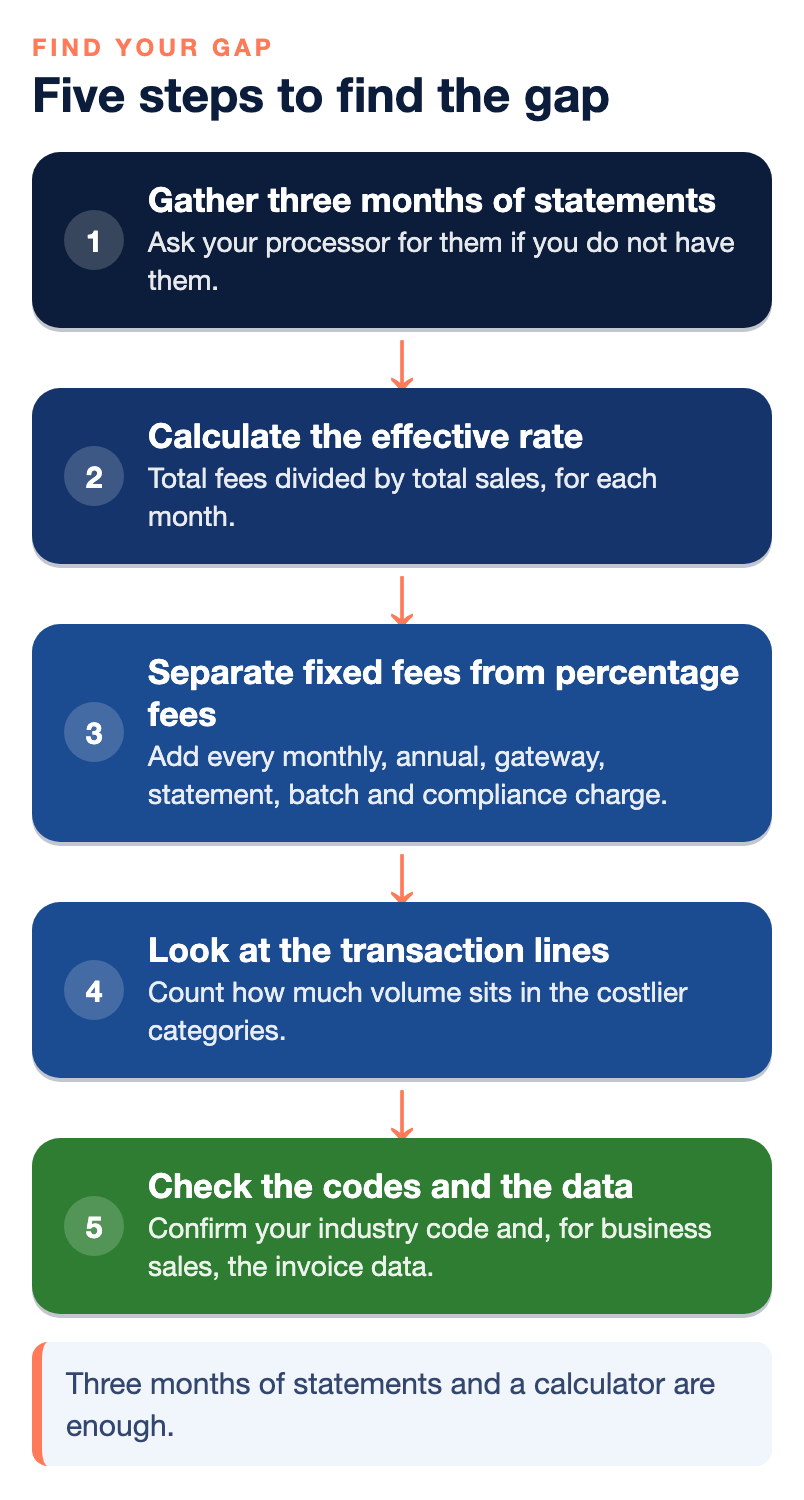
- Gather three months of statements. Ask your processor for them if you do not have them.
- Calculate the effective rate for each month. Total fees divided by total sales.
- Separate the fixed fees from the percentage fees. Add every monthly, annual, gateway, statement, batch and compliance charge. Divide that total by sales. That tells you how much of the gap is fixed cost.
- Look at the transaction lines. If you see qualified, mid-qualified and non-qualified, count how much volume sits in the costlier two. If you are on interchange-plus, look for the interchange categories that cost the most and ask why transactions landed there.
- Check the codes and the data. Confirm that your industry code fits your business. If you sell to other businesses, ask whether your system passes the extra invoice data that can qualify commercial card sales for lower rates.
What is normal and what deserves a question
Not every gap is a problem. It helps to separate the two.
Usually normal: keyed-in and online sales cost more than swiped or tapped ones. Rewards cards cost more than basic cards. PIN-based debit tends to cost less. Business-to-business sales can run higher than retail sales. A slightly different effective rate from month to month as your mix changes is expected.
Worth a question: a fee that was not on the quote, a compliance fee with no explanation, a pile of transactions in the costliest categories, a monthly minimum you did not know about and a rate that rose without notice.
When you call, be specific. “My effective rate is higher than I was quoted” is vague. “My statement shows these three fixed fees and this much volume in the non-qualified bucket, can you explain each one” gets a better answer.
Ways businesses close the gap
- Batch out every day. Settling transactions on time helps avoid late fees and downgrades.
- Collect the data that qualifies a sale. Passing address verification and, for business sales, invoice details, helps transactions land in lower categories. Our guide to Level 2 and Level 3 processing explains the extra data for business-to-business sales.
- Complete your PCI validation. It removes one avoidable charge.
- Remove fees you do not need. Ask which monthly or platform charges you can drop.
- Review your pricing model. If you are on tiered or flat-rate pricing and your volume has grown, ask for a comparison with interchange-plus, using your own statements.
- Look at other ways to offset costs. Where allowed, a properly built dual pricing or cash discount program can reduce what the business pays. It has to be set up correctly, because mistakes can lead to network violations or customer complaints.
- Offer a bank-based option for large invoices. For big, recurring or business-to-business payments, ACH is often much cheaper than a card, especially on large invoices.
Six questions to send your processor in writing
Once you have found the lines that look high, put your questions in an email. A written answer gives you something to refer back to, and it makes it easy for the other side to give a clear reply instead of a vague one.
- Which pricing model am I on, and what is my processor markup on top of the actual card costs?
- Please list every recurring fee on my account, with the amount and the reason for each.
- How much of my volume was downgraded last month, and what caused it?
- Is a PCI non-compliance fee on my account, and what do I need to do to stop it?
- Does my agreement include a monthly minimum, and has it been charged?
- Is the industry code on my account correct for what I sell, and has my processor passed the right data on business-to-business sales?
If the answers are clear, you have learned where your money goes and what you can change. If they are vague, or if your processor will not look at your statements, that tells you something too. Keep the replies with your statements so you can compare them the next time your rate moves.
Who wrote this, and where NPS fits
Nationwide Payment Systems publishes this guide. We are a payments company based in South Florida, in business since 2001, and we sell merchant accounts, so we are not neutral. When a business asks us to look at its costs, we start with its statements, usually about 90 days of processing data, and explain what is on them. We do not publish one universal rate, because pricing depends on volume, ticket size, card mix, risk and how you take payments. For more detail, see our guides to reading your merchant statement, hidden credit card processing fees and special interchange fees, or browse the full library of payments guides.
We are not the right fit for everyone. If you are a hobby seller with very low volume, if you only want an instant self-service sign-up, if you do not want to provide underwriting documents, or if the lowest advertised flat rate is the only thing that matters to you, a simpler platform will probably suit you better. Whoever you choose, ask for pricing in writing, based on your own statements.
Bottom line
A high effective rate is a symptom, not a mystery. It comes from the fixed fees, the downgrades, the compliance charges and the mix of cards and codes behind your statement, and each one can be found with three months of statements and a calculator. Once you can name the pieces, you can fix the ones that are yours to fix and ask your processor about the rest. If you would like a second set of eyes on a statement, you can contact our team, and if your current pricing is already the right fit, we will tell you.
Frequently asked questions
What is an effective rate in credit card processing?
It is your total processing fees divided by your total card sales for the same period. It counts every fee, not just the headline percentage, so it shows what you actually pay as a share of what you sell.
Why is my effective rate higher than the rate I was quoted?
The usual causes are downgrades into costlier interchange categories, fixed monthly fees, compliance charges, monthly minimums, flat-rate markup above your real cost, dispute fees and a card mix or industry code that does not match the quote.
What is a downgrade on a merchant statement?
A downgrade happens when a transaction does not meet the requirements for the lowest interchange category and is charged at a higher one. Common triggers include missing address verification data, late settlement, missing business-to-business data and an incorrect industry code.
Should I pay a PCI non-compliance fee?
Ask your provider how to complete the PCI validation and have the fee removed. It is generally an avoidable charge, and it can keep appearing every month until validation is complete.
How many months of statements should I review?
At least three. One month can be skewed by refunds, keyed-in sales or a seasonal dip, while three months show the pattern.
Does a higher effective rate always mean I am overpaying?
No. Keyed-in sales, online sales, rewards cards and business-to-business sales cost more by nature. A high rate is worth investigating when it comes from fees that were not quoted or from transactions that could have qualified for a lower category.
Can switching pricing models lower my effective rate?
It can, especially as volume grows. Flat-rate and tiered pricing blend costs together, while interchange-plus shows them separately. Whether it saves money depends on your volume, ticket size and card mix, so compare using your own statements.





