
ACH Payments for B2B Businesses
Lower Costs, Faster Cash Flow, and Smarter Electronic Payments

What Are ACH Payments?
The Backbone of U.S. Bank-to-Bank Transfers
ACH (Automated Clearing House) payments move funds directly between U.S. bank accounts. Unlike credit card transactions, which route through private card networks (Visa/Mastercard), ACH transactions move through a centralized public network governed by NACHA.
Because it bypasses the interchange fees associated with credit cards, ACH is the preferred method for businesses moving significant volume or high-dollar amounts.
Common Business Use Cases
Modern firms utilize ACH for transactions where cost-efficiency and reliability are more important than "instant" settlement:
B2B Invoicing
Settling high-ticket vendor contracts without percentage-based fees.
Recurring Billing
Automating subscriptions, memberships, or monthly rent.
Payroll & Reimbursements
Direct deposits for employees and contractors.
Vendor Payments
Managing supply chain costs while avoiding expensive wire fees.
ACH vs. Credit Cards: A Strategic Comparison
For businesses, the choice between ACH and credit cards often comes down to the balance between processing speed and profit margin.
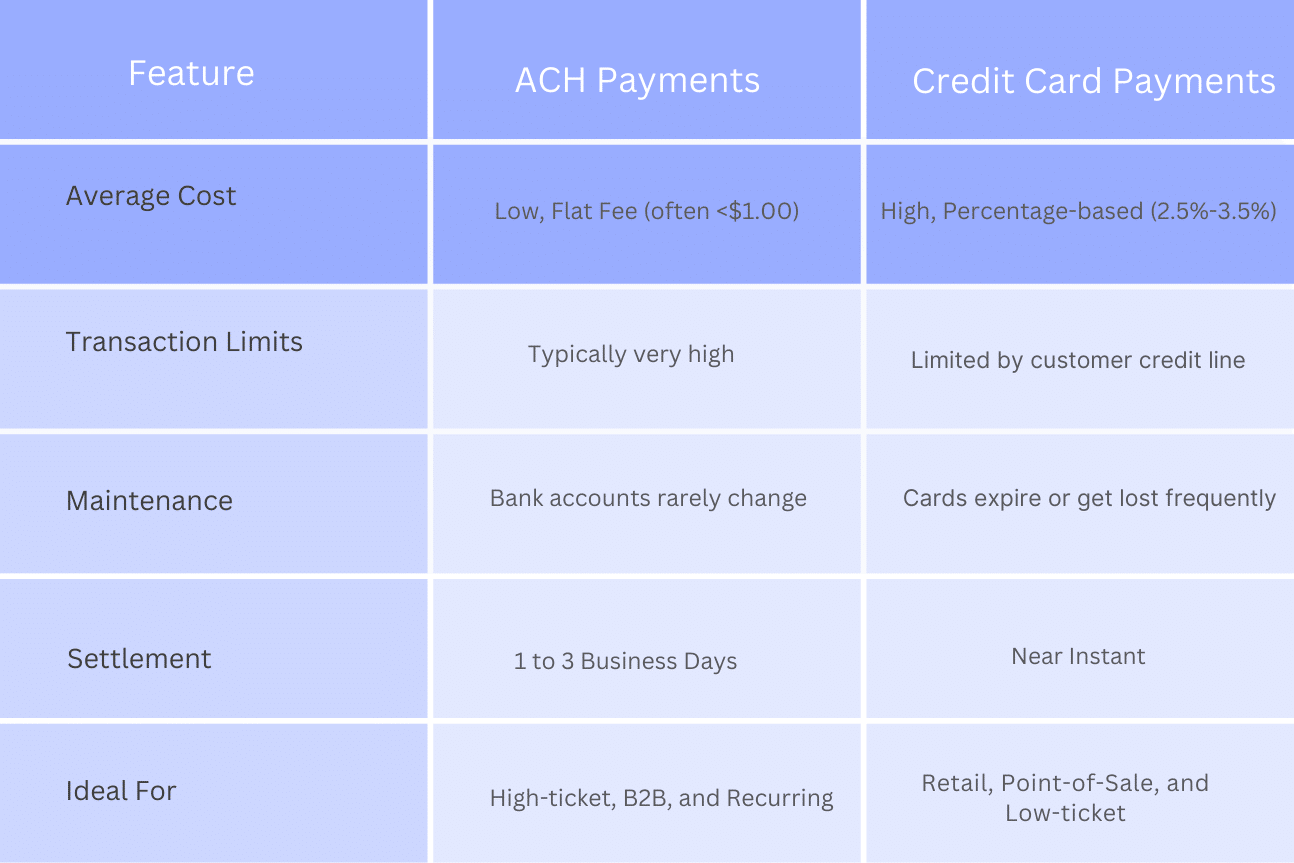
Strategic Insight: For an invoice of $5,000, a credit card fee would cost your business roughly $150. The same transaction via ACH would typically cost less than $2. Over hundreds of transactions, this shift in payment rails can save a company tens of thousands of dollars in annual overhead.
2. Strategic Rebalancing: The "Hybrid" Payment Model
Modern B2B firms no longer force a "one-size-fits-all" payment policy. Instead, they use Economic Incentives to guide customer behavior:
-
Promote ACH: Set as the default payment method for all high-value invoices.
-
Permit Credit Cards: Allow for customer convenience but apply a Compliant Surcharge.
-
The Result: You preserve the customer’s choice of payment while protecting your net margin. If a customer chooses the card, they cover the fee; if they choose ACH, your costs remain minimal.

3. The Hidden Cost of "Analog" Payments
Paper checks and wire transfers are often viewed as "free" or "standard," but they harbor significant operational drag.
The Problem with Checks
-
Mail Float: 3–7 days of transit time where capital is "dead."
-
Manual Labor: Hours spent on physical deposits and manual reconciliation in the ERP.
-
Security Risk: Checks are the #1 target for B2B payment fraud.
The Problem with Wires
-
Friction: Customers often must physically visit a bank or use complex portals to initiate a wire.
-
High Fees: $15–$40 per transaction is unsustainable for routine invoicing.
4. Cash Flow and the Time Value of Money
In B2B, Days Sales Outstanding (DSO) is a critical metric of business health. Money sitting in your customer's bank account for 30 days is capital that isn't working for you.
-
Liquidity Management: Automated ACH clearing (1–3 days) allows you to pay your own vendors faster and reduce reliance on credit lines.
-
Predictable Forecasting: Know exactly when funds will hit your account rather than waiting on "the check in the mail."
-
Ending the "Float": Electronic payments shift the responsibility of capital management back to the payer, ensuring you are not acting as an interest-free bank for your clients.


5. Technology: NPSONE Smart Invoicing
ACH is most effective when embedded within a digital workflow. The NPSONE platform bridges the gap between payment processing and accounting.
Key Capabilities:
-
Click-to-Pay Portals: Customers receive a branded digital invoice and pay via bank or card with one click.
-
Automated Dunning: The system auto-sends reminders for past-due invoices, reducing the need for "chasing" payments.
-
2-Way Sync: Direct integration with QuickBooks Online and other ERPs through a robust API.
-
Single-Pane Visibility: View all card and ACH settlements in a single dashboard for simplified reconciliation.
6. Security and Trust (NACHA Compliance)
Is ACH safe? Yes. ACH payments move through a highly regulated network governed by NACHA.
-
Encryption: Bank-level security protocols protect sensitive routing and account numbers.
-
Verification: Modern systems verify bank accounts instantly, reducing "NSF" (Non-Sufficient Funds) returns.
-
Authorization: Clear, digital authorization trails protect both the merchant and the payer from unauthorized debits.

1. Is ACH cheaper than credit cards?
Yes. ACH costs are typically a flat fee per transaction, whereas credit cards charge a percentage of the total transaction value. For high-ticket B2B invoices, switching to ACH can save a business thousands of dollars in processing fees.
2. Can I still accept credit cards if I offer ACH?
Absolutely. Most modern businesses offer both methods. By providing a smart invoicing link, you can let your customers choose their preferred payment method while setting ACH as the default to encourage lower-cost transactions.
3. Does ACH help reduce processing fees?
Yes—especially when combined with a card surcharging program. By offering ACH as a fee-free alternative while applying a surcharge to credit card payments, you can effectively drive down your overall cost of acceptance to near zero.
4. Is ACH faster than traditional paper checks?
Yes. While paper checks can take weeks to arrive and clear, ACH transactions typically clear in just a few business days. This speed significantly reduces Days Sales Outstanding (DSO) and puts capital back into your business faster.
5. Is ACH better than wire transfers?
For routine B2B payments, ACH is far superior. It is significantly cheaper than the high fees associated with domestic wires. Additionally, ACH is much more convenient for customers, as wire transfers often require a physical trip to a bank branch.
6. How can ACH improve my business's cash flow?
By automating the collection process and reducing the time spent waiting for funds to settle, ACH improves overall liquidity. Faster, predictable payment cycles allow for better inventory management and financial planning.
7. Is ACH secure for B2B payments?
Yes. When implemented under strict NACHA guidelines, ACH is one of the most secure ways to move money. It uses bank-level encryption and robust identity verification to protect against unauthorized transactions.
8. Can ACH be used for recurring billing?
Yes. ACH is the ideal method for subscriptions, retainers, and recurring service contracts. It provides a "set it and forget it" experience for the customer while ensuring the merchant receives timely payments without credit card expiration issues.
9. Do customers trust ACH payments?
Yes. ACH is the standard for most accounting and finance teams. Professional buyers and B2B clients generally prefer ACH because it integrates smoothly with their internal accounts payable processes and bank reconciliations.
10. How do I start accepting ACH?
You can start by partnering with a specialized payment provider like Nationwide Payment Systems. Our NPSONE platform includes smart invoicing and integrated ACH support to help you modernize your payment infrastructure quickly.