

After a customer pays you, the money does not land in your bank account that instant. A card payment is approved in seconds, grouped into a daily batch, settled through the processor and then deposited, and each step has its own timing and its own ways of going wrong. Nationwide Payment Systems (NPS) says funds are typically deposited within one to two banking days and that qualified merchants may be eligible for next-day funding. Your own timing depends on your provider, your account type, how you settle each day and whether anything puts a hold on your funds. This guide follows a payment from the register to your bank, explains how card and ACH timing differ, lists the six things that most often delay a deposit and gives you the questions to ask about funding before you sign with anyone.
The short answer
- Approval is instant. Deposit is not. Authorization happens in seconds. The money you can spend arrives after the day’s batch settles, typically within one to two banking days at NPS, and sometimes sooner on a next-day funding arrangement.
- ACH is slower by default. A standard ACH payment takes one to three business days, and same-day ACH is available in many cases. ACH also follows a more predictable schedule.
- Your account type affects what hits your bank. Some accounts collect fees daily from each deposit. Others deduct them once at the end of the month.
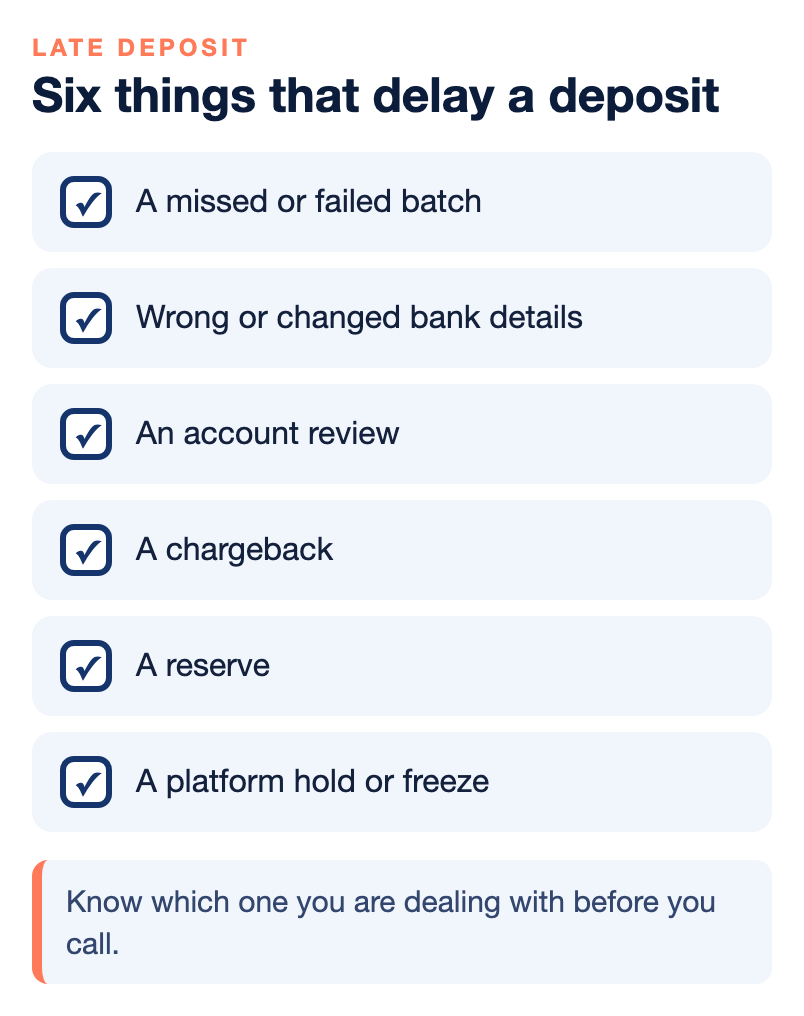
- Six things commonly cause delays: a missed batch, wrong bank details, an account review, a chargeback, a reserve and a platform hold.
- Ask before you sign. Funding speed, weekend deposits, reserves and hold rules are easy to ask about and hard to fix later.
Follow a card payment from the counter to your bank
It helps to see the payment as a chain with four links. Each link is a place where timing can change.
- Authorization. When the customer taps, dips, swipes or enters a card, the payment gateway securely sends the card details to the processor, which routes them through the card network to the customer’s bank. The bank approves or declines in seconds. Approval is a green light to finish the sale. It does not mean you have been paid.
- Batching. Approved transactions are grouped into a batch, usually once a day. Your system or terminal closes the batch and sends it for payment. If you forget to close it, or it fails, the money waits.
- Settlement. The processor handles the clearing and settlement of funds between banks. Think of your merchant account as a holding place. It collects the money from approved card transactions until it settles into your regular business account.
- Deposit. The money reaches your business bank account, net of any fees your account collects daily. Your bank’s own processing and its calendar of business days then apply.
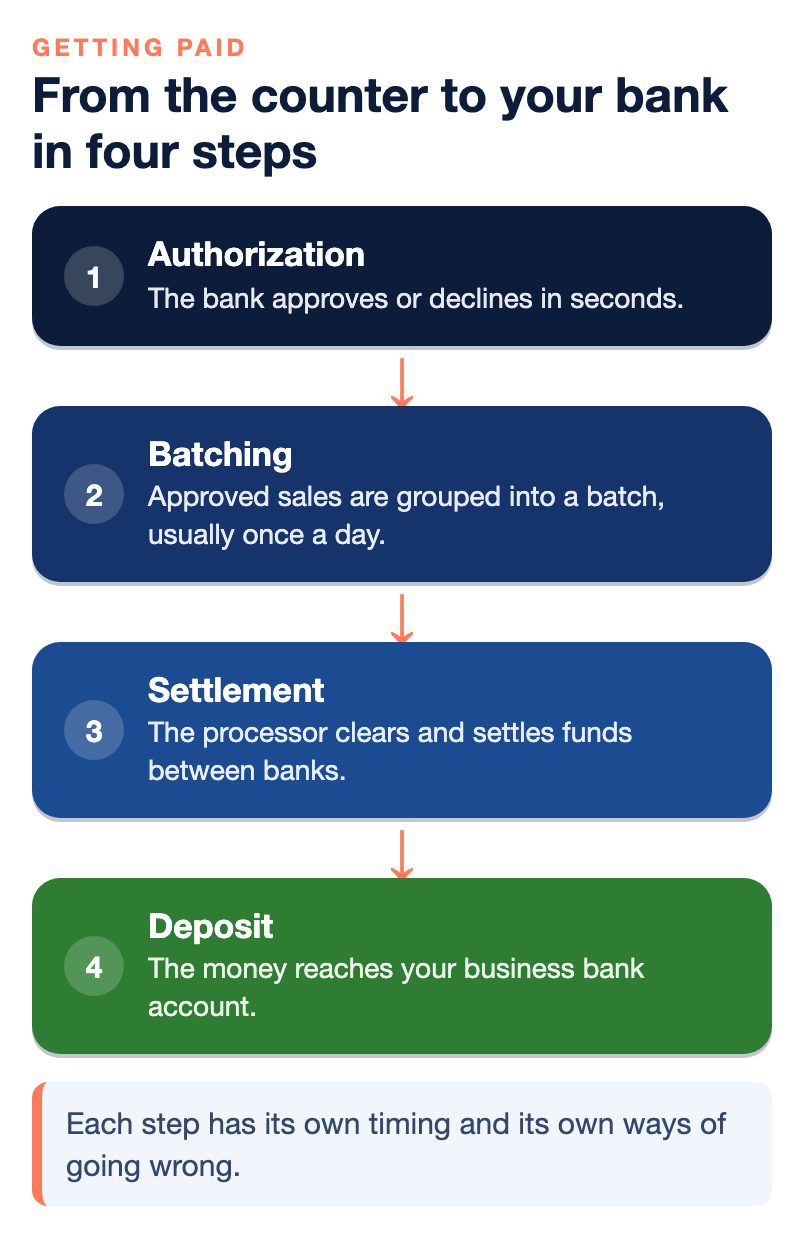
How long a card deposit usually takes
NPS says funds are typically deposited within one to two banking days, and that qualified merchants may be eligible for next-day funding. Those are NPS program statements, not a promise for every account. Your own schedule depends on the provider, the type of account and your approval. NPS also describes a dedicated merchant account as the better fit for established businesses, with lower rates, faster funding and personalized support. Use these figures as a starting point for questions, and get your timing confirmed in writing.
Two habits protect your timing from the merchant side.
- Batch out every day. Closing your batch daily helps avoid late fees and rate downgrades, and it keeps your deposits on a regular rhythm.
- Compare your deposit summary to your bank statement. Make sure the two match. If a deposit is missing or short, ask your processor promptly, because a delayed deposit hurts cash flow and the problem is easier to fix when it is recent. Our guide to reading your merchant statement shows where the deposit summary sits.
Net deposits and month-end discount: when the fees come out
Your merchant statement can show your deposits in one of two ways, and it changes what you see in your bank.
Net deposits means fees are collected daily. Each deposit arrives with the fees already taken out, so what you see in the bank is your take-home pay. A new business, a high-risk merchant or a merchant with lower credit may be set up this way, and merchants on 0% programs typically use a daily discount.
Month-end discount means your deposits arrive in full and the fees are deducted together at the end of the month. That leaves a larger deposit each day and one larger deduction later. If you budget from your daily deposits, plan for that deduction.
Neither setup is better in itself. What matters is that you know which one you have, so a deposit that looks smaller than expected does not alarm you, and a month-end deduction does not surprise you.
How ACH timing differs
ACH payments move money between bank accounts through the Automated Clearing House network. They batch and process transactions in groups, which is part of why they cost less than cards and why they follow predictable settlement schedules.
- Standard ACH takes one to three business days.
- Same-day ACH is available in many cases and settles within the same business day, which helps businesses that need quicker access to funds.
- Authorization rules apply. ACH follows the rules set by NACHA, the body that governs it in the United States. Those rules cover customer authorization, data security and how transactions are handled.
ACH is rarely as instant as a card approval, yet it is fast enough for most recurring and business-to-business payments, and it is often much cheaper than a card, especially for large invoices. NPS says businesses get paid faster when customers can pay an invoice through a secure link, including by ACH. Our ACH optimization guide covers how to steer large payments toward it.
Six things that delay a deposit
- A missed or failed batch. If the batch is not closed or fails to transmit, those sales wait for the next one.
- Wrong or changed bank details. If the account on file is closed, mistyped or no longer matches your business, deposits can bounce or stall.
- An account review. Providers may hold funds because of risk triggers, a sudden spike in volume, a compliance review or a rise in chargebacks. A review is more likely when something about your activity changes quickly.
- A chargeback. When a customer disputes a payment, the card-issuing bank reverses the funds, and the amount plus a chargeback fee is debited from your account. You then have a limited time, typically 7 to 21 days depending on the network and processor, to respond with evidence. If you miss the deadline, you lose.
- A reserve. A rolling reserve is a portion of processed funds that the acquiring bank or processor holds for a set period to protect against chargebacks, refunds or losses. Reserves are common in high-risk processing, but not every high-risk merchant needs one. A reserve is more common when a business has significant future delivery, high chargebacks, rapid growth or limited processing history. The bank might retain a percentage of processing volume for a time and release it on a set schedule. A sudden reserve, or one that grows, is a signal to ask questions.
- A platform hold or freeze. Aggregator platforms, where many merchants are placed under one master account, may hold or freeze funds after an automated review, sometimes with little warning. A dedicated merchant account has its own merchant ID and structured underwriting, which is one reason many growing businesses move to one.
What a chargeback does to your cash flow
A chargeback is not a refund you decide to give. It is a reversal started by the customer’s bank, and it works on a different clock from your deposits. The funds leave your account first, along with a fee. After that, you gather proof of the sale, such as a signed receipt, a timestamp, proof of delivery and communication with the customer, and submit it before the deadline. The issuing bank decides most disputes, and only an escalated case goes to the card network for a final ruling. For a business that depends on tight cash flow, one slow response to a chargeback can mean both the lost sale and a missed deposit. Our complete guide to chargebacks explains the process step by step.
Why funds get held, and how to lower the chance
Funds may be held because of risk triggers, sudden volume spikes, compliance reviews or chargeback increases. You cannot remove all risk, but you can make a hold less likely and less damaging.
- Tell your provider before volume jumps. A planned promotion or a seasonal surge is easier to explain beforehand than after a hold.
- Keep chargebacks low. Clear billing descriptors, receipts sent right away, posted refund policies, tracked deliveries and easy cancellation terms all help.
- Respond to every dispute on time. Missing a deadline means an automatic loss.
- Choose a provider with accessible escalation. Transparent underwriting, proactive compliance guidance and a real person to call matter most when a deposit is late. Email-only support can be a problem during urgent issues like deposit delays.
- Keep a cushion. Even with a good provider, hold enough cash that a late deposit does not stop payroll or inventory orders.
If your account has already been shut down or frozen, our guides on what to do after a processor shuts down your account and on surviving a Stripe shutdown lay out the next steps.
How to plan your cash flow around deposit timing
Knowing the typical timing is only useful if you plan around it. A few habits turn the information into stability.
- Map your week. Write down which days your deposits typically land and which bills fall due before them. Weekends and bank holidays shift a deposit to the next banking day, so a Friday sale may not show up until the following week.
- Time big costs after deposits. Payroll, inventory orders and rent are easier to cover when you know the money will be there on the day you pay.
- Treat the first weeks of a new account carefully. A new account may start with may come with daily fee collection and a closer look at your activity. Ask what the first thirty days will look like.
- Do not let customers use you as their bank. If large business customers pay on long terms, offer a quick way to pay by ACH or card through an invoice link. Faster collection helps your own cash flow.
- Watch for patterns. If deposits start arriving later than they used to, ask your provider why before it becomes a problem.
Eight funding questions to ask before you sign
- How fast is funding on my account, and is next-day funding available to me?
- Are deposits next-day, same-day or delayed, and does that change for my account type?
- Are weekend and holiday deposits available, and how are they handled?
- Will my fees be collected daily or at the end of the month?
- Does my account have a reserve, and if so, what are its size, length and release schedule?
- Are high-risk transactions subject to holds, and how would I be told about one?
- Are ACH payments supported, and what are the timings for standard and same-day ACH?
- Who do I call, at what hours, if a deposit is late?
Who wrote this, and where NPS fits
Nationwide Payment Systems publishes this guide. We are a payments company based in South Florida, in business since 2001, and we sell merchant accounts and ACH services, so we are not neutral. We offer a live phone line, 24/7 support and a dedicated account manager, and we are glad to put funding terms in writing. You can read more in our guide to high-risk merchant accounts and browse the full library of payments guides.
We are not the right fit for everyone. If you are a hobby seller with very low volume, if you only want an instant self-service sign-up, if you do not want to provide underwriting documents, or if the lowest advertised flat rate is the only thing that matters to you, a simpler platform will probably suit you better. Funding terms depend on your business, your risk profile and your approval, so ask for yours in writing.
Bottom line
A deposit is the end of a chain: approval, batch, settlement and bank. Card deposits typically arrive in a day or two, ACH in one to three business days, and the main causes of delay are a missed batch, wrong bank details, reviews, chargebacks, reserves and platform holds. You cannot control all of it, but you can batch daily, keep chargebacks low, respond to every dispute and ask the funding questions above before you commit to a provider. If you would like to talk through your timing or a late deposit, you can contact our team, and if another setup suits you better, we will say so.
Frequently asked questions
How long does it take to get paid after a credit card sale?
NPS says funds are typically deposited within one to two banking days, and qualified merchants may be eligible for next-day funding. Your own timing depends on your provider, your account type and whether your batch settles each day.
What is the difference between authorization and settlement?
Authorization is the bank approving the payment, which takes seconds. Settlement is the movement of money between banks after the batch is processed, and it is followed by the deposit into your account.
How long does an ACH payment take?
A standard ACH payment takes one to three business days. Same-day ACH is available in many cases and settles within the same business day.
What is the difference between net deposits and month-end discount?
With net deposits, fees are collected daily so each deposit arrives after fees. With month-end discount, deposits arrive in full and all fees are deducted at the end of the month.
Why would my processor hold my funds?
Funds may be held because of risk triggers, sudden volume spikes, compliance reviews or a rise in chargebacks. Reserves and platform reviews can also hold part of your money.
What is a rolling reserve?
A rolling reserve is a portion of processed funds that the acquiring bank or processor holds for a set period to protect against chargebacks, refunds or losses. It is common in high-risk processing, though not every high-risk merchant requires one.
What happens to my money when a customer files a chargeback?
The customer’s bank reverses the funds, and the amount plus a chargeback fee is debited from your account. You then have a limited time, typically 7 to 21 days, to submit evidence. Missing the deadline means an automatic loss.





