
Guide to B2B Payments
Modernizing Cash Flow, Reducing Costs, and Automating Financial Workflows

B2B Payments Authority Overview
What Are B2B Payments?
B2B (business-to-business) payments are transactions between companies for goods or services. These payments are typically:
- Higher dollar amounts
- Invoice-based
- Recurring or contract-driven
- Managed by accounting or finance teams.
Services We Offer
ACH bank transfers
Credit Cards
Virtual cards
The Hidden Cost of Traditional B2B Payment Methods
Paper Checks
Paper checks introduce significant hidden costs:
- Printing and mailing
- Manual processing
- Bank deposits
- Reconciliation delays
- Fraud and loss risk
- Long payment cycles (30–45+ days)
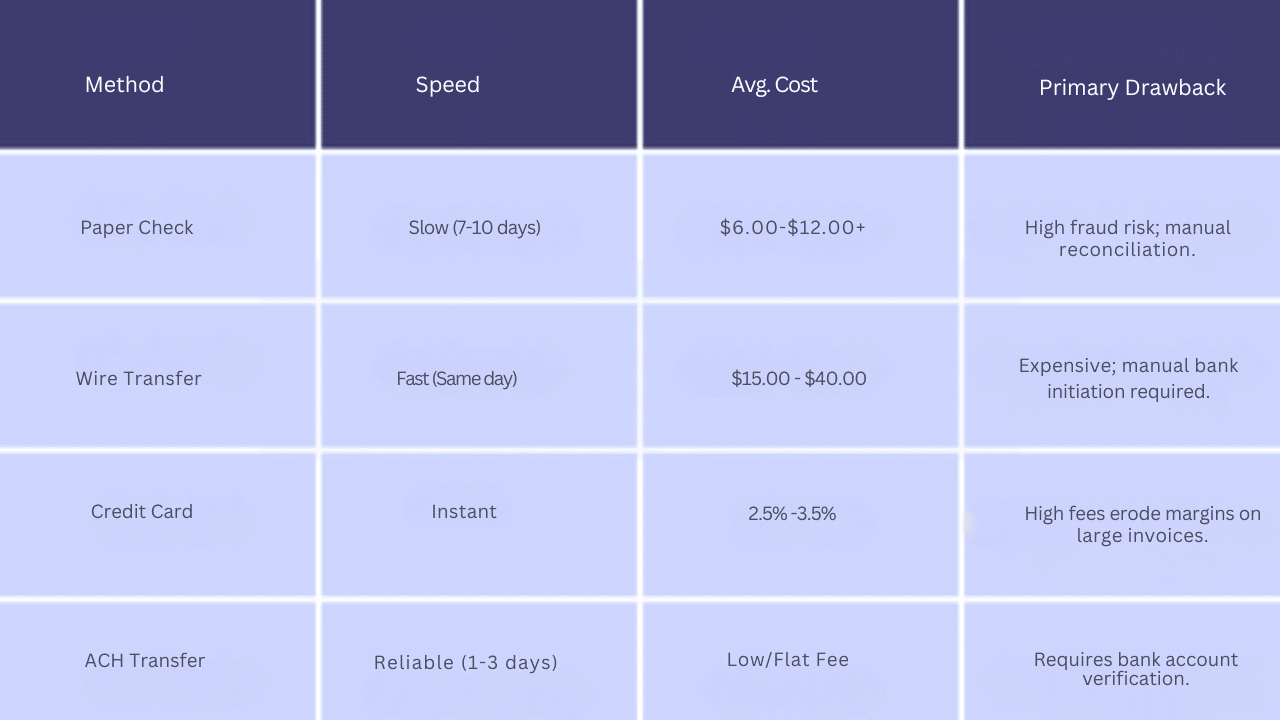
Estimated true cost per check: $6–$12+
Key takeaway: Checks cost more than they appear — and slow down cash flow.


Wire Transfers
Wire transfers are fast but inefficient for routine B2B payments:
- $15–$40 per transaction
- Manual bank initiation
- Poor scalability for frequent invoicing
Key takeaway: Wires are best reserved for exceptional, high-urgency transactions.
Credit Cards
Credit cards provide convenience but introduce margin pressure:
- 2.5%–3.5% processing fees
- Poor economics for large invoices
- Fee exposure increases as revenue grows.
Key takeaway: Cards are useful, but expensive as a primary B2B payment method.

The Real Cost of Legacy B2B Payments
While many businesses view payment processing as a "fixed cost," traditional methods carry significant hidden expenses in the form of labor, bank fees, and time.
Payment Method Comparison
The ACH Advantage: The Foundation of B2B Finance
ACH (Automated Clearing House) remains the gold standard for B2B transactions due to its scalability and low cost. By moving funds directly between bank accounts, businesses can handle high-ticket invoices without the percentage-based "tax" of credit card networks.
The Math of Scaling: On a $10,000 invoice, a credit card processing fee can cost between $250 and $350. A capped ACH transaction typically costs less than $5.00.
Why Modern Firms Prioritize ACH:
-
Predictable Settlement: Aligns with standard accounting cycles.
-
Bank-Level Security: Governed by strict NACHA regulations.
-
Higher Retention: Bank accounts expire far less frequently than credit cards.

Rebalancing Economics: Surcharging & Strategy
A modern B2B payment strategy isn't about eliminating choice; it’s about incentivizing the right behavior. The most successful businesses utilize a "Hybrid Strategy":
Why Modern Firms Prioritize ACH:
-
Predictable Settlement: Aligns with standard accounting cycles.
-
Bank-Level Security: Governed by strict NACHA regulations.
-
Higher Retention: Bank accounts expire far less frequently than credit cards.

- Promote ACH as the preferred, default payment method.
- Accept Credit Cards for customer convenience.
- Apply Compliant Surcharging to pass card processing costs to the buyer.
Strategic Insight: By offering a "Click-to-Pay" experience that defaults to ACH but allows for Surcharged Credit Cards, you protect your margins while letting the customer decide how to manage their own float.

1. Is ACH secure for large B2B transactions?
Yes. ACH transactions are protected by bank-level encryption and are strictly governed by NACHA rules. These protocols, combined with robust identity verification, make ACH one of the most secure and cost-effective ways to move large sums of money compared to wire transfers or paper checks.
2. How does "Smart Invoicing" change customer behavior?
Smart Invoicing shifts the customer experience from a chore to a convenience. By providing a mobile-friendly payment link directly in the invoice, you remove the physical friction of writing and mailing a check. Customers are significantly more likely to settle invoices immediately upon receipt when the process takes only seconds.
3. Can I automate my entire AR department?
While human oversight is recommended for high-level strategy and complex disputes, API-driven platforms like NPSONE can automate up to **90% of manual tasks**. This includes generating invoices, sending follow-up reminders, and performing real-time reconciliation with your accounting software.
4. How does real-time sync benefit my cash flow visibility?
Real-time synchronization ensures that your financial dashboard reflects your actual bank balance and outstanding receivables instantly. This eliminates the "blind spot" created by manual batching, allowing for better-informed decisions regarding investments and operational spending.
5. How can I implement these automated tools?
Nationwide Payment Systems offers a consultation to analyze your current workflow. We can help you deploy the NPSONE smart gateway and invoicing tools to modernize your B2B payment infrastructure within days.