
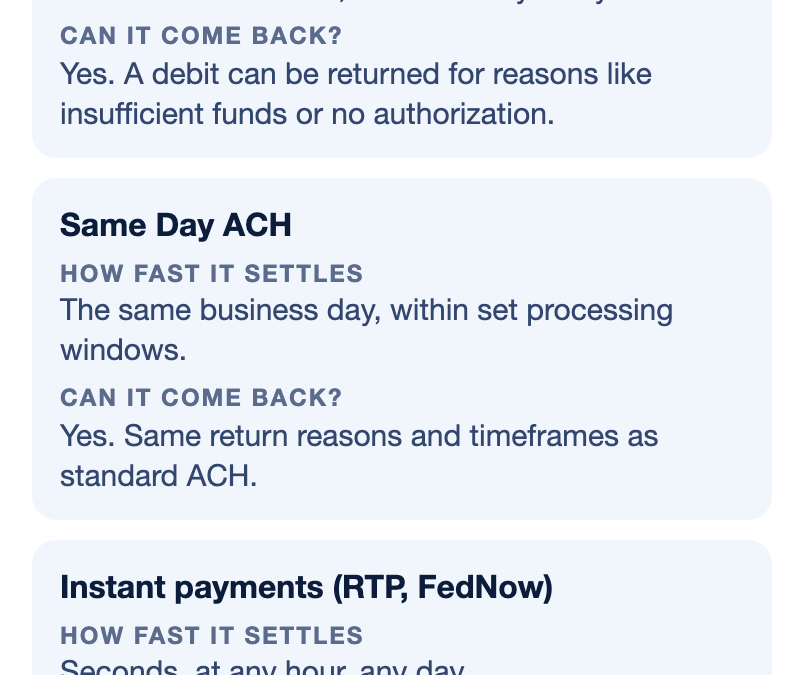
Same Day ACH moves money faster than standard ACH, but it does not make the payment final, while a true real-time payment is both instant and final once it lands. That is the whole difference in one sentence, and it matters far more to a merchant’s risk than the speed itself. Strictly speaking, there is no such thing as real-time ACH. ACH is a batch network, and “real-time” belongs to the instant payment rails that banks reach through networks such as RTP and FedNow. People mix the terms up all the time, and the mix-up leads businesses to ship goods, release services or issue refunds on money that can still come back. This guide explains how each rail settles, where the risk sits, and how to write a return and refund policy that matches the way you actually get paid.
The bottom line
- Same Day ACH speeds up settlement, not finality. A Same Day ACH debit can still be returned for reasons like insufficient funds or an unauthorized charge, just as a standard ACH debit can.
- Instant payments are pushed by the payer and final once received. There is no return process like ACH’s, which removes the risk of a pulled payment bouncing but also means mistakes and refunds are handled by the people involved, not by the network.
- Your risk depends on who starts the payment. When you pull money from a customer’s account, you carry the return risk. When the customer pushes money to you, the main risk shifts to fraud before the payment is sent.
- Write your return policy around the rail. Decide when goods ship, when services start and how refunds go back based on how each payment can still change after you receive it.
Who wrote this, and what we will not claim
Nationwide Payment Systems (NPS) publishes this guide. We are a payment processing company in South Florida, in business since 2001, and we help businesses accept ACH and card payments, so we have a stake in how merchants set this up. We are not lawyers and this is not legal advice. ACH network rules are written by Nacha and change from time to time, and each instant payment network sets its own rules through participating banks. We describe how these rails generally work. Before you change a policy, confirm the current rules and your own agreement with your bank or processor, and ask them for the details in writing.
Why “real-time ACH” is a mix-up worth clearing up
ACH, the Automated Clearing House network, moves money between U.S. bank accounts in batches. Banks collect payment instructions, send them to an ACH operator in groups at set times, and the money settles between banks on a schedule. Standard ACH can take a day or more to settle, and Same Day ACH lets qualifying payments settle on the same business day, within several processing windows. It is faster, and for many businesses it is fast enough. It is still a batch system, and it still runs on business days.
Real-time payments are a different kind of rail. The RTP network and the Federal Reserve’s FedNow service let participating banks send money from one account to another in seconds, at any hour, including nights, weekends and holidays. Our guide to FedNow and the future of payments covers how that service came about. The point to hold on to is that these are payment rails, banking infrastructure, not consumer apps, and they work differently from ACH in a way that matters to a merchant.
So when someone asks about “real-time ACH settlement”, they usually mean one of two things. Either they mean Same Day ACH, which is faster ACH, or they mean an instant payment, which is not ACH at all. The difference is not just a few hours of speed. It is whether the money can still come back.
How each rail settles, and when the money can still come back
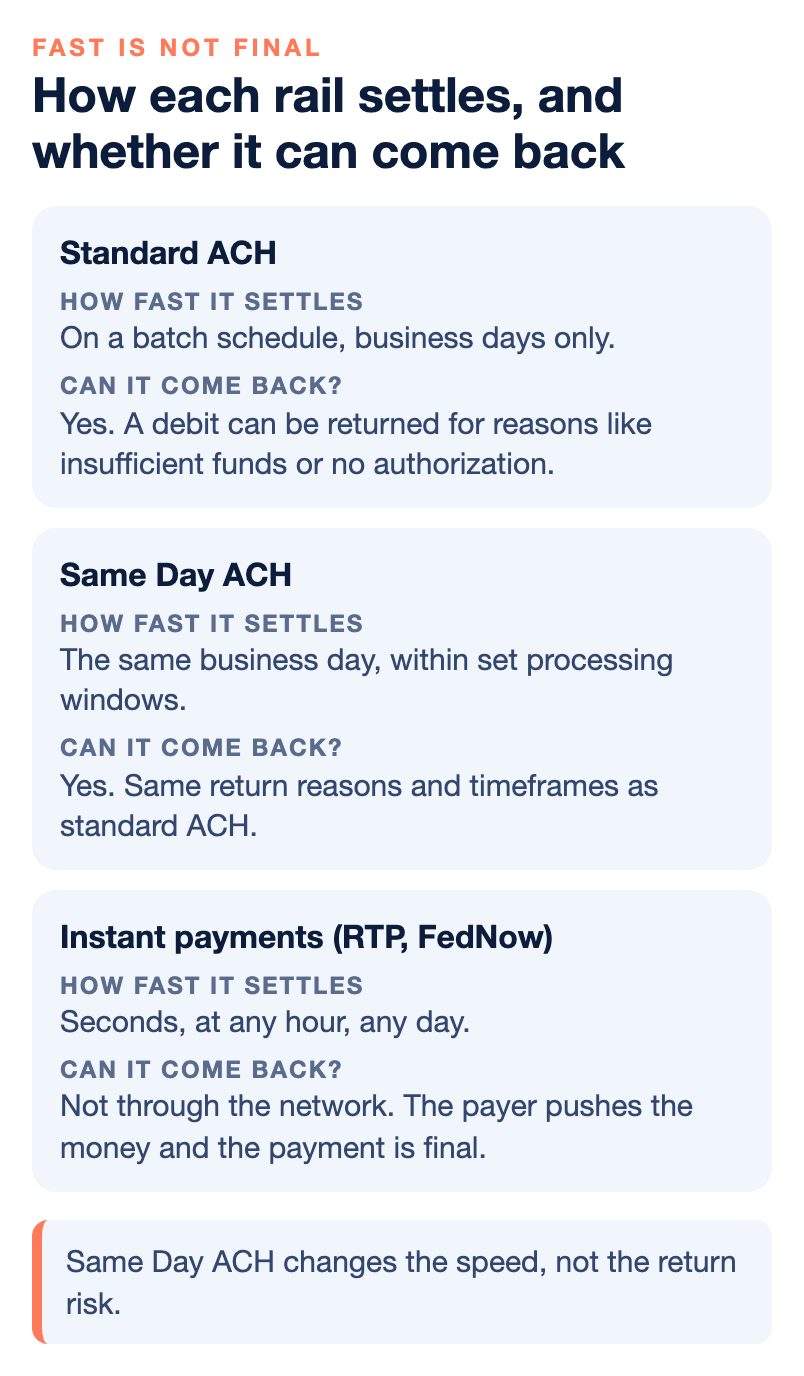
The question that decides your risk is not “how fast does the money arrive?” It is “after it arrives, can it be taken back, and for how long?” The three rails answer that differently.
| Rail | How fast it settles | Can it come back? |
|---|---|---|
| Standard ACH | On a batch schedule, usually a day or more, business days only. | Yes. A debit can be returned for reasons like insufficient funds, a closed account or no authorization. |
| Same Day ACH | The same business day, within set processing windows. | Yes. Same return reasons and timeframes as standard ACH. Faster settlement does not shorten the return window. |
| Instant payments (RTP, FedNow) | Seconds, at any hour, any day. | Not through the network. The payer pushes the money and the payment is final. Corrections happen between the parties. |
Why ACH debits can be returned
Most merchant ACH is a debit. You, through your processor, pull money from the customer’s account with their authorization. Because you start the payment, the system gives the customer’s bank a way to send it back if something is wrong. The common reasons are insufficient funds, a closed or invalid account, a stopped payment and a claim that the debit was not authorized. Under the ACH rules, most returns have to come back within a couple of banking days, but a consumer who says a debit was unauthorized generally has a much longer window, up to about 60 days after the payment settled. Business accounts have a shorter window for that kind of claim. The exact rules have details and exceptions, which is why your processor’s agreement is the place to confirm them.
This is the part that Same Day ACH does not change. The money can arrive this afternoon and still be returned weeks later if the account holder disputes it. It is true that ACH payments are much harder to reverse than a card payment, because there is no casual “friendly fraud” dispute button, but a return for a valid banking reason is always possible.
Why instant payments are final
Instant payment rails work the other way around. The payer’s bank sends the money, which is called a credit push, and once it settles in your account it is final. There is no return code for “insufficient funds”, because a bank will not send money that is not there. There is no network process for a customer to claw back a payment they regret. That is the attraction for merchants: when the money lands, it is yours.
The trade-off is that the risk moves to the front of the transaction. Fraud on instant rails usually happens before the payment is sent, when someone tricks a payer into pushing money to the wrong place, or when a criminal uses a stolen bank login. And because the network will not reverse a payment, a mistake, such as a payment sent twice, is fixed by the business sending money back itself. Instant payments are also not available to every customer, because both banks have to take part and the business needs a way to request or receive them.
What the timing difference means for merchant risk
Put the two ideas together and the risk picture gets clear. With an ACH debit, the risk is that money you already counted goes away. With an instant payment, the risk is mostly that money never should have been sent, which is usually the payer’s problem rather than yours, except where your own customers or staff are the target of a scam.
That has a few practical consequences. First, faster ACH is not safer ACH. A business that ships high-value goods as soon as a Same Day ACH debit settles is carrying exactly the same return risk as one that waits for standard ACH, it just discovers the problem later relative to delivery. Second, the size of the payment matters. A returned $200 debit is an annoyance. A returned $40,000 debit on equipment that already left the warehouse is a loss, and it is the kind of risk worth designing around. Third, new customers carry more risk than repeat ones, because you have no history showing that their payments clear.
Card payments sit in a different place again. Cards are authorized instantly, but they can be disputed through chargebacks long after the sale, which is why many B2B businesses steer larger invoices toward ACH in the first place. Our ACH optimization guide explains where moving payments from cards to ACH makes financial sense, and the risk side of that move is what this page is about.
How to design your return and refund policy around the rail
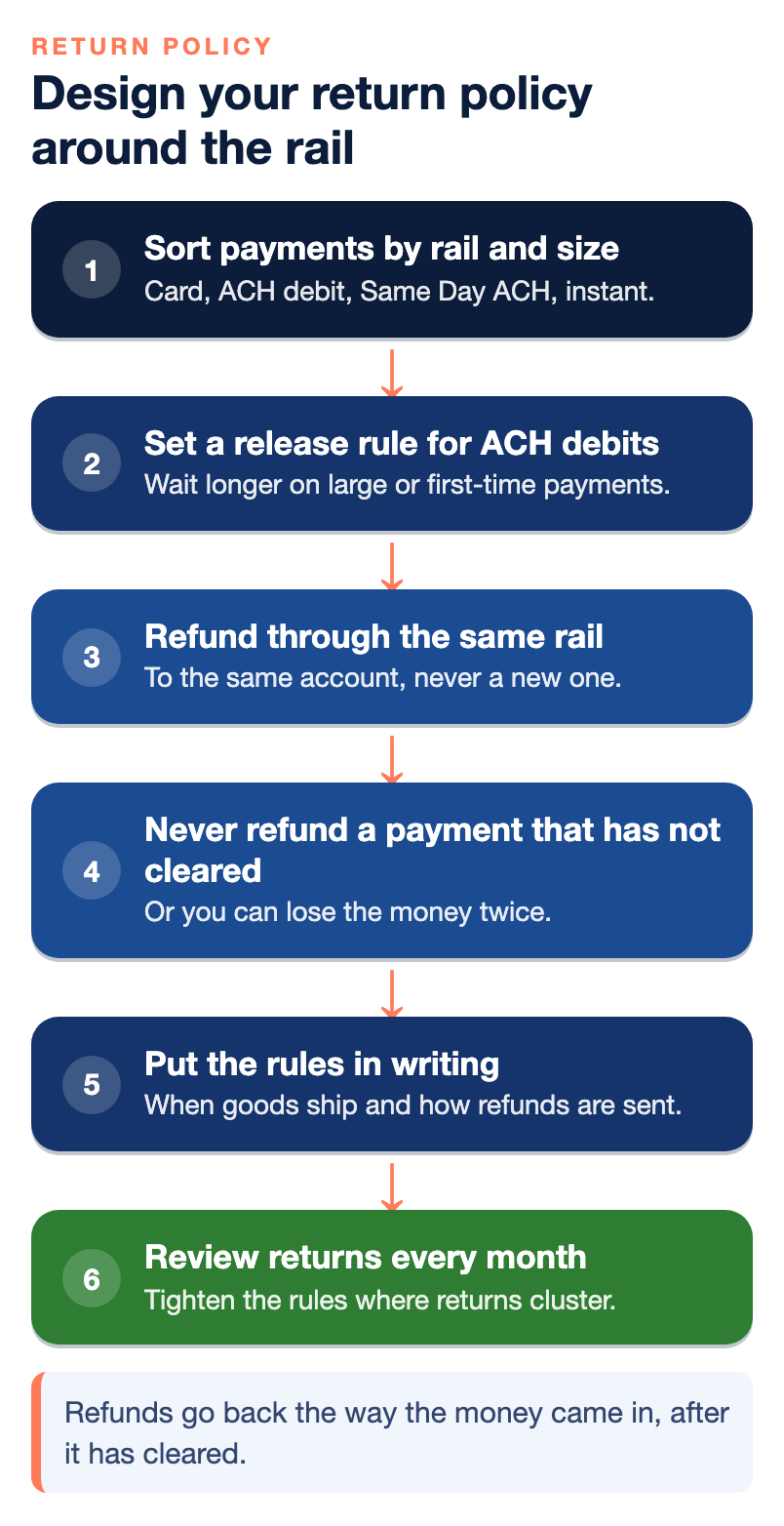
A good return policy is written with the payment rail in mind, not copied from a template. The goal is to make sure you never hand over goods, start a service or send a refund on money that can still change. Work through it in this order.
- Sort your payments by rail and size. Know which sales come in by card, ACH debit, Same Day ACH or instant payment, and which are large enough that a return would hurt.
- Set a release rule for ACH debits. For large or first-time ACH payments, decide how long you wait after settlement before shipping goods or starting work. Repeat customers with a clean history can move faster.
- Refund through the same rail, to the same account. Send refunds back the way the money came in, never to a different account, card or person because someone asks.
- Never refund a payment that has not cleared. A refund on an ACH debit that is later returned means you lose the money twice.
- Put the rules in writing. State in your terms when goods ship for each payment type, how refunds are sent and how long they take, so customers know before they pay.
- Review returns every month. Track return reasons by customer and payment type, and tighten the rules where returns cluster.
The refund trap that catches good businesses
One pattern deserves its own warning. A customer pays by ACH, then asks for a refund, often with a reason that sounds urgent, and asks for it to go to a different account or by a faster method. If the original debit has not cleared, or is later returned as unauthorized, the business has refunded money it never had. The same pattern shows up with overpayments: a “customer” sends too much and asks for the difference back by instant payment or wire. Our guide to check fraud and business payment scams walks through the versions of this we see most often. The rule that stops nearly all of them is simple. Refunds go back the way the money came in, to the same account, after the original payment has settled and cleared.
Policies that differ by rail, and why that is fair
Some owners worry that treating payment types differently will look unfair to customers. In practice, most customers accept it when it is explained plainly in your terms. A business might ship immediately on a card payment or an instant payment, ship on a first-time ACH payment only after a short wait, and ship to established ACH customers right away. That is not distrust. It is matching the release of goods to the moment the money is actually safe. If you want to encourage faster or safer payment methods, invoicing tools that let you control which payment options appear on an invoice, and when, make the policy easy to enforce.
When each rail is the right choice
None of this means one rail is better than the others across the board. Each fits a different situation.
- Standard ACH fits recurring payments, memberships, payroll-style payouts and invoices where a day or two does not matter and cost does.
- Same Day ACH fits payments where speed helps cash flow, such as a supplier who needs funds before the end of the business day, as long as you understand the return risk has not changed.
- Instant payments fit situations where finality matters, such as large one-time payments from a new customer, where both banks take part and the customer is willing to push the money.
- Cards still fit customers who want rewards, a credit line or a corporate card, and they move money quickly at the authorization, with chargeback risk instead of return risk.
Our guide to payment methods in the USA describes every major rail and where each tends to fit. If you are comparing processors on how they handle ACH, cards and funding, our comparison of payment processors by business type is a good place to start.
Where NPS fits, and where it does not
We help businesses accept ACH alongside card payments, including recurring ACH and ACH on invoices through our NPSONE Smart Invoicing, where customers can choose a payment method and businesses can control which options appear. We look at how a business gets paid as a whole, including which payments should be card, which should be ACH and how the policy around each should work. Accounts come with live, U.S.-based support around the clock and a dedicated account manager, and we price each merchant individually rather than publishing one rate.
Here is where we may not be the right choice:
- Very low volume or a hobby business. We may not be the best fit for sellers with very low processing volume.
- You want instant self-service signup. We underwrite each account.
- You would rather not provide underwriting documents. ACH and card accounts both need them.
- You are choosing only on the lowest advertised flat rate. We do not publish one universal rate.
- You need legal advice on payment rules. For that, talk to a payments attorney. We can explain how processing works, not interpret the law for you.
Next step
The speed of a payment is the headline, but the finality is the story. Know which of your payments can still come back, wait the right amount of time before releasing goods on the ones that can, and send refunds back the way the money came in. You can find more practical guides in our payments guides library. If you want help setting up ACH and card payments with a policy that fits your business, you can talk with our team.
Frequently asked questions
Is there such a thing as real-time ACH?
Not strictly. ACH is a batch network, and its fastest option is Same Day ACH, which settles within the same business day. Payments that truly settle in seconds at any hour run on instant payment rails such as RTP and FedNow, which are separate from ACH.
Can a Same Day ACH payment be returned?
Yes. Same Day ACH changes how fast a payment settles, not whether it can come back. A Same Day ACH debit can be returned for the same reasons and within the same timeframes as a standard ACH debit, such as insufficient funds or an unauthorized charge.
How long can an ACH payment be returned after it settles?
Most returns, such as for insufficient funds, come back within a couple of banking days. A consumer who says a debit was not authorized generally has a much longer window, up to about 60 days, and business accounts have shorter windows. Confirm the current rules and your own terms with your bank or processor.
Can a real-time payment be reversed?
Not through the network. Instant payments are pushed by the payer and are final once they settle. If a payment was sent by mistake, the parties have to sort it out, usually by the receiver sending the money back.
Is Same Day ACH safer for merchants than standard ACH?
No, it is faster, not safer. The return risk is the same, so a business that releases goods as soon as a Same Day ACH debit settles still carries the risk of a later return. Use release rules based on payment size and customer history.
How should refunds work for ACH payments?
Send refunds back through the same rail to the same account the payment came from, and only after the original payment has settled and cleared. Never send a refund to a different account or by a different method because a customer asks, since that is a common fraud pattern.
Should my return policy be different for each payment type?
Often, yes. Matching the release of goods to the moment a payment is actually safe is reasonable, and most customers accept it when your terms explain it plainly. Many businesses ship right away on cards and instant payments and wait briefly on large or first-time ACH payments.





