
An ACH payment does not travel alone. It is collected with other payments, sent in a group at set times, settled between banks on a schedule and then left open to being sent back for a short or long window depending on who the customer is. Each of those steps has its own clock and its own kind of risk. This guide follows one ACH debit, the kind where you pull money from a customer’s bank account with their permission, from the moment the customer agrees to pay to the moment the money is safely yours, and marks where the timing slips and where the risk sits at every stop.
The short answer
- ACH moves in groups, not one at a time. Banks collect payment instructions, send them in batches at set times and settle between banks on a schedule. That is why it costs less than a card and why it is not instant.
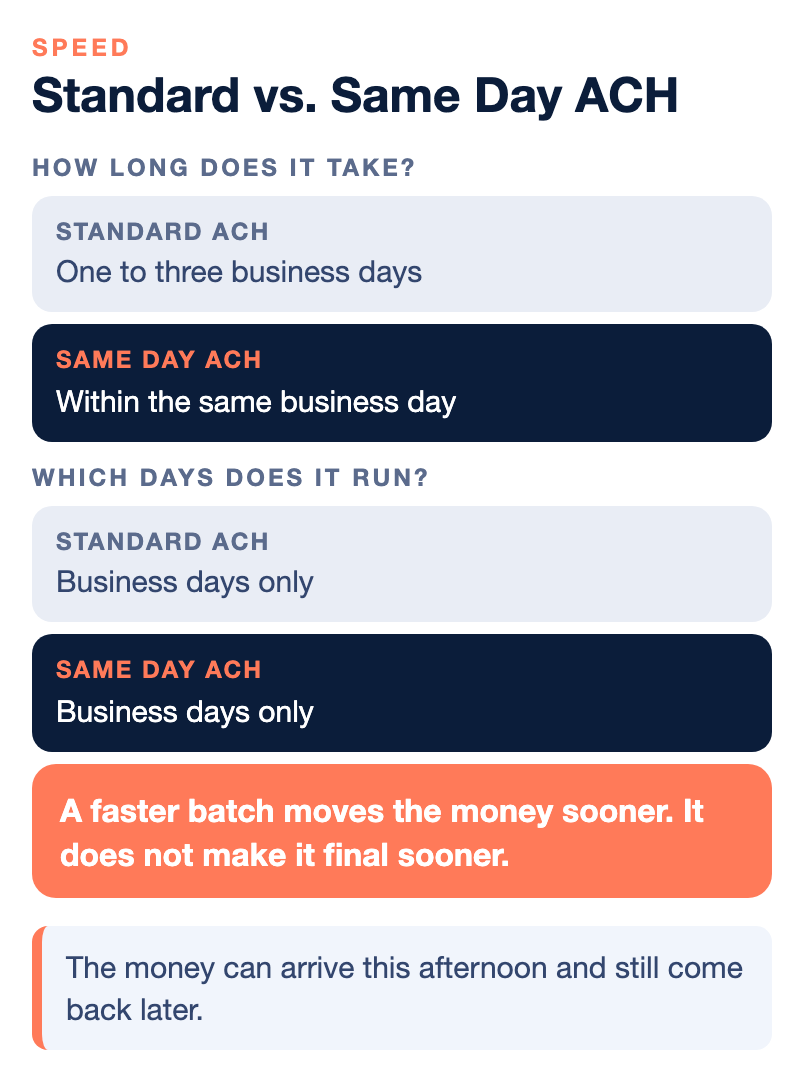
- Standard ACH usually takes one to three business days. Same Day ACH can settle within the same business day in set processing windows, but only on business days.
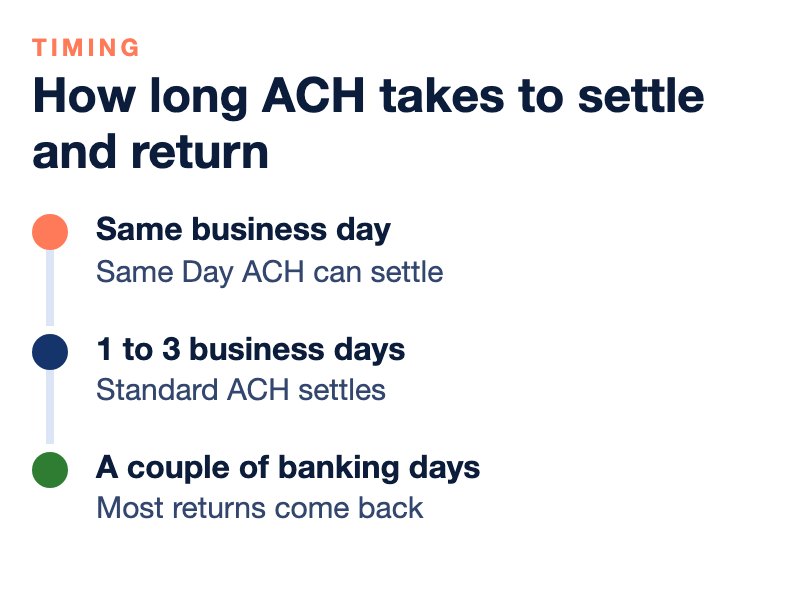
- Arriving is not the same as final. A debit that lands today can still be returned. Most returns come within a couple of banking days, while a consumer who says a debit was unauthorized generally has up to about 60 days.
- Most problems start before the batch. Wrong bank details and missing permission cause more trouble than the network itself.
- The timing risk and the money risk are different. One is about when you can use the funds. The other is about whether you keep them.
The five stops on an ACH payment
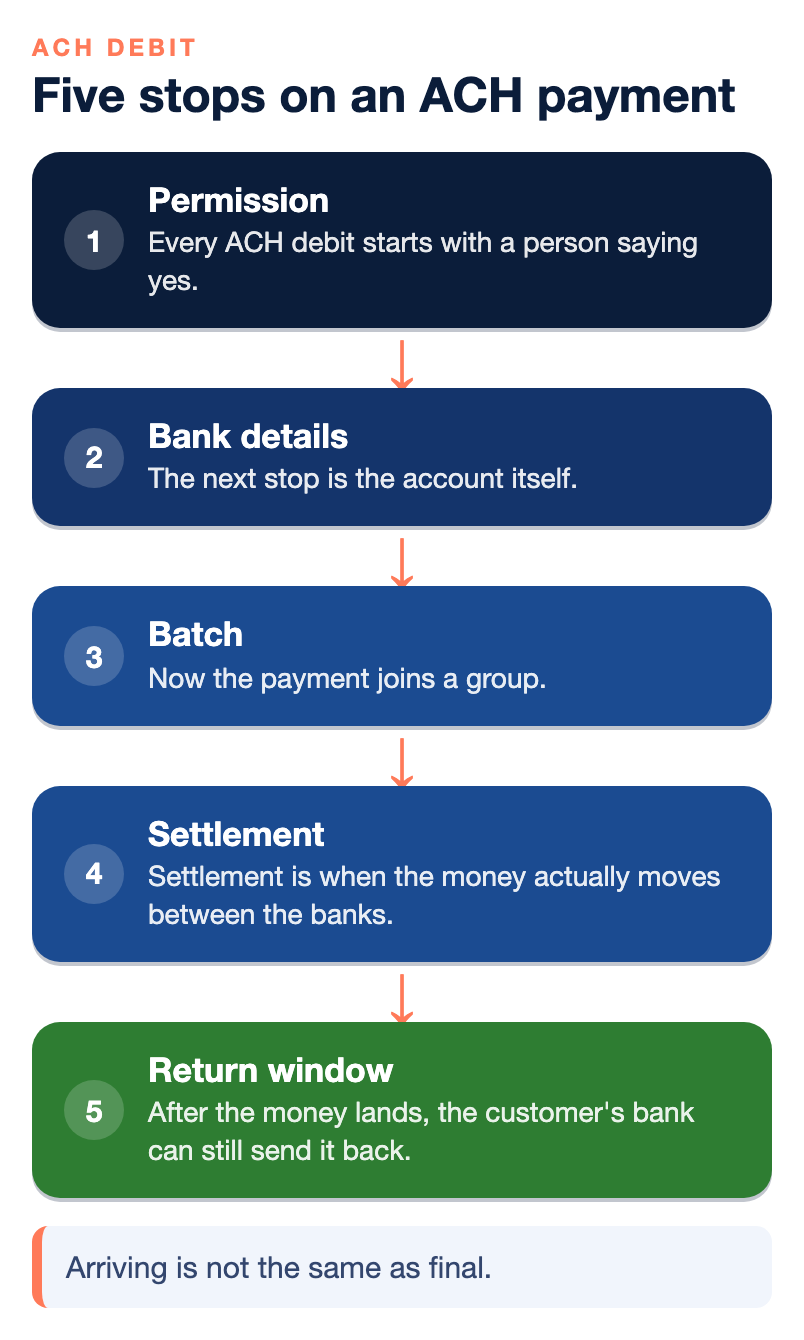
Think of an ACH debit as a trip with five stops. At each stop a different party holds the payment, and a different thing can go wrong. The stops are the permission, the bank details, the batch, the settlement and the return window. The sections below take them in order.
First, a short definition. ACH stands for Automated Clearing House, the network that moves money between bank accounts in the United States. The rules for it are written by Nacha. NPS describes these rules as covering customer authorization, data security and how transactions are handled. A debit is when you, through your processor, pull money from the customer’s account. A credit is when money is pushed to an account. Most merchant ACH is a debit, so that is what we follow here.
Stop 1: the customer’s permission
Every ACH debit starts with a person saying yes. The ACH rules require that you have the customer’s authorization before you pull money, and the clearest way to hold it is in writing or on a recorded record you can find quickly. For a recurring payment, the amount, the schedule and the way to cancel should be easy for the customer to see.
This stop has no clock, but it carries the longest tail of risk. If the permission is vague, the trouble does not show up today. It shows up weeks later as a claim that the debit was not authorized, and the window for a consumer claim is the longest in the system. Our guide to ACH return codes explains how those claims show up when they do arrive.
- Where the timing sits: nowhere yet. Nothing has moved.
- Where the risk sits: in how clear your record of permission is.
- What to ask a provider: where the authorization is stored, and how quickly you can pull it up for one customer.
Stop 2: the bank details
The next stop is the account itself. To send a debit, the system needs the customer’s routing and account information. Most small mistakes happen here, because numbers get mistyped, read wrong over the phone or copied from an old record.
The safer pattern is to let the customer enter their own bank details through a secure form or payment link, rather than reading numbers aloud. NPS says businesses get paid faster when customers can pay an invoice through a secure link, and that link also takes your staff out of the typing job. It is the same reason our ACH Optimization Guide recommends ACH-enabled invoices. If you want to know what happens to a payment when the details turn out to be wrong, the sections on the return window below show how that looks.
- Where the timing sits: a wrong account number does not slow the batch down. It makes the payment come back later, after you have counted it.
- Where the risk sits: in typing errors, closed accounts and stolen or borrowed account numbers.
- What to ask a provider: whether customers can enter their own details, and what checks happen on a new account before the first payment.
Stop 3: the batch
Now the payment joins a group. ACH is a batch system. Banks collect payment instructions, send them to an ACH operator in groups at set times, and the money settles between banks on a schedule. That grouping is part of why ACH costs less than a card, and part of why it follows a predictable calendar.
It is easy to miss what this means in practice. Cards are approved in seconds. An ACH debit is not approved at all in that sense. It is submitted, and the answer comes later. So when your dashboard says a payment was sent, that is the batch stop, not the end of the trip.
Timing is the main issue here. A batch has cutoffs, and ACH runs on business days. A payment started on a Friday evening will not arrive on Saturday. A payment that misses a window may have to wait for the next one, so ask your provider where its cutoffs are. If a customer says they paid on Thursday night, the honest answer is that it depends on the processing window and your provider’s schedule, not on the clock on the customer’s phone.
- Where the timing sits: cutoffs, windows, weekends and bank holidays.
- Where the risk sits: a missed window or a failed transmission, which delays the payment rather than losing it.
- What to ask a provider: what time of day a payment has to be submitted to make the next window, and how weekends and holidays are handled.
Stop 4: settlement
Settlement is when the money actually moves between the banks. NPS describes standard ACH as taking one to three business days. Same Day ACH lets qualifying payments settle within the same business day, in several processing windows. It is faster, and for many businesses it is fast enough, but it is still a batch system and it still runs on business days.
The choice between the two is about how soon you need the money, and it is worth being honest about whether you do. For monthly retainers and recurring invoices, a known date matters more than a fast one. Our guide on real-time ACH settlement vs. same-day ACH goes through that trade-off, and our article on which payment rail is fastest compares ACH with instant payments, wires and cards.
One more thing sits between settlement and your spending money: your own bank and your processor. Funds reach your account on a schedule, and the deposit can be held. Our guide to when you will actually get paid lists the common causes of a held deposit, including an account review and a reserve.
- Where the timing sits: the choice between standard and same-day, plus your bank’s and processor’s own schedule.
- Where the risk sits: funds that are in your account but not final. Settled does not mean safe.
- What to ask a provider: when settled funds become available to you, and whether new accounts see a longer wait.
Stop 5: the return window
This is the stop that surprises people. After the money lands, the customer’s bank can still send it back. Common reasons are insufficient funds, a closed or invalid account, a stopped payment and a claim that the debit was not authorized. The ACH rules give returns a time limit, and the limit depends on the reason.
Under the rules, most returns have to come back within a couple of banking days. A consumer who says a debit was unauthorized generally has a much longer window, up to about 60 days after the payment settled. Business accounts have a shorter window for that kind of claim. Details and exceptions exist, which is why your processor’s agreement is the place to confirm them.
Same Day ACH does not change any of this. The money can arrive this afternoon and still come back later. A faster batch moves the money sooner. It does not make it final sooner.
This is also where ACH and cards differ. A card dispute is a chargeback that you answer with evidence. A return is not an argument. The customer’s bank decides, the money comes back, and the code tells you what to do next. NPS also notes that business-to-business ACH payments are harder to reverse, because a business customer who has a problem has to call you and work it out directly. If you accept both, the card side is covered in our chargeback survival guide.
- Where the timing sits: a few banking days for most returns, up to about 60 days for a consumer unauthorized claim.
- Where the risk sits: money you already counted going away, after you may have shipped goods or started work.
- What to ask a provider: how you are told about a return, how fast, and what your process is for each kind.
A timing and risk map for the whole trip
Put the five stops side by side and the pattern is clear. The first two stops are about preventing problems. The third and fourth are about timing. The last is about risk that stays open after the money arrives.
| Stop | What happens | Main timing issue | Main risk |
|---|---|---|---|
| 1. Permission | The customer agrees to the debit | None yet | Weak record of authorization |
| 2. Bank details | Routing and account information is collected | None yet | Typos, closed or borrowed accounts |
| 3. Batch | The payment is grouped and sent at set times | Cutoffs, weekends, holidays | A missed window delays it |
| 4. Settlement | Money moves between the banks | Standard vs. same-day, plus your bank’s schedule | Funds arrive but are not final |
| 5. Return window | The customer’s bank can send it back | Days for most reasons, longer for consumer claims | Counted money reverses |
What this means for when you ship or start work
The map matters most for a business that delivers something of value right after a payment. A returned $200 debit is an annoyance. A returned large debit on equipment that already left the warehouse is a loss. The gap that creates trouble is the one between stop 4 and the end of stop 5: the money looks like yours, and it is not final.
The practical answer is not to avoid ACH. It is to decide, ahead of time, what you will treat as paid. A few habits help.
- Match your wait to the size and the customer. A repeat customer with a long payment history is a different case from a new customer paying a large first invoice. Many businesses wait a few days before treating an ACH payment as final.
- Do not spend money you cannot afford to lose. Keep a cushion so that a return does not stop payroll or an inventory order.
- Use the right payment for the job. For large and recurring business payments, ACH is often a good fit, and NPS pairs it with Smart Invoicing so customers can pay through a secure link.
- Keep the permission record close. The best defense against a later claim is a clear record you can find in minutes.
Why batches are part of why ACH costs less
It helps to connect the batch to the price. NPS says ACH batches and processes transactions in groups, which is part of why it costs less than cards and why it follows predictable settlement schedules. Our ACH Optimization Guide describes optimized ACH as often costing a fraction of a percentage-based card fee, with a fixed cap, and says businesses can steer large invoices toward it by giving customers a choice between a card and an ACH payment. We do not publish a price here because pricing depends on your volume, ticket size and risk. What the batch tells you is the trade: you give up an instant approval and you get a lower cost and a predictable schedule.
That trade makes sense for some payments and not for others. A counter sale with a card in hand wants an instant answer. A $10,000 invoice due in thirty days does not. Our article on net-30 and net-60 terms looks at the other side of that wait: what long terms do to the cash of the business waiting to be paid.
Questions to ask a provider about the batch
- What are the daily submission cutoffs for standard and same-day ACH, and what happens to a payment that misses one?
- How long until settled funds are available in my account, and does that change for a new account?
- Is Same Day ACH available to me, and is there a difference in how it is priced?
- How and how fast am I told about a return, and which kinds of return can I try again?
- Can my customers enter their own bank details through a secure link?
- Are reserves or holds possible on my account, and how would I be told about one?
- Do ACH payments sync to my accounting software, so a returned payment shows up next to its invoice?
- Who do I call, and at what hours, if a payment looks stuck?
Who wrote this, and where NPS fits
Nationwide Payment Systems publishes this guide. We are a payments company based in South Florida, in business since 2001, and we offer ACH and card processing, so we have a stake in how you set it up. Our NPSONE platform accepts ACH and card payments, with Smart Invoicing that sends secure payment links by email or text, recurring ACH for retainers and subscriptions, auto-pay enrollment and QuickBooks sync. You can read more in our guide to B2B payments and browse the full library of payments guides.
This guide describes how ACH generally works in plain terms. It is not legal advice. Nacha writes the ACH rules and updates them from time to time, and your processor and bank have the final word on timing, cutoffs and return handling for your account. Ask for the details in writing before you change how you ship or release work.
We are not the right fit for everyone. If you only collect an occasional bank payment, if you want an instant self-service sign-up with no review, or if the lowest advertised price is the only thing that matters, a simpler platform may suit you better. If you want to talk it through, contact our team.
Bottom line
An ACH payment is a trip with five stops: permission, bank details, the batch, settlement and the return window. The first two stops are about getting the payment right. The batch and settlement stops are about timing, which depends on cutoffs, business days and your provider’s schedule. The last stop is about risk that stays open after the money lands, so arriving is not the same as final. Decide in advance what you will treat as paid, keep a clear record of permission, let customers enter their own details, and ask your provider the questions above in writing.
Frequently asked questions
What is an ACH batch?
It is a group of ACH payment instructions that banks collect and send together at set times. The money then settles between banks on a schedule. Batching is part of why ACH costs less than a card and why it is not instant.
How long does an ACH payment take?
NPS describes standard ACH as taking one to three business days. Same Day ACH can settle within the same business day in set processing windows. Both run on business days only, so a payment started on a Friday evening will not arrive on Saturday.
Can an ACH payment be returned after the money arrives?
Yes. A debit can be returned for reasons such as insufficient funds, a closed or invalid account, a stopped payment or a claim that it was not authorized. Most returns come within a couple of banking days. A consumer who says a debit was unauthorized generally has up to about 60 days.
Does Same Day ACH make the payment final sooner?
No. Same Day ACH moves the money faster, but it does not shorten the return window. The money can arrive this afternoon and still be returned later.
Why do most ACH problems start before the batch?
Wrong bank details and unclear permission cause many returns. Letting customers enter their own details through a secure link and keeping a clear record of their authorization prevents most of them.
What should I ask my provider about ACH timing?
Ask about submission cutoffs for standard and same-day ACH, when settled funds become available, how weekends and holidays are handled, how you are told about a return and who to call if a payment looks stuck. Get the answers in writing.
Is ACH harder to reverse than a card payment?
NPS says ACH is harder to reverse than a card payment without a valid banking reason, because there is no casual dispute button. A return for a valid banking reason is still possible, so decide in advance when you will treat an ACH payment as final.





