
The best payment processor is the one that fits how your business actually sells, shows you every fee in writing, puts the contract terms in plain view and has a real person to call when money stops moving. No single provider wins for every business, so this guide does not rank anyone. It gives you a step-by-step way to compare any two or three providers on equal terms: describe your business, ask for the same quote from each, turn every quote into one comparable number, read the contract, test the support and then decide.
The short answer
- Start with your own profile, not a provider’s list. What you sell, how you take payments, your typical sale and your monthly volume decide which setups are even worth a quote.
- Get the same quote from every provider. Ask for a written quote based on your real volume, with every fee listed, so the numbers can sit side by side.
- Compare one number, your effective rate. Total fees divided by total sales is the fair way to compare a flat-rate quote with an interchange-plus quote.
- Read the contract for the exit, not only the entry. Term, early termination fees, auto-renewal, equipment leases and notice of price changes decide what a bad fit costs you.
- Test support before you sign. A processor that is easy to reach during the sales process but hard to reach afterward is the most expensive kind.
Why a “best processor” list cannot answer your question
Search for the best payment processor and you will find rankings. They are a fine way to learn which names exist. They cannot tell you which one is best for you, because the answer changes with the business. A shop that rings up many small card sales, a consultant who sends a few large invoices and an online store with a subscription all use payments differently, and a provider that suits one can be a poor match for another.
NPS has already published a plain overview of the choices, Best Payment Processors for Businesses: How to Choose in 2026, which describes the main kinds of providers and who each tends to fit. This guide picks up where that one stops. Once you have two or three names, how do you compare them fairly? That is a method, and a method works for any provider, including the ones that did not exist when this was written.
One idea runs through everything below. Many owners shop by asking “What is your rate?” The better question, as NPS puts it in its processor checklist, is “What happens when something goes wrong?” Rate matters, and a rate is only one line of a comparison.
Step 1: Write down your business profile
Before you contact anyone, spend ten minutes writing a one-page profile. Every provider will ask for most of it anyway, and having it ready keeps you in charge of the conversation. Include these items:
- What you sell, in specific terms. Some businesses are treated as higher risk by many banks. If that could be you, say so at the start, because it narrows the list of providers that will approve you.
- How customers pay you. In person, online, by phone, by invoice, by recurring billing or by bank transfer (ACH). Each channel is priced and risk-rated differently.
- Your average sale and your biggest sale. Underwriters, the people at the bank who review whether to approve you, pay close attention to ticket size.
- Your monthly card volume, and how much of it you expect to add in the next year or two.
- The systems you already use, such as a point-of-sale system, an online store platform or accounting software. Ask whether each provider connects to them.
- Your last three months of statements, if you already accept cards. They are the single best input for a fair quote.
NPS also suggests thinking three years ahead. Will you add locations, an online store, recurring billing or ACH? Switching processors in the middle of growth is costly and disruptive, so a provider that can handle where you are going is worth more than one that only fits where you are today.
Step 2: Build a short list that actually supports your business
Two or three providers is enough. Pick them with two screens, not with a ranking.
Screen one is business fit. A legal business is not automatically acceptable to every bank or provider. Ask each one directly: “Do you support my actual business, not something close to it?” and “Are any of my products, services or sales channels restricted under your program?” It is far better to learn that before you apply than after your first deposit is held. Our guide on what makes someone eligible for a merchant account explains what underwriters look at.
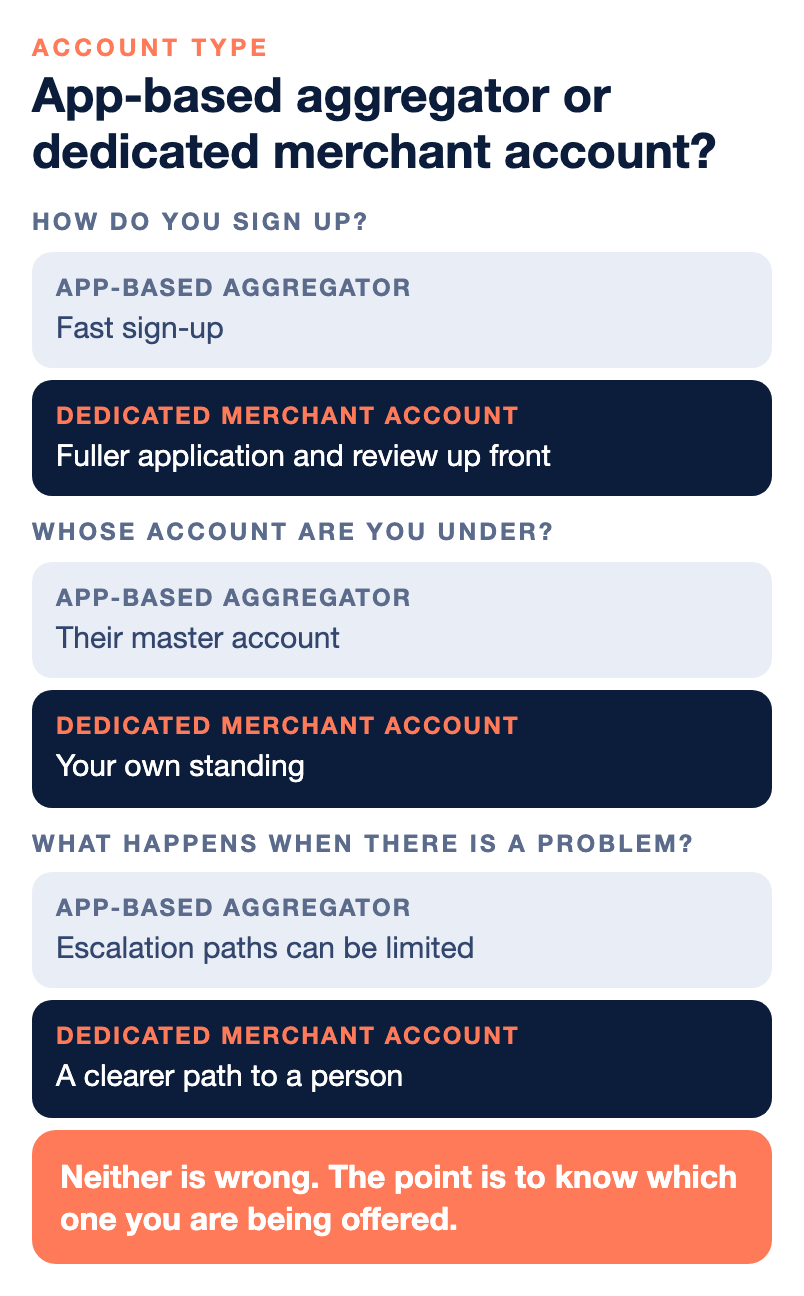
Screen two is account type. Many app-based providers work as aggregators, which means you board under their master account instead of having your own. Sign-up is fast and it works well for many small businesses. The difference shows up when there is a problem, because risk decisions can be automated, escalation paths can be limited and support may be ticket-based only. A dedicated merchant account usually involves a fuller application and review up front, and in return you get your own standing and a clearer path to a person. Neither is wrong. The point is to know which one you are being offered. Our small business questions and answers guide covers more of the common questions.
Step 3: Ask every provider for the same quote
A comparison only works if the quotes are built the same way. Send each provider the same request, in writing, and tell them the number you are working from. Ask for:
- The pricing model they are proposing, and why they chose it for you.
- Every fee, not just the headline rate. That includes monthly or statement fees, per-transaction fees, gateway fees, PCI compliance fees, batch fees, chargeback fees, annual fees and any monthly minimums.
- Equipment costs, and whether equipment is bought, rented or leased.
- A sample statement, so you can see how the fees would look on a real bill.
- A review of your existing statements, so they can show where your current costs come from.
When NPS compares a flat-rate setup with cost-plus pricing for a business, it starts by reviewing about 90 days of that business’s processing data. That is a good standard to ask any provider to match. A quote based on your real numbers beats a quote based on an average.
Pay attention to how each provider responds. A provider that answers clearly, in writing, and is glad to review your statements is showing you how it will treat you later. One that dodges the question about fees is also showing you something. To go deeper on this step, read Transparent Merchant Pricing: What It Means and How to Check Whether a Processor Really Offers It, which gives a seven-point test for a quote.
Step 4: Turn every quote into one comparable number
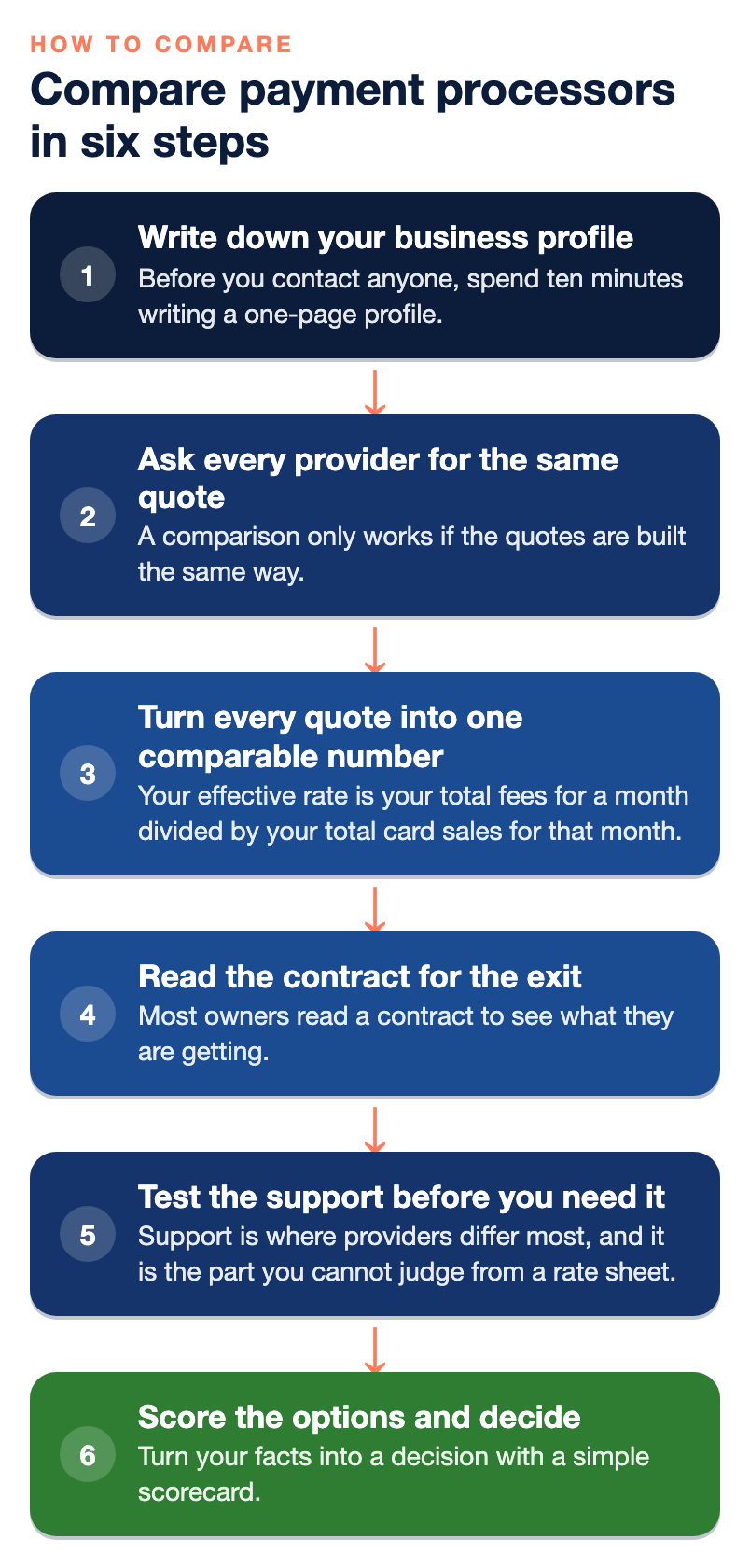
Quotes arrive in different shapes. One is a single percentage. Another shows a markup over cost plus six monthly fees. A third advertises low equipment cost. The way to line them up is to calculate an effective rate for each one.
Your effective rate is your total fees for a month divided by your total card sales for that month. It folds the markup, the monthly fees, the gateway fee and the rest into one percentage. It is the fair way to compare a flat-rate quote with an interchange-plus quote, and it is the number to compare against what you pay today. Here is a worksheet to fill in once per provider, using last month’s volume:
| Line | What to write down | Where to find it |
|---|---|---|
| Processing cost | The dollar amount the model would charge on your volume | The written quote plus your last statement |
| Monthly and statement fees | Every recurring fee, added together | Fee schedule in the quote |
| Gateway and software fees | Any charge for online payments, invoicing or a virtual terminal | Fee schedule in the quote |
| Equipment | Monthly rental or lease payment, or purchase price spread over the term | Equipment section of the quote |
| Other fees | PCI, batch, chargeback, annual and minimum fees | Fee schedule in the quote |
| Total fees | Add the lines above | Your worksheet |
| Effective rate | Total fees divided by total sales | Your worksheet |
Two cautions. First, a quote is a forecast and your first real statement is the proof, so check the first one against the quote line by line. Second, the lowest effective rate is not automatically the winner. A slightly higher number from a provider with clear terms and good support can cost you less than a low number that comes with a long lease and a ticket form. If your current effective rate looks higher than the rate you were quoted, our guide to finding the gap walks through the usual reasons, and The Merchant’s Guide to What You Really Pay for Card Processing shows the whole path from quote to bill.
Step 5: Read the contract for the exit
Most owners read a contract to see what they are getting. The more useful reading is about getting out. Processing agreements differ. Some providers offer month-to-month agreements and others require multi-year terms, so the first thing to find is the length. NPS lists these items as the ones to look for in any processing agreement:
- Early termination fees, and exactly how they are calculated.
- Auto-renewal clauses, and how much notice you must give to stop one.
- Equipment leases. NPS warns that some long-term equipment leases can cost far more than buying the device outright.
- Minimum monthly fees, software subscription fees and PCI compliance fees.
- Whether the markup is fixed, and how much notice you get if the provider changes any fee.
Then ask the exit questions from NPS’s guide to 12 questions to ask before opening a merchant account. If you leave, what happens to your equipment? Can you move your gateway? What happens to stored customer card tokens and recurring billing schedules? How do you close the account, and how long can funds remain subject to chargebacks or holds afterward? A provider that has thought about your exit has usually thought about the rest of the relationship too.
Be realistic about how much you can change. NPS notes that most merchant agreements are standard bank or processor contracts, and a small or mid-sized business should not expect the bank to rewrite them. Read anyway, ask about the clauses that worry you and put your effort into the questions that decide whether the relationship will work. Card network rules can also change after you sign, which we explain in What Rights Do Merchants Have When a Card Network Changes Its Rules Mid-Contract?
Step 6: Know what you can negotiate
You cannot negotiate interchange or card-network assessments, because those are set outside your provider. The rest is a conversation. NPS’s guidance is that businesses with higher volume, a strong processing history, low chargeback ratios and stable operations usually have more room. The items you may be able to discuss include:
- The processor markup.
- Monthly fees, gateway fees and PCI fees.
- Equipment costs and contract length.
- Early termination fees.
- Chargeback fees and batch fees.
Use your statement as evidence and ask for each change in writing, before you sign rather than after the first statement arrives.
Step 7: Test the support before you need it
Support is where providers differ most, and it is the part you cannot judge from a rate sheet. You can test it during the sales process. Do these four things:
- Call the support number, not the sales number. Is there a public phone number? Is support available around the clock, or only during business hours? Is it based in the United States?
- Ask who you call if your funds are held. Find out whether there is a direct contact in risk review, what documents are usually needed, how long reviews take, whether reserves are disclosed up front and whether there is an appeal process.
- Ask whether you get a dedicated representative. Some providers rotate you through a queue, and some assign one person who knows your volume and industry.
- Ask who helps with chargebacks, risk reviews and compliance questions. Eventually something will happen. Find out in advance whether guidance comes with the account.
It is also fair to ask for two or three references from businesses like yours, and to ask each what changed after they switched. A reference you can call is worth more than any claim on a website. Our list of 20 questions to ask before signing goes further on support and risk.
Step 8: Check how and when you get paid
A fast approval is not the same as fast access to your money. Ask each provider how soon deposits arrive, whether weekend deposits are available, whether large transactions are reviewed by hand, and what triggers a reserve or hold. NPS lists common triggers as sudden volume increases, chargeback spikes, compliance concerns, website inconsistencies and changes to what you sell. Our guide When Will You Actually Get Paid? covers deposit timing in detail.
Step 9: Score the options and decide
Turn your facts into a decision with a simple scorecard. Give each factor a weight from one to five, score each provider from one to five on it, and multiply. The factors below fit most owners, so change the weights to match your business.
| Factor | What to compare |
|---|---|
| Fit for your business | Supports what you sell, with no restricted items left unresolved |
| Effective rate | The number from step 4, on the same volume for every provider |
| Contract | Term, exit fees, auto-renewal, leases, notice of changes |
| Support | Phone access, hours, dedicated contact, hold and chargeback help |
| Funding | Deposit timing, reserve triggers, how reviews work |
| Technology | Connects to your POS, online store, accounting and invoicing tools |
| Room to grow | New locations, higher volume, ACH, recurring billing |
If two providers score close, let support and contract terms break the tie. They are the two factors you feel most when something goes wrong. Our guide to reading your merchant statement shows where each fee appears.
Five mistakes that skew a comparison
- Comparing different things. A flat percentage from one provider and a markup over cost from another cannot be compared until both become an effective rate.
- Trusting a teaser rate. Low advertised rates can hide tiered pricing, downgrades, gateway markups and batch fees. Ask for the full fee schedule.
- Clicking “I agree” without reading. Online sign-ups can hide restricted-business lists, reserve rights and termination terms in the terms of service. Read them as carefully as a paper contract.
- Judging only on price. Poor support, weak technology or an account shutdown can cost more than a small difference in rate.
- Skipping the three-year view. The cheapest fit for today may not handle the second location or the online store you add next year.
Who wrote this, and where NPS fits
Nationwide Payment Systems publishes this guide. We are a payments company based in South Florida, in business since 2001, and we sell merchant accounts, so we are not neutral. We offer cost-plus and other pricing models, live U.S.-based support, ACH, smart invoicing, point-of-sale systems and a gateway, and we match the pricing to your volume, ticket size and card mix. We do not publish one universal rate, and we do not rank other providers here. Browse the full library of payments guides for more.
We are not the right fit for everyone. If you are a hobby seller with very low volume, if you only want an instant self-service sign-up, if you do not want to provide underwriting documents, or if the lowest advertised flat rate is the only thing that matters to you, a simpler platform will probably suit you better. Use the steps above on us the same way you would on anyone else.
Bottom line
Comparing payment processors is a method, not a ranking. Describe your business, shortlist providers that support it, get the same written quote from each, turn every quote into an effective rate, read the contract for the exit, test the support, check the funding rules and then score what you found. If you would like a second opinion on a quote or on the statement you have today, you can contact our team, and if another setup fits you better, we will say so.
Frequently asked questions
What is the best payment processor for a small business?
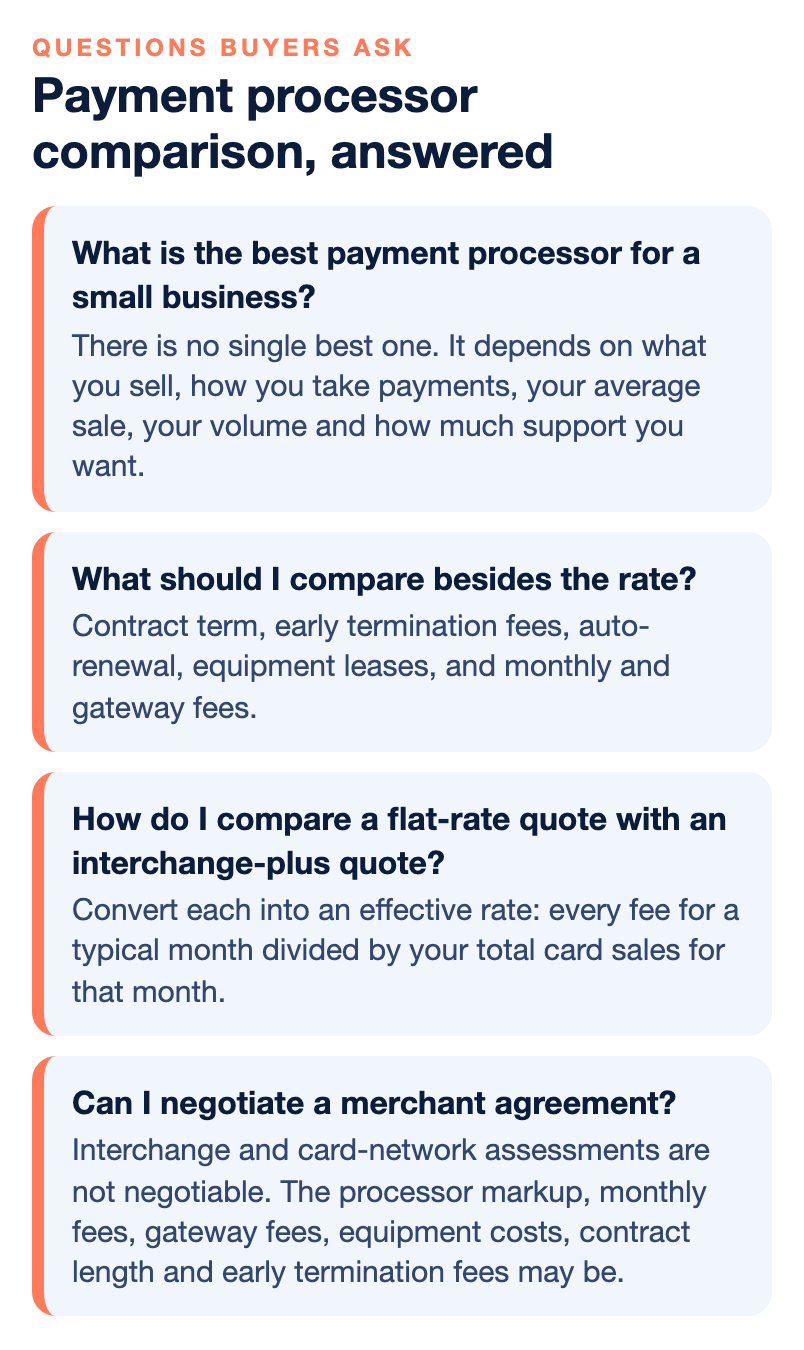
There is no single best one. The best fit depends on what you sell, how you take payments, your average sale, your volume and how much support you want. Compare two or three providers on the same written quote, the same effective rate and the same contract questions.
What should I compare besides the rate?
Compare the contract term, early termination fees, auto-renewal, equipment leases, monthly and gateway fees, support access, how held funds are handled, deposit timing and whether the provider connects to your point-of-sale, online store or accounting software.
How do I compare a flat-rate quote with an interchange-plus quote?
Convert each into an effective rate. Add up every fee for a typical month, including monthly, gateway and equipment charges, and divide by your total card sales for that month. The two percentages can then be compared directly.
How much volume data should I give a provider to get a real quote?
Give them your recent statements. NPS starts by reviewing about 90 days of processing data when it compares a flat-rate setup with cost-plus pricing, and you can ask any provider to work from the same kind of data.
Can I negotiate a merchant agreement?
Interchange and card-network assessments are not negotiable. The processor markup, monthly fees, gateway fees, equipment costs, contract length and early termination fees may be. Businesses with higher volume and low chargebacks tend to have more room, and any change should be put in writing before you sign.
How can I test a processor’s support before I sign?
Call the support number rather than the sales line, and ask who you would reach if your funds were held. Find out the hours, whether support is U.S.-based, whether you get a dedicated representative, and who helps with chargebacks and risk reviews. Ask for references from similar businesses.
Should I choose the processor with the lowest rate?
Not by itself. A low rate can come with a long equipment lease, a hard-to-reach support team or fees that appear later. Weigh the effective rate together with contract terms, support and funding rules.





