
Fewer than most owners hope, and more than most owners use. You almost never have a contract with Visa or Mastercard directly. Your contract is with a processor and its acquiring bank, and nearly every merchant agreement says you will follow the card network rules as they are changed from time to time, so a network rule change usually applies to you the day it takes effect, without your signature. Your real rights live in that merchant agreement: how much notice you get, what happens to your pricing, whether you can leave without a penalty, and what the processor has to show you. This guide explains how a network change reaches your business, how to tell a real network change from a processor price increase wearing a network label, and what to do in the first week after the notice arrives.
The bottom line
- A network rule change usually binds you automatically, because your merchant agreement adopts the network rules as they change. You cannot keep accepting cards under the old rule.
- Your bargaining power is in your own agreement, not in the network’s rulebook. Read the clauses on amendments, fee changes, notice and termination before you call anyone.
- Not every “network change” on a notice is a network change. Ask your processor which network bulletin it is passing along and what changes on your statement, in writing.
- If a change makes your current setup a bad fit, you can adapt, negotiate or move, and the cost of moving depends on termination fees and equipment leases you agreed to earlier.
Who wrote this, and what we will not claim
Nationwide Payment Systems (NPS) publishes this guide. We are a payment processing company based in South Florida and in business since 2001, which means we sit on the processor side of the merchant agreements we are describing. We are not lawyers, nothing here is legal advice, and we do not quote anyone’s rates or fees. Card-network rules and fee schedules change, and merchant agreements differ from one processor to the next, so check your own agreement, ask your processor for anything important in writing, and talk to an attorney if you are in a real contract dispute.
Why the network can change your rules without asking you
The card networks, Visa, Mastercard, Discover and American Express, write the operating rules that every transaction on their network has to follow. Those rules cover how cards are accepted, how disputes work, which data has to travel with a transaction, what a merchant may and may not charge at checkout, and which kinds of businesses need extra registration before they can process. Visa and Mastercard publish their core rules, and they update them regularly.
The networks do not sign up most merchants themselves. They license acquiring banks, and the acquiring bank, usually through a processor or a sales partner, signs the merchant. The acquiring bank promises the network that its merchants will follow the rules, and it keeps that promise by writing the rules into your merchant agreement. That is the clause most owners skim past at signup: some version of “merchant agrees to comply with the card network rules, as amended from time to time.” Once you have agreed to it, a change in the network’s rulebook becomes a change in your obligations, even though you never signed anything new.
So the honest answer to “can they do that mid-contract?” is usually yes. The question that actually helps you is a different one: what does your agreement say happens to you when they do?
Two kinds of changes, and they work differently
Owners tend to lump every network change together, but the ones that land on a merchant fall into two groups, and they reach your business by different routes.
Rule changes: how you are allowed to take payments
These change what you must do, not directly what you pay. A network can change its dispute process, tighten its fraud and chargeback monitoring, require new data on certain transactions, change the rules on surcharges and checkout fees, or add registration requirements for certain industries. Visa’s newer monitoring program, VAMP, which looks at fraud and disputes together, is a recent example of a rule change that changed the math for many online merchants, because a ratio that used to be fine could now put an account into monitoring. Our guide to chargebacks, reason codes, RDR and VAMP explains how those programs work and why they are enforced at the network level, not just by your processor.
A rule change cannot be negotiated away with your processor. The processor is bound by it too. What you can control is how quickly you adjust your checkout, your policies and your fraud tools, and whether your processor helps you do it.
Fee changes: what the transaction costs underneath
Interchange, the fee that goes to the bank that issued your customer’s card, and the networks’ own assessment fees are set by the networks, and they are updated on a schedule, often more than once a year. These are the costs underneath every processing price. Whether a change in them shows up on your statement, and by how much, depends almost entirely on your pricing model.
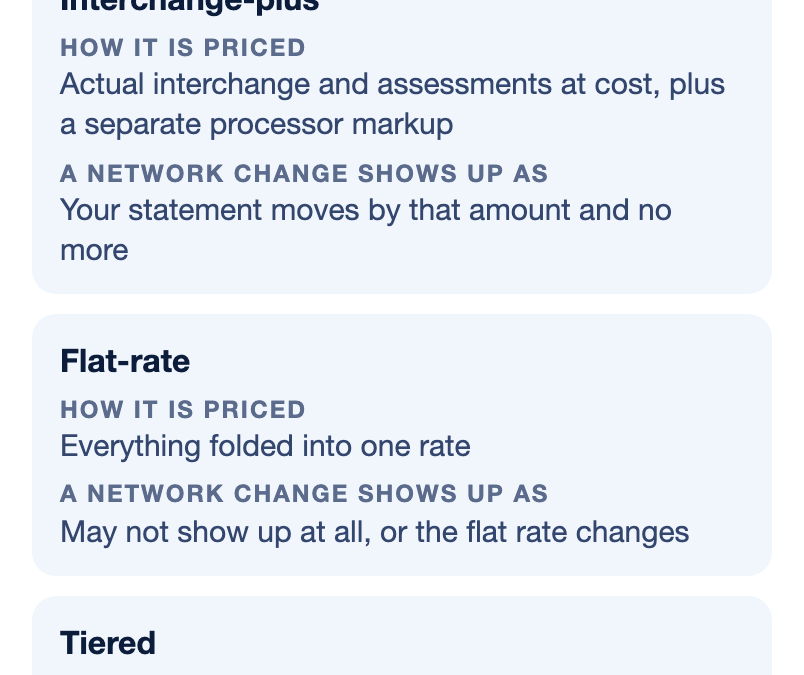
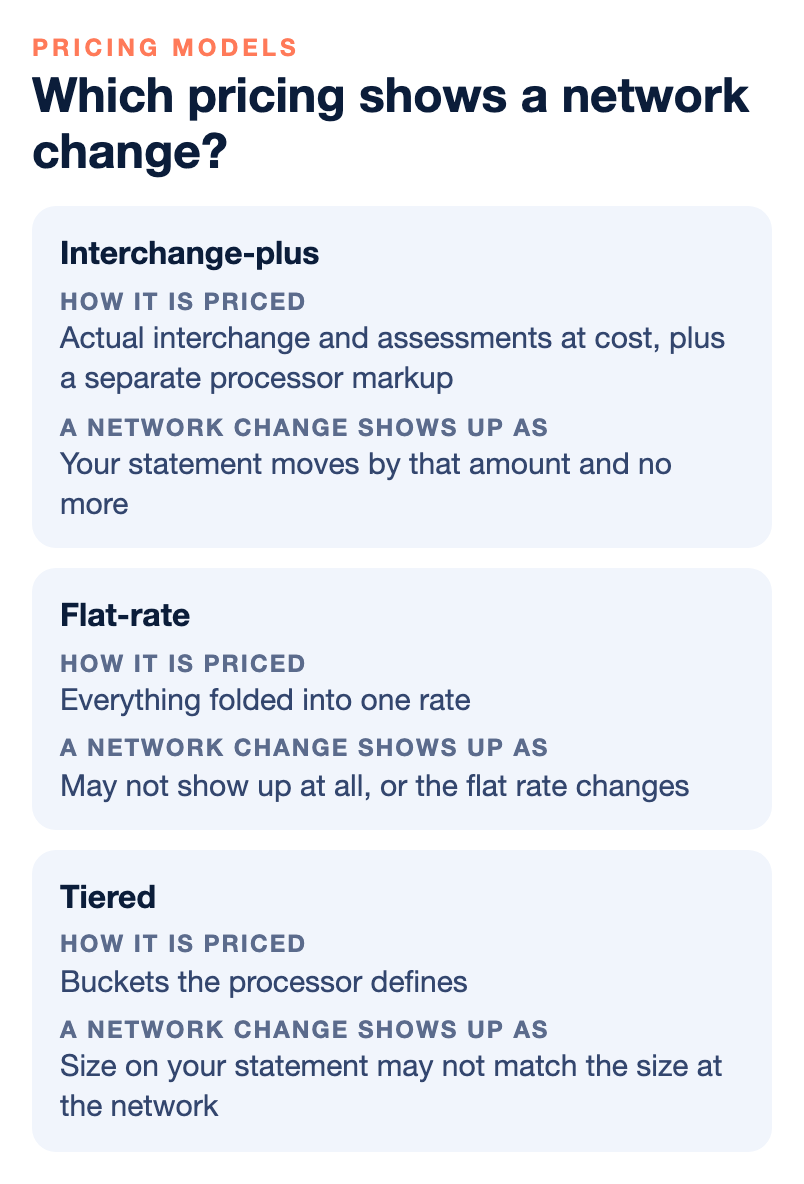
- Interchange-plus or cost-plus pricing passes the actual interchange and assessments through at cost and adds a separate processor markup. When the network raises or lowers a fee, your statement moves by that amount and no more, and you can see it line by line.
- Flat-rate pricing folds everything into one rate. A network change may not show up at all, or the provider may change the flat rate, and you cannot easily tell how much of the change was the network.
- Tiered pricing sorts transactions into buckets the processor defines. A network change can be the reason given for moving rates or buckets, and the size of the change on your statement may not match the size of the change at the network.
Our guide to special interchange rates for Visa and Mastercard explains how interchange categories work and why the same card can cost different amounts depending on how the transaction is run.
The rights most merchants actually have
Every agreement is different, so treat this as a map of where to look, not a promise of what you will find. These are the protections that commonly appear in merchant agreements, and the questions that tell you whether yours has them.
| Right to look for | Where it usually lives | What to ask |
|---|---|---|
| Notice of changes | The amendments or fee-change clause, and the notice section | How much notice do I get, and how is it sent: statement message, email or a website update? |
| Pass-through at cost | The pricing schedule | Are network fees passed through at cost, or can you change my rate when the network changes? |
| Leaving after a price increase | The termination clause | If you raise my pricing, can I end the agreement, and is the termination fee waived? |
| Seeing the change itself | Statement and reporting terms | Which network bulletin is this, what is the effective date, and which statement line changes? |
| Disputing an error | Billing and statement dispute terms | How long do I have to dispute a charge that looks wrong? |
Two things are worth saying plainly. First, many agreements let the processor change fees with notice, and some also let the merchant walk away if it objects to a fee increase, sometimes without the early termination fee. Whether yours does is in the fine print, and it is the single most valuable clause to find. Second, the notice you are owed is often a message on a statement or a change to terms posted online. If you never read your statement messages, you can miss the notice you were entitled to.
What you generally cannot do
You cannot opt out of a network rule and keep accepting that network’s cards. You cannot insist that the rule in effect on the day you signed still governs your account, because the agreement you signed said otherwise. And you cannot usually get your processor to absorb a network rule for you. A processor that tells you it will ignore a network requirement on your behalf is either mistaken or taking a risk that eventually lands on your account.
Where state and federal law come in
Some checkout rules are not set by the networks alone. Surcharging is the clearest example: what you may add to a card payment depends on the card brand’s rules, the payment method and your state’s law, and those can point in different directions. When a network changes a rule that touches pricing at the register, check your state’s rules too, and make sure your program is set up properly rather than by adding an arbitrary fee. If you need a legal opinion about a specific rule or your specific agreement, that is a question for an attorney, not for a processor or a guide like this one.
How to tell a network change from a price increase
Network changes are real, and they are also a convenient explanation. A notice that says “due to card network changes, your rates will increase” may be passing along a network fee exactly, passing along more than the network fee, or using the phrase to cover a markup increase. You can usually tell which in a few minutes if you ask the right questions.
- Ask which network change it is. A real network change has a name, a network and an effective date. “Industry changes” is not an answer.
- Ask which line on your statement will change. On interchange-plus pricing, the change should show up in the interchange or assessment lines, not in the processor’s markup.
- Compare two statements. Put a statement from before the effective date beside one from after it, and compare your effective rate, meaning total fees divided by total volume.
- Look for new fee names. A new monthly fee, a compliance fee or a renamed charge that arrives with a “network change” notice deserves its own question.
Our guide on how to read your merchant statement walks through the sections of a statement and where interchange, assessments and markup appear. And if fees you do not recognize keep appearing, our article on junk fees and PCI compliance explains how to tell a legitimate charge from one that is just padding.
What to do the week a change notice arrives
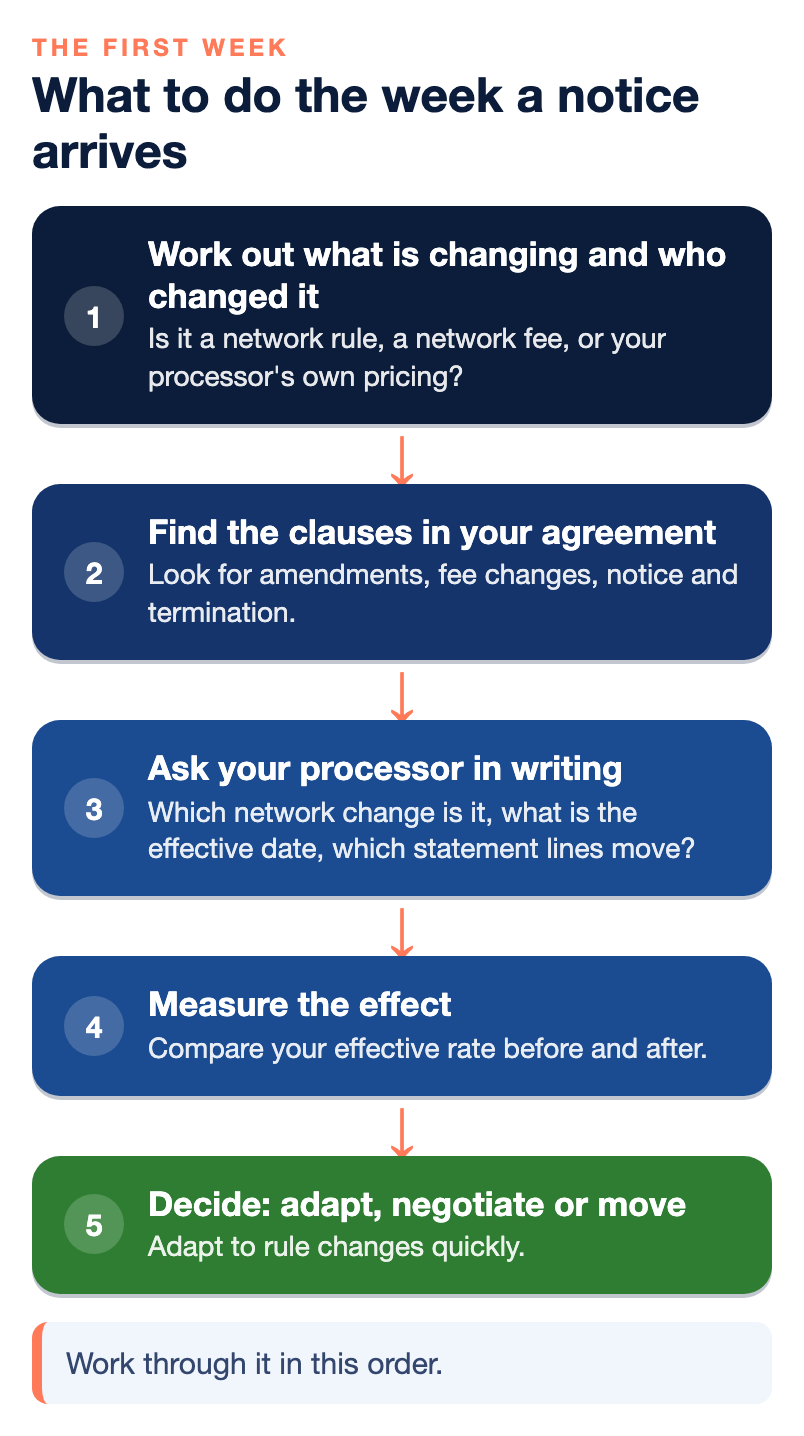
Most owners either ignore the notice or panic about it. Neither helps. Work through it in this order, and keep everything in writing.
- Work out what is changing and who changed it. Is it a network rule, a network fee, or your processor’s own pricing? The notice should say, and if it does not, that is your first question.
- Find the clauses in your agreement. Look for amendments, fee changes, notice and termination. Note any early termination fee and any equipment lease, which is often a separate contract.
- Ask your processor in writing. Which network change is it, what is the effective date, which statement lines move, and what do you need to do differently at checkout, if anything?
- Measure the effect. Compare your effective rate before and after, and check whether a rule change affects your dispute ratios, your checkout or your data requirements.
- Decide: adapt, negotiate or move. Adapt to rule changes quickly. Negotiate if the processor’s markup moved. Move if the agreement lets you and a better fit exists, and get the new processor’s terms in writing first.
If you decide to move, do it carefully. Keep your current account open until the new one is approved and working, because a gap in processing costs more than almost any fee change. And be complete and honest on the new application, because the new processor will underwrite your business on what you tell it.
Protect yourself before you sign the next agreement
The best time to find out what happens when the rules change is before you sign, when you still have every option. These are the questions worth asking any processor, including us.
- Is the pricing interchange-plus, and are network fees passed through at cost? This decides whether a network fee change reaches you at its real size.
- How do you notify me of changes, and how much notice do I get? Ask where the notice will appear so you know where to look.
- Is there an early termination fee, and is it waived if you raise my pricing? Get the answer in the agreement itself, not just in an email from a sales rep.
- Is the equipment leased, and is the lease a separate contract? A lease can outlast the processing agreement and cost more than the termination fee.
- Who helps me when a network rule changes how I take payments? A rule change is easier to absorb with someone who explains it before it takes effect.
Our checklist for selecting a payment processor covers the full list of questions to ask before signing a merchant agreement, from downgrade fees to the effective rate.
Where NPS fits, and where it does not
We offer several pricing models, including interchange-plus and cost-plus pricing, where the actual interchange and card-brand assessments are shown separately from our markup, so a network fee change shows up on the statement at its real size. We review statements and rates for merchants and prospects, and when a network rule changes how a business has to take payments, our team explains what it means for that business. Every account comes with live, U.S.-based support and a dedicated account manager. Like any processor, we have our own merchant agreement, and you should read ours as carefully as anyone’s and ask us for anything important in writing.
Here is where we may not be the right choice:
- Very low volume or a side project. We may not be the best fit for hobby sellers with very low processing volume.
- You want an instant, self-service account. We review each business, so we are not an instant-signup product.
- You would rather not provide underwriting documents. We ask for them, as any processor that underwrites properly will.
- You are choosing only on the lowest advertised flat rate. We price each merchant individually and do not publish one universal rate.
- You need a legal opinion on your current contract. We can explain how processing works, but a contract dispute belongs with an attorney.
If you are comparing providers more broadly, our comparison of payment processors by business type covers the main options and pricing models, and our payments guides library collects our other guides in one place.
Next step
A network rule change is not a breach of your contract. It is a change your contract already agreed to accept. What you control is what you agreed to around it, how quickly you notice the change, and whether your processor shows you its real size.
If a change notice just landed and you want a second opinion on what it means for your statement, you can talk with our team. If your current setup is the better fit, we will tell you.
Frequently asked questions
Can a card network change its rules in the middle of my merchant contract?
Usually yes. Your merchant agreement is with a processor and acquiring bank, and it almost always says you will follow the card network rules as they are amended. When the network changes a rule, the change applies to your account on its effective date.
Do I have a contract with Visa or Mastercard?
Usually not directly. The networks license acquiring banks, and the bank or its processor signs you. The network rules reach you through the merchant agreement you signed with them.
Can I cancel my merchant agreement if my processing fees go up?
It depends on your agreement. Some agreements let a merchant end the contract after a fee increase, sometimes without the early termination fee, and others do not. Read the termination and fee-change clauses and ask your processor to confirm in writing.
How do I know if a fee increase really came from the card networks?
Ask your processor which network change it is, its effective date and which statement line changes. On interchange-plus pricing, a network change should appear in the interchange or assessment lines, not the markup. Comparing your effective rate before and after the change shows its real size.
Does my processor have to tell me about network rule changes?
Your agreement decides how and when you are notified. The notice often comes as a statement message, an email or updated terms posted online. Read your statement messages so you do not miss a notice you were owed.
What if a new network rule hurts my type of business?
You cannot opt out of the rule and keep accepting that network’s cards. You can adjust your checkout, policies and fraud tools, and ask your processor what the rule means for your account. If your current processor cannot support you under the new rule, look for one that underwrites your category, and be fully honest on the application.
Are state laws involved in card network rules?
Sometimes. Surcharging is the common example, because what you may add to a card payment depends on the card brand’s rules, the payment method and your state’s law. For a legal opinion on a specific rule or contract, talk to an attorney.





