Best Payment Processors for Businesses: How to Choose in 2026
For most new businesses the best payment processor is Square or PayPal, for teams with developers it is Stripe, for growing businesses it is Helcim or Stax, and for high-risk merchants or anyone who wants a person to call it is a specialist such as Nationwide Payment Systems (NPS), the company that publishes this guide. The right one still depends on how much you process, how big each sale is, where you sell, and what happens when something goes wrong. This guide compares ten providers by business type, explains the four ways processors charge you, and gives you seven questions to ask before you sign.
The bottom line
- Just starting out, or under about $10,000 a month: a flat-rate provider such as Square or PayPal is usually the simplest start.
- Selling online with developers on your team: Stripe is built for custom checkout and international sales.
- Growing, B2B, multi-location, or taking large payments: look for interchange-plus pricing and a real person you can call. Helcim, Stax and Nationwide Payment Systems (NPS) all work in this space in different ways.
- High-risk industries: some popular providers will not board you. Ask this before you apply, not after a hold.
- Whoever you pick, the question that matters most is not “what is your rate?” It is “what happens when something goes wrong?”
A note before we compare: we are one of the options
This guide is published by Nationwide Payment Systems, which is a payment processor. So we are on this list, and you should read our entry knowing that. We tried to describe every provider by what it does well and who it fits, and we say plainly where we are not the right choice. Prices and terms change often, so confirm current details on each provider’s own site before you decide.
The four ways a processor can charge you
Every card payment carries three costs: the interchange fee paid to the bank that issued the customer’s card, the Visa and Mastercard assessments plus the card networks’ own fees, and the processor’s own markup. The processor’s pricing model is how that markup is applied, and how much of it you can see on your statement.
1. Flat-rate
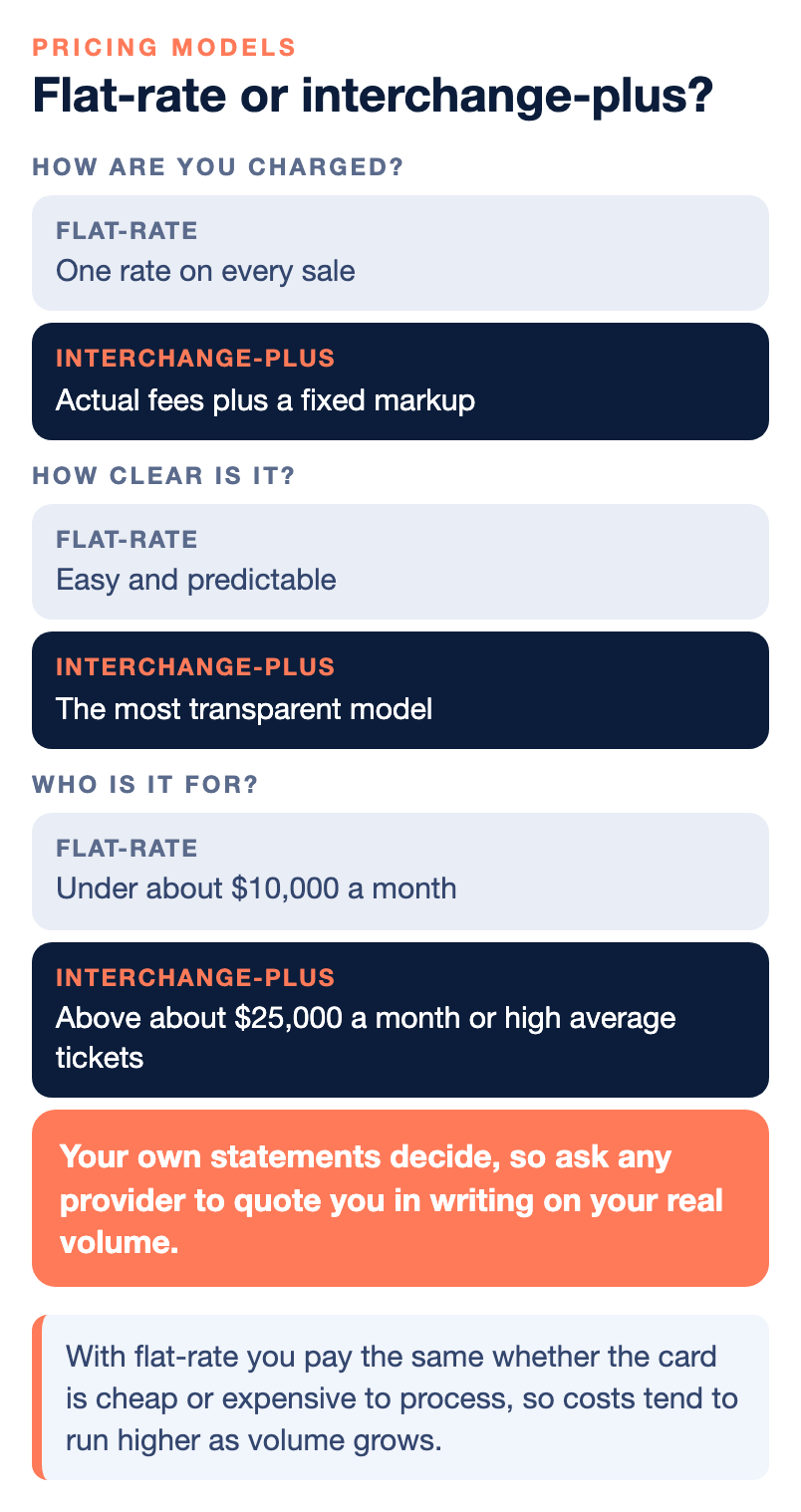
One rate on every sale, for example 2.9% plus 30 cents. Square, PayPal and Stripe are built this way. It is easy to understand and predictable. The tradeoff is that you pay the same whether the card is cheap or expensive to process, so costs tend to run higher as volume grows.
2. Tiered
Transactions are sorted into “qualified,” “mid-qualified” and “non-qualified” buckets, each with its own rate. It looks simple on paper, but many sales fall into the higher tiers, and it is easy for markups to hide. If you are offered tiered pricing, read a sample statement first.
3. Interchange-plus (also called cost-plus)
You pay the actual interchange and assessment fees plus a fixed markup, for example a small percentage and a few cents per sale. This is the most transparent model, because you can see what the card networks charge and what the processor adds. It usually fits businesses that process larger volumes, large average tickets, or B2B payments. It does ask you to be willing to read a statement.
4. Membership or subscription
A flat monthly fee instead of a percentage markup, with interchange passed through at cost. Stax is known for this model. It can work well for high-volume businesses, and it can cost more than it saves if your volume is small.
As a rough guide, flat-rate fits a business under about $10,000 a month, interchange-plus starts to make sense above about $25,000 a month or with high average tickets, and membership pricing tends to pay off at several hundred thousand dollars a month. Your own statements decide, so ask any provider to quote you in writing on your real volume.
Want the full breakdown? Read our guide to merchant account pricing models.
Which processor fits which business
Use this table as a starting point, not a verdict. Find the row that sounds most like your business, look at the providers named, and then compare a written quote from two or three of them on your own numbers. If your business sits between two rows, such as a growing online store that also sells in person, read both and weigh support and pricing transparency more heavily than any single feature.
| If you are… | Look at | Why |
|---|---|---|
| A startup or very small shop | Square, PayPal | Quick setup, flat-rate pricing, free or low-cost starter tools |
| An online business with developers | Stripe, BlueSnap, Adyen | Custom checkout, subscriptions, international payments |
| A growing small or mid-size business | Helcim, Stax, NPS | Interchange-plus or membership pricing and real support |
| A B2B company with large invoices | Authorize.Net, or a processor with invoicing and ACH | ACH, invoicing and card data that can lower costs on large payments |
| A multi-location retailer, liquor store or smoke shop | A processor with POS integrations | POS integrations and account management across locations |
| A high-risk business | High-risk specialists, including NPS | Many flat-rate providers will not board or may freeze funds |
| A large international business | Adyen | Global payment methods in one platform |
The ten providers, one by one
Square
Known for a free POS app, card readers and simple flat-rate pricing. Best for microbusinesses and small retailers who want to start taking cards the same day. The tradeoff is that flat-rate costs can add up at higher volume.
PayPal
A household name for online payments, with simple connections to many e-commerce platforms and a payer base that already trusts it. Best for online sellers and startups. Watch the fees on cross-border sales and read the policies on account holds.
Stripe
Built for developers, with flexible APIs, multi-currency support and strong tools for subscriptions and marketplaces. Best for software companies and sellers who need a custom checkout. It takes technical resources to set up and manage.
Chase Merchant Services
Part of JPMorgan Chase. Ask about reporting, fraud tools and pricing. A natural fit to consider if you already bank with Chase.
Authorize.Net
A long-established payment gateway for e-commerce, with support for cards and eCheck (electronic check) payments, rules-based fraud tools and recurring payments. Best for online sellers who want a proven gateway.
Adyen
A global platform that handles online and in-store payments across many payment methods and countries. Best for large international businesses.
Stax (formerly Fattmerchant)
Known for subscription pricing, where you pay a flat monthly fee instead of a percentage markup. Best for high-volume businesses that want predictable processing costs.
BlueSnap
An all-in-one platform with subscription management and fraud prevention, aimed at e-commerce and software companies with more complex billing.
Helcim
Focuses on transparent interchange-plus pricing and no long-term contracts, for small and mid-size businesses that want fair, visible pricing.
Nationwide Payment Systems (NPS)
A South Florida payment company working with merchants since 2001. NPS offers card processing, ACH, smart invoicing, POS systems, e-commerce gateways and dual pricing or surcharge programs, with live U.S.-based support and a dedicated account manager. Its merchants include retail, restaurants, e-commerce, B2B and high-risk businesses. More on where we fit, and where we do not, is below.
Aggregator or your own merchant account: what changes when something goes wrong
Many app-based processors work as aggregators. That means you board under their master account instead of having your own. It makes signup fast, and for many small businesses it works well. The difference shows up when there is a problem. With an aggregator, risk decisions can be automated, escalation paths can be limited, and support may be ticket-based only. A delayed deposit or a restricted account is then something you wait out, often without a person to call.
A dedicated merchant account usually means a fuller application and underwriting review, and in return you get your own account standing and a clearer path to a human when something needs attention. Neither model is wrong. The point is to choose on purpose, and to know before you sign which one you are getting.
How to read a processing statement in five minutes
A statement is the fastest way to see what you really pay. Find these lines and write down the dollar amount for each:
- Interchange: the fees that go to the banks that issued your customers’ cards.
- Assessments: the small fees paid to the card networks.
- Processor markup: what your provider adds on top. This is the number you can negotiate.
- Monthly and annual fees: statement fees, gateway fees, compliance fees and any minimums.
- Chargeback and dispute fees: what you are charged each time a customer disputes a payment.
Divide your total fees by your total sales for the month. That single percentage is your effective rate, and it is the fair way to compare a flat-rate quote with an interchange-plus quote. If a provider will not itemize these lines for you, that tells you something too.
Ways to lower what you pay, whichever processor you choose
- Move large invoices to ACH. Bank transfers can cost less than cards on big payments, so ask for a quote on both.
- Look at dual pricing or surcharging. Both are ways to offset card costs, and the rules differ by state and by card network, so confirm what applies to you before you start.
- Send better data on B2B card payments. Level 2 and Level 3 card data can qualify eligible business-to-business payments for lower interchange. Ask your processor whether your payments qualify.
- Prevent disputes. Clear descriptors, fast refunds and good records cost less than fighting chargebacks afterward.
- Re-check pricing each year. The model that fit you at $8,000 a month may not fit at $80,000.
Questions to ask before you sign
Most business owners shop for a processor by asking for the rate. A better starting point is to ask what happens when the money stops moving.
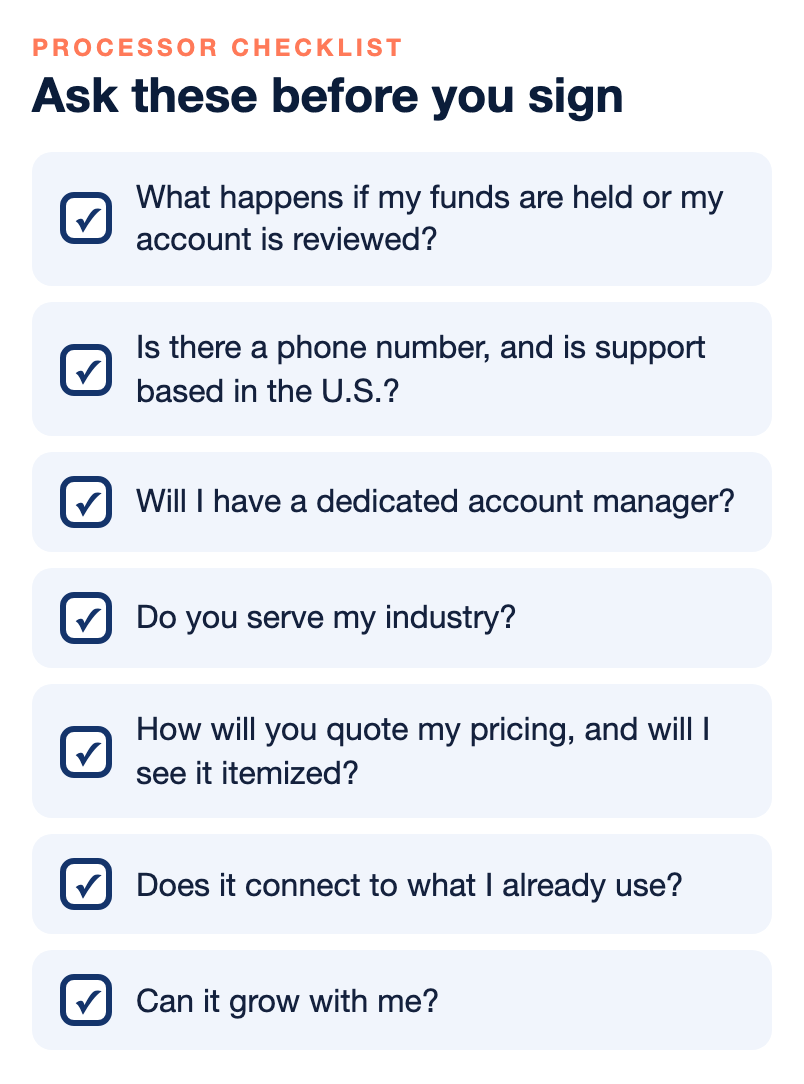
- What happens if my funds are held or my account is reviewed? Ask how long it takes, who you talk to, and how the escalation path works.
- Is there a phone number, and is support based in the U.S.? Email-only or ticket-only support is a risk when a terminal fails or a deposit is late.
- Will I have a dedicated account manager? Or is it a shared queue?
- Do you serve my industry? If you sell CBD, tobacco, vape or other regulated products, ask directly and ask early.
- How will you quote my pricing, and will I see it itemized? Ask for a sample statement and a written quote based on your real volume.
- Does it connect to what I already use? POS, accounting software, e-commerce platform, invoicing and ACH.
- Can it grow with me? Multiple locations, higher volume, new payment types.
Our full payment processor checklist walks through each of these in more detail.
Where Nationwide Payment Systems fits, and where it does not
NPS is built for businesses that want a payment partner more than a payment button. That usually means one of these situations:
- You want real phone support and an account manager who knows your business.
- You want a choice of pricing, including cost-plus, and you want to understand your statement.
- You take ACH or large B2B payments and want to lower what you pay on them.
- You want to look at dual pricing or surcharging to offset card fees, with compliance in mind.
- You run a liquor store, smoke shop or other retailer that needs POS and payments to work together. See our guide to POS systems for smoke shops.
- You are in a high-risk industry and need a processor who will board you and help you protect the account. Our high-risk processing Q and A covers what to expect.
NPS may not be the best fit if you are a hobby seller with very low volume, if you only want instant self-service signup, if you do not want to provide underwriting documents, or if you are choosing only by the lowest advertised flat rate. In those cases, one of the flat-rate options above may serve you better.
Whichever processor you consider, including us, ask for two or three references from businesses like yours, and ask each one what changed after they switched. A reference you can call is worth more than any claim on a website.
Frequently asked questions
What is the best payment processor for a small business?
For a business just starting out, Square and PayPal are popular because setup is quick and pricing is a simple flat rate. As volume grows, interchange-plus or membership pricing from a provider such as Helcim or Stax may cost less, so compare a written quote against your real statements.
Which payment processor is best for high-risk businesses?
Choose a provider that works with your industry before you apply. Many flat-rate providers restrict or decline high-risk categories. Specialists exist for these businesses, NPS among them, so ask each one how they handle holds and reserves.
Which processor is best for subscriptions or software?
Stripe and BlueSnap are built for recurring billing and complex subscription needs. Whichever you consider, ask whether recurring charges, retries and failed-payment handling are included.
Do I need a merchant account?
Not always. Aggregators such as Square and PayPal let you accept cards without your own merchant account, by placing you under theirs. A dedicated merchant account gives you your own underwriting and more direct control, which many growing businesses prefer. The tradeoff is an application and underwriting process.
Which processors work with Shopify or WooCommerce?
Check your platform’s payment settings for the list of supported processors, then confirm that your specific plan is supported before you sign. Ask any processor you are considering whether it has a plugin or integration for your platform.
Which processor has the lowest fees?
It depends on your volume and average ticket. Interchange-plus pricing, which Helcim publishes on its pricing page, shows what the card networks charge and what the processor adds. The only reliable comparison is a written quote on your own volume.
Can I accept ACH with every provider?
No. ACH support varies. Stripe offers ACH Direct Debit for customers with a US bank account and Authorize.Net offers eCheck payments, while other providers may not. Check before you rely on it.
Who has the best customer support?
Ask each provider whether there is a phone number, whether support is U.S.-based, and whether you get a dedicated account manager. Check the same for every provider you consider, and call the support line once before you sign.
Next step
The right choice is rarely the cheapest headline rate or the biggest brand. It is the provider that fits your volume, serves your industry, and picks up the phone when you need it. Whichever one you choose, get the pricing in writing, keep a copy of your first statement, and review it after the first full month.
To make a comparison useful, bring your last three monthly processing statements, your average sale amount, your monthly card volume, and a short list of the products you sell. With those four things, any provider can give you a real quote instead of a guess, and you can compare quotes side by side without doing the math twice.
If you want a second set of eyes on your current processing statement, you can talk with our team. We will tell you plainly whether a switch makes sense for your business, even when the answer is to stay where you are.