
No single, permanent blacklist of businesses that can never accept cards exists in the places most merchants fear. What does exist is a handful of different records, rules and decisions that all get called “a blacklist,” and only one of them, a MATCH listing, is a shared industry record, and under Mastercard’s current rules it generally ages out after five years. Most of what feels permanent after a shutdown is not a record at all. It is a mismatch between your business and the provider you chose, or a file that tells a confusing story. This guide separates the five things people mean, explains what really happens after a termination, and shows what can be done for each.
The short answer
- “Blacklisted” is a nickname, not a list. It can mean a MATCH listing, a closure by a payment platform, a decline inside a processor, a business type that providers will not support, or a history that follows the owners into new applications.
- Only MATCH is a shared record, and it is not public. Acquiring banks and their processors use it. Under Mastercard’s current rules, a record generally stays for five years and is then purged automatically.
- A closed account is not proof of a listing. Many terminations never reach MATCH, so the first job is to find out, not to assume.
- Starting a new company does not erase anything. Underwriters look at owners, addresses, websites and processing history, so honesty works better than a fresh name.
Why “blacklist” is not one list
When a merchant says “I got blacklisted,” the next question is “by whom, and how do you know?” The word hides at least five situations, each with its own cause, fix and lifespan.
It helps to see this from the bank’s side. An acquiring bank, the bank that settles card payments for a merchant, can be left holding the loss if customers dispute charges, products are never delivered or a merchant disappears after collecting money. Every tool in this guide exists because of that exposure. Some are shared across the industry and some are one company’s private decision. Treating them as one thing is why many merchants spend months chasing the wrong problem.
Kind 1: A MATCH listing
MATCH is Mastercard’s system for acquiring banks and the processors that work for them. When a bank closes a merchant account for certain serious reasons, it can enter the merchant into the database, and other banks check the database when a new application arrives. You may also hear it called the Terminated Merchant File, the older name.
Three facts surprise most merchants.
- It is not a public database. You cannot search your business name online and see whether you are listed. You find out by asking the bank or processor that closed your account, or when a new bank runs the check during underwriting.
- It is about more than the company name. A record can include information about the business and its principal owners, the type of business, its websites, the date the account was terminated and the reason for the listing.
- Each record carries one of 14 reason codes. The codes are grouped in plain words in our guide to the 14 MATCH reasons. They cover things like data breaches, laundering, excessive chargebacks, excessive fraud, a fraud conviction, a fraudulent or stolen identity, card-security noncompliance and illegal transactions.
So is MATCH a permanent blacklist? Not in the way people fear. It is a risk-information system. It tells a bank that a merchant, or information connected to that merchant, was reported before and why. It does not order every bank to decline every application. What it does is change the conversation: the questions get harder and the file gets heavier.
Under Mastercard’s current rules, MATCH records generally stay for five years and are then purged automatically, and the bank that listed you can confirm the period for your record. MATCH is also separate from the credit bureaus, so it does not touch your credit score. It affects your ability to get card processing, which is serious enough. For the full walkthrough of finding out whether you are listed, read Am I on the MATCH List?
Kind 2: A shutdown by a payment platform that never reached MATCH
This is the most common “blacklist” story we hear. A business signs up with an instant-approval payment platform, processes for months or even years, and then one morning the account is closed and the money is held. It feels like being banned. In many cases it is something narrower.
Instant-approval platforms open accounts quickly and do much of their risk review afterward, once real transactions start to flow. They also keep lists of restricted and prohibited business types and they update those lists. A business can process for a long time, have its category added to a restricted list and be shut down without having done anything new. That termination can be painful and can come with held funds, but on its own it is not the same thing as a MATCH listing. See sudden account shutdowns and the merchant account alternative: these platforms combine many merchants under one master account and handle risk through centralized, automated review.
Common triggers include transactions that do not match the website description, a jump in average ticket size, rising refunds, products near a restricted list, a missing refund policy, hidden recurring billing and money movement that looks like handling funds for other people. None of those automatically means a MATCH listing, so find out which of the two happened.
What does a shutdown leave behind? Each company keeps its own records under its own policies, and we cannot tell you how another company handles yours. Ask the platform directly, and be completely open about the closure on your next application. A past termination, a monitoring program or a fund hold can put a business into a higher-risk group, even when it was not the merchant’s fault.
Kind 3: A decline inside a processor that the bank never saw
Merchants often say, “The bank denied me.” Often a sales organization or processor declined the file internally, a reviewer flagged the website, an automated model rejected the industry, or the business model was not explained clearly enough. Banks make risk decisions based on clarity, and many processors make them based on automation and their own appetite.
That matters for the word “permanent” because one processor’s no is one processor’s no. A different provider, a different bank and a better-prepared file can lead to a different result. Our guide on how acquirers read a merchant application shows what underwriters weigh.
The risk is the reaction. After one decline, many owners apply everywhere at once, and each application can add another decline to their history. A cluster of applications can itself look like a red flag.
Kind 4: A business type that many providers will not support
Every processor and platform decides which businesses it will support, and most publish the decision as a restricted list and a prohibited list. Restricted usually means extra review and approval. Prohibited means no. Legal is not the same as approved: a lawful business can sit outside what one provider or its bank is willing to support because of chargeback history in the industry, card-brand registration requirements, licensing, future-delivery exposure or plain internal policy. One bank may turn down an industry that another bank actively wants.
This can feel like a permanent ban because the answer is the same at every mainstream provider. But it is a statement about the category, not a record about you. The fix is an account underwritten by a bank that wants your kind of business. We explain the labels in What Does Restricted Merchant Mean? and the specialized route in our high risk merchant services overview.
Kind 5: A file that follows the owners
The last kind is not a list. It is the fact that underwriting reads people and patterns, not just a company name. Banks examine ownership, principals, business addresses, websites, tax information, processing history and related companies. A MATCH record itself can carry information about the owners. A prior termination, a high chargeback history or documents that contradict each other travel with the people behind the business.
This is why “just start a new company” fails. Hiding an ownership link or a processing history is not a legitimate strategy, and it tends to turn a solvable problem into a worse one. Calling a vape store a convenience store, for example, may get an account opened, but when the mismatch surfaces the result is worse than the original problem.
What “permanent” really means for each kind
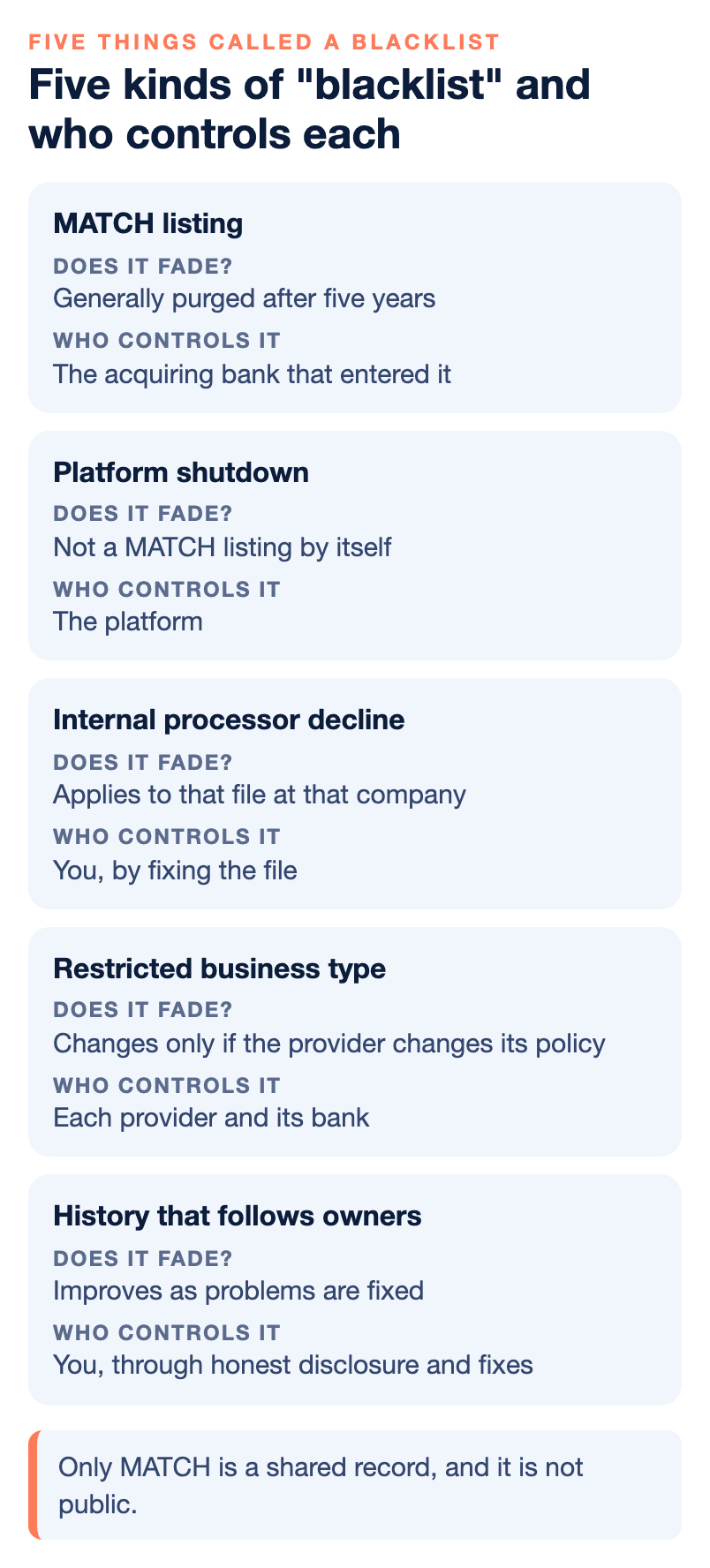
Here is the whole picture side by side. The last column shows who can actually change the outcome.
| What it is | Does it fade or change? | Who controls it |
|---|---|---|
| A MATCH listing, a shared record used by acquiring banks | Under Mastercard’s current rules a record generally stays five years and is then purged. Removal earlier is limited. | The acquiring bank that entered it, working through Mastercard’s process |
| A platform shutdown without a listing | Not a MATCH listing by itself. Ask the platform what it keeps and how it treats your history. | The platform, under its own policies |
| An internal decline at one processor | Applies to that file at that company. A better-prepared file elsewhere can get a different answer. | You, by fixing the file, and the next underwriter |
| A restricted or prohibited business type | Changes only if the provider changes its policy. Other banks may want the category. | Each provider and its bank |
| A history that follows the owners | Improves as problems are fixed and clean processing builds up. It does not vanish by renaming. | You, through honest disclosure and fixes |
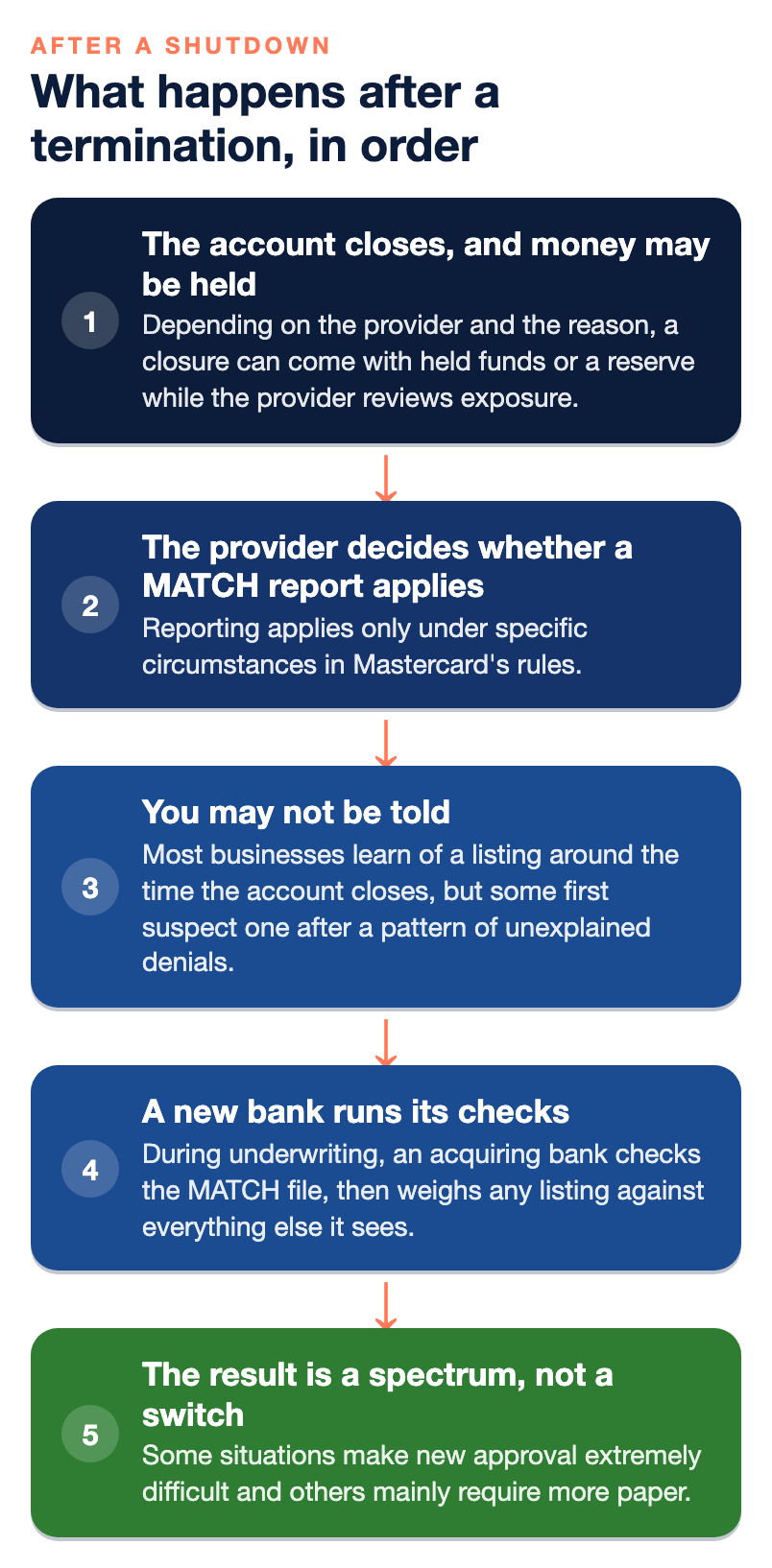
What really happens after a termination, in order
- The account closes, and money may be held. Depending on the provider and the reason, a closure can come with held funds or a reserve while the provider reviews exposure. Read the termination notice in full and save it.
- The provider decides whether a MATCH report applies. Reporting applies only under specific circumstances in Mastercard’s rules. A change to the provider’s own list of supported business types is a different thing from the serious reasons that lead to a listing.
- You may not be told. Most businesses learn of a listing around the time the account closes, but some first suspect one after a pattern of unexplained denials.
- A new bank runs its checks. During underwriting, an acquiring bank checks the MATCH file, then weighs any listing against everything else it sees: the reason, the industry, the time since the termination, the business’s financial condition, its processing history, ownership, operations and its own policy.
- The result is a spectrum, not a switch. Some situations make new approval extremely difficult and others mainly require more paper. A bank that works with higher-risk merchants may review a listed merchant case by case, and approval often comes with stricter terms, closer monitoring and higher costs than a standard account.
That last trade can still be worth making. It keeps the business running while a listing ages out and the record of clean processing grows. Just read the terms before you sign.
What can be done, by situation
If you are not sure what you are dealing with
Ask the bank or processor responsible for the closed account whether the business or any principal was submitted to MATCH. If yes, ask in writing for the reason code, the date, the acquiring bank responsible and the basis for the listing. Follow up by email so there is a record.
If the listing is wrong
Information can be entered against the wrong business, filed under the wrong reason, or tied to an account that was never yours. Identify the bank that entered it, get the reason code, gather your documents (termination notices, processing statements, correspondence, compliance and chargeback records, proof of ownership) and put your dispute in writing. If the cause could be identity theft, read You’re on the MATCH List and Did Nothing Wrong? If the bank will not engage, it may be time to speak with an attorney who handles merchant processing disputes.
If the listing is accurate
Fix the cause, document the fix and find an acquiring relationship willing to look at the whole picture. Removal is not available just because a merchant disagrees, and calling Mastercard to explain your side is generally not how the system works. The rules allow removal in limited situations: mainly when the bank that entered the listing reports it was added in error, and through a specific process for certain card-security noncompliance listings once compliance is confirmed. Nobody outside the bank that made the listing can honestly promise to remove it, and an offer to make a listing disappear for a fee is a warning sign.
If it was a platform shutdown or an internal decline
Work out the real trigger. Was it your category, a gap between what the site says and what you sell, a spike in refunds or disputes, or money movement that looked like handling funds for others? Fix what can be fixed, then bring a complete file to a provider that underwrites your kind of business before you process. If disputes were part of the story, see chargeback ratios and card network warnings, and for what a reserve means, reserve requirements.
If the cause was laundering
Processing payments for activity that was never approved on your account is one of the clearest paths onto MATCH, and it is not a favor to a friend who cannot get processing. See our guide to transaction laundering and card testing.
What not to do
- Do not apply everywhere at once. Understand the situation first, because each decline adds to your history.
- Do not hide the termination or describe your business as something vaguer. Underwriters check, and a mismatch usually comes out.
- Do not use a new company name as a shield. Owners, addresses and websites are all read.
- Do not wait out the clock and do nothing. Use the time to fix the cause and build a record that shows it was fixed.
- Do not pay anyone who promises to erase a listing. Only the bank that entered it can ask for removal.
Questions to ask before you apply again
Whether you talk to us or to anyone else, these questions show whether a provider understands your situation.
- “Were the business and its principals submitted to MATCH, and what reason code, date and reporting bank apply?”
- “Which bank would actually hold my account, and does it underwrite my kind of business?”
- “Will you review my website, products and policies before I process a single sale, and what are the reserve and monitoring terms in writing?”
- “If the application is declined, will you tell me why?”
- “Who do I call when something goes wrong?”
Who wrote this, and where NPS fits
Nationwide Payment Systems (NPS) publishes this guide. We are a payments company based in South Florida, in business since 2001, and we work with high-risk and hard-to-place merchants, so we are a seller here and not neutral. We can review your situation before another application goes out, covering the termination, any MATCH information you have, chargebacks, products, your website, licenses and compliance documents. We cannot remove anyone from MATCH, we do not promise approval, and we do not publish one universal rate because pricing depends on industry, volume, ticket size and risk. If you want an instant self-service sign-up with no documents, a simpler platform may suit you better. For the basics of who qualifies, see what makes someone eligible for a merchant account, and for the original guide on the shared record, see The MATCH List: What It Is, Why It Matters, and How to Avoid It. You can browse more in our payments guides.
Bottom line
A business is rarely blacklisted from accepting cards forever. What exists is a set of different things that look alike from the outside: a shared MATCH record that Mastercard’s rules generally purge after five years, a platform’s closure under its own policy, one processor’s internal decline, a category many providers avoid, and a history that follows the owners. The first step is to find out which one you have, in writing. The second is to fix what caused it and document the fix. The third is to apply once, honestly, to a provider that understands your business. If you would like a second opinion on your situation, you can contact our team, and if another path fits you better, we will say so.
Frequently asked questions
Can a business be blacklisted from accepting credit cards forever?
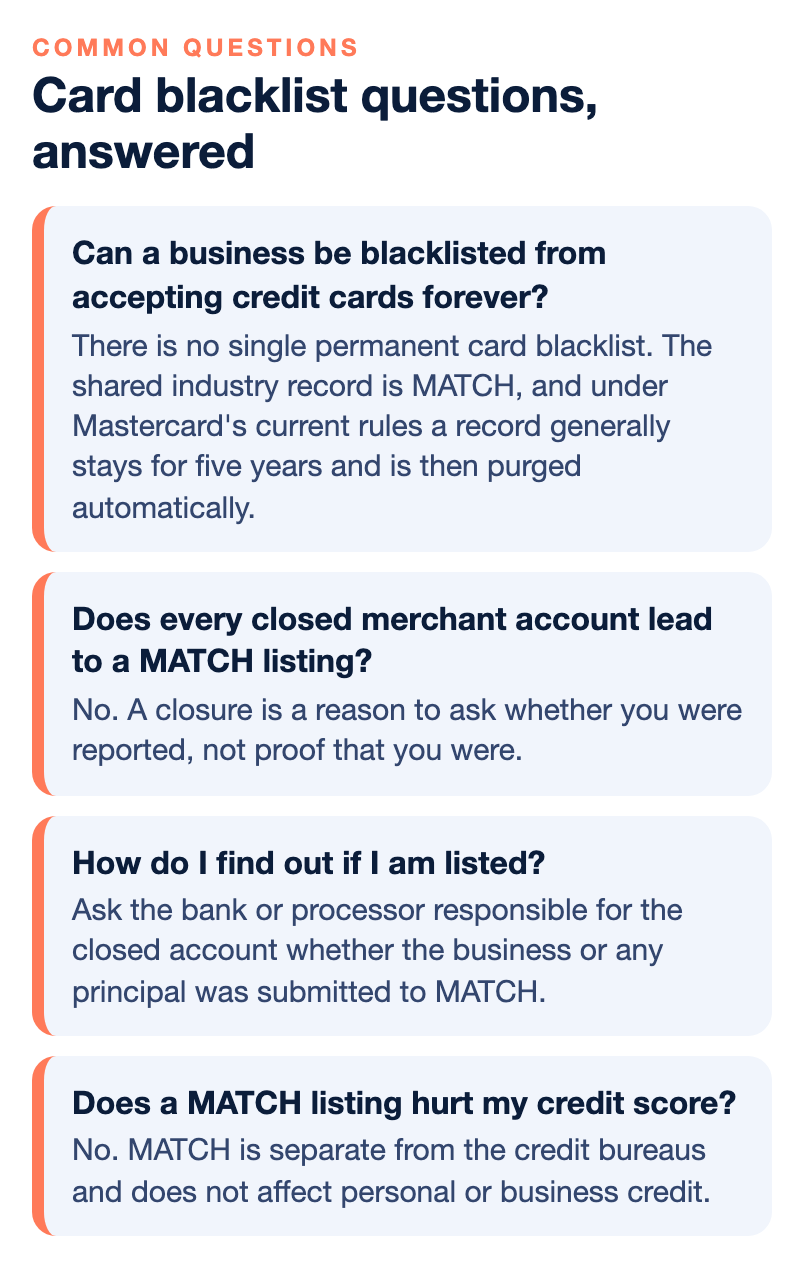
There is no single permanent card blacklist. The shared industry record is MATCH, and under Mastercard’s current rules a record generally stays for five years and is then purged automatically. Other outcomes, such as a platform shutdown or a processor’s decline, are decisions by one company, not a permanent record.
What is the closest thing to a blacklist for merchants?
MATCH, Mastercard’s system that acquiring banks and their processors use to record merchants whose accounts were terminated for specific serious reasons. It is not a public database, and a listing does not order every bank to decline you, but it makes underwriting harder.
Does every closed merchant account lead to a MATCH listing?
No. Providers close accounts for many reasons, including changes to their own lists of supported business types. MATCH reporting applies only under specific circumstances in Mastercard’s rules. A closure is a reason to ask whether you were reported, not proof that you were.
How do I find out if I am listed?
Ask the bank or processor responsible for the closed account whether the business or any principal was submitted to MATCH. If yes, ask in writing for the reason code, the date, the bank responsible and any information about the basis. A new bank may also find a listing during underwriting.
Can I get off MATCH sooner?
Removal is limited. The main path is the bank that entered the listing reporting that it was added in error, and Mastercard’s rules include a process for certain card-security noncompliance listings once compliance is confirmed. Only the bank that made the listing can request removal, so nobody else can promise it.
Can I start a new company to get a clean slate?
No. Underwriting looks at owners, principals, addresses, websites, tax information, processing history and related companies, and a MATCH record can include information about the owners. Hiding a history tends to make the problem worse. Disclosure and specialized underwriting work better.
Can I still accept cards if I am on MATCH or was shut down?
Possibly. It depends on the reason, the industry, the time since the termination, your processing history, ownership and whether the problem was fixed. Expect stricter terms, closer monitoring and higher costs with providers that specialize in higher-risk accounts.
Does a MATCH listing hurt my credit score?
No. MATCH is separate from the credit bureaus and does not affect personal or business credit. It affects your ability to get card processing.





