
A restaurant card payment is a two-step event, and that is the root of most restaurant payment problems. The card is approved for one amount when the check is paid, and the tip often arrives afterward, so the final charge can be larger than what the card was approved for. This guide follows one card payment through a restaurant or bar from the first tap to the deposit, shows where tips, tabs and chargebacks come in, and explains which equipment setup fits which kind of place.
The short answer
- A card payment has stages. The card is authorized, the sale is settled in a batch, and the money is deposited in your bank account. A tip added after the first stage is where restaurants run into trouble.
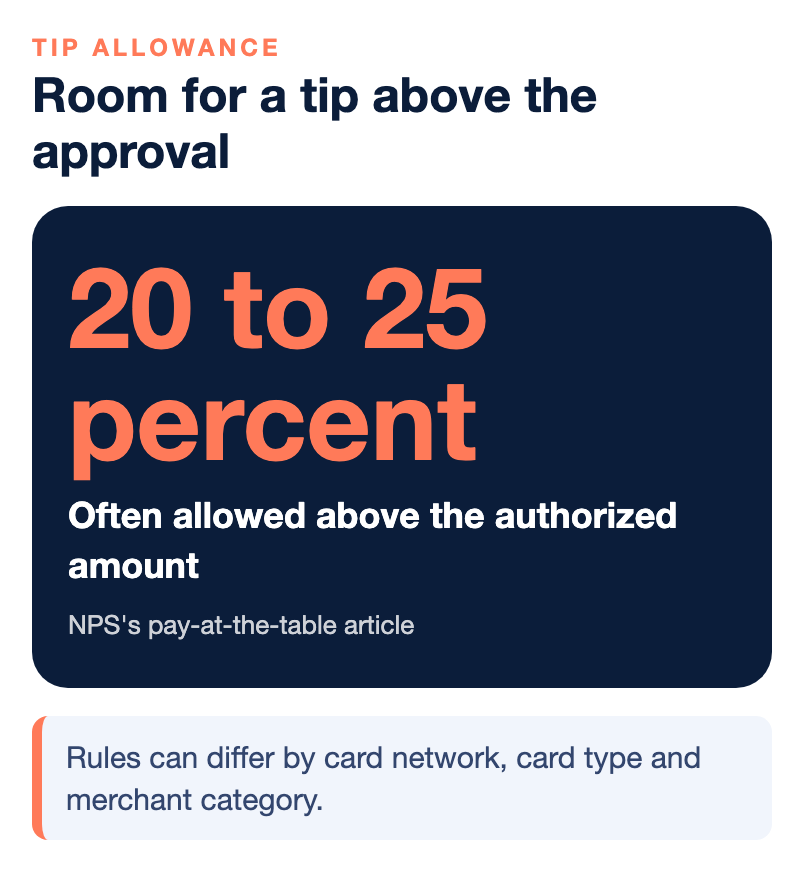
- Tip adjustments carry risk. NPS describes card issuers allowing the authorized amount to be exceeded only by a limited margin, often discussed as roughly 20 to 25 percent. Big tips beyond that margin can lead to partial chargebacks.
- Taking the tip before the card is run removes most of that risk. Pay-at-the-table devices and counter screens put the tip into the same authorization as the check.
- Bars and nightclubs face the most disputes. Open tabs, duplicate tabs and big night-out totals are common reasons for chargebacks.
- Equipment follows service style. A counter cafe, a sit-down dining room and a busy bar each need a different mix of card machine, wireless terminal or full restaurant POS.
How one card payment moves through a restaurant
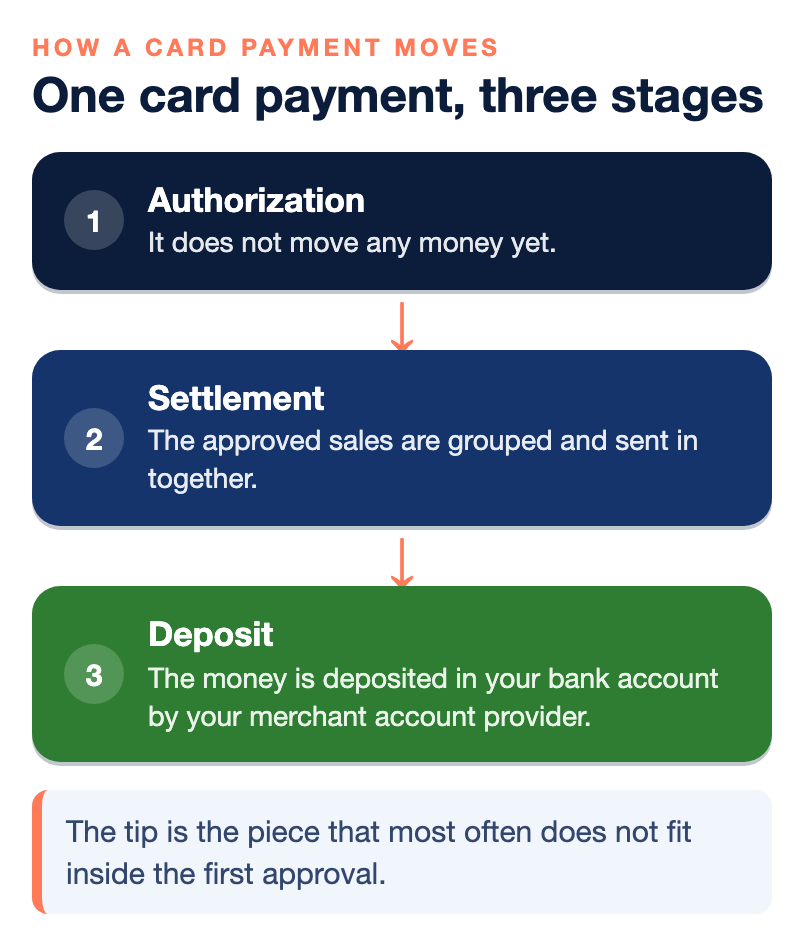
Picture a table of four finishing dinner. The check is $100. The server brings a card machine or a handheld device, the guest taps or inserts a card, and a message travels from your device to the card network and on to the bank that issued the guest’s card. The issuing bank checks that the card is real and has enough available credit or money, and sends back an approval. That approval is called an authorization. It does not move any money yet. It is a promise that the funds are there and are being held.
At the end of the day, or on whatever schedule your equipment uses, the approved sales are grouped and sent in together. This group is called a batch, and sending it in is called settlement. After settlement, the money is deposited in your bank account by your merchant account provider. A merchant account is the account that lets a business accept card payments and receive the funds. If the term is new, our guide on what changes by how you sell shows how it fits different kinds of businesses.
Three terms are worth keeping in mind through the rest of this guide. The authorization is the approval for an amount. The capture or settlement is the final amount you actually collect. The chargeback is a reversal the cardholder’s bank forces after the fact when a charge is disputed. Almost every restaurant payment headache lives in the gap between the first and the second of those three, because the amount approved and the amount collected are not always the same.
Why the tip is the tricky part
In a retail store the guest pays the exact price. In a restaurant, the guest decides on an extra amount after seeing the food, the service and the bill. In many sit-down places, the old workflow was to run the card for the check amount, hand back a slip, and let the guest write in the tip. The server then keyed that number in later as a tip adjustment. That workflow made sense when cards were swiped and slips were signed. It makes less sense now, and NPS has written about why.
NPS’s page on the 20% tip tolerance explains the idea in plain terms. When a card is run for a $100 check, the authorization can include an allowance for a tip, so the approval may be for about $120. If a guest leaves a much larger tip than that allowance, the card issuer may reverse the extra amount. NPS’s article on pay-at-the-table technology describes the same threshold as roughly 20 to 25 percent and gives an example: a card is authorized for $100, the guest adds a $50 tip, only about $25 of that tip fits inside the allowance, and the business can face a partial chargeback of the rest plus a chargeback fee.
These figures come from NPS’s own published pages, and rules can differ by card network, card type and merchant category. So treat them as a way to understand the problem, not as a promise about how your cards will behave. The practical question to ask your provider is simple: how does my equipment handle a tip that is larger than usual, and what happens to the extra amount?
Where large tips come from
NPS notes that generous tips are common at bars and nightclubs, where a guest may want to reward a bartender or a bottle-service team, and in any place where regulars decide to tip well. The same page also mentions that during the pandemic, regulars leaving bigger than usual tips made the issue more visible. Large tips are good news for staff and a risk for owners if the payment workflow was not built for them.
Credit cards, debit cards and gift cards behave differently
The same NPS page explains why a restaurant cannot simply approve every card for a much higher amount. On a debit card, the held amount takes money out of the guest’s account, and NPS says that hold can take several days to drop off, while on a credit card it usually clears sooner. Prepaid gift cards add another limit: a card loaded with $100 cannot cover a $120 payment, so a tip cannot be added on top. Teach staff to ask before running a gift card for a sit-down meal.
Ways to take the tip so the whole amount is approved
The fix NPS recommends is to capture the tip at the time of the sale, so the card is approved once for the full amount. There are three common ways to do that.
- Pay at the table. The server brings a wireless terminal to the table. The guest inserts or taps the card, picks a tip percentage or types an amount, and the device approves the full total. The card never leaves the guest’s hand, which guests tend to like.
- Tip on the screen at the counter. A customer-facing screen shows tip choices before the guest pays, so the check and the tip go through together. NPS describes this for counter-service and for places where guests pay at the front.
- Write the tip first. If you still use a printed check, print it with a tip line, let the guest fill it in, and only then take the card away and run the full amount once. NPS suggests this for older setups that cannot do tableside payment.
NPS’s pay-at-the-table article also points out that chip cards and phone wallets such as Apple Pay and Google Pay changed guest habits, because many guests now expect the card to stay with them throughout the payment. That is another reason the old method of taking the card away, running it and adjusting later feels outdated to many diners.
When the tip is part of the first approval, there is also less room for a handwriting mistake. A $20 tip that is read as $30 is a classic dispute. A guest who chooses the tip on the device sees the number before it is charged.
Bar tabs and nightclub tables
A bar tab works a little differently from a restaurant check. NPS’s guide to POS systems for small restaurants and bars explains the usual approach: the card is pre-authorized when the tab opens, drinks are added through the night, and the final amount is captured when the tab closes. A pre-authorization is a temporary hold on the card to show it is valid. It is not the final charge.
That approach raises several questions that are worth asking any provider before you sign:
- What happens to a tab that is still open when the bar closes?
- What happens when a guest walks out without closing the tab?
- What happens when a guest opens two tabs by accident?
- How is the tip added when the tab closes?
Duplicate tabs matter because they are a well-known cause of the dispute that reads, “I was charged twice.” NPS’s chargeback guide for bars, nightclubs and restaurants lists that “duplicate charge” claim next to “wrong amount,” which it links to confusion over tip adjustments. For a view of nightclub equipment in particular, see NPS’s explainer on nightclub POS systems.
Chargebacks in a restaurant or bar
A chargeback happens when a cardholder asks their bank to reverse a charge. The bank pulls the money back from you and gives you a chance to respond with evidence. Hospitality businesses see disputes for a few repeated reasons. NPS’s chargeback survival guide for bars, nightclubs and restaurants lists these common claims:
- “I wasn’t there.” The cardholder says they never visited.
- “Duplicate charge.” Often caused by more than one tab for the same guest.
- “Wrong amount.” Often caused by confusion over a tip adjustment or a total that changed after approval.
- “Didn’t receive the item.” The guest claims the food or drinks never arrived.
The guide’s point is that many of these are not fraud by a stranger. They are disputes from guests who regret a charge or do not recognize it, a pattern often called friendly fraud. Our article on first-party fraud explains why that kind of dispute can be hard to spot in your data, and our overview of how chargeback reason codes work shows how to read the code attached to each one.
What a chargeback really costs
NPS’s guide says a chargeback costs more than the sale itself. The business can lose the sale, the food and drink, and the tip it already paid out to staff, plus a per-dispute fee from its processor. Chargeback fees vary by provider, so ask what yours charges for each one. A few lost disputes in a month can add up faster than owners expect.
What helps you respond
The NPS guide recommends a short, factual letter of explanation: you are a restaurant, the customer was present, ordered, received the food and paid with a chip card, and no refund was requested. It also advises keeping the tone businesslike. Keep your documents ready: the signed or electronic receipt, the itemized check, and any record showing the tip was chosen by the guest. A tip that was entered on the guest’s own device is easier to defend than one keyed in by hand after the guest left. The guide adds that chip card payments can still be disputed, but they are easier to defend when documented. Deadlines to respond vary by processor, so ask yours for the exact timeline. For the full picture, read our chargeback survival guide.
Picking equipment that fits how you serve
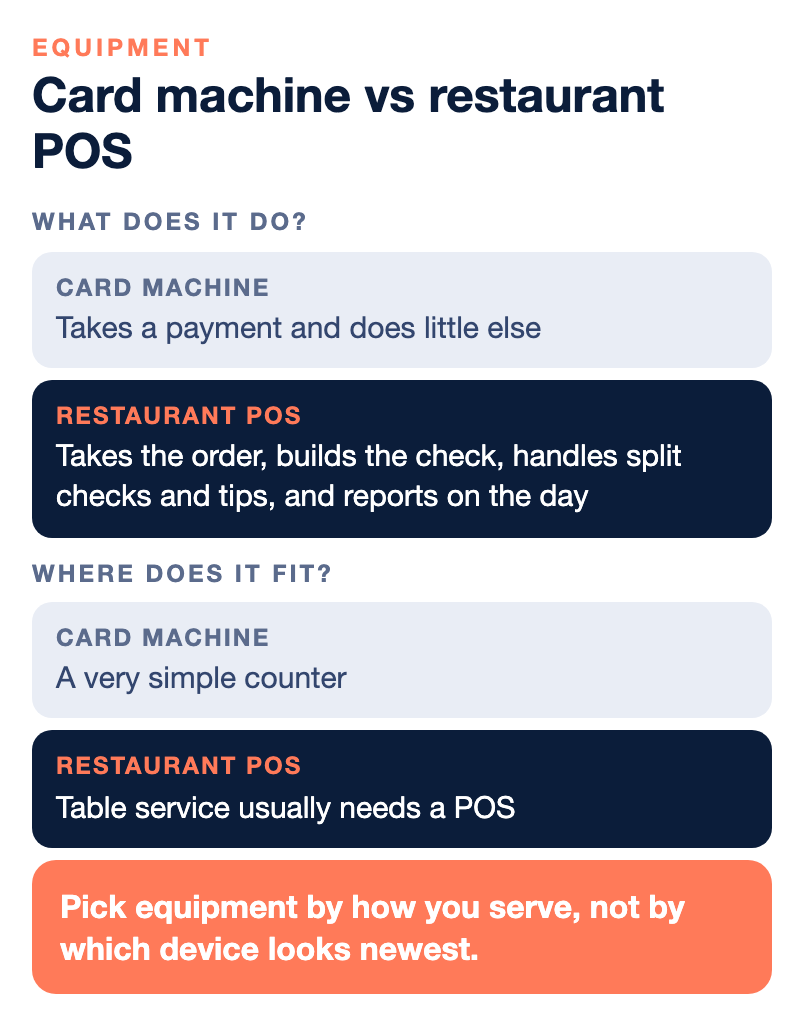
Equipment questions usually start with a rate, but the better starting point is service style. Ask three things: do guests pay at a counter, at the table or at the bar, how many people work the floor, and do you run tabs. NPS’s explainer, credit card machine, POS system or virtual terminal, describes the three tools this way. A credit card machine, also called a terminal, takes a payment and does little else. A point-of-sale system, or POS, runs the whole sale: the order, the check, the payment and the reports. A virtual terminal is a web page for keying in payments with no equipment.
Here is how those choices tend to line up with restaurant styles, based on NPS’s guides.
- Food truck, coffee cart or a counter with a short menu. A card terminal with a simple register may be enough. You outgrow it once you add tables or more staff.
- Sit-down restaurant. A restaurant POS with table service, split checks, kitchen routing and a wireless pay-at-the-table device fits best, because tips and split checks run through every table.
- Busy bar. You need tab handling, fast closeouts and durable bar terminals. A POS that supports pre-authorized tabs and reports by employee is worth asking about.
- Nightclub. Table service, large totals and fast turnover make tip capture and clear receipts especially important.
Keep one more choice in mind: how the POS software and the card processing connect. NPS’s article on semi-integrated and fully integrated point of sale explains that the difference affects reporting, cost and how easily you can change processors later. If you are unhappy with processing in two years, ask whether you could change it without replacing your POS. Some systems make that simple and some do not, and it is far easier to ask before you buy hardware.
When you compare options, NPS’s checklist of 20 restaurant POS questions is a useful companion. It covers handheld and tableside devices, paying at the table or bar with mobile pay or a QR code, how chargebacks are handled, tip tracking, working offline when the internet drops, and whether support is available nights and weekends.
Pricing, fees and what to ask before you sign
NPS does not publish rates, and neither will this guide, because pricing depends on the business. What you can do is ask better questions. Ask how the pricing is structured, what each statement line means, and whether any equipment costs, monthly fees or chargeback fees are separate. NPS also covers two ways some restaurants offset card costs: dual pricing, where cash and card prices are shown separately, and surcharging, where a fee is added to a card payment. Those programs have rules that differ by state and card network, so read dual pricing vs. surcharging and cash discount or absorbing fees and confirm the details with your provider before changing a menu or a receipt.
Before you sign with anyone, ask these questions:
- How does your equipment handle a tip larger than the usual allowance, and who covers a partial chargeback?
- Can servers take the tip on a wireless device at the table, or on a screen at the counter?
- How are bar tabs pre-authorized, and what happens to a tab left open at closing?
- What happens to orders and card payments if the internet goes down mid-service?
- What does a chargeback cost per dispute, and will someone help me write the response?
- If I want to change processors later, can I keep my POS?
- Who do I call at 10 p.m. on a Saturday, and will a person answer?
Who wrote this, and where NPS fits
This guide is published by Nationwide Payment Systems (NPS), a payment processing company in Fort Lauderdale, Florida, led by Allen Kopelman. NPS works with restaurants, bars and nightclubs on both the POS and the card processing side, so we are not a neutral party. We do not quote rates here. The figures about tip allowances come from NPS’s own articles and describe the general idea, not a guarantee for any particular card or provider. Check current rules and your own equipment’s behavior with the company that supplies them. If you want to talk through your setup, contact NPS, and for more explainers see our payments guides.
Bottom line
A restaurant card payment is approved first and finalized later, and the tip is the piece that most often does not fit inside the first approval. Capture the tip at the time of the sale with a pay-at-the-table device or a counter screen, handle tabs carefully, keep your documents ready for the disputes that still arrive, and pick equipment by how you serve, not by which device looks newest. Then ask your provider the questions above in writing.
Frequently asked questions
What is a tip adjustment?
It is a change to the amount of a card sale after the card was first approved. The server runs the card for the check amount, and the tip is added afterward. It is a common restaurant workflow, and it is the one that can run into trouble when the tip is much larger than expected.
Why can a large tip cause a chargeback?
Card issuers may only allow a limited margin above the approved amount. NPS’s pages describe that margin as roughly 20 to 25 percent. If the tip pushes the total past it, the issuer may reverse the extra amount, and the business may also pay a chargeback fee.
How can a restaurant avoid tip chargebacks?
Take the tip before the card is run, so the card is approved once for the full total. NPS recommends pay-at-the-table devices, customer-facing tip screens at the counter, or a printed check with a tip line that the guest fills in before the card is processed.
Do bars and nightclubs need different equipment than restaurants?
Often yes. Bars run open tabs, close out quickly and see larger tips, so they benefit from tab handling, durable terminals and clear receipts. Ask any provider how tabs are pre-authorized and what happens to a tab that is left open at closing.
What is the difference between a card machine and a restaurant POS?
A card machine takes a payment and does little else. A restaurant POS also takes the order, sends it to the kitchen or bar, builds the check, handles split checks and tips, and reports on the day. A very simple counter can run on a card machine. Table service usually needs a POS.
Can a restaurant fight a chargeback?
Yes. NPS recommends a short factual letter of explanation, the itemized check and the receipt, and proof the guest was present and received the order. Even chip card payments can be disputed, but good records make them easier to defend. Ask your processor for its response deadline.
Can I add a tip to a gift card payment?
Not beyond what is on the card. NPS notes that a prepaid gift card loaded with a fixed amount cannot cover a bill plus a tip that exceeds the balance. Ask guests before running a gift card for a sit-down meal.





