
A high-risk payment gateway is not a special kind of checkout. The gateway is the same secure doorway on every store, and the “high risk” part comes from the merchant account behind it, which is approved for a business that a bank sees as carrying extra risk. If you sell on Shopify or another hosted store platform, the real questions are whether your checkout can connect to a gateway that works with a specialized account, and whether the bank has reviewed your business before you start selling. This guide explains the pieces, what a high-risk account changes, and the questions to ask before you choose.
A plain note on platforms: a hosted store is an online store where the platform runs your website and checkout for you, instead of you building and hosting them yourself. NPS says it supports e-commerce payments for platforms such as WooCommerce, WordPress, Shopify, BigCommerce and Magento “depending on merchant needs.” We could not confirm platform-specific details for this guide, such as which gateways a given platform lets you connect, what its own payments product restricts, or how long a setup takes. Those details change and belong to the platform and the provider, so we turn them into questions you can ask rather than claims.
The short answer
- The gateway and the merchant account are two jobs. The gateway captures and sends the payment. The merchant account holds and settles the approved money. “High risk” describes the account and the business, not the gateway software.
- Fast sign-up is not the same as being approved. Some platforms let you open an account in minutes and review your business afterward. A dedicated account is reviewed up front.
- A hosted store adds one question. Ask whether your checkout can connect to the gateway and account you want, and who fixes it when a payment fails.
- Online sales are reviewed with extra care. Card-not-present sales, where the card is not physically in front of you, carry different fraud and dispute risk than a chip card in a shop.
- Staying approved matters as much as getting approved. Refund policies, billing descriptors, fraud tools and chargeback habits decide how long the account lasts.
What a payment gateway does on a hosted store
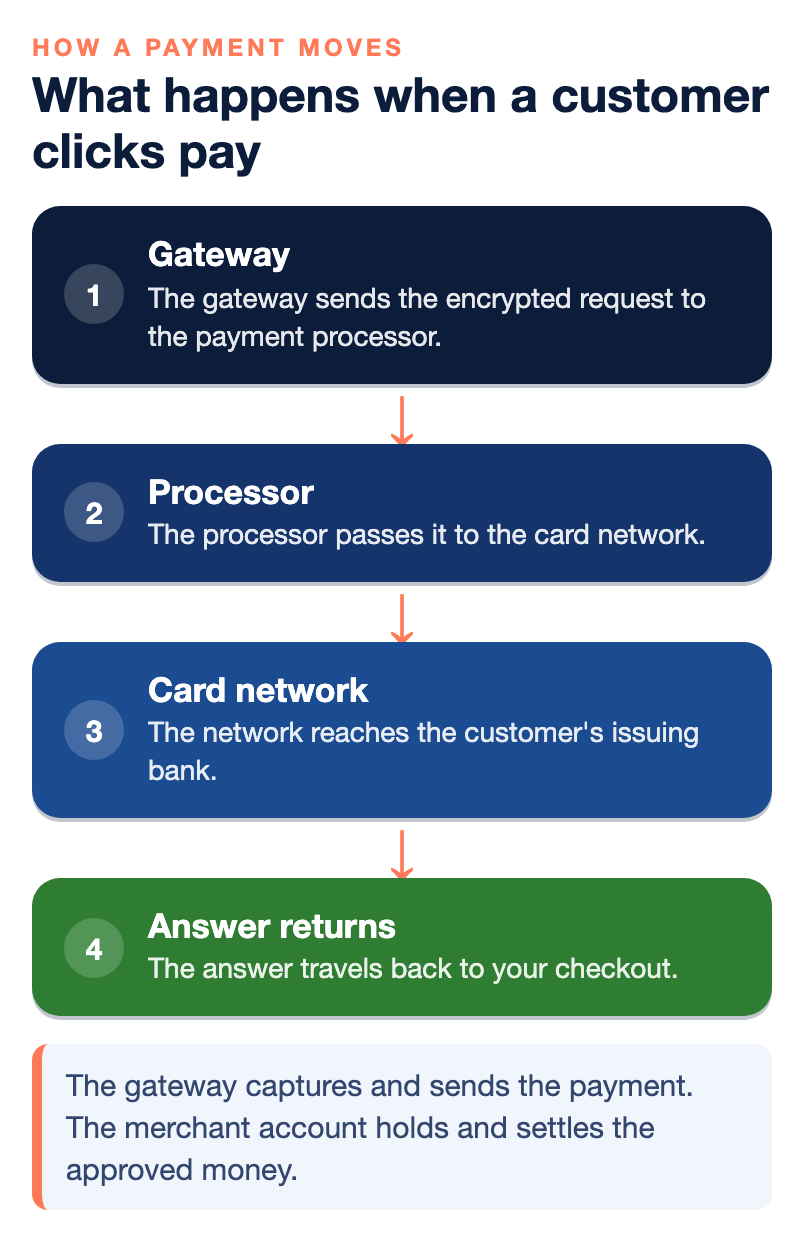
A payment gateway is the technology that securely captures and transmits payment information from your checkout. NPS calls it the digital doorway that collects and sends payment data. When a customer clicks “pay,” the gateway sends the encrypted request to the payment processor, which is the company that routes the transaction. The processor passes it to the card network, the network reaches the customer’s issuing bank, and the answer travels back to your checkout.
Many gateways also hold your fraud settings. Address checks, security code checks and limits on repeated attempts are examples. On a hosted store, some of these settings may sit in the platform and some in the gateway, so ask where each one lives and how much you can change yourself.
We cover the difference between the gateway and the account in detail in our guide to online payment gateways vs merchant accounts. This page does not repeat it. It focuses on what changes when the account is high risk.
What “high risk” actually means
A high-risk merchant account is a payment account approved for a business that an acquiring bank believes carries greater-than-average financial, regulatory, chargeback, fraud, fulfillment or compliance risk. The acquiring bank is the bank that signs up merchants and carries the financial exposure on their sales. The label can sound alarming, but NPS is clear that it does not mean the business is doing anything wrong. High risk does not mean illegal. It often means the business needs a bank that understands its industry. You can read the full definition in What Is a High-Risk Merchant Account?.
NPS lists seven kinds of risk that can lead to the label:
- Industry risk. Some industries have a history of more chargebacks, fraud or regulatory attention.
- Regulatory risk. Regulated products can bring licenses, age checks, certifications or product testing.
- Chargeback risk. A business with excessive disputes is harder to approve in any industry. A chargeback is when a customer disputes a charge with their bank and the money is pulled back.
- Future-delivery risk. A customer who pays today for something delivered months from now creates more exposure than a customer who walks out with the product.
- Average-ticket risk. A business that regularly processes large transactions presents more exposure per sale.
- Card-not-present risk. E-commerce, phone and keyed orders are reviewed differently from in-person chip payments.
- Recurring-billing risk. Subscriptions create disputes about renewals, cancellations and free trials.
An online store can trip several of these at once. A store that sells on subscription, ships weeks after payment and has a high average order is looking at three of the seven before anyone considers the product.
Why a hosted store changes the picture
A hosted store is built for speed. That is its strength, and NPS says the same about many payment platforms: fast onboarding is helpful for businesses that fit a platform’s underwriting model. The catch is what happens after sign-up. According to NPS, fast onboarding does not remove ongoing risk review. A platform can later look at your website, products, volume, average ticket, chargebacks, refunds, customer complaints, fulfillment and products you added after you signed up.
NPS also names Shopify Payments, along with Stripe, Square, PayPal, Wix Payments and QuickBooks Payments, in its advice to read a provider’s terms of service, payment terms, acceptable use policy, restricted business list and prohibited business list before you process transactions. Do that before your first sale, not after an account-review notice. Our guide for merchants who were shut down by a platform, Stripe Shut Me Down? High-Risk or Startup Merchant Survival Guide, explains why a quick approval can still end in a shutdown.
NPS’s view is that real underwriting should happen before you go live, not after revenue begins.
Two ways a high-risk store gets set up
Most stores end up in one of two situations. We describe both, and we keep the platform-specific details as questions because we could not confirm them.
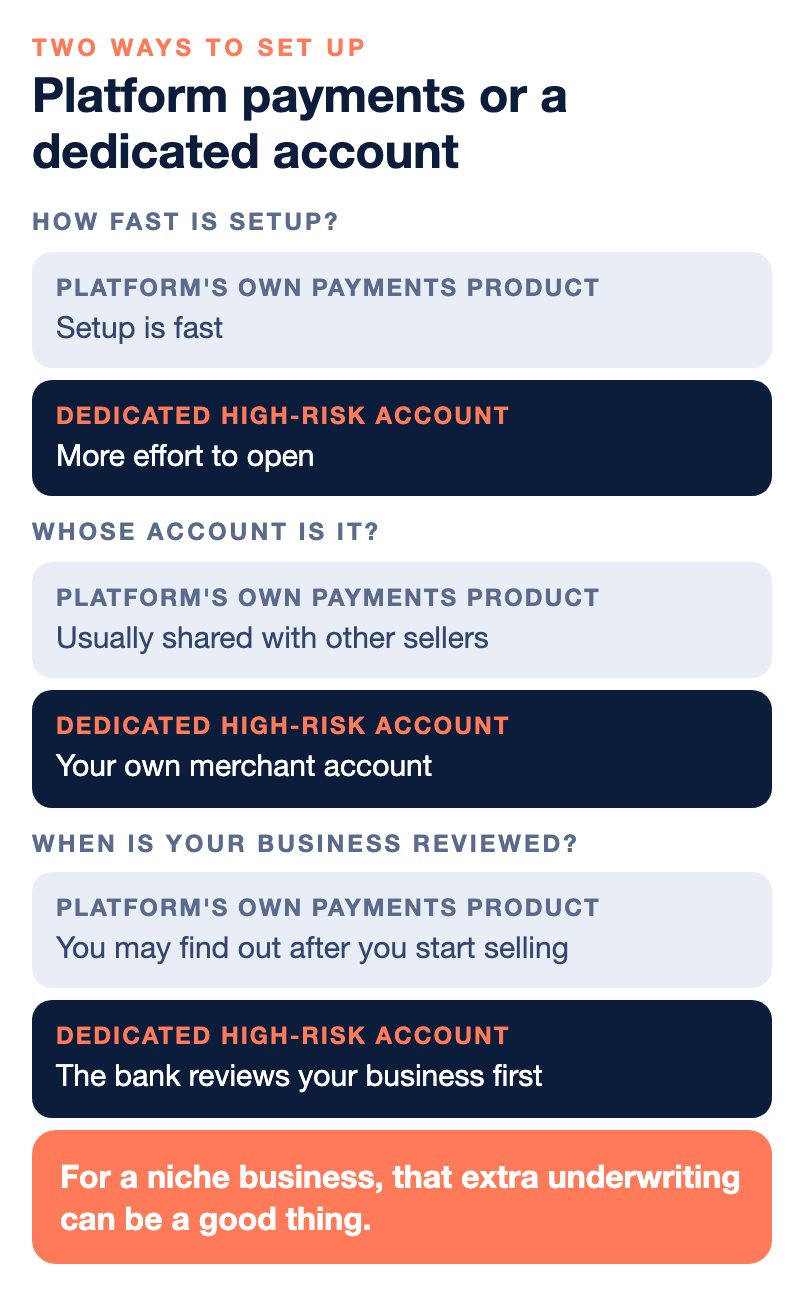
Option 1: The platform’s own payments product
This is the all-in-one route. You use the payment service that comes with your store platform, and the checkout, gateway and account are bundled. Setup is fast. The tradeoff is that you usually share an account structure with other sellers, risk decisions can be automated, and support may be ticket-based. If your business falls into a restricted category, you may find out after you start selling.
Option 2: A dedicated high-risk account with a gateway that connects to your store
Here you apply for your own merchant account, the bank reviews your business first, and a gateway connects your checkout to that account. It takes more effort to open, but the bank sees your whole business model before you process volume. NPS says that for a niche business, that extra underwriting can be a good thing, because you want the bank to understand the business before large volumes arrive.
The question for a hosted store is the connection. Ask the provider, and read the platform’s own help pages, for answers to these:
- Does my store platform allow a third-party gateway on my plan, or only its own payments product?
- If a third-party gateway is allowed, is there a supported plugin or app, or does it need custom work?
- Does my checkout stay on the platform, or do customers move to a page hosted by the gateway?
- Are there extra platform charges when I use a gateway other than the platform’s own?
- Who do I call when an order is paid but never appears in my store?
We cannot answer those for any platform in this guide. A provider that supports your platform should be able to answer them in writing.
What to check in a gateway before you choose one
NPS recommends comparing gateways on a few basic points, and they matter more when the account is high risk.
- Security. Look for encryption and tokenization. Tokenization stores a stand-in token instead of the real card number.
- Integration. There are three common ways a gateway connects to a store. An API integration gives full control inside your site. A plugin or module is a pre-built connector that is fast to set up. A hosted checkout is a payment page run by the gateway, and card data never touches your server.
- Fees. Weigh per-transaction costs against monthly fees, and ask for every fee by name.
- Payment methods. Cards, digital wallets and alternatives in one dashboard.
- Reporting. Sales, disputes and chargebacks in one place.
- Recurring billing. If you sell subscriptions, ask how renewals, declines and cancellations are handled.
- ACH. Ask whether bank payments (ACH) are available next to cards.
- Support. Ask whether a real person answers.
A hosted checkout deserves a closer look. NPS describes it as reducing PCI scope. PCI DSS is the security standard for protecting cardholder data, and any business that accepts cards has responsibilities under it. Ask what PCI tools the provider supplies and whether it charges a PCI fee.
What a high-risk account changes
The gateway stays the same kind of tool. The account behind it works differently in these ways.
The bank reviews more
NPS says an underwriter can look at your website first. They look for an accurate business name, an address, a customer service phone number and email, product descriptions and pricing, and posted refund, cancellation, shipping and privacy policies, plus terms and conditions. They also look for subscription disclosures, checkout authorization and any required disclaimers or licensing information. If you already accept cards, expect a request for three to six months of processing statements. Larger accounts may be asked for bank statements and financials.
Tell the bank exactly what you sell. NPS warns against describing a business as something it is not to make approval easier. A mismatch can create a much bigger problem later, including termination and a listing on the MATCH list, which is a database banks use when judging merchant risk and which can make getting another conventional account considerably harder.
A reserve may apply
A reserve is money the bank holds back to protect against losses. One common type is a rolling reserve, where the bank keeps a percentage of processing volume and releases it on a schedule. NPS says reserves are more common with significant future delivery, high chargebacks, rapid growth, limited processing history, high average tickets and subscription billing. Not every high-risk merchant has one. Our guide on why acquirers use reserves instead of simply declining explains the reasoning. Ask any provider how a reserve would work for you, in writing.
Chargeback limits matter more
For high-risk merchants, even a small rise in disputes can trigger network monitoring programs, which can bring fines, higher costs and in some cases account termination. NPS describes a tool called Rapid Dispute Resolution, or RDR, that lets a merchant refund a dispute before it becomes a formal chargeback. NPS says a dispute handled this way does not count toward monitoring ratios. Ask whether your provider supports it. For the full picture, read the high-risk chargeback and account protection guide and our chargeback survival guide.
Pricing needs a closer read
NPS says high-risk processing can cost more, because price reflects risk, industry, volume, average ticket and bank requirements. It also says a high-risk label should not mean accepting any rate you are handed, and that some niche businesses can use interchange-plus pricing. Ask for the whole structure: processing markup, transaction fees, monthly fees, gateway fees, chargeback fees, PCI fees, reserve terms, early termination terms, equipment costs and registration fees. NPS does not publish rates, and neither do we here. To check a quote, use the effective rate, which is total fees divided by total sales, and read why your effective rate is higher than the rate you were quoted.
Protect the account once it is open
NPS puts it simply: high-risk processing is not just about getting approved, it is about staying approved. Several habits help on a hosted store.
- Post your policies where customers see them. Refund, return, cancellation, shipping and privacy policies should be easy to find, and a checkout checkbox that confirms customers have seen them gives you a record.
- Be clear about recurring billing. Disclose how often you bill, how a trial turns into a paid plan and how to cancel. Hidden terms raise dispute rates quickly. See subscription billing and failed payments.
- Use fraud tools. NPS lists address verification (AVS), security code checks (CVV), 3D Secure where appropriate, device and IP logging and velocity filters, which limit repeated attempts. Too many checks can cost you real customers, so see fraud screening vs customer friction.
- Keep records. Save IP logs, timestamped consent, subscription acceptance, delivery confirmation and customer messages. Weak documentation means a weak defense.
- Watch your numbers. Track chargeback ratio, fraud rate, refund rate and volume. Do not wait for your processor to tell you.
- Use a clear billing descriptor. That is the name that appears on the customer’s card statement. If they do not recognize it, they may dispute the charge.
Questions to ask any provider
These questions follow the checklist NPS gives for choosing a processor for a regulated or hard-to-place business, plus the store-specific questions above. Bring them to any provider, including us.
- Do you understand my industry, and have you placed businesses like mine before?
- What documents will underwriting require, and will you review my website before submission?
- Is my business reviewed before I sell, or after?
- Which store platforms do you support, and how does the gateway connect to mine?
- Do I stay on my platform’s checkout, or use a hosted payment page?
- What is every fee, by name, including the gateway, monthly, PCI, chargeback and termination fees?
- Would a reserve apply to me, and how is it released?
- What fraud and chargeback tools do you offer, and do you support RDR?
- Can I add ACH and recurring billing?
- If I leave, can I move the gateway, and what happens to stored customer card tokens and recurring billing? Our list of 12 questions to ask before opening a merchant account covers more.
- When a payment fails, who answers the phone?
Common mistakes
- Treating a quick approval as a final one. Review can continue after sign-up.
- Not reading the platform’s restricted business list. Do it before your first sale.
- Describing the business as something else. It can lead to termination and a MATCH listing.
- Comparing only the headline rate. Gateway, monthly, PCI and chargeback fees all count.
- Moving from provider to provider to escape chargebacks. NPS advises fixing the cause: unclear descriptors, weak refund processes, thin customer service or missing fraud tools.
Who wrote this, and where NPS fits
Nationwide Payment Systems publishes this guide. We are a payments company based in South Florida, in business since 2001, and we sell merchant accounts and gateways, so we are not neutral. We work with businesses that need specialized underwriting, and we support e-commerce through gateway options, hosted payment pages and integrations with platforms such as Shopify, depending on the merchant. We do not publish one universal rate, because pricing depends on volume, ticket size, industry and risk. You can read more on our high-risk merchant services page, in our high-risk processing question-and-answer guide, and across the full library of payments guides.
We are not the right fit for everyone. Platform payment tools can be good options for businesses that want fast setup and simple tools. If you want an instant self-service sign-up, do not want to provide underwriting documents, or care only about the lowest advertised flat rate, a simpler platform may suit you better. Ask any provider for pricing and terms in writing.
Bottom line
The gateway is a doorway, and the high-risk part lives in the account behind it. On a hosted store, check three things before you choose. First, confirm that your checkout can connect to the gateway and account you want. Second, make sure the bank reviews your whole business before you sell, so a quick approval does not turn into a surprise shutdown. Third, ask for every fee, any reserve and the chargeback tools in writing. If you want a second opinion on a quote or your current setup, you can contact our team, and if another setup fits you better, we will say so.
Frequently asked questions
What is a high-risk payment gateway?
There is no separate kind of gateway software for high risk. The gateway securely captures and sends payment data, and the high-risk label applies to the merchant account and the business behind it. A gateway used with a high-risk account should support the fraud, recurring billing and reporting tools that kind of business needs.
Can I use a high-risk payment gateway with Shopify?
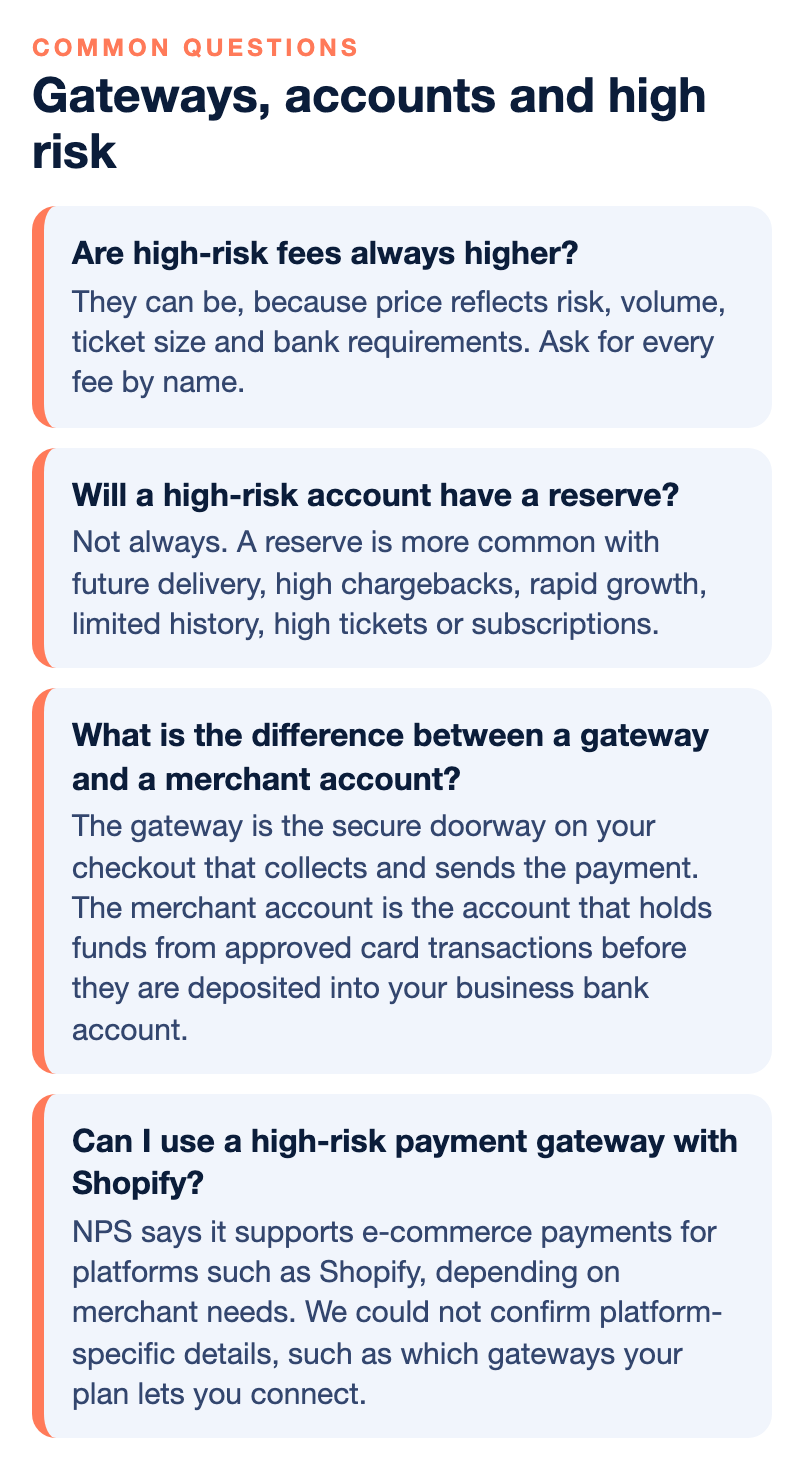
NPS says it supports e-commerce payments for platforms such as Shopify, depending on merchant needs. We could not confirm platform-specific details, such as which gateways your plan lets you connect, so ask your provider and read the platform’s own help pages before you apply.
What is the difference between a gateway and a merchant account?
The gateway is the secure doorway on your checkout that collects and sends the payment. The merchant account is the account that holds funds from approved card transactions before they are deposited into your business bank account. A store needs both.
Why would a business be treated as high risk?
Banks look at industry, regulation, chargebacks, future delivery, average ticket size, card-not-present sales and recurring billing. Rapid growth can also trigger extra review. High risk does not mean illegal.
Is a platform’s built-in payment service enough for a high-risk store?
It can be for some businesses, and it is fast to set up. The risk is that review can continue after sign-up, so read the provider’s restricted and prohibited business lists before you process payments. A dedicated account is reviewed up front.
What documents might a bank ask for?
Typical items include identification, a voided check or bank verification, an EIN, articles of incorporation, a business license, three to six months of processing statements, three months of bank statements, product and supplier information, and your refund, shipping, privacy and cancellation policies. Larger accounts may need financial statements.
Will a high-risk account have a reserve?
Not always. A reserve is more common with future delivery, high chargebacks, rapid growth, limited history, high tickets or subscriptions. Ask how it would be set and released.
Are high-risk fees always higher?
They can be, because price reflects risk, volume, ticket size and bank requirements. NPS says a high-risk label should not mean accepting any rate, and some niche businesses can use interchange-plus pricing. Ask for every fee by name.





