
An ISV, short for independent software vendor, is a company that makes and sells its own software, and in payments the word is used for any software company whose customers take payments through that software or ought to. If you run a scheduling app, a practice-management system, a point-of-sale product or any other platform where money changes hands, you are an ISV in the eyes of a payment processor. The real question is not what the label means. It is how much of the payment experience you want to own, how much risk you are willing to carry and how much of the payment revenue you want to share in. This guide explains the term, lays out the six ways a software company can work with payments, and shows what to ask a partner before you sign.
The short answer
- ISV means independent software vendor. A VAR, or value-added reseller, sells and installs someone else’s software. A SaaS company is an ISV that sells its software by subscription. In payments the three words are often used loosely for the same kind of partner.
- Your customers are already taking payments. Somebody earns money from that activity. The ISV choice is whether it is you, a processor you send them to, or no one on your side of the table.
- There is a wide range between two extremes. At one end you send customers to another processor. At the other you become a full payment facilitator, or PayFac. Most software companies belong somewhere in between.
- More control means more responsibility. Every step toward owning the merchant experience also moves underwriting, compliance and risk closer to you.
- The best partner handles what you do not want to build. That usually means underwriting, support, compliance and the card and ACH plumbing, while you keep your brand and your customer relationship.
What ISV, VAR and SaaS mean
The labels overlap, and people mix them up, so it helps to pin each one down.
An independent software vendor builds a software product and sells it to businesses. A restaurant ordering system, a salon booking tool, a church donation platform and an equipment-rental system are all examples.
A value-added reseller does not build the software. It sells and installs a product made by someone else and adds services around it, such as setup, training, custom programming and support. A company that installs a retail system in a store and then supports the store afterward is acting as a VAR.
A SaaS company, short for software as a service, is an ISV that delivers its product over the internet for a monthly or annual fee. Many software businesses today are built this way.
In payments, the term ISV is often used for all three, because they share the same situation. Their customers run a business, that business takes payments, and the software sits in the middle of the sale. Nationwide Payment Systems (NPS) runs a program for what it calls ISVs and VARs, and it describes its ISV program as customized programs for card-present and card-not-present solutions. Card-present means the customer and the card are physically there, as at a counter. Card-not-present covers online, phone and invoice payments.
Why payments matter to a software company
Software companies already understand recurring revenue. A subscription keeps paying month after month, and the business grows when it adds customers or when each customer spends more. Payments follow the same logic. The more merchants you serve and the more volume each one runs, the larger the payment activity that flows through your product.
Here is a simple illustration, not a promise. If your platform serves 100 merchants and each one runs $50,000 a month in card and bank payments, your software sits in front of $5 million a month, or $60 million a year. If you send those merchants to an outside processor and walk away, you have handed over the economics of all that activity. How much of it can come back to you depends on the program, the merchants’ pricing, the mix of cards, ACH volume, ticket size and industry. That is why no honest partner will quote a single number before looking at your business.
There are three reasons beyond revenue.
- A smoother experience. When your customers can invoice, check out or collect a recurring payment inside your software, they do not have to jump to a separate tool and reconcile the two by hand.
- Stickiness. The more of a customer’s daily work lives in your product, the harder it is to leave. Payments, and the services that sit next to them, make software harder to replace.
- Trust. A secure, well-supported payment flow reflects well on you. A confusing one with surprise fees lands on your support desk, not on the processor’s.
Six ways an ISV can work with payments
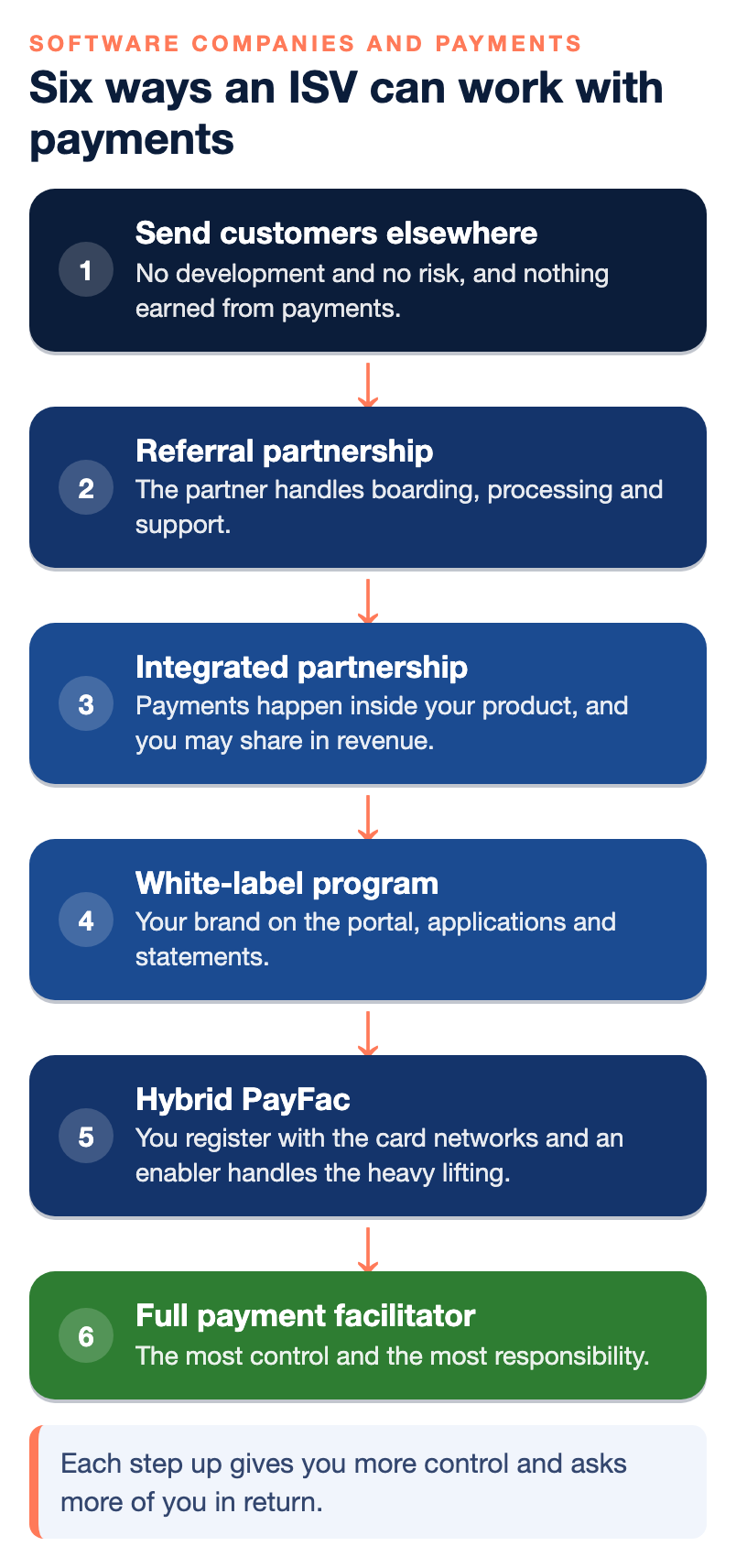
Think of a ladder. At the bottom you do almost nothing. At the top you run the whole payment business yourself. Each rung up gives you more control and more of the economics, and it asks more of you in return.
1. Send your customers to another processor
You tell customers to open an account somewhere else and connect it to your software, or you do not connect it at all. It takes no development and no risk. It also earns you nothing from payments, and your customers’ experience depends on a company you do not control.
2. Referral partnership
You introduce your customers to a payments partner, and the partner handles boarding, processing and support. Depending on the program, you may be paid for introductions or for the volume that follows. You carry almost no risk and almost no workload, and you also have little say over what the customer experiences.
3. Integrated partnership with revenue share
Your software connects to the partner’s payment gateway through an application programming interface, or API, so payments happen inside your product. The partner underwrites the merchants, processes the payments and supports them. Depending on the arrangement, you share in the net payment revenue your merchants generate. This is where many software companies land, because it delivers the in-product experience without turning the software company into a payment company.
4. White-label program
A white-label program puts your brand on the payment experience while the partner runs the back end. NPS describes its white-label program for ISVs and VARs as a portal with your branding, custom applications and statements, and an arrangement where you control the pricing your customers see. A clear fee schedule between you and the partner, often called a Schedule A, matters a great deal here. It tells you what you pay, what you earn and where you can improve your margin, so you can forecast residuals instead of guessing.
5. Hybrid PayFac
In a hybrid arrangement, the software company registers as a payment facilitator with the card networks and works with a PayFac enabler that handles the heavy lifting of compliance, risk management and underwriting. You gain more control over merchant onboarding and funding options, and you offload much of the burden. NPS offers a white-label hybrid PayFac program for software companies with both card-present and card-not-present products.
6. Full payment facilitator
A traditional PayFac signs up its own sub-merchants under its own master account. That means running underwriting, risk management, compliance, merchant monitoring, chargeback oversight and sponsor-bank relationships, with the technology and staff to support all of it. It offers the most control and the most potential revenue, and it needs the most resources. For many software companies it is far more than they want to take on.
How much responsibility moves to you at each step
The most useful way to compare the six options is to ask who carries four jobs: underwriting merchants, handling risk and chargebacks, supporting merchants and meeting card-network rules. The table shows illustrative, typical splits. Your contract decides the details, so read it before you rely on any row.
| Option | Who underwrites | Who carries the risk | Who supports the merchant | Your control over the experience |
|---|---|---|---|---|
| Send customers elsewhere | The processor | The processor | The processor | None |
| Referral partnership | The partner | The partner | The partner | Low |
| Integrated partnership | The partner | The partner | The partner, often with your help | Medium |
| White label | The partner | The partner, under your brand | The partner, under your brand | High |
| Hybrid PayFac | The enabler, with you in the loop | Shared | Shared | High |
| Full PayFac | You | You | You | Complete |
Read the table from the bottom up. Each row that gives you more control also gives you a bigger share of the duties. There is no free ride at the top. A company that cannot staff a risk department is better off on a middle rung with a partner who can.
What a good payments partner handles for you
Most software companies do not want to build payment infrastructure. A capable partner can take on the following so your team stays focused on the product.
- Merchant underwriting, including help for higher-risk merchants that general platforms turn away.
- Acquiring relationships and payment processing for cards and ACH, in person and online.
- Risk review and merchant support, including real people who answer the phone.
- B2B features, such as Level 2 and Level 3 processing for qualifying business-to-business card payments.
- Gateway services and API connectivity, with hosted payment pages, webhooks and recurring billing.
- Developer help. NPS says it assigns a developer to guide integration and describes its API as very similar to Stripe’s.
- Hardware that fits your product. NPS says it can match a product with the right semi-integrated hardware solution.
Some partners also offer services that make your software stickier, such as payroll and PEO consulting, buy now pay later financing, chargeback services, business loans and insurance. NPS lists these across its ISV Toolbox and white-label program pages. They are optional, and none of them matters if the basics are not solid.
Eight questions to ask before you choose a partner
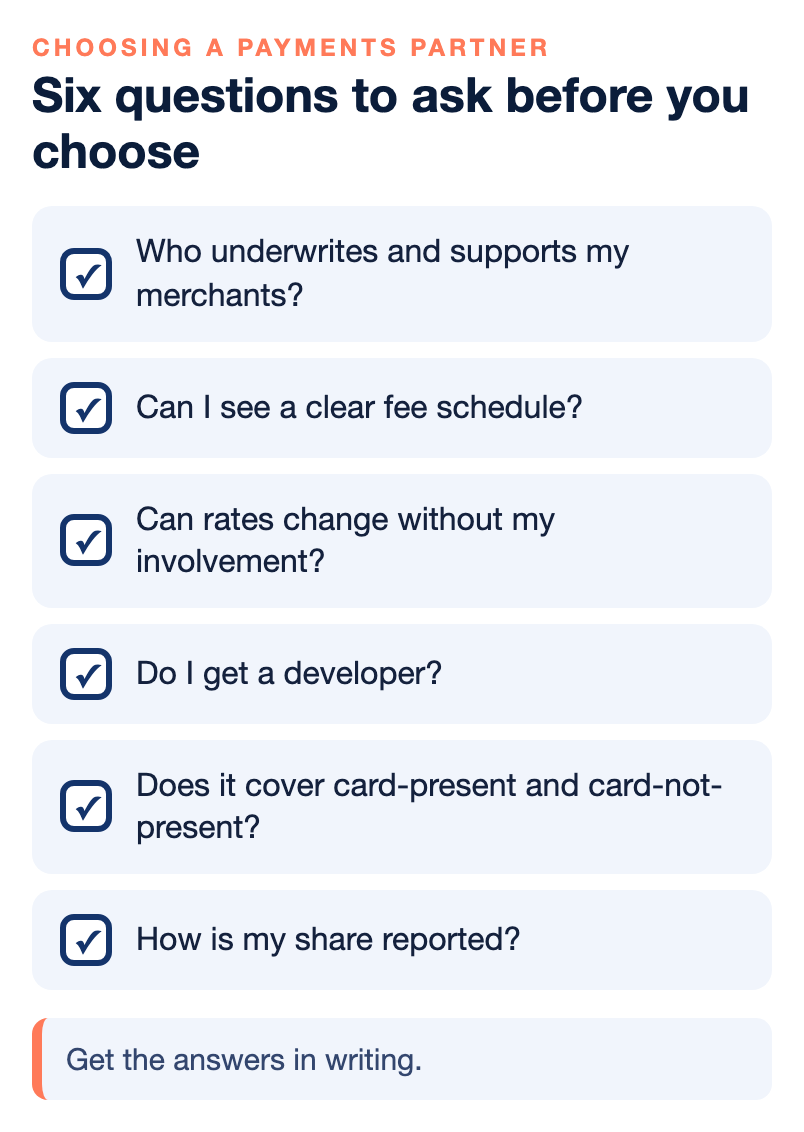
- Who underwrites and supports my merchants? If the answer is “you,” ask how many people and what hours. Your customers will call you first when a deposit is late.
- Can I see a clear fee schedule? You need to know what you pay, what you earn and where you can add margin. Vague pricing makes residuals impossible to forecast.
- Can rates change without my involvement? A rate increase you did not know about arrives as an angry customer call. Ask the partner to commit in writing to involve you first.
- Do I get a developer? A named person to meet with during integration saves weeks.
- Does it cover both card-present and card-not-present? Many software products need an in-person terminal for some customers and online checkout for others.
- Can the experience carry my brand? Ask about the portal, merchant applications and statements.
- What does support look like on a bad day? Ask what happens when a batch does not fund, a merchant is frozen or a chargeback lands.
- How is my share reported? You should be able to see volume, revenue and your share by merchant, not just one monthly total.
How to decide which option fits
Four questions settle most decisions.
How much of the merchant experience do you want to own? If you only want customers to be able to take payments, a referral or integrated partnership is enough. If you want your brand on the applications and statements, look at white label.
How much risk can you carry? Underwriting, chargebacks and card-network monitoring are real obligations. A company without a risk team should start with a partner that carries them.
How much development will you take on? An embedded checkout takes engineering time. A referral takes almost none. Match the option to the team you have, not the team you hope to hire.
How much of the payment revenue do you want to share in? More revenue usually comes with more responsibility. Decide the revenue goal first, then ask what duties come with it.
Many software companies begin with an integrated partnership or white-label program, learn how their merchants actually behave, and only later consider whether a hybrid or full PayFac model is worth the extra weight. Starting a rung or two lower is a reasonable plan, not a failure.
Common mistakes software companies make
- Assuming PayFac is the only way to earn from payments. It is one way, and the most demanding one.
- Choosing on the revenue share alone. A generous share means little if the partner’s support leaves your customers stranded.
- Ignoring merchant mix. A platform serving regulated or higher-risk businesses needs a partner that underwrites them, or the program stalls at the first higher-risk application.
- Skipping the fee schedule. If you cannot read exactly what you pay and earn, you cannot price your own product.
- Forgetting the exit. Ask what happens to your merchants and your reporting if you leave the program.
Who wrote this, and where NPS fits
Nationwide Payment Systems publishes this guide. We are a payments company based in South Florida, in business since 2001, and we run an ISV program, so we are not neutral. For software companies, we offer integrated card and ACH payments through our NPSONE gateway, a white-label program, a hybrid PayFac program and a team that works with your developers. You can read more on our ISV program page, our white-label program for ISVs and VARs and our guide to monetizing payments without becoming a PayFac.
We are not the right fit for every software company. If you need to build a full, traditional PayFac from the ground up, with your own sponsor-bank relationship and your own compliance team, that is a larger project than a partner program, and you should price it separately and compare it honestly against the partner route. If very few of your customers take payments through your product, an integration may not repay the effort yet. Ask any provider for pricing and program terms in writing, based on your own merchant base. For a deeper look at the next step up, see our guide on what an acquirer reads when you apply to become a PayFac, and browse the full library of payments guides.
Bottom line
An ISV in payments is simply a software company whose customers take payments. What you do about it is a choice along a ladder, from sending customers elsewhere to running a full PayFac. Most software companies are best served by a middle rung, where a partner handles underwriting, risk, support and compliance, and the software company keeps its brand, its customer relationship and a share of the payment economics. Decide how much control, risk and revenue you want, then test every partner against the eight questions above. If you would like to talk it through with people who work with software companies every day, you can contact our team, and if another path fits you better, we will say so.
Frequently asked questions
What does ISV stand for in payments?
ISV stands for independent software vendor, a company that builds and sells its own software. In payments, it means a software company whose customers take payments through its product, or that wants them to. VARs and SaaS companies are usually grouped with ISVs.
What is the difference between an ISV and a PayFac?
An ISV is a software company. A PayFac, or payment facilitator, is a company that signs up its own sub-merchants under a master merchant account and takes on underwriting, risk and compliance. An ISV can partner with a payments company, run a hybrid arrangement or become a PayFac, but it does not have to.
Does a software company need to become a PayFac to earn from payments?
No. Referral, revenue-share, integrated and white-label programs let a software company take part in payment revenue without carrying the full duties of a PayFac. The right model depends on how much control, risk and development work the company wants.
What is a white-label payments program?
It is a program where the payment experience carries the software company’s brand, such as the portal, merchant applications and statements, while a payments partner runs processing, underwriting and support behind the scenes. The software company often controls the pricing its customers see.
What is a hybrid PayFac?
A hybrid PayFac is an arrangement where the software company registers as a payment facilitator with the card networks and works with an enabler that handles most compliance, risk management and underwriting. It offers more control than a partner program with less burden than a full PayFac.
What should an ISV look for in a payments partner?
Look for clear underwriting and support, a readable fee schedule, a commitment not to change merchant rates without your involvement, a developer to guide integration, coverage for card-present and card-not-present payments, and reporting that shows your share by merchant.
Can an ISV accept higher-risk merchants?
Only if the partner underwrites them. Many general platforms decline higher-risk categories. If your merchant base includes regulated or higher-risk businesses, ask the partner about those categories before you integrate.





