
The Durbin Amendment is a 2010 federal law that changed three things for small merchants: it limited what the largest banks can charge on debit card interchange, it required debit cards to work on at least two unaffiliated networks, and it gave you clear room to set a minimum on credit card sales while barring any minimum on debit. It did not cap credit card interchange, it did not touch your processor’s markup and it did not make every card fee sign legal. This guide separates what the law actually did from what people assume it did, shows where each piece reaches your statement and gives you questions to ask a provider so you can tell whether it is helping you.
The short answer
- Debit interchange is limited for the largest issuers. A Federal Reserve rule called Regulation II sets the cap. Smaller banks and credit unions are exempt, so not every debit card costs the same to accept.
- Debit must be routable two ways. The rule requires debit cards to work on at least two unaffiliated networks, which gives you, through your processor, a choice of routing.
- You may set a credit card minimum up to $10, and never a minimum or fee on debit. Post it clearly.
- Credit card interchange has no federal cap. The law did not change that, and your processor’s markup is outside it too.
- Your pricing model decides whether you see any benefit. On interchange-plus pricing, lower debit interchange shows on your statement. On a flat rate, it can disappear inside one blended number.
What the Durbin Amendment is
The Durbin Amendment is part of the Dodd-Frank Wall Street Reform and Consumer Protection Act, a federal financial reform law passed in 2010. NPS describes its purpose in our guide on how interchange fees get set: it directed the Federal Reserve to make debit card interchange reasonable and proportional to the issuer’s cost.
Interchange is the fee the merchant’s side of a card payment pays to the bank that issued the customer’s card. Every card sale has two banks behind it. The issuing bank gave your customer the card, and the acquiring bank holds your merchant account. When the sale settles, the acquiring side pays the issuing side, and that payment is interchange. It is usually the largest single part of what you pay to accept a card, and it sits underneath your processor’s own charges.
Before 2010, a merchant had little say about this cost. The law did two things that matter at your counter or on your website. It told the Federal Reserve to write a rule limiting debit interchange, and it spoke to what merchants may and may not do when they steer customers toward cheaper ways to pay. We take those one at a time, because they work very differently and they reach you in different places.
Change one: a cap on debit interchange for the largest issuers
The Federal Reserve carried out the law through Regulation II, which caps debit interchange for the largest card issuers. A debit card is tied to a checking account, so this cap applies to the most common everyday card in a wallet.
The cap does not apply to everyone. Smaller banks and credit unions are exempt from it, which means a debit card from one of those issuers can carry higher interchange than a debit card from one of the biggest banks. Two customers can hand you two debit cards on the same afternoon, and the cost to you can differ because of who issued each card, not because of anything you did.
We do not quote the cap or any interchange rate here. The Federal Reserve can revise the cap and has proposed changes in recent years, so a figure printed in an old article may be out of date. Check the current rule with your processor or counsel. NPS’s how to read your merchant statement guide also notes that debit transactions regulated this way can lower your effective rate, which is your total fees divided by your total card sales.
What this means for you in practice: if a large share of your sales is debit, lower debit interchange is a real benefit, but only if it reaches you. Whether it does depends on how your processor charges you, and that is the subject of a later section.
Change two: debit has to be routable on at least two networks
Regulation II also requires debit cards to work on at least two unaffiliated networks. In plain words, a debit card cannot be locked to a single network. The merchant side of the payment gets a choice of how the transaction is routed.
You do not usually make that choice yourself on a transaction-by-transaction basis. Your processor, within network rules, decides how your debit transactions are routed. That is why NPS tells merchants to ask the question directly: how are my debit transactions routed, and is that decision made with my costs in mind? A provider that gives a clear answer is usually a provider that has looked at the issue. A provider that cannot explain it is telling you something too.
Routing is one of those parts of a processing account that does not appear on a sign or a receipt, but it can affect what a debit sale costs you. It belongs on your list of questions at every contract renewal.
Change three: what you can and cannot do at the register
The same law also drew lines around what a merchant may do about card costs. NPS covers this in detail on our Durbin Amendment, card minimums and flat fees page, and the short version is below.
- Allowed: a minimum purchase of up to $10 for credit card transactions, with clear signage stating the minimum.
- Not allowed: a credit card minimum above $10, and any minimum or fee on debit cards.
- Not allowed on its own: a flat per-card fee, such as a posted “50 cent card fee,” unless it is set up as a compliant program with the right registration and disclosure.
The debit rule is the one that trips up the most small businesses. A sign that says “card minimum $5” is fine for a credit card under that $10 limit, but when the sign is applied to debit as well, it breaks the rule. A cashier cannot tell a debit card from a credit card by looking at it, so a blanket card minimum often ends up applied to both. That is one reason NPS suggests dual pricing or a properly structured program instead of a homemade sign.
The scale of the risk is also real. NPS’s page warns that non-compliance can lead to processor termination and fines, so a sign that seems harmless can cost far more than it saves. If you have a card minimum or a card fee posted today, read it against the list above.
What the law left untouched: credit card interchange
The Durbin Amendment limits debit interchange for the largest issuers. It did not cap credit card interchange. As NPS explains in how interchange fees get set, credit card interchange has no federal cap in the United States. Members of Congress have introduced bills over the years that would change how credit transactions are routed, usually by requiring large issuers to enable a second network on credit cards, in the hope that competition would push interchange down. Supporters and opponents disagree about what such a law would do to costs and rewards. As of the time that guide was written, none of those proposals had become law.
So if someone tells you credit card fees are about to fall because of federal legislation, treat the claim with care until a bill has actually passed. The same guide points out that interchange is set by the card networks, mainly Visa and Mastercard, and paid to the issuing banks. Your processor does not set it and cannot waive it.
Premium rewards credit cards are the clearest example of what stayed the same. A basic debit card and a rewards credit card are sorted into different categories on the networks’ schedules, and the rewards card has become one of the most expensive cards to accept. The law that reshaped debit did not change that.
What the law left untouched: your processor’s share of the bill
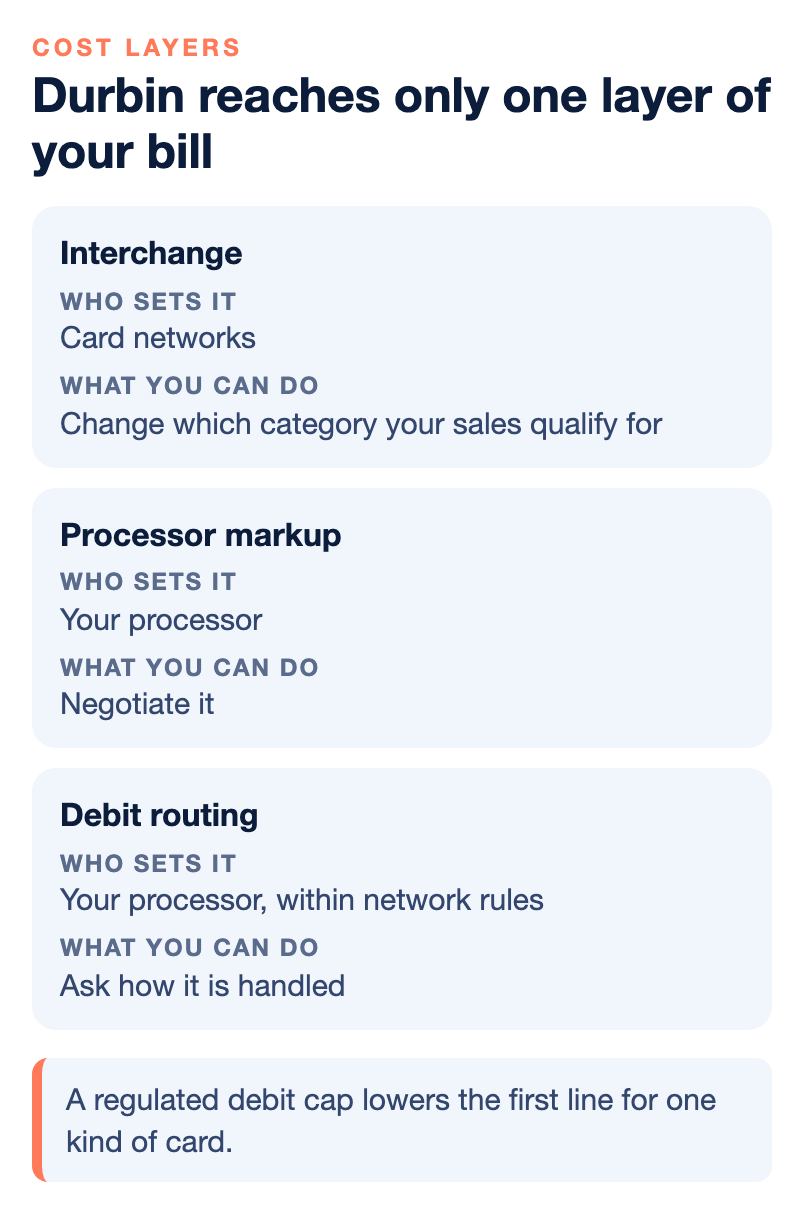
Your card cost has several layers, and the Durbin Amendment reaches only one of them. Here is how NPS lays out who sets each part and what you can do about it.
- Interchange. Set by the card networks and paid to the issuing bank. You cannot change the rate, but you can change which category your sales qualify for.
- Card-brand assessments. Set by the card networks. Every processor passes them on.
- Processor markup. Set by your processor. This is the part you can negotiate.
- Monthly, gateway and other fees. Set by your processor or platform. Ask for them itemized and in writing.
- Debit routing. Decided by your processor within network rules. Ask how it is handled.
A regulated debit cap lowers the first line for one kind of card. It leaves the other lines exactly where they were. A provider with a high markup or a long list of monthly fees can still cost you more than a competitor, even on debit sales that carry a capped interchange. When you compare quotes, compare the layers, not only the headline number.
Why your pricing model decides whether you notice any benefit
This is where the law meets your statement. NPS’s guide to the four merchant account pricing models explains how each model shows these costs, and the difference matters a great deal for debit.
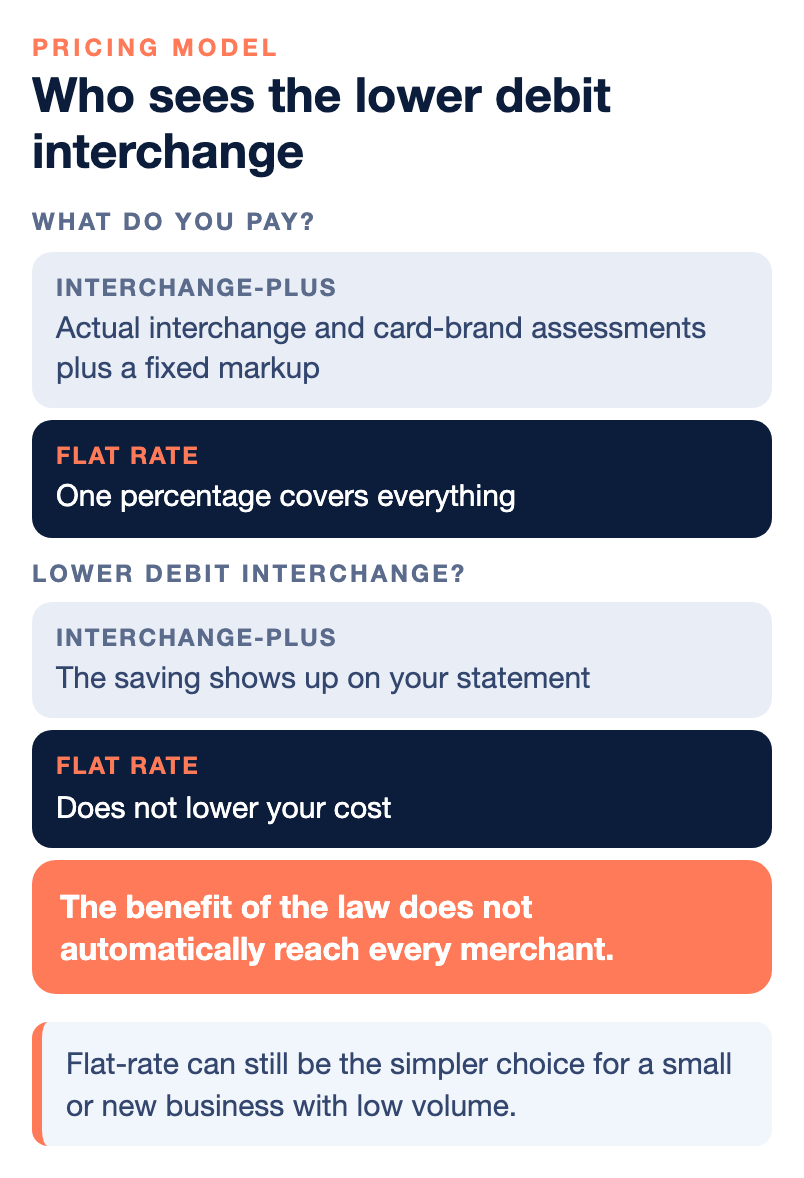
On interchange-plus pricing, you pay the actual interchange and card-brand assessments plus a fixed markup. When a sale lands in a lower category, such as a regulated debit card, the saving shows up on your statement. NPS says it offers interchange pass-through pricing so that qualified savings, including lower debit interchange, can reach the merchant directly. You can read the longer case for it in interchange pass-through pricing.
On a flat-rate plan, one percentage covers everything. A sale that qualifies for a lower interchange category does not lower your cost, and the processor keeps the difference. So a merchant with a lot of debit sales on a flat rate may be paying the same percentage on a regulated debit card as on an expensive rewards card. Flat-rate can still be the simpler choice for a small or new business with low volume, and NPS says so. The point is only that the benefit of the law does not automatically reach every merchant.
There is also a gap between the rate a processor quotes and what you actually pay. If you have ever wondered why your total cost is higher than the number you were promised, NPS has a separate guide on why your effective rate is higher than the rate you were quoted. The first step is always the same: pull your statement and look at the lines.
Does Durbin make dual pricing, cash discount and surcharging legal?
You will hear this claim often, and it needs care. NPS’s guide to dual pricing, cash discount and surcharging says that cash discounting is not new. Gas stations, utilities, colleges and government offices offered lower prices for cash long before most small businesses could. What opened the door for independent merchants, in our guide’s words, was the Durbin Amendment, which gave merchants room to encourage lower-cost payment methods, offer discounts for cash and structure their pricing to reflect what card acceptance costs.
That is room, not a free pass. The same guide describes three layers of rules. Federal law sets the outer frame. The card networks write their own requirements for how surcharges and discounts are shown. And individual states add display and disclosure rules of their own. A program that ignores any one layer can create complaints, card network audits, forced changes and, in the worst cases, the loss of your merchant account.
Two rules from those guides apply no matter what you call your program. A surcharge can never be applied to a debit card, even when the customer runs the debit card as credit at checkout. And a flat per-card fee posted at the register is one of the most common mistakes NPS sees, because it is not structured the way the card networks require. If you want the full picture of the three models, our guide to dual pricing walks through dual pricing step by step.
How to tell whether the law is helping your business
You can check this yourself in about an hour with your last few monthly statements. Here is a simple routine.
- Find your debit sales. Look for a breakdown by card type. If your statement does not separate debit from credit, that is worth a question on its own.
- Look at how debit is priced. Is there a separate line, or is everything blended into one rate?
- Check your effective rate. Divide total fees by total card sales. NPS’s statement guide walks through this step by step, and says a high result can mean you are paying too much.
- Check your category code. NPS notes that a merchant category code that does not match your business can cost you on interchange, so make sure yours is accurate.
- Read any sign you have posted. Compare it to the allowed and not-allowed list earlier in this guide.
If your statement is hard to read, that is information. NPS has a guide on what transparent merchant pricing means and how to check whether a processor really offers it, and it is a useful companion to the steps above.
Questions to ask a provider about debit and the Durbin rules
- Do you price debit separately from credit, and will my statement show the difference?
- If a sale qualifies for lower debit interchange, does that saving reach me, or does it stay inside a blended rate?
- How are my debit transactions routed, and who decides?
- What is my markup, in writing, and is it fixed or can it change?
- Which monthly, gateway and other fees apply, itemized?
- If I want to use dual pricing or a surcharge, how do you keep the program compliant, and how do you handle debit?
- If I post a card minimum, how do I make sure it is not applied to debit?
- What will you do if the Federal Reserve changes the debit rule or a card network changes its rules mid-contract?
Good answers are specific and in writing. Vague answers about “the best rate” are a reason to keep asking.
Who wrote this, and where NPS fits
Nationwide Payment Systems publishes this guide. We are a payments company based in South Florida, in business since 2001, and we sell payment processing, so we are not neutral. We offer interchange-plus pricing and set up compliant dual pricing, surcharging and ACH options, and we do not quote interchange rates in guides like this one because they change and differ by card and transaction. Laws and rules also move, so where this guide describes legislation in general terms, check the current status with your processor or counsel before you rely on it. You can browse our full library of payments guides.
We are not the right fit for everyone. If a single advertised flat rate is the only thing that matters to you, or you only want an instant self-service sign-up, a simpler platform may suit you better. Whoever you choose, ask for pricing and terms in writing, based on your own statements.
Bottom line
The Durbin Amendment limited debit interchange for the largest issuers, required debit to be routable on two networks and set the lines for card minimums at the register. It left credit card interchange, card-brand assessments and your processor’s markup where they were. Whether you feel any benefit depends on your card mix and, above all, on how your processor charges you. Pull a statement, find the debit lines and ask the questions above. If you would like a second opinion on a quote or your current setup, you can contact our team, and if another setup fits you better, we will say so.
Frequently asked questions
What is the Durbin Amendment in simple terms?
It is a 2010 federal law, part of Dodd-Frank, that directed the Federal Reserve to make debit card interchange reasonable and proportional to the issuer’s cost. The Federal Reserve did that through a rule called Regulation II, which caps debit interchange for the largest card issuers.
Does the Durbin Amendment cap credit card fees?
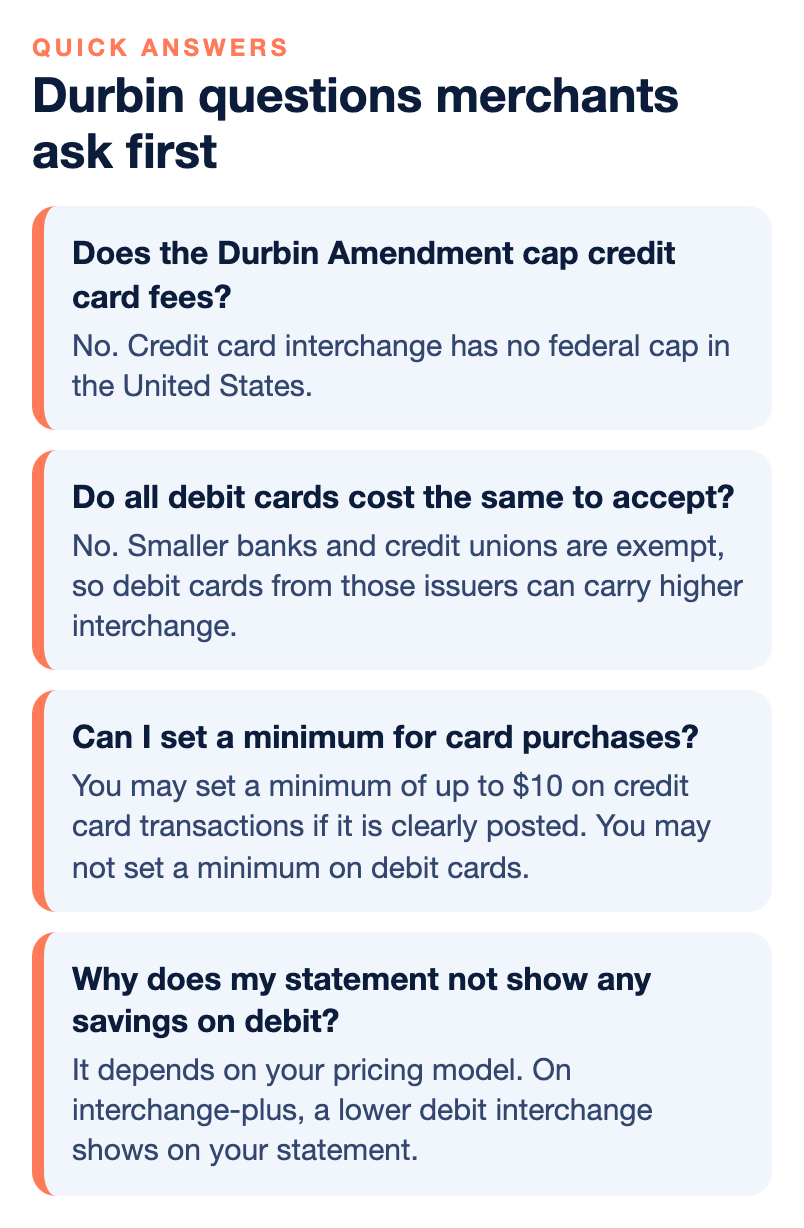
No. Credit card interchange has no federal cap in the United States. Proposals to change how credit transactions are routed have been introduced in Congress, but as of the time NPS wrote its guide, none had become law.
Do all debit cards cost the same to accept?
No. The cap applies to the largest issuers. Smaller banks and credit unions are exempt, so debit cards from those issuers can carry higher interchange.
Can I set a minimum for card purchases?
You may set a minimum of up to $10 on credit card transactions if it is clearly posted. You may not set a minimum on debit cards, and a flat fee on cards is not allowed unless it is part of a compliant program.
Why does my statement not show any savings on debit?
It depends on your pricing model. On interchange-plus, a lower debit interchange shows on your statement. On a flat rate, one percentage covers everything, so a lower interchange category does not lower your cost. Ask your provider how debit is priced.
Did the Durbin Amendment make dual pricing and cash discounts legal?
NPS’s guides say it gave merchants room to encourage lower-cost payment methods and offer cash discounts. Programs still have to follow federal law, card network rules and state rules, and a surcharge can never apply to a debit card.
Can the debit cap change?
Yes. The Federal Reserve can revise the cap and has proposed changes in recent years. Check the current rule with your processor or counsel instead of relying on an older figure.





