
Expect a reserve if your business looks risky to the bank. That usually means a lot of future delivery, high chargebacks, fast growth, little processing history, large average sales or subscription billing. Expect it to be set for your file in particular, not pulled from a standard chart. There is no honest universal number, because the bank sets the type, the size and the release schedule for your business alone, so anyone who quotes a figure before reading your file is guessing. The good news is that a reserve is not permanent by nature. It exists to cover a risk, and when you can show the risk has shrunk, you have real grounds to ask for it to be reduced, capped or released. This guide explains the kinds of reserves, what drives them, what to get in writing before you sign, and how to negotiate one down over time.
The bottom line
- A reserve is money the bank holds back to cover losses that might arrive later, such as chargebacks, refunds or undelivered orders. It is your money, held under conditions, not a fee.
- The size and type depend on your risk, mainly future delivery, chargebacks, growth, processing history, average ticket and billing model. Not every high-risk merchant gets one.
- Get the terms in writing before you sign: the amount or method, the reason, the release schedule, any cap and the conditions for a review.
- Reserves come down when the risk comes down. Clean processing history, low disputes, shorter delivery windows and good records are what you negotiate with, and the best time to set up that negotiation is before you sign.
Who wrote this, and what we will not claim
Nationwide Payment Systems (NPS) publishes this guide. We are a payment processing company in South Florida, in business since 2001, and much of our work is with businesses that banks treat as high-risk, so we deal with reserves often and have a stake in the topic. We do not quote reserve percentages or holding periods on this page, and we do not promise that any reserve will be reduced. Reserves are set by the acquiring bank based on its own review of your business, and the terms are in your merchant agreement. What we can do is explain how reserves work and what tends to move them.
What a reserve is, in plain terms
When a bank approves a merchant account, it takes on exposure for the payments that run through it. If customers dispute charges, if products are never delivered, if refunds cannot be paid or if the business closes after collecting money, the acquiring side can be left holding the loss. A reserve is money withheld from your deposits, or set aside up front, to protect the bank against those future losses. It sits in the background of your account, and under the right conditions it is released back to you.
The detail that matters most is timing. Chargebacks and refunds can arrive weeks or months after a sale. A business that takes payment today for something delivered in six months has open exposure for the whole six months. The reserve is the bank’s way of keeping enough money nearby to cover what might come back during that window.
The kinds of reserves you might see
Reserve structures depend on the merchant agreement and the risk, and the names vary a little from bank to bank. These are the common ones.
| Type | How it works | What to watch |
|---|---|---|
| Rolling reserve | A share of each day’s processing is held and released after a set period, on a rolling basis. | The share held, how long each amount is held, and whether there is a cap. |
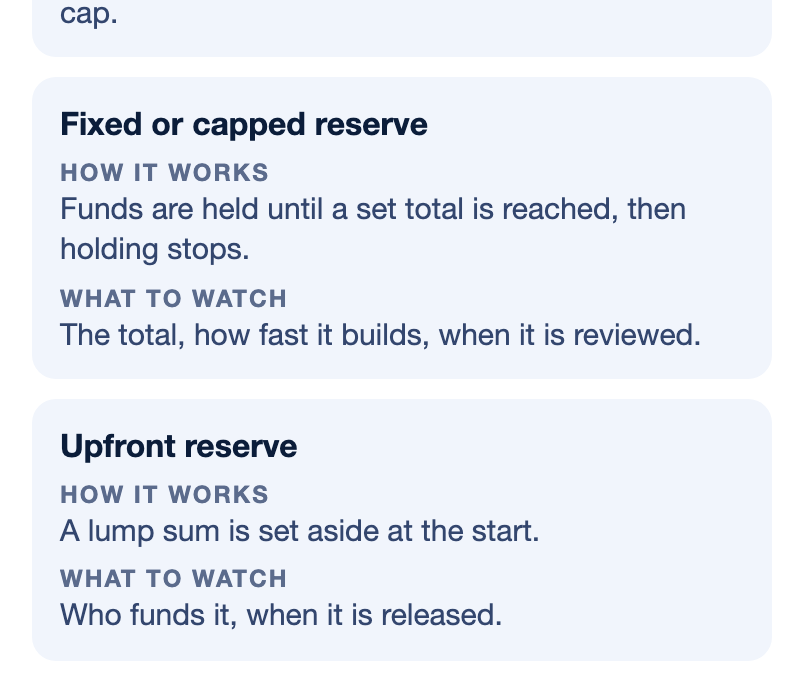
| Fixed or capped reserve | Funds are held until a set total is reached, then holding stops. | The total, how fast it builds, and when it is reviewed. |
| Upfront reserve | A lump sum is set aside at the start, sometimes instead of withholding from deposits. | Who funds it, when it is released, and what can reduce it. |
| Termination hold | Funds are kept after an account closes, because chargebacks can arrive after processing stops. | The amount, the reason and the written release schedule. |
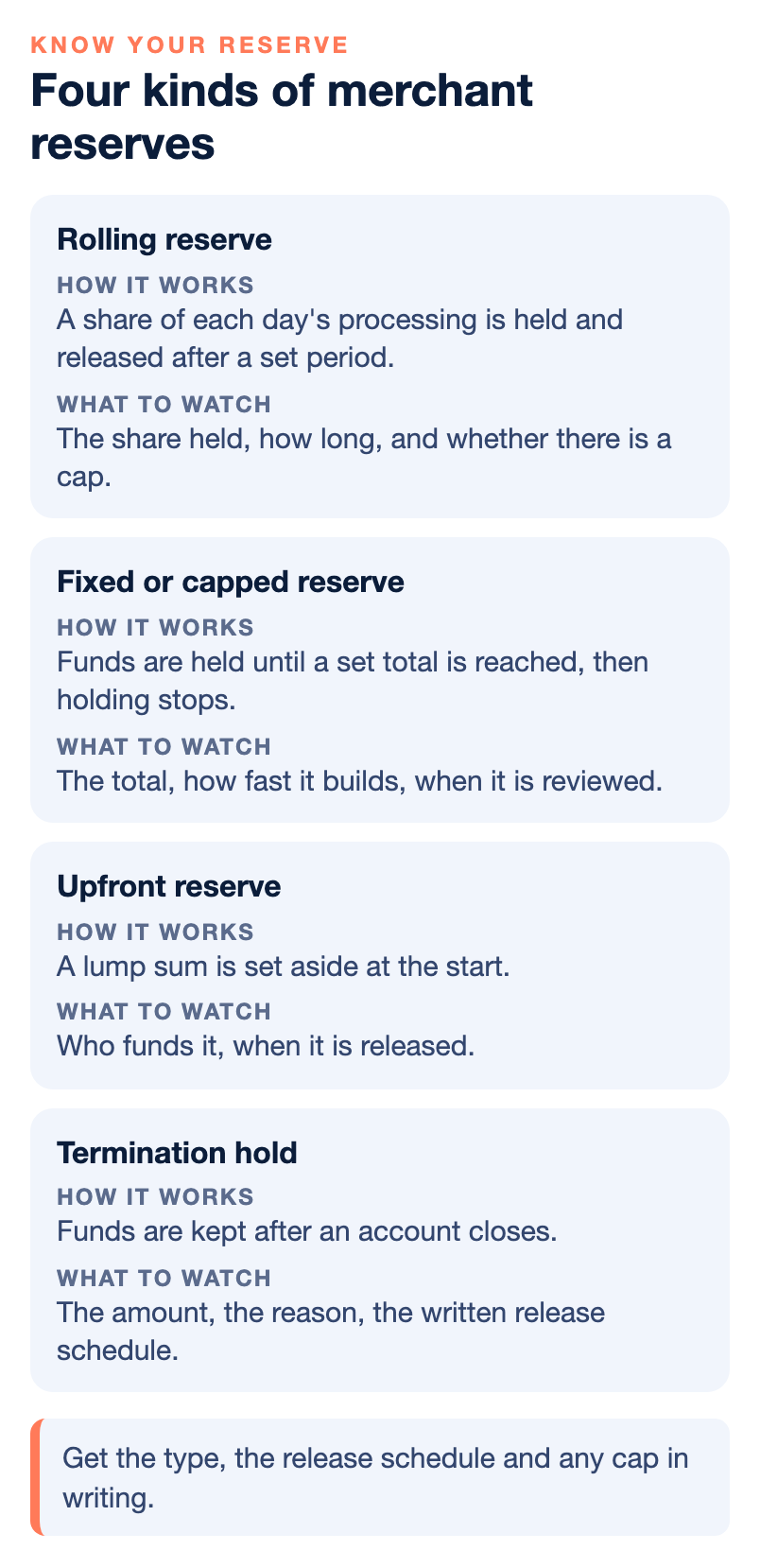
A rolling reserve is the structure most owners meet first, and it is the one that most affects cash flow, because it takes a slice of every deposit. A capped reserve is often easier to live with, because once the cap is reached your deposits come through in full. That difference alone is worth negotiating over, which we come back to below.
What drives the size of a reserve
The bank sizes a reserve to its view of how much could come back and how soon. A reserve is more common, and tends to be larger, when a business has one or more of these:
- Significant future delivery. Customers pay now for something delivered later, as in travel, ticketing, events, memberships, preorders and custom manufacturing.
- High chargebacks. A history of disputes, or an industry known for them, means more money is likely to come back.
- Rapid growth. A business processing much more than it did a few months ago has exposure the bank has not seen tested.
- Limited processing history. A new business, or one new to card payments, has no track record to judge.
- High average tickets. A single large dispute does more damage than many small ones.
- Subscription billing. Recurring charges that customers forget about are a frequent source of disputes.
- Higher financial exposure in general, such as thin financials, a past termination or a business model the bank considers hard to monitor.
Industry plays a part too, because some categories carry higher dispute rates or card-network requirements than others. Our guide to high-risk merchant accounts explains why a business can be completely legal and still be treated as high-risk. Not every high-risk merchant needs a reserve, though. The structure depends on the bank and on the individual business, and two businesses in the same industry can get very different terms.
What to get in writing before you sign
The most expensive reserve is the one you did not understand when you signed. Reserve terms are part of the merchant agreement, and the time to clarify them is before processing starts, when you still have choices. Ask for each of these in writing:
- The method and amount. Rolling, capped, upfront or a combination, and how the amount is calculated.
- The reason. What in your file led to the reserve. This tells you what you would need to change.
- The release schedule. When held funds come back to you, in what amounts and on what dates.
- Any cap. Whether the reserve stops growing at a set total.
- Review conditions. When the bank will look at the reserve again and what it would take to reduce or remove it.
- What happens if the account closes. How long funds would be held after termination and how they would be released.
A reserve with a clear reason, a cap and a scheduled review is a very different thing from an open-ended holdback that can change at any time. If a provider will not explain reserve terms clearly, treat that as an answer.
How to negotiate a reserve down over time
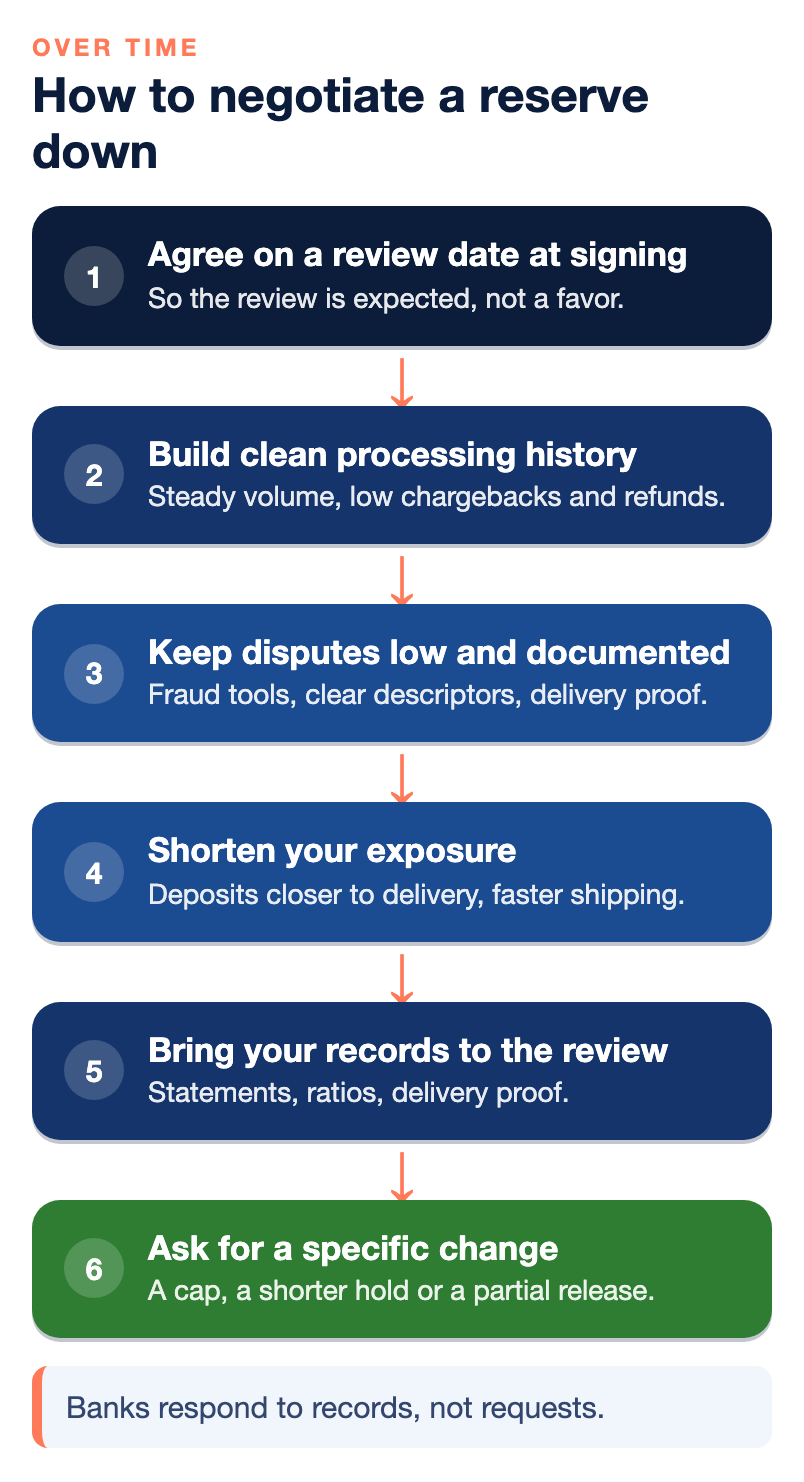
Negotiating a reserve is not about persuasion. It is about showing the bank, with records, that the risk it priced in has gone down. Banks respond to evidence. They rarely respond to “we have been good customers”. Work through it like this.
- Agree on a review date at signing. Ask for a written point at which the reserve will be reviewed, so the conversation is expected rather than a favor.
- Build clean processing history. Steady volume, low chargebacks and refunds, and no surprises in what you sell are the strongest arguments you can bring.
- Keep disputes low and documented. Use fraud tools, clear descriptors and easy-to-find refund policies, and keep evidence of delivery for every order.
- Shorten your exposure. Take deposits closer to delivery, ship faster and add tracking, so less money is at risk at any moment.
- Bring your records to the review. Processing statements, chargeback ratios, delivery proof and, where useful, financial statements showing the business can cover refunds.
- Ask for a specific change. A lower holdback, a shorter hold period, a cap in place of an open rolling reserve, or a release of part of what is held.
Ask for a cap before you ask for less
If you are on a rolling reserve with no cap, the most useful first request is often a cap rather than a lower percentage. A cap puts a ceiling on how much of your money can be tied up, which makes cash flow predictable, and banks can find it easier to agree to because the protection they need is still there. Once the cap is in place and your history is clean, asking for a lower cap or a partial release is the natural next step.
Things that make a reserve go up, not down
The same factors work in both directions. A spike in chargebacks, a sudden jump in volume, a much larger average sale than you described, or products added to your website that the bank did not approve can all lead to a larger reserve or a review of the account. Tell your processor before you change what you sell or how you sell it. Our guide to high-risk chargebacks and account protection covers the dispute side in detail, and it is the area that most often decides which way a reserve moves.
Reserves, held funds and terminations are not the same thing
Owners sometimes use “reserve” for any money a processor is not paying out. It helps to keep three situations apart. A reserve set at approval is part of your agreed terms. A hold placed during a review is a reaction to something the processor saw, and it is usually resolved by answering its questions. A termination hold is money kept after an account closes, because chargebacks can still arrive after processing stops. Each one is handled differently. If your account has been closed, our guide to what to do when a processor shuts down your account explains how to request the amount held, the reason, the release schedule and the conditions in writing. A closure for certain reasons can also lead to a MATCH listing, which our article on the 14 reasons merchants end up on the MATCH list explains.
It also helps to read your statements every month. A reserve shows up as withheld amounts and releases, and the only way to know the schedule is being followed is to check it. Our guide to reading your merchant statement shows where to look.
Where NPS fits, and where it does not
We work with low-risk and high-risk merchants, and a large part of our work is placing businesses in regulated or hard-to-place categories with acquiring banks that understand them. Before we submit an application, we review the business and its website so the file goes to underwriting complete, which is the best starting point for fair reserve terms. We explain reserves, holds and funding terms before you sign, and reserve planning is part of how we work with high-risk merchants. Accounts come with live, U.S.-based support around the clock, a dedicated account manager and chargeback tools. Our high-risk merchant services page describes the categories we work with.
For cannabis-related businesses, we are specific about the line. We work with businesses such as CBD, hemp, and pipes and smoking accessories that do not touch the plant. We do not process for dispensaries, growers or any business that touches the plant.
Here is where we may not be the right choice:
- Very low volume or a side project. We may not be the best fit for hobby sellers with very low processing volume.
- You want an instant, self-service account. We underwrite each account.
- You would rather not provide underwriting documents. Fair reserve terms depend on them.
- You want a guarantee of no reserve. No honest processor can promise that before the bank has reviewed your file.
- Your products cannot be sold lawfully. No processor can fix that.
Next step
A reserve is the bank’s answer to a risk it sees in your business. Understand which risk it is, get the terms and a review date in writing, and then build the record that shows the risk has shrunk. You can find more practical guides in our payments guides library. If you want a second opinion on reserve terms you have been offered, or on a reserve you already have, you can talk with our team.
Frequently asked questions
What is a reserve on a merchant account?
It is money a bank or processor withholds from your deposits, or sets aside up front, to cover losses that could arrive later, such as chargebacks, refunds or undelivered orders. It is still your money. It is released back to you under the conditions in your merchant agreement.
How much of a reserve should I expect?
There is no universal figure. The bank sets the type, size and release schedule based on your business, mainly future delivery, chargebacks, growth, processing history, average ticket and billing model. Ask any provider for the proposed terms in writing before you sign, and be wary of anyone who quotes a number without reviewing your file.
What is the difference between a rolling reserve and a capped reserve?
A rolling reserve holds a share of each day’s processing and releases it after a set period, so it takes a slice of every deposit. A capped reserve holds funds only until a set total is reached, after which your deposits come through in full. Many merchants find a cap easier to manage.
Can I negotiate a reserve before I sign?
Often you can discuss it, especially the structure, a cap and a review date. A complete application, clean processing history and clear delivery and refund policies give you more to work with. The bank makes the final decision, so get whatever is agreed in writing.
How do I get a reserve reduced later?
Show that the risk has gone down. Bring processing statements, chargeback and refund ratios, delivery proof and, if useful, financial statements to a scheduled review, and ask for a specific change such as a cap, a shorter hold or a partial release. No outcome is guaranteed, but evidence is what moves a reserve.
Does every high-risk merchant have a reserve?
No. Reserves are more common for high-risk businesses, but the structure depends on the bank and the individual business. Two businesses in the same industry can receive very different terms based on their history and exposure.
What happens to my reserve if my account is closed?
The processor may keep funds for a period after closure, because chargebacks can arrive after processing stops. Ask in writing for the amount held, the reason, the release schedule and the conditions for release. Account closure does not automatically mean the money is lost.
Can a reserve be increased after I am approved?
Yes. A spike in chargebacks, a sudden jump in volume, larger average sales or products the bank did not approve can lead to a larger reserve or an account review. Telling your processor before you change what or how you sell is the best way to avoid surprises.





