
When you apply to become a payment facilitator, the acquiring bank is not grading your software. It is deciding whether it can accept responsibility for you and for every business you will ever sign, because under card-network rules the acquirer answers for what its payment facilitators and their sub-merchants do. So the file it reads is about your owners, your money, your underwriting policy, your monitoring and your controls, and the application form is the smallest part of it. This guide walks through what that review covers, in the order an underwriter tends to think about it, and then gives you an honest test for whether you should be a PayFac at all.
The short answer
- The acquirer reads you as a risk it will carry. Visa’s public risk guide for payment facilitators says an acquirer that contracts with one is responsible for what the payment facilitator and its sponsored merchants do, and may only contract with one it has screened for risk. Every question in the review follows from that.
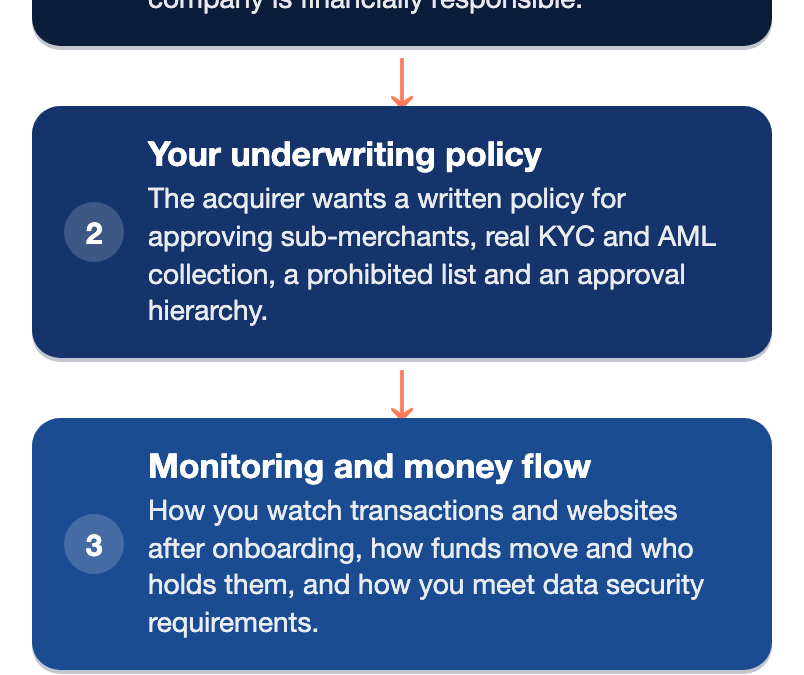
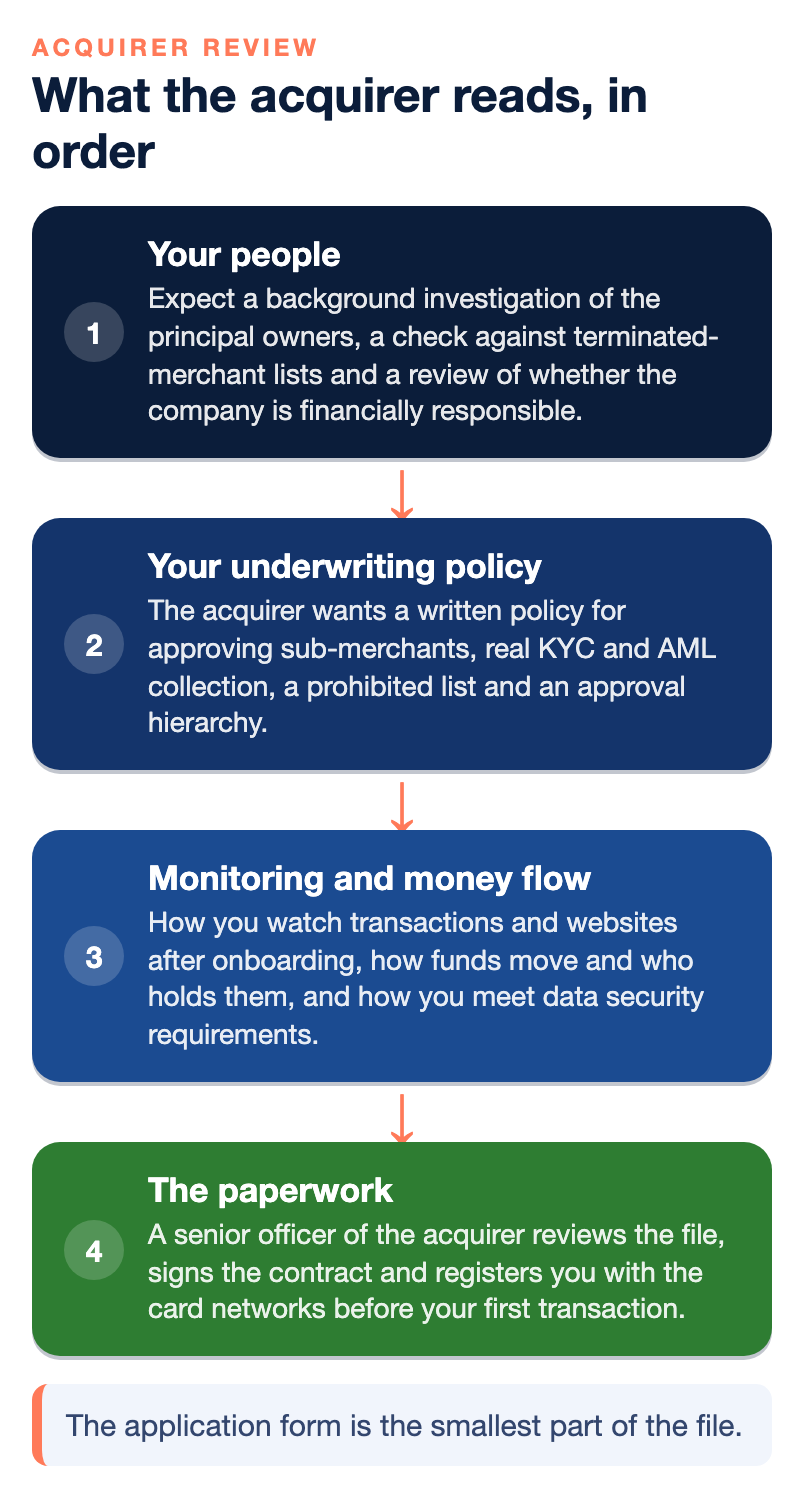
- Your people come first. Expect a background investigation of the principal owners, a check against terminated-merchant lists and a review of whether the company is financially responsible.
- Your underwriting policy is the heart of the file. A PayFac is a gatekeeper. The acquirer wants a written policy for approving sub-merchants, real KYC and AML collection, a prohibited list and an approval hierarchy.
- Your monitoring and money flow come next. How you watch transactions and websites after onboarding, how funds move and who holds them, and how you meet data security requirements.
- Then the paperwork the bank must sign. A senior officer of the acquirer reviews the file, signs the contract and registers you with the card networks before your first transaction.
Who wrote this, and what we will not claim
Nationwide Payment Systems (NPS) publishes this guide. Allen Kopelman started the company in 2001. We sell our own hybrid PayFac and white-label programs to software companies, so we are not a neutral party. We describe what card-network rules and acquiring banks ask for in general terms. We do not quote capital requirements, reserve amounts, fees or timelines here, because those depend on the acquirer, your volume, your merchant mix and the current network rules, and any number we printed would be wrong for someone. Ask your acquirer for its requirements in writing.
Nothing here is legal advice. Money movement can raise licensing questions that depend on your state and your structure, so involve a payments lawyer before you take in a single dollar on someone else’s behalf.
Why the acquirer reads so carefully
A payment facilitator signs up businesses, called sponsored merchants or sub-merchants, under its own relationship with an acquiring bank. That is the whole appeal for a software company. You onboard your customers inside your own product instead of sending each one to apply for a separate merchant account. The trade is that the bank never meets most of those businesses. It meets you, and it relies on your judgment to keep fraud, prohibited products and unmanageable chargebacks out of the system.
The card networks make that reliance formal. Visa’s risk guide describes payment facilitators as gatekeepers to the payment system, and it puts the acquirer on the hook for the conduct of the payment facilitators it sponsors. Mastercard defines a payment facilitator as a service provider registered by an acquirer to facilitate transactions on behalf of submerchants. In both cases, the acquirer is the one who has to say yes, sign the contract and register you, which means it is also the one that has to explain itself if something goes wrong. Read every request in your application through that lens and most of them stop feeling arbitrary.
What is in the file, section by section
1. The people who own and run the company
The review usually starts with ownership, not product. Visa’s guide lists a background investigation to verify the financial and fiduciary responsibility of the principal owners and to make sure there is no significant derogatory information, such as present or past litigation or regulatory action. Expect to provide identification for every owner above the threshold your acquirer sets, an ownership chart that goes all the way up through any holding companies, and an honest account of anything a search will find. A lawsuit you disclose with context reads very differently from one an underwriter finds on their own.
The acquirer will also check whether your company has been terminated for cause before. Visa’s guide calls for a query of the Visa Merchant Screening Service, or a comparable terminated merchant file where that is required and available. If you or a past company ever landed on a terminated-merchant list, say so up front and bring the paperwork that explains how it was resolved. Our guide on the reasons merchants end up on the MATCH list explains how those listings happen and what people do about them.
2. Whether the business can carry the risk
The second question is whether you are financially responsible. The acquirer is going to absorb losses that your sub-merchants cannot cover, at least at first, so it wants to see that you can stand behind your portfolio. That usually means financial statements, bank statements, your funding history and a realistic projection of volume by month and by merchant type. If you are venture funded, show the runway. If you are profitable, show the books. Underwriters are far more comfortable with a modest, well-supported projection than with a hockey-stick chart that has no merchants behind it.
Keep in mind that the card networks also set requirements on the acquirer itself. Visa’s guide says an acquirer must meet minimum capital requirements to sponsor a payment facilitator, and that those requirements vary with factors such as region and sales volume. That is one reason two acquirers can give you very different answers about the same plan. Their own limits are part of the decision.
3. Your business plan and how you sell
Visa’s due diligence list includes a review of the prospective payment facilitator’s business strategy, merchant solicitation materials, collateral and online presence, and it says that review must establish sound sales and marketing practices. In plain terms, the underwriter will read your website, your pricing page, your sales deck and anything else a future sub-merchant might see. If your homepage promises instant approval for everyone, expect a question about how that squares with an underwriting policy. If your target market is a single vertical, expect questions about that vertical’s chargeback patterns and any products in it that sit on a restricted list.
Be exact about who you plan to sign. A software platform for home service contractors is a different file from a platform that onboards online sellers of anything. Card-network rules also restrict who a payment facilitator may sign at all. Visa’s guide, for example, says payment facilitators may not provide payment services to outbound telemarketers, other payment facilitators or marketplaces, and that only payment facilitators registered as high-risk internet payment facilitators may solicit high-brand risk merchants. If any part of your plan touches higher-risk categories, raise it in the first conversation. Our page on high-risk merchant services covers what those categories usually involve.
4. Your underwriting policy for sub-merchants
This is the section most first-time applicants underestimate, and it is where the acquirer spends the most time. You are asking to make approval decisions on the bank’s behalf, so the bank wants to read exactly how you will make them. Visa’s guide lists the capabilities a payment facilitator should be able to show, including a written underwriting policy and procedures, acquirer-approved merchant agreements, proper collection of seller information, due diligence against the merchant qualification standards, rejection of prohibited sellers, use of a terminated merchant file and controls on automated boarding.
A strong policy answers practical questions. What information do you collect from each sub-merchant, and how do you verify it? Which business types will you decline outright, and which will you send to a human reviewer? Who in your company can approve a higher-risk merchant, and up to what volume? Visa’s guide describes a hierarchy of underwriters with cascading approval limits for different risk categories, and it suggests acquirers keep their own concurrence step for sellers that pose higher risk. Your policy must also follow the acquirer’s own merchant acceptance criteria, which may be stricter than the network rules.
If you plan to approve sub-merchants automatically, explain your controls. Visa’s guide warns that poorly controlled auto-boarding invites fraudulent applications, and it calls for checks that authenticate each seller and confirm what it sells, plus velocity checks that catch unusual application activity. An underwriter reading your file wants to see that speed for honest merchants does not mean an open door for everyone else. If you have not written this policy yet, our piece on merchant underwriting when a business does not fit the box shows the kind of questions an underwriter asks about a single merchant, and your policy needs to answer them at scale.
5. How you will watch your portfolio after onboarding
Approval is the start of the risk, not the end of it. The acquirer will ask how you monitor transactions for fraud and unusual patterns, how you watch sub-merchant websites for changes in what they sell, how you track chargebacks and refunds, and what you do when a sub-merchant crosses a line. Visa’s guide devotes a full chapter to risk monitoring, covering transaction monitoring, website monitoring and merchant reserves. Describe your tools, your alert rules, who reviews the alerts and how quickly, and the steps you take before a sub-merchant is paused or closed.
Reserves deserve their own paragraph in your application. Explain when you would hold a reserve on a sub-merchant, how you decide its size and how you release it. The acquirer is not looking for a specific number from us or from you in a guide. It is looking for a policy that is written down, applied consistently and explained to sub-merchants before they sign.
6. How the money moves
Draw your flow of funds and put the drawing in the file. Who collects the payment? Where does settlement land? Do funds pass through an account you control before they reach the sub-merchant, and if so, for how long? Who pays refunds and chargebacks when a sub-merchant cannot? Visa’s guide notes that a due diligence review checks that the entity follows applicable laws and regulations, which in some jurisdictions may include holding money transmission licenses. The structure you choose can change whether that question applies to you, which is one more reason to talk to counsel early.
Location matters too. Visa’s guide says a payment facilitator may only contract with sponsored merchants located in the same country as the payment facilitator and its acquirer. If your plan includes merchants abroad, raise it before the application, not after.
7. Data security and the technical setup
A payment facilitator stores, processes or transmits card data, or controls systems that do, so data security is part of the review. Expect questions about your compliance with the PCI Data Security Standard, whether card data ever touches your servers, how you use tokenization, and which gateway or processor handles the sensitive parts. Mastercard’s rules include payment facilitators in its site data protection program. Visa’s guide also says the acquirer’s due diligence includes an onsite inspection of the payment facilitator’s operations and its policies and controls for underwriting, risk monitoring and data security.
The technical side also includes identifiers. Visa’s guide says payment facilitators must assign a unique identifier to each sponsored merchant, and Mastercard’s switch rules require the names of both the payment facilitator and the sponsored merchant on each transaction. Make sure your platform can carry those fields from the first day.
8. The contracts and the sign-off
The last part of the review is the one you see least. Visa’s guide says a senior officer of the acquirer must review and accept the due diligence documentation and must execute the contract with the payment facilitator. The acquirer then registers you with the network and must receive confirmation before it submits any transactions on your behalf. The acquirer also approves the merchant agreement you will use to sign sub-merchants, and any later changes to it. Under Visa’s rules, once a sponsored merchant’s volume passes the limits the rules set, the acquirer must be a party to that merchant’s agreement, so plan for what happens when a customer outgrows sponsorship.
What a strong application usually includes
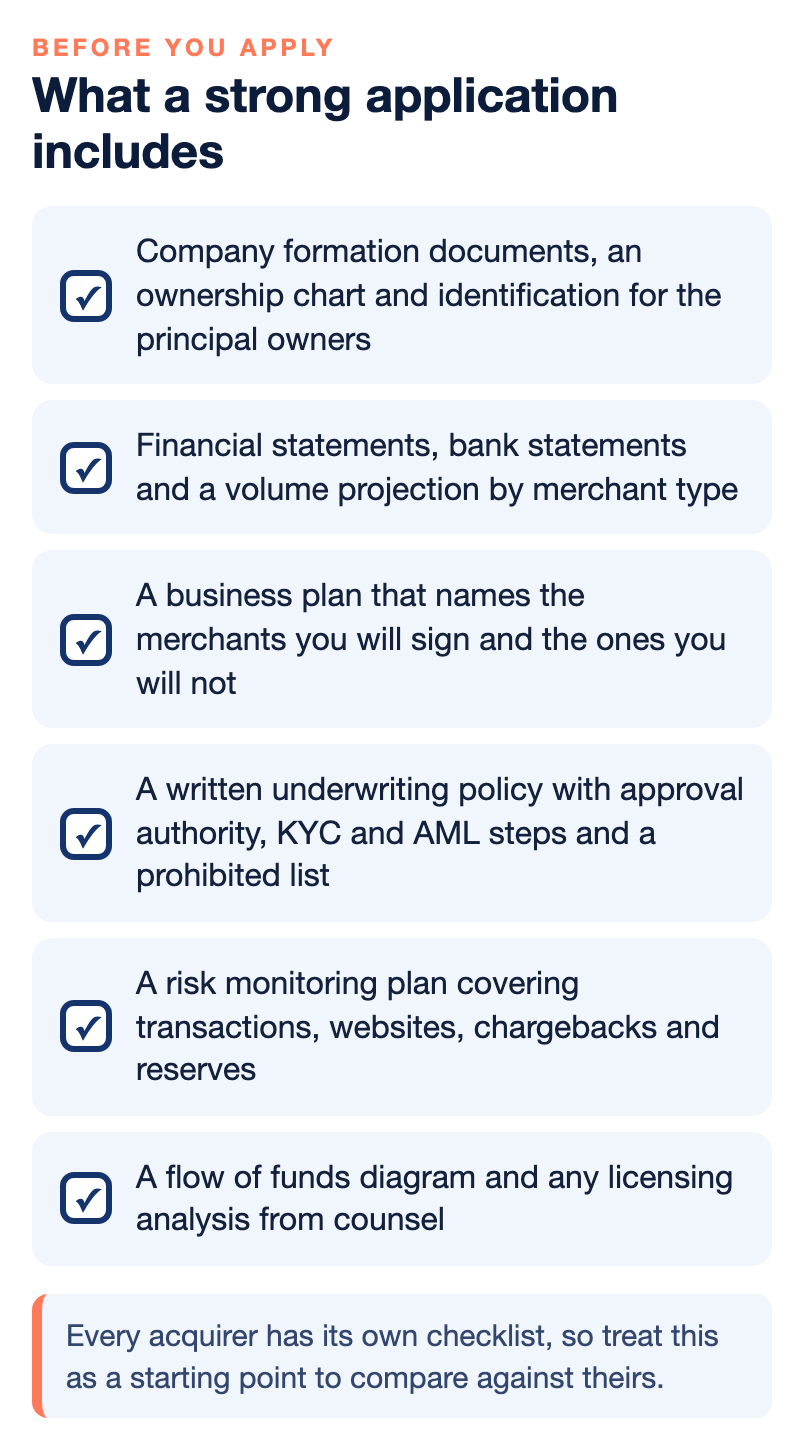
Every acquirer has its own checklist, so treat this as a starting point to compare against theirs, not a substitute for it.
- Company formation documents, an ownership chart and identification for the principal owners
- Financial statements, bank statements and a volume projection by merchant type
- A business plan that names the merchants you will sign and the ones you will not
- Your website, sales materials and draft sub-merchant agreement
- A written underwriting policy with approval authority, KYC and AML steps and a prohibited list
- A risk monitoring plan covering transactions, websites, chargebacks and reserves
- A flow of funds diagram and any licensing analysis from counsel
- Your data security approach, including your PCI status and the systems that touch card data
Should you become a PayFac at all?
Read the list above again and be honest about it. Becoming a registered payment facilitator means hiring or building an underwriting and risk function, carrying losses your sub-merchants cannot cover, passing a deep review and staying in good standing after it. For a software company with a large, growing merchant base and the appetite to run a payments operation, that can be worth it. For many others, it is a lot of weight to take on in exchange for control they could get another way.
There is a wide middle ground between sending your customers to a processor and becoming a full payment facilitator. Referral and revenue-share programs, white-label payments and hybrid models let a software company embed payments and share in the economics while a partner carries much of the underwriting, risk and compliance work. We wrote about those options in how SaaS companies can monetize payments without becoming a PayFac, and it is worth reading before you commit to a full application.
Where NPS fits, and where it does not
NPS offers a hybrid PayFac model for software companies, sometimes called PayFac as a service, along with white-label programs for ISVs and resellers. In those programs we can help with merchant underwriting, acquiring relationships, risk review and merchant support, and our NPSONE gateway gives developers APIs and webhooks for card, ACH and recurring payments. Our post on the hybrid PayFac model explains the trade-offs in more detail.
We are probably not the right fit if you have already decided to become a fully independent payment facilitator and want to own every part of risk and compliance directly with your own acquirer and no partner in between. We are also not the right choice if you want a self-serve signup with no conversation at all, or if your plan depends on signing sub-merchants that no acquirer we work with will underwrite. And if you are early, with a handful of merchants, a simple referral or integrated payments setup may make more sense than any PayFac structure for now.
Bottom line
The acquirer reads a PayFac application the way a lender reads a loan file for a borrower it will be stuck with. It wants to know who you are, whether you can absorb losses, how you will decide who gets in, how you will watch them once they are in, and how the money and the data move. Write those answers down before you apply, make every document tell the same story, and you will have a far better conversation with any bank. If that list looks like more than you want to run, take that seriously, because a hybrid or white-label setup may give you most of what you want without the weight. Either way, you can talk it through with our team or browse more of our payments guides first.
Frequently asked questions
What does an acquirer look at when you apply to become a PayFac?
It looks at the people who own the company, whether the business is financially responsible, your business plan and sales materials, and your written underwriting policy for sub-merchants. It also reviews how you will monitor transactions, how funds move and how you protect card data. The acquirer carries responsibility for what you and your sub-merchants do, so the review is about whether it can safely stand behind you.
Do I have to register with Visa and Mastercard myself?
The acquirer registers you. Under card-network rules, the acquiring bank completes its due diligence, signs the contract and registers the payment facilitator with the network, and it must receive confirmation before it submits transactions on your behalf. You supply the information the acquirer needs to do that.
How much capital do I need to become a PayFac?
There is no single number we can give you honestly. Requirements depend on the acquirer, your projected volume, your merchant mix and current network rules, and the networks also set capital requirements on the acquirer itself. Ask each acquirer for its requirements in writing before you apply.
Why does the acquirer care about my underwriting policy?
Because a PayFac approves sub-merchants on the bank’s behalf. The acquirer needs to see a written policy, real identity and business checks, a prohibited list and clear approval authority before it lets you decide who gets access to card payments.
Can a PayFac sign high-risk merchants?
Only with the right registration and an acquirer willing to support it. Under Visa’s rules, only payment facilitators registered as high-risk internet payment facilitators may solicit high-brand risk merchants. Tell your acquirer about any higher-risk categories in the first conversation.
What happens when a sub-merchant grows too large for a PayFac?
Card-network rules set volume limits for sponsored merchants. Under Visa’s rules, once a sub-merchant passes those limits, the acquirer must be a party to that merchant’s agreement. Plan for that step in your contracts and your product so a growing customer is not caught by surprise.
Is there a way to earn from payments without becoming a PayFac?
Yes. Referral and revenue-share programs, white-label payments and hybrid PayFac models let a software company embed payments and share in the economics while a partner carries much of the underwriting, risk and compliance work. NPS offers hybrid and white-label programs, and we can tell you plainly if a full PayFac application makes more sense for you.





