
When you give customers net-30 or net-60 terms but have to pay your own suppliers sooner, you are lending your customers money out of your own working capital, and the gap between the two dates is the size of that loan. The fix is rarely one big move. It is a set of smaller ones: getting paid earlier, paying later where you can, and choosing payment methods that close the gap instead of widening it. This guide shows how to see the gap clearly, how to measure it, and which levers actually move it.
The short answer
- Net terms are a loan you make to your customer. If you pay suppliers in 15 days and collect in 60, your business carries the cost of those 45 days on every sale.
- The real number is when customers actually pay, not the terms on the invoice. Net-30 that is paid on day 50 behaves like net-50.
- Growth makes the gap bigger, not smaller. More sales on terms means more money waiting to come in, even when the business is profitable.
- The levers are timing levers. Collect earlier, with payment links, card or ACH at invoice, deposits and autopay. Pay later, by negotiating supplier terms. Fill what remains with planned financing rather than surprises.
- Card acceptance is a timing tool when it is used early. A card payment on day 5 helps your cash. The same card payment on day 60 means you financed the sale and then paid the card cost on top.
Who wrote this
Nationwide Payment Systems (NPS) publishes this guide. We have worked with merchants since 2001, including many B2B suppliers, distributors and service companies, and we sell invoicing and payment tools, so we are a seller here. This is general information, not accounting or financial advice. For decisions about borrowing or tax treatment, talk with your accountant or banker.
What net-30 and net-60 actually mean
Net-30 means the full invoice amount is due 30 days after the invoice date. Net-60 means it is due in 60 days. Some invoices add an early-payment discount, written like “2/10 net 30”, which means the customer can take a small discount if they pay within 10 days, or pay the full amount by day 30. Terms are common in B2B because buyers want time to receive goods, check them and run the invoice through their own approval process.
From your side of the table, terms mean you have already delivered the product or service, already paid for the materials and labor that went into it, and are now waiting. The money is earned but not in your account. That is fine when you have the cash to wait. It becomes a problem when your own bills come due first.
The cash gap, in plain terms
Picture three dates on a calendar for a single order.
- The day you pay your supplier for the materials or inventory behind the order.
- The day you deliver and send the invoice.
- The day the customer’s money actually lands in your account.
The distance between the first date and the third is the stretch of time your business is funding that order with its own cash. Accountants have a formal name for this, the cash conversion cycle, built from three measures: how long inventory sits before it sells, how long customers take to pay (days sales outstanding, or DSO), and how long you take to pay suppliers (days payable outstanding, or DPO). You do not need the formula to use the idea. If you pay out on day 15 and collect on day 60, you have a 45-day gap on that order, and every order in the pipeline has its own.
Now multiply it. If most of your sales run on terms, your business always has roughly the gap’s worth of sales sitting in receivables. A company that collects in about 60 days has about two months of sales waiting to come in at any moment. That is money you cannot spend on payroll, rent, inventory or the next supplier invoice.
Why the terms on the invoice are not the real number
Terms describe when you asked to be paid. DSO describes when you were paid. They are often far apart. As our B2B Vault conversation with Visa’s B2B payments director put it, a supplier may offer net-30 terms while the buyer pays at day 45 or day 60, and some buyers then want to pay that late invoice by card.
To find your real number, look at your last few months of paid invoices and compare the invoice date with the date the payment arrived. Your accounting software may show this as an aging report or a DSO figure. Do it by customer if you can, because the average often hides a few slow payers who drive most of the problem. You may find that the customers you think of as your best are also the ones stretching you the hardest.
Why growth makes the squeeze worse
This catches many owners off guard. A business can be profitable on paper and still run short of cash, because profit is counted when you invoice and cash is counted when you collect. When sales grow, you buy more inventory and pay more labor now, while the matching customer payments arrive weeks later. The faster you grow on terms, the more cash you need to fund the wait.
That is why a growing supplier can feel poorer in its best year. It is also why fixing the gap before a growth push matters more than fixing it after. A plan that shortens collection by even a couple of weeks frees up that many weeks of sales, permanently, for as long as the business runs that way.
Lever one: get paid sooner
Collecting earlier is usually the biggest and cheapest lever, because it changes the date that matters most.
Make paying easy the day the invoice arrives
Every extra step a customer has to take is a day added to your DSO. Invoices that carry a secure payment link, so the buyer can pay by card or ACH in a couple of clicks, remove the “mail a check” and “call in a card number” steps entirely. Payment links also cut down on the errors that come from reading card numbers over the phone. Our article on smarter B2B payment strategies that improve cash flow goes deeper on this.
Set a payment policy, and write it down
Customers keep doing what you allow them to do. A clear policy changes behavior. Common cash-friendly choices are “pay on invoice”, “net-7 by card”, or a policy that accepts card payments only within an early window, such as the first 10 or 15 days, and ACH after that. The point of an early card window is that card acceptance then speeds up your cash instead of arriving at the end of a long wait. Put the policy in your proposals, order forms and onboarding so it is not a surprise on the first invoice.
Ask for deposits and progress payments on big jobs
For custom orders, projects and large ticket sales, a deposit at order and progress payments at milestones move part of the cash ahead of your costs. Many buyers expect this on large jobs, and asking for it is a normal business practice, not a sign of distrust.
Move recurring customers to autopay
If customers owe you every month, enroll them in automatic card or ACH payments. One example from our B2B Vault episode on working capital: an accounting and bookkeeping firm moved its clients to automatic monthly billing and collected far more each month with fewer people chasing receivables. Autopay turns a collection job into a schedule.
Send reminders before the due date, not after
A friendly automated reminder a few days before an invoice is due catches the ones that slipped into an approval queue. Reminders after the due date are collections. Reminders before it are customer service.
Lever two: pay suppliers later, or more cleverly
The other side of the gap is how fast you pay out. You may have more room here than you think.
- Ask your suppliers for longer terms. A supplier that sees steady orders and on-time payment may agree to net-45 or net-60. The worst answer is no.
- Line up your payables with your receivables. If most of your customers pay at the end of the month, ask whether supplier due dates can move to match.
- Pay suppliers by card where they accept it. On the buying side, paying a supplier by card can add the time until your card statement is due. Weigh that against any card fee the supplier passes on, and pay the card balance in full, since card interest wipes out the benefit quickly.
- Take early-payment discounts only when the math works. A discount for paying early is worth it when you have the cash and the discount beats what that cash would cost you elsewhere. When cash is tight, paying on the due date may be the better choice.
Lever three: fill the remaining gap on purpose
After you have collected faster and paid out smarter, there may still be a gap. Filling it on purpose is better than filling it in a panic. The common options, described generally, are a business line of credit from your bank, invoice financing or factoring, where a finance company advances money against your unpaid invoices for a fee, and supplier financing programs offered by some vendors. Each has a cost, and each is a decision to make with your banker or accountant, with the terms in writing.
There is a payments angle here that many B2B suppliers miss. When a buyer pays you by card early in the cycle, the buyer’s card issuer is the one extending credit to the buyer, not you. If a customer wants more time, letting their card provide it can be cheaper for you than carrying the receivable yourself. Our B2B Vault episode on why the time value of money can make cards cheaper than net terms walks through that reasoning.
Choosing payment methods with the gap in mind
Each way a customer can pay you has a different effect on timing and cost. None is right for every invoice.
| Method | Effect on your timing | Things to weigh |
|---|---|---|
| Paper check | Slowest. Mail time, handling time and deposit time all add days. | Staff time to process, risk of loss, and no structured way to prompt payment. |
| ACH bank transfer | Fast once the customer initiates it, especially from a payment link or autopay. | Usually lower cost than cards for large invoices. Returns and reversals follow bank rules rather than card dispute rules. |
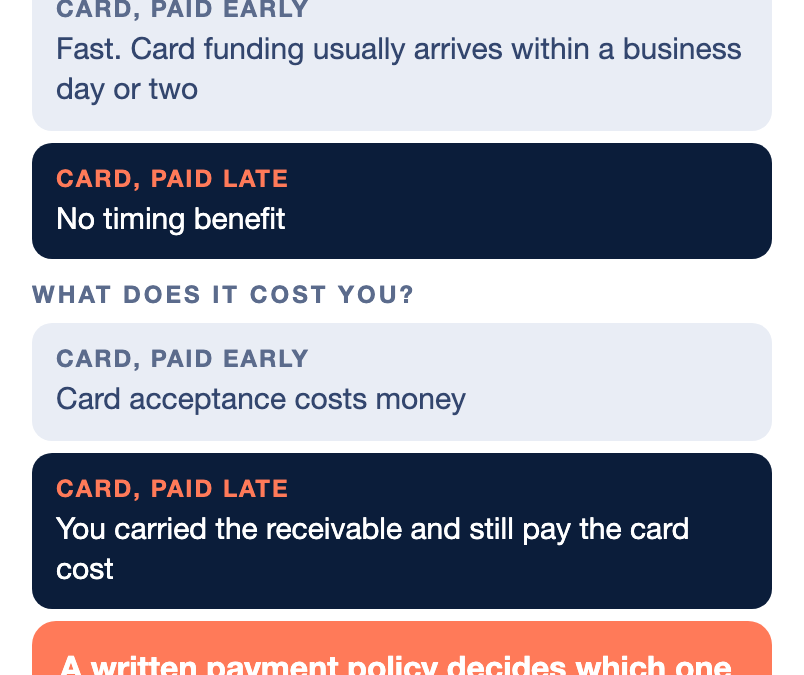
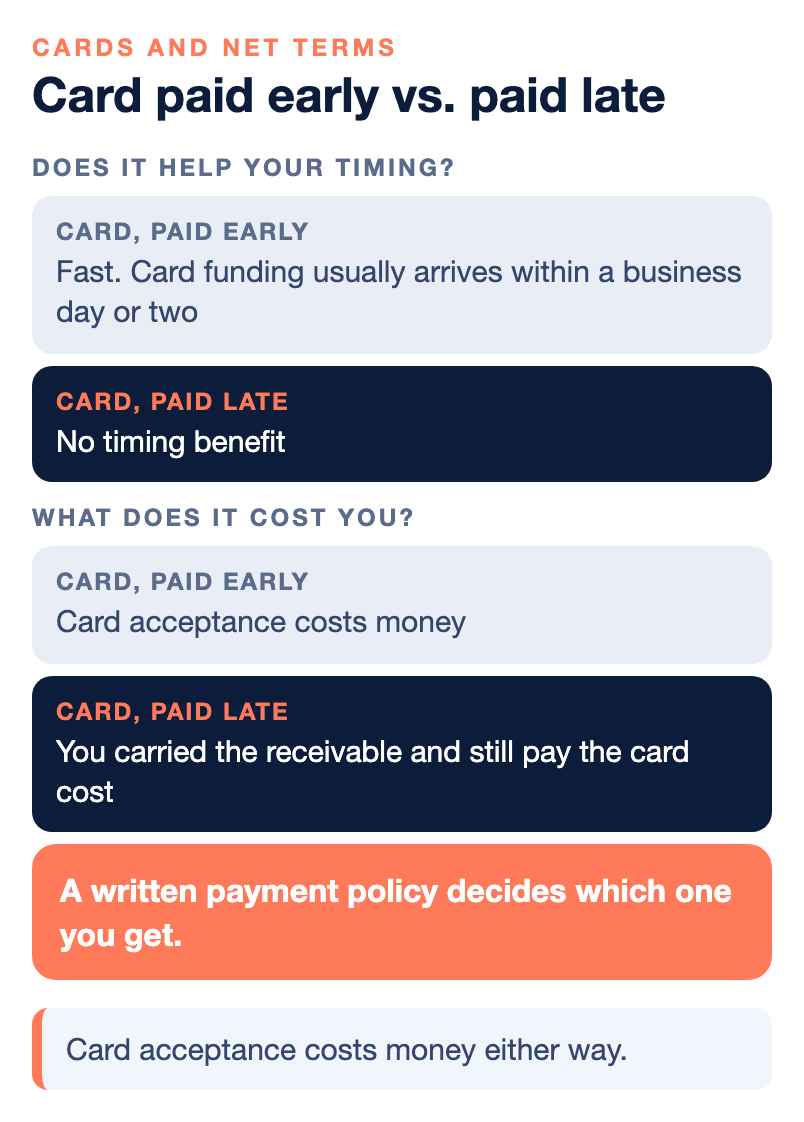
| Card, paid early | Fast. Card funding usually arrives within a business day or two, depending on your setup. | Card acceptance costs money. For business and purchasing cards, passing extra invoice data can lower that cost. Ask your provider. |
| Card, paid late | No timing benefit. You have already waited the full term. | You carried the receivable and still pay the card cost. This is the case a payment policy should prevent. |
If you accept business, corporate or purchasing cards, ask about Level 2 and Level 3 data. When the right invoice details are sent with an eligible transaction, it may qualify for lower card costs. Our guide to Level 2 and Level 3 credit card processing explains what qualifies. For larger, routine invoices, our ACH optimization guide covers when bank transfers make more sense.
A simple way to measure your gap this month
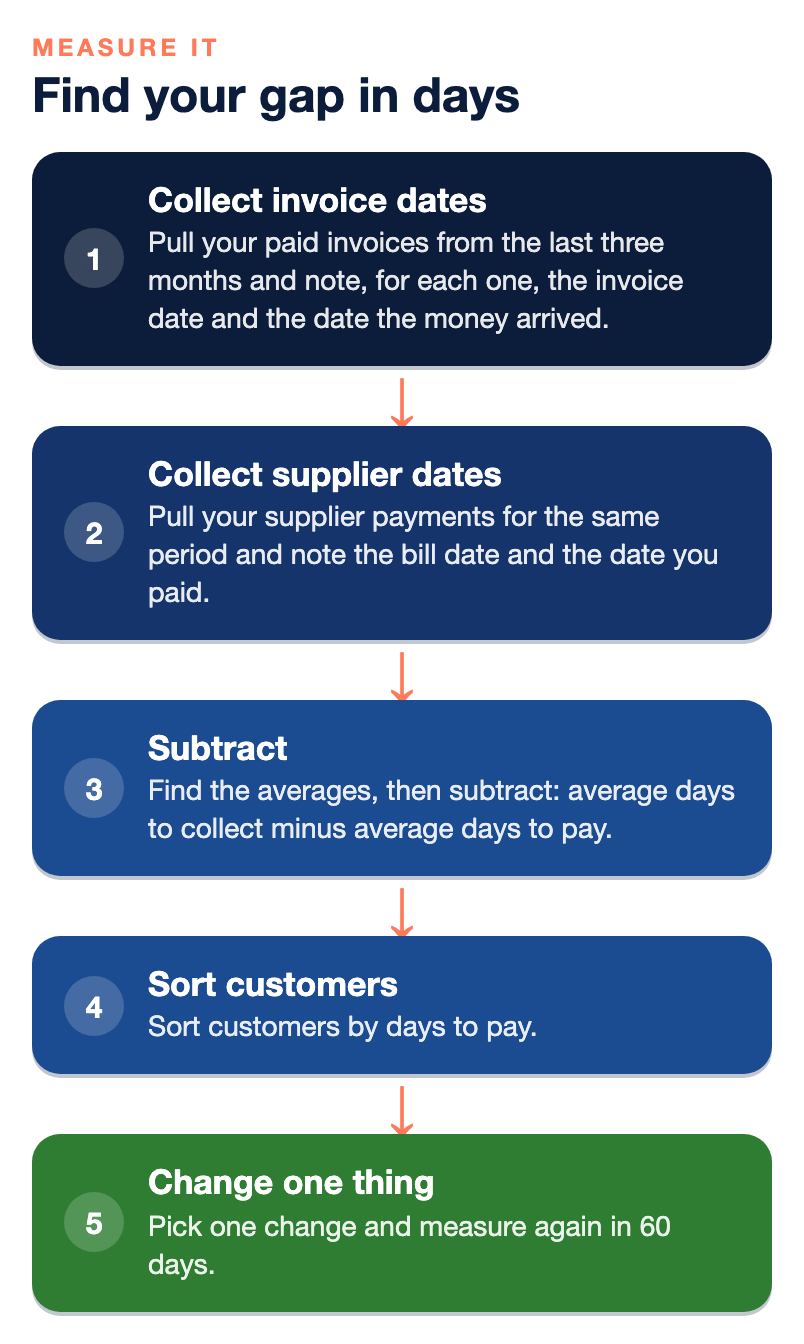
- Pull your paid invoices from the last three months and note, for each one, the invoice date and the date the money arrived.
- Pull your supplier payments for the same period and note the bill date and the date you paid.
- Find the averages, then subtract: average days to collect minus average days to pay. That is your gap in days, before inventory time.
- Sort customers by days to pay. The slowest few are usually where a new policy or an autopay offer will help most.
- Pick one change and measure again in 60 days. A payment link on every invoice, an early card window, or autopay for monthly accounts. Change one thing at a time so you can see what worked.
None of this requires new software to start, although tools that send invoices with payment links and reminders make it far easier to keep going.
Where NPS fits, and where it does not
We offer NPSONE Smart Invoicing, which sends invoices with secure payment links by email or text and lets customers pay by card or ACH. It supports one-time, partial and recurring payments and deposits, syncs with QuickBooks Online, and can prompt for the Level 2 and Level 3 fields that eligible business cards need. It can also apply payment rules, such as accepting cards only in an early window and leaving ACH as the option after that. We offer 24/7 live support and a dedicated account manager, and we price each merchant individually.
We may not be the right fit if:
- You send only a handful of invoices a year. A simple payment button may be all you need.
- You want instant, self-service sign-up. We underwrite each merchant account before it goes live.
- You are choosing only on the lowest advertised flat rate. We do not publish one universal rate.
- Your real need is financing, not payments. If your gap is large even after faster collection, talk with a lender or your accountant first.
If you are comparing providers for business payments in general, see our overview of the best payment processor for B2B companies.
Bottom line
Net terms are not free. Every day between paying your supplier and collecting from your customer is a day your business is the bank. You will not close that gap with one trick, but you can shrink it from both ends: make it easy to pay the day the invoice arrives, set a written policy that rewards early payment, move recurring accounts to autopay, ask suppliers for terms that match your collections, and fill what is left with planned financing. Measure your real days to collect first, because that number, not the one printed on your invoices, is the one running your cash.
If you want help looking at your invoicing setup or your payment policy, you can talk with our team. For more guides, see our payments guides.
Frequently asked questions
What does net-30 mean on an invoice?
Net-30 means the full invoice amount is due 30 days after the invoice date. Net-60 means it is due in 60 days. Some invoices add an early-payment discount, such as 2/10 net 30, which rewards payment within 10 days.
How do net terms affect my cash flow?
While you wait for customers to pay, your own cash is funding the sale. If you pay suppliers in 15 days and collect in 60, your business carries 45 days of that order. Across all your orders, that gap can add up to weeks of sales sitting in receivables.
Why can a profitable business run out of cash?
Profit is counted when you invoice, while cash arrives when customers pay. When sales grow on terms, you pay for inventory and labor now and collect weeks later. Faster growth on terms means more cash tied up waiting.
How do I calculate my cash gap?
Compare the invoice date with the payment date on your recent paid invoices to find your average days to collect. Do the same for supplier bills to find your average days to pay. Subtract the second number from the first to get your gap in days, before inventory time.
Should I accept credit cards from B2B customers on net terms?
Card acceptance helps your cash when the card payment comes early, such as at invoice or within an early window. A card payment at the end of a long term means you financed the sale and also pay the card cost. A written payment policy decides which one you get.
Is ACH better than cards for large invoices?
ACH is often lower cost than cards for large invoices and is fast once the customer starts the payment. Cards can be useful when timing matters, such as with new buyers or large orders. Many suppliers offer both and steer each invoice to the method that fits.
What is Level 3 data and does it help with cash flow?
Level 2 and Level 3 data are extra invoice details sent with an eligible business or purchasing card transaction. They do not speed up payment, but they may lower the card cost on qualifying sales. Ask your provider whether your setup sends them.
How can I get B2B customers to pay faster?
Put a secure payment link on every invoice, set a written payment policy, ask for deposits on large jobs and move recurring customers to autopay. Send friendly reminders before the due date. Change one thing at a time and measure your days to collect again.





