
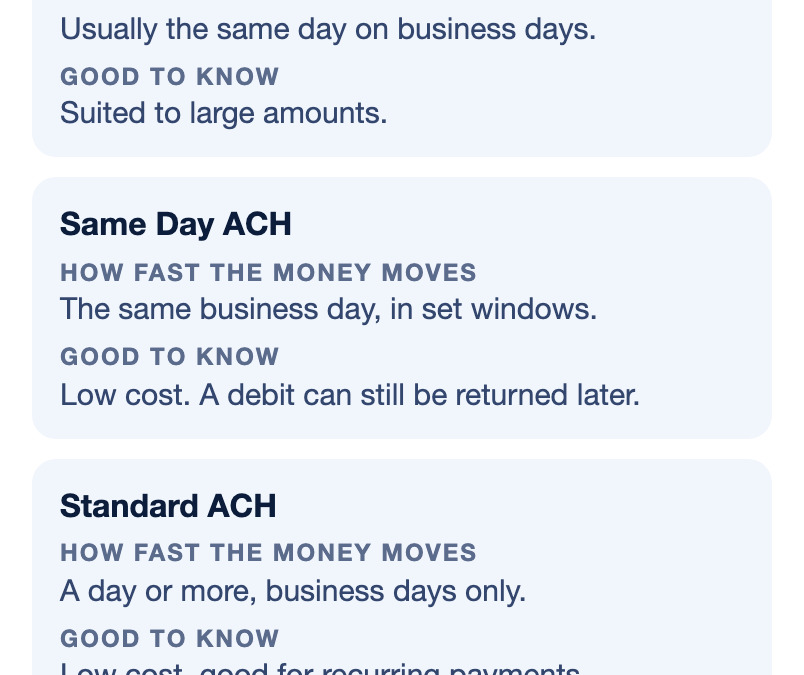
The fastest rail is an instant payment, sent through a network such as RTP or FedNow. The money lands in seconds, at any hour, and it is final once it arrives. The catch is that the customer has to push the payment and both banks have to take part. When an instant payment is not available, Same Day ACH can get bank-to-bank money to you within the same business day, and a wire is a same-day option for large amounts. Card payments are approved instantly, but the money reaches your bank on your processor’s funding schedule. For most businesses the bigger delay is not the rail at all. It is the days before the customer pays. This guide compares the rails on the one question that matters here, when you can actually use the money, and explains how to shorten each part of the wait.
The bottom line
- Fastest: instant payments. Seconds, any day, final on arrival, but only when the payer’s bank and yours take part and the customer is willing to push the money.
- Next fastest on business days: Same Day ACH and wires. Same Day ACH settles within the same business day in set windows. Wires usually move the same day and suit large amounts.
- Cards are fast to approve, not fast to fund. Deposits follow your processor’s funding schedule, often a day or two, with next-day funding available to qualified merchants with some processors.
- Usable is not the same as final. An ACH debit that lands today can still be returned later, so fast access does not always mean safe access.
Who wrote this, and what we will not claim
Nationwide Payment Systems (NPS) publishes this guide. We are a payment processing company in South Florida, in business since 2001, and we help businesses accept card and ACH payments, so we have a stake in how this question gets answered. We do not quote rates or promise deposit times here. Funding times depend on your processor, your bank, your business type, whether payments are card-present or not, your risk category and the time of day a payment is made. The rails themselves also have rules set by their networks and participating banks, which change from time to time. We describe how they generally work, and you should confirm the specifics for your account in writing.
Speed to the account is not speed to usable cash
When an owner says “I need the money today”, three separate clocks are running, and it helps to see them apart.
The first clock is how long the customer takes to pay. An invoice that sits unpaid for three weeks is three weeks of delay that no payment rail can fix. The second is how long the payment takes to move once the customer starts it, which is the part people usually mean by “rail speed”. The third is when your bank makes the money available to spend, and for some payment types, whether that money can still be pulled back afterward.
A business that only looks at the second clock can switch to a faster rail and see almost no change in its cash, because the first clock was the real problem. A business that ignores the third can spend money that comes back a week later. The right setup works on all three.
How the rails compare on speed
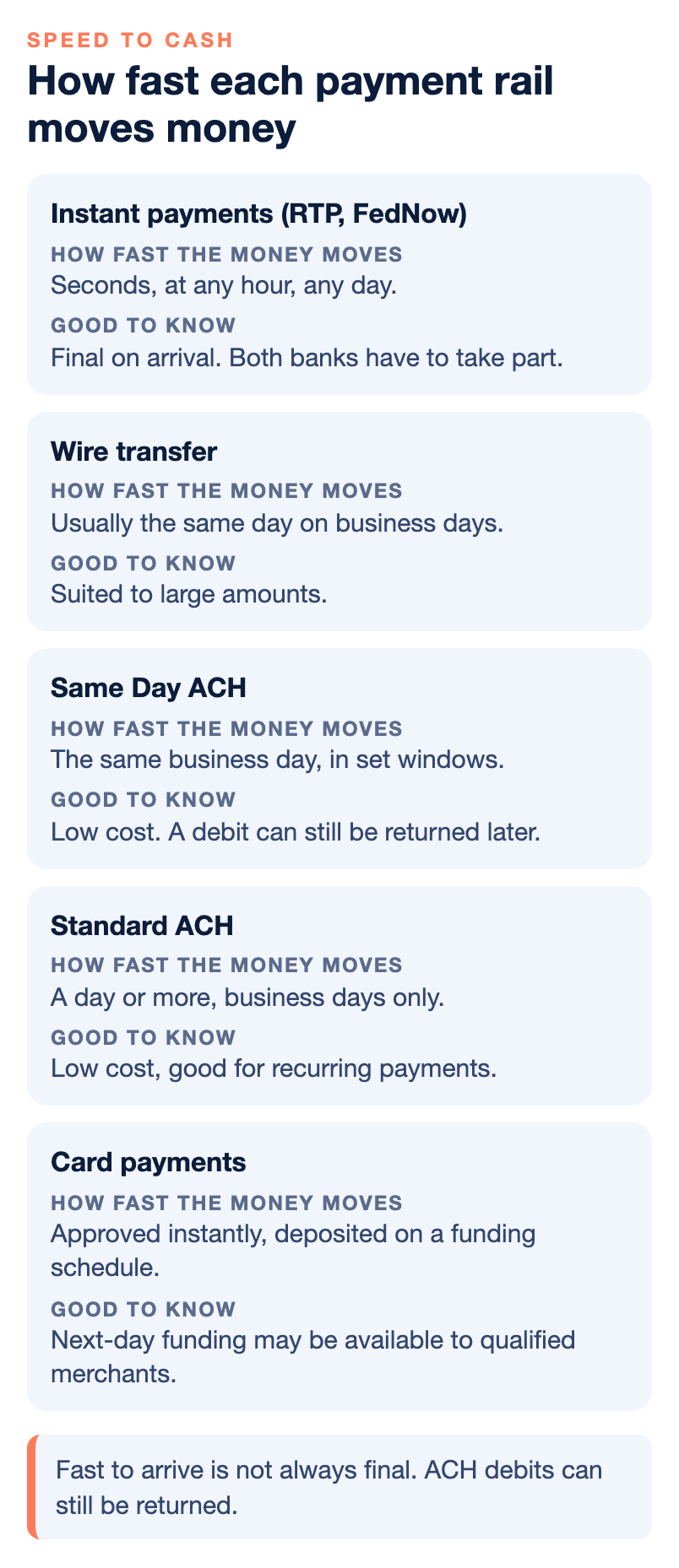
| Rail | How fast the money moves | Good to know |
|---|---|---|
| Instant payments (RTP, FedNow) | Seconds, at any hour, including nights, weekends and holidays. | The payer pushes it and it is final. Both banks have to take part. |
| Wire transfer | Usually the same day on business days. | Suited to large amounts. Less automated for invoices and reconciliation. |
| Same Day ACH | The same business day, within set processing windows. | Low cost. A debit can still be returned later. |
| Standard ACH | On a batch schedule, usually a day or more, business days only. | Low cost and good for recurring payments. A debit can still be returned later. |
| Card payments | Approved instantly, then deposited on your processor’s funding schedule. | Next-day funding may be available to qualified merchants. Chargebacks can come later. |
Instant payments: the fastest, when you can get them
The RTP network and the Federal Reserve’s FedNow service are instant payment rails. They let participating banks move money between accounts in seconds, around the clock, every day of the year. They are payment rails, banking infrastructure, not consumer apps, and a customer may use one through their bank without knowing which rail is underneath. Our guide to FedNow and the future of payments covers that service in more depth.
Two things limit them. Instant payments are pushed by the payer, so you cannot pull one from a customer the way you can with an ACH debit. The customer has to send it, sometimes in answer to a request for payment if their bank supports that. And both banks have to participate, which is not yet universal. When everything lines up, though, no other rail beats it, and because the payment is final, the money is safe to use the moment it arrives.
Wires: same day, built for large amounts
Wire transfers remain common for large-dollar payments such as equipment, real estate-related transactions, international business and large B2B invoices. They usually move the same day when sent during business hours, and they carry a fixed fee rather than a percentage. Wires can be useful, but they typically do not come with the automated invoice reconciliation and customer-facing payment experience of an integrated system, so someone on your team ends up matching them by hand.
Same Day ACH: fast and low cost, on business days
Same Day ACH lets qualifying ACH payments settle within the same business day, in several processing windows. It gives you the low cost of bank payments without the longer wait of standard ACH, which makes it a good fit for businesses that want to move invoice payments off checks and cards. It runs on business days, so a payment started on a Friday evening will not arrive on Saturday. And because most merchant ACH is a debit, the money can still be returned after it lands, for reasons such as insufficient funds or an unauthorized charge. Same Day ACH changes how fast money moves. It does not change how long it can be returned.
Cards: instant approval, scheduled funding
A card payment is approved in seconds, which feels like being paid. The money itself moves later. Your processor groups the day’s card payments into a batch, settles them and deposits the funds into your bank account on its funding schedule. With many processors, funds typically arrive within one or two banking days, and qualified merchants may be eligible for next-day funding. The exact timing depends on your business type, whether payments are card-present or online, your risk category and when you close your batch each day.
If most of your revenue comes from cards, your processor’s funding schedule is the single biggest factor in your speed to cash. Ask what it is in writing, what you would need to qualify for faster funding, and what time your batch has to close to make the next deposit.
Which rail fits which situation
The fastest rail on paper is not always the right answer, because speed is only one of the things a business needs from a payment. Here is how the choice tends to play out.
- A large one-time payment from a new customer, needed today. An instant payment is ideal if both banks support it, because it is fast and final. A wire is the usual fallback.
- Regular B2B invoices. ACH, with Same Day ACH where speed matters, is usually the best balance of cost and speed, paired with a payment link so customers pay sooner.
- Counter or online card sales. Focus on your card funding schedule, next-day funding if you qualify and your batch close time.
- Recurring payments. Standard ACH or card on file. Speed matters less than reliability here, because the payment date is known in advance.
- A customer who wants to pay by card on a large invoice. A card can turn a slow receivable into a payment today, which may be worth the cost even though the deposit follows the funding schedule.
Our guide to payment methods in the USA describes every major rail and where each tends to fit. The trade-off between card cost and waiting to be paid is the subject of our article is accepting credit cards cheaper than waiting to get paid.
How to get same-day access to more of your money
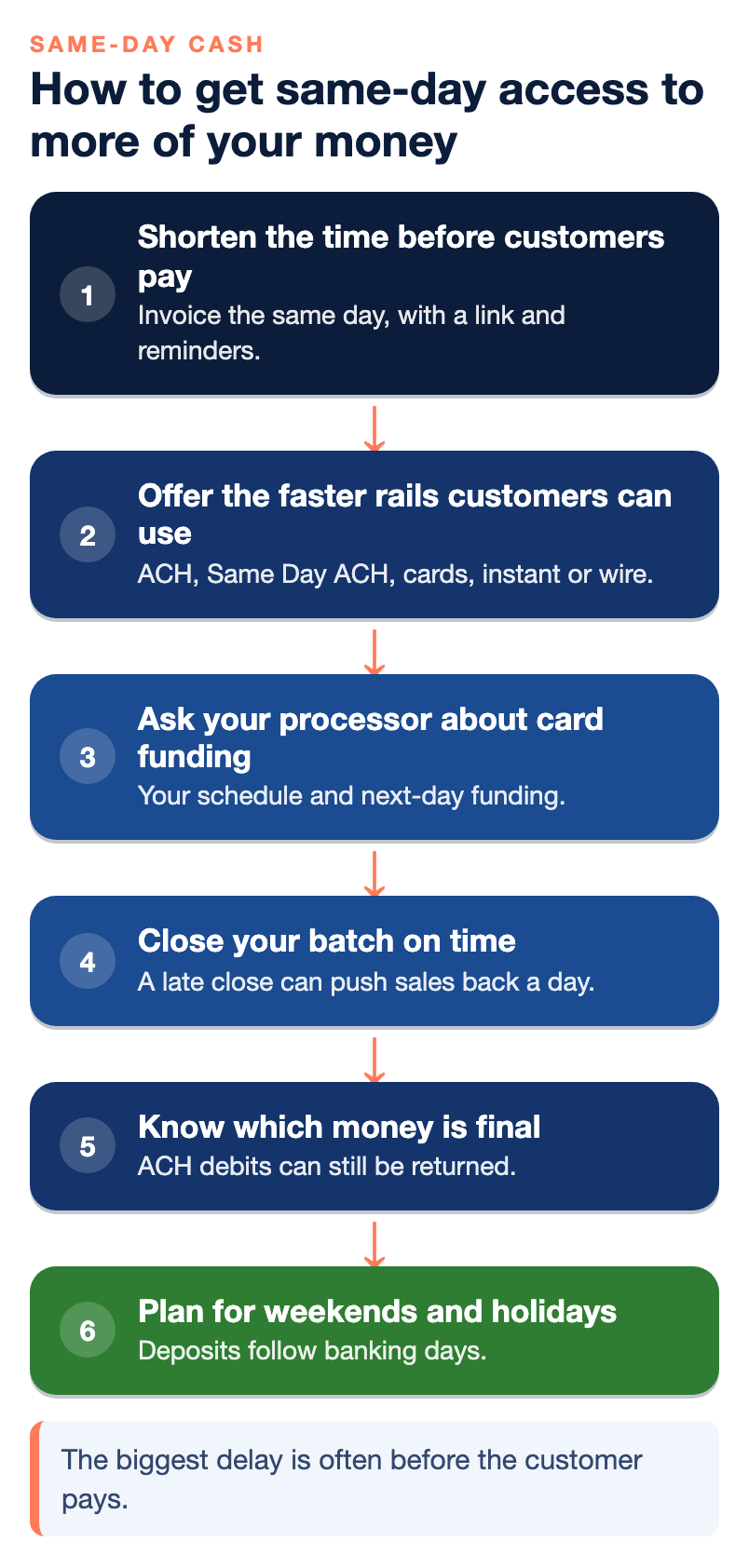
Switching rails helps, but the biggest gains usually come from working on all three clocks at once. Work through it in this order.
- Shorten the time before customers pay. Send invoices the day work is done, with a payment link by email or text, and set automatic reminders.
- Offer the faster rails your customers can use. ACH, with Same Day ACH where available, and cards for customers who want them. Accept instant payments or wires for large amounts where your bank supports them.
- Ask your processor about card funding. Find out your current schedule, whether you qualify for next-day funding, and the batch close time that hits the next deposit.
- Close your batch on time every day. A batch that closes late can push a whole day’s card sales back.
- Know which money is final. Treat ACH debits as usable but not final, especially large or first-time payments, until the return window has passed.
- Plan for weekends and holidays. ACH and card deposits follow banking days, so plan payroll and supplier payments around them.
For B2B companies, the first step is usually the one that pays off most. Our guide on why B2B companies should stop being their customers’ bank explains how payment links, rules about when cards are accepted and automatic payments shorten the wait before a customer pays at all.
Common mistakes when chasing faster funds
The first mistake is choosing a payment provider only on its headline deposit speed. Fast funding on a platform that later holds your money or closes your account is not fast. The second is spending ACH money as if it were final. A large ACH debit that lands today and is returned next week can leave a hole in your account at the worst moment.
The third is ignoring the batch. Many owners do not know what time their card batch closes, and a late close can quietly cost them a day of funding every week. The fourth is assuming every customer can send an instant payment. Some banks do not yet take part, so offer instant payments as an option, not the only way to pay. The last is forgetting to tell your processor about changes. If you start taking much larger payments to speed up cash flow, a sudden change in average ticket can lead to a review, which slows funding down rather than speeding it up.
If you are comparing providers on funding, support and pricing together, our comparison of payment processors by business type is a good place to start, and our explainer on what a merchant account is covers how card deposits reach your bank.
Where NPS fits, and where it does not
We help businesses accept card and ACH payments together, including recurring ACH and ACH on invoices through our NPSONE Smart Invoicing, which sends invoices with secure payment links by email or text so customers pay sooner. Funds from card sales are typically deposited within one to two banking days, and qualified merchants may be eligible for next-day funding. Accounts come with live, U.S.-based support around the clock and a dedicated account manager, and we price each merchant individually.
Here is where we may not be the right choice:
- Very low volume or a hobby business. We may not be the best fit for sellers with very low processing volume.
- You want instant self-service signup. We underwrite each account.
- You would rather not provide underwriting documents. We will ask for them.
- You are choosing only on the lowest advertised flat rate. We do not publish one universal rate.
- You need a guaranteed deposit time before underwriting. Funding depends on your business and risk category, so we confirm it for your account, not in advance.
Next step
If you need money the same day, use instant payments where you can, Same Day ACH and wires where you cannot, and make sure your card funding schedule is as short as your account qualifies for. Then fix the clock that usually matters most, the days before your customer pays. You can find more practical guides in our payments guides library. If you want help looking at your current deposit times and payment mix, you can talk with our team.
Frequently asked questions
What is the fastest way for a business to receive money?
An instant payment through a network such as RTP or FedNow is the fastest. It arrives in seconds at any hour and is final once received. It only works when the customer pushes the payment and both banks take part, so many businesses also offer Same Day ACH or wires.
Is Same Day ACH the same as an instant payment?
No. Same Day ACH settles within the same business day in set processing windows and runs only on business days. An instant payment settles in seconds at any hour. Same Day ACH debits can also still be returned later, while instant payments are final.
How fast do credit card payments reach my bank account?
Cards are approved instantly, but funds are deposited on your processor’s funding schedule. With many processors that is typically one to two banking days, and qualified merchants may be eligible for next-day funding. Your business type, risk category and batch close time all affect it.
Can I get same-day funding on card sales?
It depends on your processor and your account. Some processors offer faster funding to qualified merchants, and the terms vary. Ask your processor in writing what schedule you are on, what faster options exist and what you would need to qualify.
Is a wire transfer faster than ACH?
Usually, yes. A wire typically moves the same day on business days and suits large amounts, while standard ACH runs on a batch schedule. Same Day ACH narrows the gap, and wires carry a fixed fee with less automated reconciliation for invoices.
Can money from a fast payment still be taken back?
It depends on the rail. Instant payments are final once received. ACH debits, including Same Day ACH, can be returned later for reasons such as insufficient funds or an unauthorized charge, and card payments can be disputed through chargebacks.
Why does my money still feel slow after switching to a faster rail?
Often the delay is before the payment starts, in how long customers take to pay. Sending invoices right away with a payment link, setting reminders and closing your card batch on time usually do more for cash flow than the rail alone.





