
4 Merchant Account Pricing Models: Interchange Plus, Flat Rate, Tiered and Membership

CEO – Nationwide Payment Systems
There are four merchant account pricing models in common use, flat rate, tiered, interchange plus (also called cost plus) and membership or subscription pricing, and the one you are on decides how much of every card sale you keep. All four pass along the same underlying card costs. What changes is how your processor adds its markup and how clearly your statement shows it. For most established businesses, interchange plus is the model we recommend, because it puts the real cost and the markup on separate lines where you can see them, while flat rate still makes sense for a very small or brand new business that values a simple bill over the lowest cost. This guide explains how each model works, why tiered pricing is the one we steer merchants away from, what Level 2 and Level 3 data means for B2B companies, which fees to watch for, and how to compare written quotes on your own statements before you sign anything.
The short answer
- If you are just starting out or process very little by card: flat rate pricing is simple and predictable, and the convenience can be worth more than the savings you would get elsewhere while your volume is small.
- If your volume is growing or steady: interchange plus is usually the most transparent and cost-efficient model, because you pay the actual card costs plus one disclosed markup.
- If you run a high-volume store, a large online business or several locations: a membership or subscription model, where you pay a fixed monthly fee and card costs pass through at cost, can make your processing expense very predictable.
- If you are on tiered pricing today: look closely at your statement, because tiered buckets make it easy for the real markup to hide and for transactions to slide into the more expensive tiers.
- Whatever model you are offered, ask for it in writing and compare it against your own recent statements, not against an advertised rate.
What every card sale actually costs
Before the models make sense, it helps to know what you are paying for. Every credit or debit card transaction carries three kinds of cost, and they go to three different places.
- Interchange goes to the bank that issued your customer’s card. It is set by the card networks, it varies by card type and by how the payment was taken, and no processor can change it. A processor can only pass it through or mark it up.
- Assessments go to the card networks themselves. Like interchange, they are not something your processor sets.
- The processor markup is what your provider charges for moving the money, supporting the account and keeping your equipment or gateway running. This is the only part that is truly negotiable.
Interchange works a little like the wholesale cost of a card payment. There are hundreds of interchange categories, and a premium rewards card, a business card, a basic debit card, a card tapped at the counter and a card number typed in by hand can all land in different ones. That is why two businesses with the same monthly sales can pay very different amounts. Their card mix and the way they take payments are different, even before the processor adds anything.
The key difference between merchant account pricing models is how the processor markup is applied and how clearly your provider shows it to you. Some models fold everything into one number. Others break every piece out. Once you see the three layers, the four models below stop looking like four competing price tags and start looking like four ways of packaging the same costs.
The 4 merchant account pricing models
Here is how each model is built, what it does well and where it tends to cost you.
1. Flat rate pricing
Flat rate pricing charges one fixed rate on every transaction, regardless of the card type or how the payment was taken. A basic debit card and a premium rewards card cost you the same. It is the simplest structure there is, and it is common with the payment platforms that let a new business sign up in minutes.
The appeal is easy to understand. You can predict your fees from your sales, the statement is short, and there is nothing to learn. The trade-off is that you lose visibility and you lose the benefit of lower-cost cards. When a customer pays with a card whose interchange is low, the processor still charges you the same flat rate and keeps the difference. For a business processing very little, that difference is small. As volume grows, it turns into one of the more expensive ways to accept cards.
Flat rate tends to fit startups, pop-up shops, seasonal sellers and small merchants with low monthly card volume, where simplicity is worth more than the savings.
2. Tiered pricing
Tiered pricing sorts transactions into a small number of buckets, usually called qualified, mid-qualified and non-qualified, and each bucket carries its own rate. Which bucket a sale lands in depends on things like the card type, such as a standard card versus a rewards card, and the way it was taken, such as swiped or tapped versus keyed in.
On paper it looks simple, and it is often sold alongside offers of free equipment. In practice it is the hardest model to audit. The processor decides which interchange categories go into which bucket, so the real markup is never shown on its own, and many transactions “downgrade” into the mid-qualified or non-qualified tiers, which cost more than the qualified rate you were quoted. At NPS we are not fans of tiered pricing, because it usually benefits the processor more than the merchant.
If you are on tiered pricing, it does not mean you are being cheated, but it does mean you cannot easily tell. That alone is a good reason to have your statement reviewed.
3. Interchange plus pricing (cost plus)
Interchange plus, also called cost plus, passes the actual interchange and assessment fees through to you at cost and adds a fixed, clearly listed processor markup on top. Your statement shows what the card networks and issuing banks charged, then shows what your processor charged, as separate lines.
This is the most transparent model and, for most growing businesses, the most cost-efficient one. You get the benefit of every lower-cost card your customers use, the markup stays the same as your volume grows, and you can see exactly which part of your bill is negotiable. It also makes room for the optimizations that only show up when costs are passed through, such as Level 2 and Level 3 data for business cards and the lower interchange on many debit cards.
The honest downside is that the statement is longer. Interchange varies from transaction to transaction, so your fees will not be the same percentage every month, and reading the statement takes a little more attention. Some interchange plus accounts also carry small separate monthly fees, which should be disclosed in writing up front. For businesses with steady or growing volume, B2B companies and multi-location merchants, those trade-offs are usually well worth it.
4. Membership or subscription pricing
With a membership or subscription model, the processor charges a flat monthly membership fee instead of a percentage markup on each sale, and passes interchange through to you at cost. Select NPS programs use this approach.
The strength of this model is predictability. Your processing cost becomes the pass-through card costs plus one known monthly fee, which suits high-volume retailers, large online stores and franchises that want their overhead fixed. The weakness is the mirror image. For a smaller or seasonal business, the monthly membership can cost more than the savings it produces, especially in slow months.
Merchant account pricing models side by side
Here is how the four models compare on the points that usually decide the choice. Treat it as a starting point. The real answer depends on your card mix, your average ticket and how you take payments.
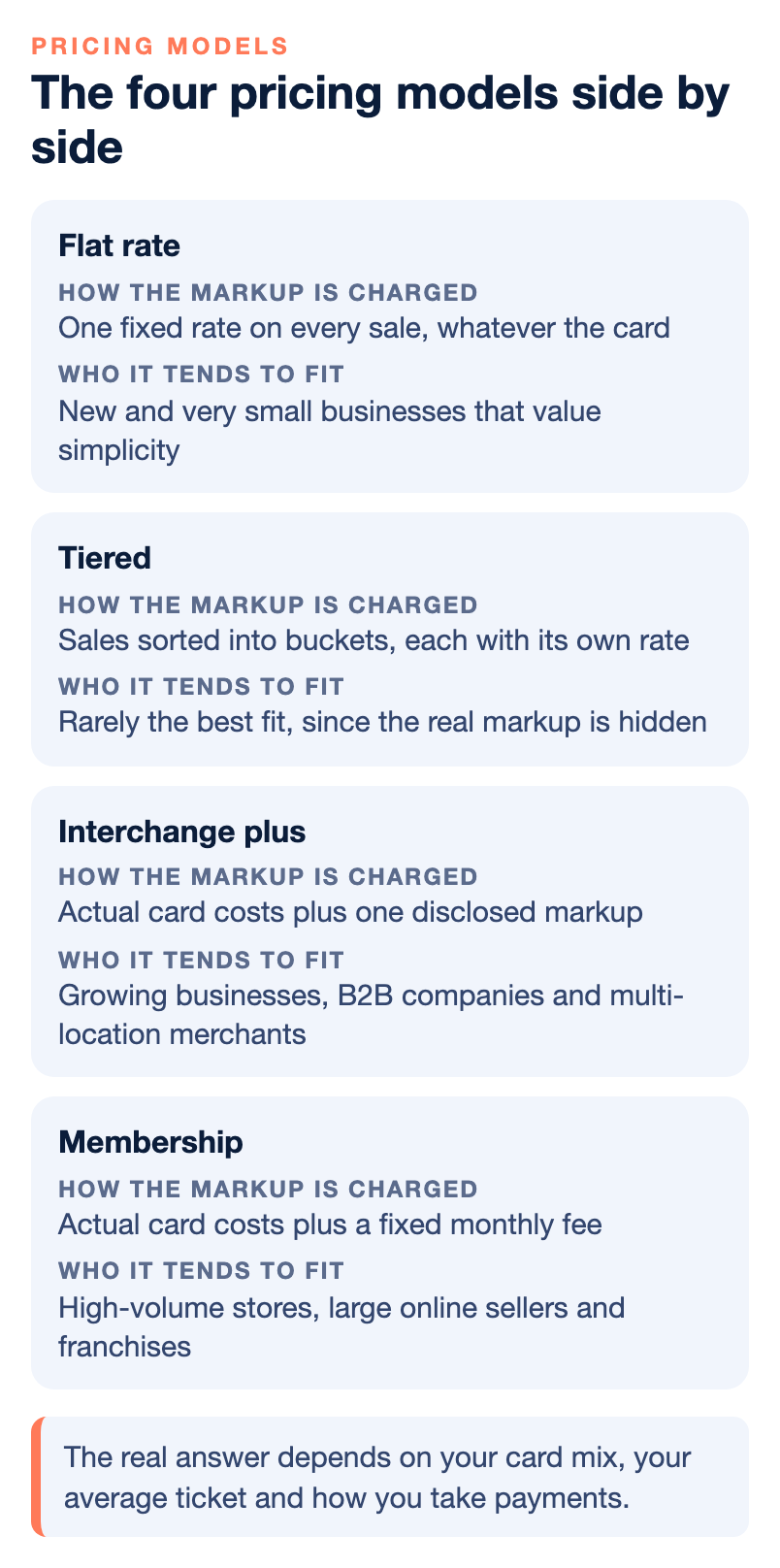
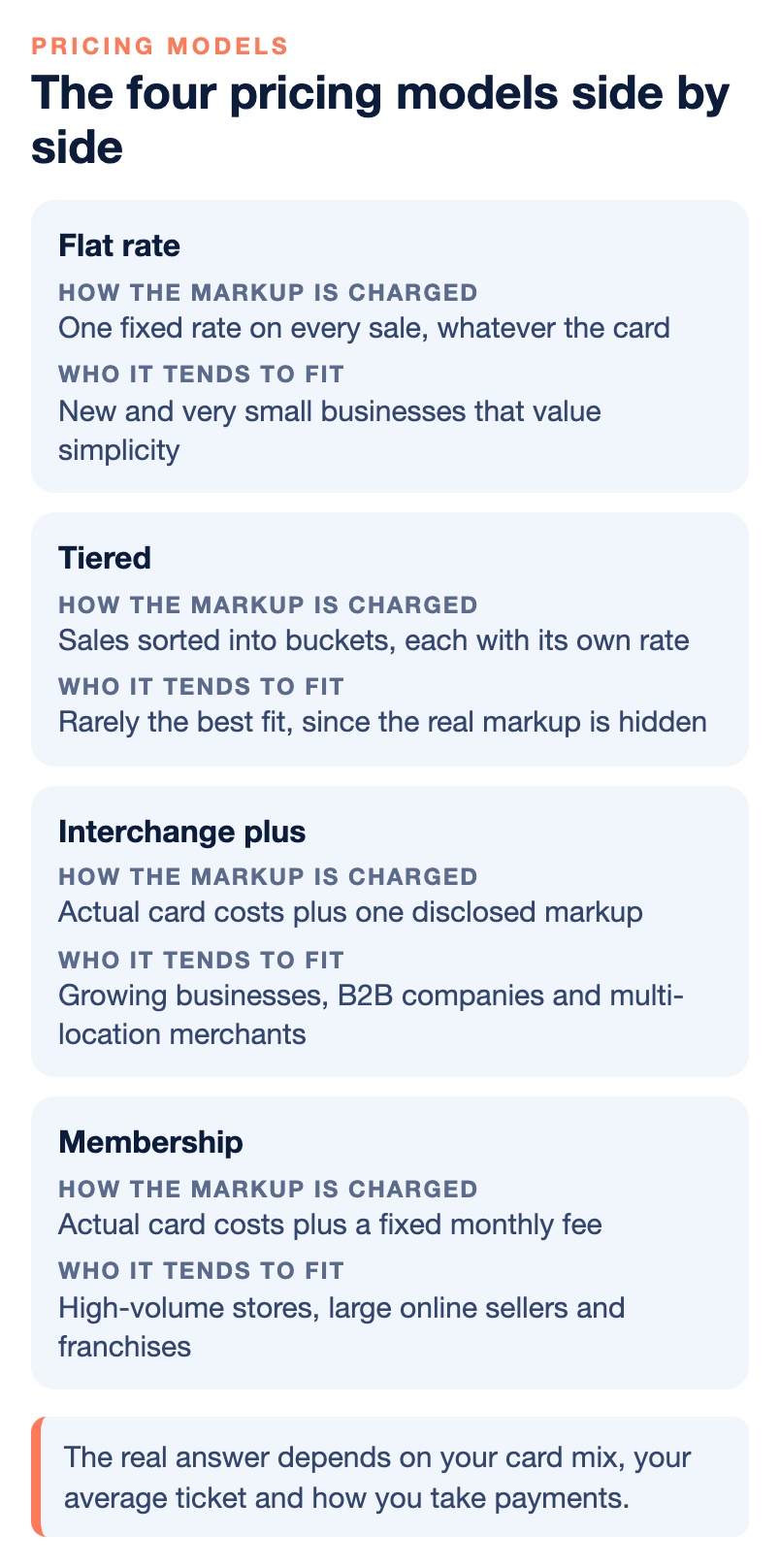
| Model | How the markup is charged | Who it tends to fit |
|---|---|---|
| Flat rate | One fixed rate on every sale, whatever the card | New and very small businesses that value simplicity |
| Tiered | Sales sorted into buckets, each with its own rate | Rarely the best fit, since the real markup is hidden |
| Interchange plus | Actual card costs plus one disclosed markup | Growing businesses, B2B companies and multi-location merchants |
| Membership | Actual card costs plus a fixed monthly fee | High-volume stores, large online sellers and franchises |
The pattern is simple once you see it laid out. The more transparent the model, the easier it is to find, audit and reduce what you are really paying. Flat rate and tiered pricing are easier to read at a glance and harder to check. Interchange plus and membership pricing take a little more reading and give you far more control.
Why flat rate gets expensive as you grow
Flat rate pricing is not a bad deal for everyone. It is a deal priced for convenience, and the price of that convenience grows with your sales. The reason is the card mix. Under a flat rate, you pay the same on a low-cost debit card as you do on a premium rewards card, so every time a customer reaches for a card with lower interchange, the gap between what the payment actually cost and what you paid goes to the processor.
When a business processes a modest amount each month, that gap is easy to ignore. When it processes much more, and especially when many customers pay with debit, the same gap repeats on thousands of transactions. That is the point where we usually suggest a business compare its actual effective cost under flat rate with what it would pay under cost plus. We walk through that comparison in more depth in our guide to flat-rate vs cost-plus payment processing, and for larger merchants in what to review when your monthly volume outgrows flat rate. If you want to see where a flat-rate fee actually goes, layer by layer, read where card fees go: interchange plus vs flat rate.
None of this means a small business should rush off flat rate. It means flat rate should be a decision you revisit as you grow, not one you made once at sign-up and never looked at again.
Qualified, mid-qualified, non-qualified: how tiered pricing hides the markup
Tiered pricing deserves its own section, because it is the model we see cause the most confusion on real statements. The hundreds of actual interchange categories are collapsed into a few broad tiers, and the processor, not the card networks, decides where each category goes. The quoted rate is almost always the qualified rate, the cheapest bucket. What the quote rarely tells you is how many of your transactions will actually qualify for it.
A transaction can downgrade into a more expensive tier for ordinary reasons. The customer used a rewards card or a business card. The card was keyed in instead of tapped or dipped. The batch was settled late. Each downgrade moves that sale into a higher bucket, and because the statement only shows the bucket, you cannot see the interchange underneath or how much of the tier rate is markup. Over a month, a business that was quoted one rate can end up paying noticeably more without anything on the statement looking wrong.
If you are on tiered pricing, the simplest test is to ask your processor what share of your transactions fell into each tier last month, and to ask what the same month would have cost on interchange plus. A provider confident in its pricing should be able to answer both questions in writing.
Interchange pass-through and the debit card advantage
Interchange pass-through, which is the heart of interchange plus pricing, matters most on debit cards. The Durbin Amendment, part of the Dodd-Frank Wall Street Reform and Consumer Protection Act, requires debit card interchange to be reasonable and proportional to the issuer’s cost, and that rule created special, lower interchange rates for many debit transactions.
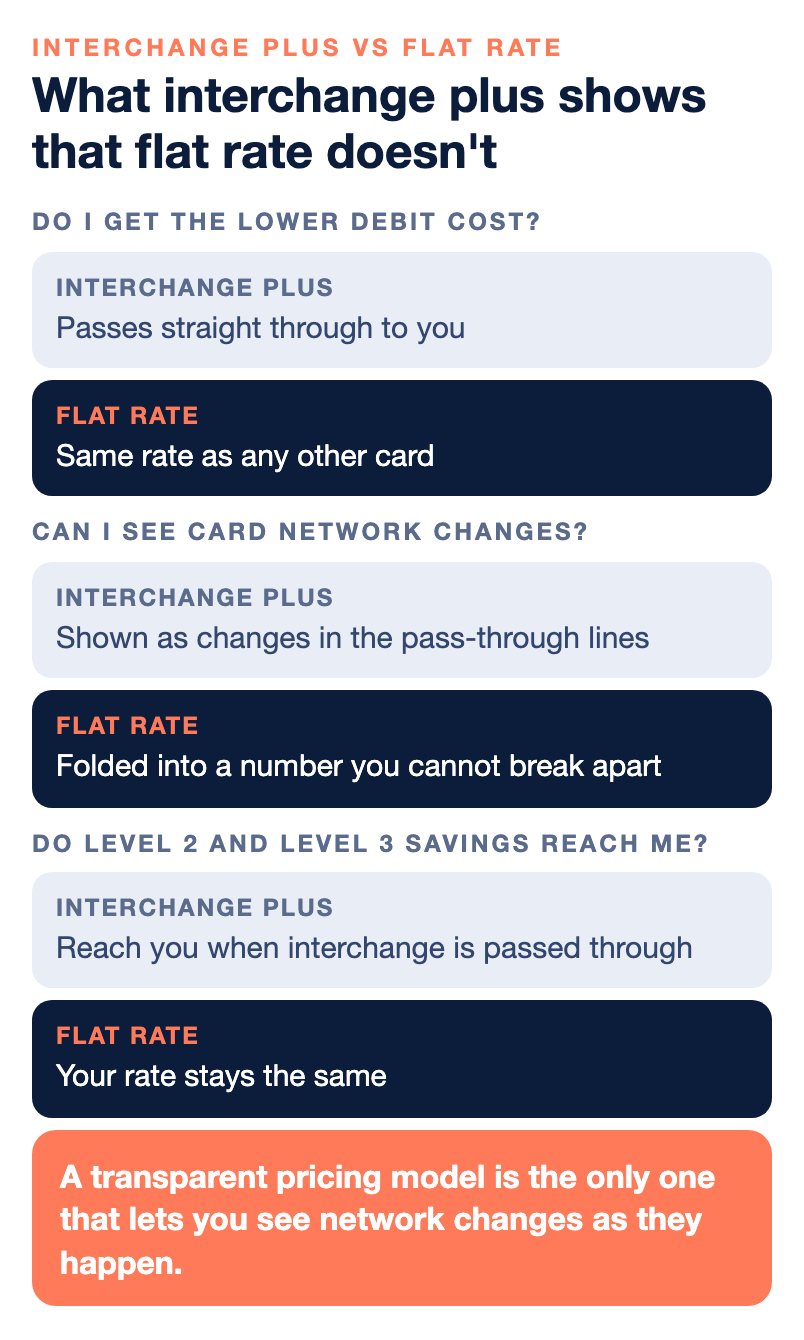
Here is why the pricing model decides whether you see that benefit. On interchange plus, the lower debit interchange passes straight through to you, so every regulated debit sale costs you less than a credit sale. On flat rate, you pay the same rate on that debit card as on any other, so the lower cost stays with the processor. For a business where many customers pay with debit, such as a grocery, convenience store, restaurant or service counter, that difference can be one of the strongest reasons to move to pass-through pricing once volume is steady.
The Durbin Amendment also shapes what you are allowed to do at the register, including how card minimums work and what can never be applied to debit cards. We cover those rules separately in our article on the Durbin Amendment, card minimums and flat fees.
Level 2 and Level 3 data for B2B payments
If your business accepts corporate, purchasing or government cards, there is another reason the pricing model matters. Visa and Mastercard offer reduced interchange on business-to-business and business-to-government transactions that carry enhanced data with them. This is called Level 2 and Level 3 processing.
- Level 1 is a basic transaction, the kind most retail, restaurant and online sales are. It carries only the standard details, such as the card number, expiration date and amount.
- Level 2 adds fields such as sales tax, a customer code and merchant information.
- Level 3 adds line-item detail, such as product descriptions, quantities, unit prices, tax and purchase order numbers. It is designed for larger B2B, government and corporate card transactions.
The more complete and accurate the data, the more likely a business card sale qualifies for a lower interchange category, with fewer downgrades along the way. There is a catch worth knowing. These savings only reach you when interchange is passed through. On a flat rate, the enhanced data might lower what the processor pays, but your rate stays the same. On tiered pricing, the savings disappear into the buckets. That is why Level 2 and Level 3 optimization goes hand in hand with interchange plus or membership pricing.
The data also has to be real. The card networks have tightened the rules on what qualifies, and generic or placeholder values, such as the same purchase order number on every invoice, no longer count. Our NPSONE Gateway supports Level 2 and Level 3 processing, and our smart invoicing captures line-item detail as part of the invoice itself. You can read more about how to qualify for Level 2 and Level 3 interchange, including how the NPSONE Gateway and smart invoicing send that data for you.
Card network changes you will not see on a flat-rate or tiered statement
The costs underneath your pricing model are not fixed. The card networks adjust interchange schedules on a regular cycle, typically twice a year, and they also change the fee programs and data requirements that sit beside interchange. In recent years that has included stricter rules for the commercial enhanced data that B2B rates depend on, and fees tied to how authorizations are handled.
On interchange plus, those changes show up on your statement as changes in the pass-through lines, so you can see them and ask about them. On a flat-rate or tiered plan, they are folded into a number you cannot break apart. Sometimes the processor absorbs a change. Sometimes it quietly raises a rate or a tier to cover it. Either way, you are not shown what happened.
We are deliberately not listing specific fee changes here, because they change often and the details depend on your card mix and how you take payments. The practical point is general and lasting. A transparent pricing model is the only one that lets you see network changes as they happen, and a regular statement review is how you catch the ones that matter to you.
Watch out for junk fees
Whatever model you are on, the markup is not the only place a processor can make money. Some statements carry extra charges that have little to do with the cost of processing. These are the ones we see most often when we review a merchant’s statement.
- PCI non-compliance fees, charged every month when a simple compliance questionnaire was never completed, sometimes because nobody told the merchant it was needed.
- Monthly minimums, which charge you the difference when your fees fall below a set amount in a slow month.
- Statement and annual fees for things that cost the processor very little to provide.
- “Regulatory” or “network” fees with official-sounding names that are really added margin rather than a pass-through cost.
Some of these charges are legitimate and disclosed. Others are profit padding, and over a year they can add up to a meaningful amount. The fix is the same in every case. Ask for every fee in writing, ask what each one is for, and compare that list against what actually appears on your statement each month.
Where dual pricing, cash discount and surcharging fit
Pricing models decide how you pay for processing. Programs like dual pricing, cash discounting and surcharging decide who pays for it. They are a different lever, and they work alongside a pricing model rather than replacing it.
Dual pricing shows a card price and a cash price side by side before the customer pays. A cash discount posts the card price and takes a discount off when the customer pays with cash or another lower-cost method. A surcharge adds a disclosed fee to credit card sales only, and it can never be applied to debit cards. All three can offset much of what you pay to accept cards, but only when they follow card network rules and your state’s law, with clear signs, matching prices and the right receipts.
Because the rules are specific, we cover them in a separate guide. If you are considering any of these programs, or already run one and are not sure it is set up correctly, start with dual pricing vs cash discount vs surcharging: how to stay compliant.
How to compare quotes on your own statements
The single most useful thing you can do is stop comparing advertised rates and start comparing what you actually paid. A low headline rate on one model and a higher one on another tell you very little, because the models charge in different ways. Your own statements tell you everything. This is the process we use, and you can follow it yourself.
- Gather your recent statements. Use about three months, so one unusual month does not skew the picture.
- Find your effective rate. Add up your total processing fees and divide by your total card sales for the same period. That one figure lets you compare any model with any other, because it includes everything.
- Note what drives your cost. Look at your transaction count, average ticket, card mix between debit, credit and business cards, and how you take payments, whether in person, keyed in, online, recurring or by invoice.
- List every fee. Separate the processing charges from the monthly, annual and compliance fees, and mark any you cannot explain.
- Ask for written quotes on the same volume. Give each provider the same statements and ask what those months would have cost under its pricing, with the markup and every fee written out.
- Compare totals, not rates. Put each written quote next to what you actually paid, and look at the total cost for the same transactions.
If a provider will not put its markup and fees in writing, or will only quote a headline rate, that tells you something too. A clear quote is the easiest way to tell a transparent offer from one that only looks cheap.
Habits that keep processing costs down
Choosing the right model is the biggest decision, but a few habits keep the savings from slipping away after you switch.
- Batch out daily. Settling your transactions every day helps avoid late-settlement downgrades and some late fees.
- Take cards the lower-cost way when you can. A card tapped or dipped at the counter usually costs less than the same card typed in by hand, so key in only when you have to.
- Send complete data on business cards. If you sell to other businesses, make sure your gateway or invoicing sends real Level 2 and Level 3 data.
- Review your statement regularly. We suggest at least twice a year, timed after the card networks update interchange, and quarterly if your volume is high. Markups can be raised and new fees can appear between reviews.
- Clear out junk fees. Complete your PCI questionnaire, ask about minimums, and question any fee you cannot explain.
Which pricing model fits which business
There is no single best model for everyone, but the patterns are consistent enough to give a clear starting point.
- A new business or very small seller: flat rate is reasonable while volume is low. Plan to revisit it as sales grow.
- A growing retail store, restaurant or service business: interchange plus usually costs less and shows you more, especially when many customers pay with debit.
- A B2B company that takes business, purchasing or government cards: interchange plus with Level 2 and Level 3 data, and often ACH for customers who will pay that way.
- A multi-location merchant: interchange plus gives each location’s costs a clear line, which makes it much easier to see where money goes.
- A high-volume store, large online seller or franchise: a membership model is worth pricing next to interchange plus, because the fixed fee can make costs very predictable.
- Any business currently on tiered pricing: have the statement reviewed and compared before renewing.
Many businesses also combine a pricing model with a program such as dual pricing, or add ACH payments for invoices. Your processor should be able to change your pricing model as your business changes, such as moving from flat rate to interchange plus, so the choice you make today does not have to be permanent.
When interchange plus is not the right choice
We recommend interchange plus more than any other model, so it is fair to say where it is not the answer. If your card volume is very low, the difference between models may be smaller than the time it takes to switch, and a simple flat-rate account can be the sensible choice. If you truly will not read a longer statement, the transparency you are paying for will not help you, and you may be better served by a provider who walks you through it each month. And if your sales swing hard by season, a membership fee that suits your busy months can feel heavy in the slow ones.
The goal is not to put every business on the same model. It is to make sure the model you are on still fits the business you have now, not the one you had when you signed up.
How NPS reviews and sets up your pricing
Nationwide Payment Systems has helped merchants across retail, restaurant, ecommerce and B2B industries understand and optimize their processing costs since 2001. We support flat rate, interchange plus and customized programs, including select membership programs, dual pricing and cash discounting, and Level 2 and Level 3 optimization for B2B merchants through the NPSONE Gateway, along with smart invoicing, recurring billing and ACH tools.
When you ask us to look at your pricing, we start with your statements, not a rate sheet. We review about three months of your processing data, calculate your effective rate, and look at your card mix, average ticket, transaction count and how you take payments. Then we go through the statement line by line, separate the pass-through costs from the markup and the extra fees, and show you in writing what each model would mean for the same transactions. If the account you have is already a good fit, we will tell you that.
Our office is open from about 9 or 10 a.m. to 6 p.m., and merchants can reach 24/7 support through the help desk for the product they use. For more on payments in general, including invoicing, ACH and compliance, browse our payments guides.
The bottom line
Every merchant account pricing model passes along the same card costs, so the real question is how your processor marks them up and whether you can see it. Flat rate trades transparency for simplicity and becomes expensive as volume grows. Tiered pricing looks simple and hides the most. Interchange plus shows you the real cost and one disclosed markup, and for most established businesses it is the model that costs less and gives you control. Membership pricing can make sense at high volume, when a fixed fee is easier to plan around than a percentage.
Do not pick a model from an advertised rate. Pick it from your own statements, with every fee in writing. If you would like a second set of eyes on what you pay today, talk with our team, and we will show you what each model would mean for your business.
Frequently asked questions
What are the main merchant account pricing models?
The four common models are flat rate, tiered, interchange plus (also called cost plus) and membership or subscription pricing. All four pass along the same underlying card costs. They differ in how the processor adds its markup and how clearly your statement shows it.
What is the best pricing model for most businesses?
For most established businesses with steady or growing volume, interchange plus. It shows the actual card costs and one disclosed markup on separate lines, so it is the most transparent model and usually the most cost-efficient one. Very small or brand new businesses may still prefer flat rate for its simplicity.
What is the difference between interchange plus and cost plus?
They are two names for the same model. In both, the processor passes interchange and assessment fees through at cost and adds a fixed, disclosed markup on top.
What is the difference between tiered and interchange plus pricing?
Tiered pricing collapses hundreds of interchange categories into a few buckets, such as qualified, mid-qualified and non-qualified, so the real markup is hidden and many sales downgrade into the more expensive tiers. Interchange plus breaks out the exact interchange and the processor’s markup on your statement.
Is flat rate pricing always a bad deal?
No. It is simple and predictable for very low-volume merchants. It becomes more costly as volume grows, because you pay the same rate on low-cost cards such as debit, and the processor keeps the difference.
Are interchange fees negotiable?
No. Interchange is set by the card networks and paid to the bank that issued the card. The processor’s markup and the overall fee structure are what you can negotiate.
How can I tell if I am overpaying for card processing?
Find your effective rate by dividing your total processing fees by your total card sales for the same period, then ask for written quotes based on those same statements. Compare total cost, not advertised rates, and list every fee you cannot explain.
Can I change pricing models later?
Yes. As your business or volume changes, your processor should be able to move your account to a more suitable model, such as from flat rate to interchange plus.