
Interchange fees are set by the card networks, mainly Visa and Mastercard, which publish schedules of rates that the acquiring side of each transaction pays to the bank that issued the customer’s card. Your processor does not set interchange and cannot discount it, and in the United States the only federal limit applies to debit cards from the largest issuers, under a Federal Reserve rule known as Regulation II. Everything else about who can change these fees runs through the networks themselves, Congress, state legislatures and the courts, which is why the rates you pay feel fixed even though they are argued over constantly. This guide explains who sets interchange, who receives it, which forces can change it, and the parts of your own cost that you do control.
The bottom line
- The networks write the rate tables. Visa and Mastercard publish interchange schedules with hundreds of categories, and they revise those schedules from time to time.
- The issuing bank receives the money. Interchange is the issuer’s compensation for extending credit, managing cardholder risk and funding rewards programs.
- Government only caps part of it. In the United States, federal law limits debit interchange for the largest issuers. Credit card interchange has no federal cap, although bills to change that have been introduced in Congress.
- You control more than you think, just not the rate table. How your account is coded, what data your transactions carry, how quickly you settle, which pricing model you are on and what markup you accept all change what you actually pay.
Who wrote this, and what we will not claim
Nationwide Payment Systems (NPS) publishes this guide. We are a payment processing company in South Florida, in business since 2001, and we sell processing, including interchange-plus pricing, so we have a view on how merchants should be charged. We do not quote interchange rates here, because they change, differ by card type and transaction and are published by the networks themselves. Laws and court cases about interchange also move, so where this guide describes legislation or litigation it does so in general terms. Check the current status with your processor or counsel before you rely on any of it.
What interchange is, in one paragraph
Every card payment has two banks behind it. The issuing bank gave your customer the card, and the acquiring bank holds your merchant account. When the sale settles, the acquiring side pays the issuing side a fee for the transaction, and that fee is interchange. It is the wholesale cost of accepting the card and usually the largest single part of your processing bill. On top of it sit card-brand assessments, which go to the networks themselves, and the processor’s markup, along with any gateway or platform fees. Our breakdown of where processing fees actually go follows a single fee through each of those hands.
Who sets interchange
The card networks set it. Visa and Mastercard each maintain an interchange schedule, a long table of categories and rates that tells the acquiring side what it owes the issuer for a given transaction. Discover runs its own schedule for its network. American Express works differently, because it has historically acted as both the network and the card issuer for most of its cards, so it sets the fee merchants pay for its cards more directly rather than through a separate interchange table.
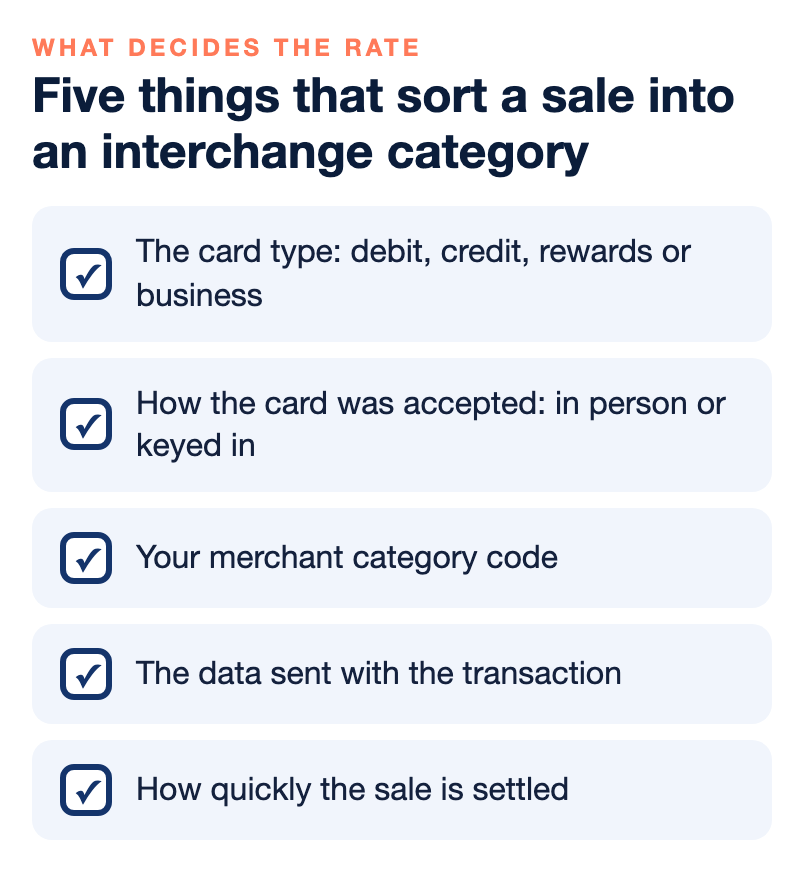
The schedules are not a single price. A transaction’s interchange depends on a combination of factors, and the networks use those factors to sort each sale into a category. The ones that matter most are:
- The card type. Debit, prepaid, standard credit, premium rewards credit and business or corporate cards each carry different rates.
- How the card was accepted. A chip or tap in person usually costs less than a card typed into a website, because the fraud risk is lower when the card is present.
- Your merchant category code. The code on your account tells the networks what kind of business you are, and some industries have their own programs.
- The data sent with the transaction. Address verification, order details and, for business cards, Level 2 and Level 3 data such as tax amounts and line items can move a sale into a lower category.
- Timing. How quickly the authorized transaction is settled can affect whether it qualifies for the best category.
That is why two sales of the same amount at the same store can carry very different interchange. Our guide to special interchange rates for Visa and Mastercard shows how certain industries, such as insurance, education, healthcare and real estate, can qualify for their own categories when their accounts are coded and configured correctly.
Why the networks set it and the issuers keep it
This is the part that surprises most business owners. Visa and Mastercard write the rate tables, but the interchange itself does not go to them. It flows to the issuing banks, which use it to fund the cost of credit, fraud losses and the rewards programs that make premium cards attractive to consumers. The networks earn their own money through the separate assessment fees.
That arrangement explains why interchange rarely falls on its own. A network competes for two customers at once. It wants banks to issue its cards, and banks prefer the network that pays them more interchange. It also wants merchants to accept its cards, and merchants prefer lower interchange. Because consumers choose cards and merchants rarely refuse a major brand, the pull toward the issuer side has tended to win, and premium rewards cards have become some of the most expensive cards to accept. Seen this way, interchange is less a price than a settlement between banks, set by the networks, that merchants pay.
Who has the power to change interchange
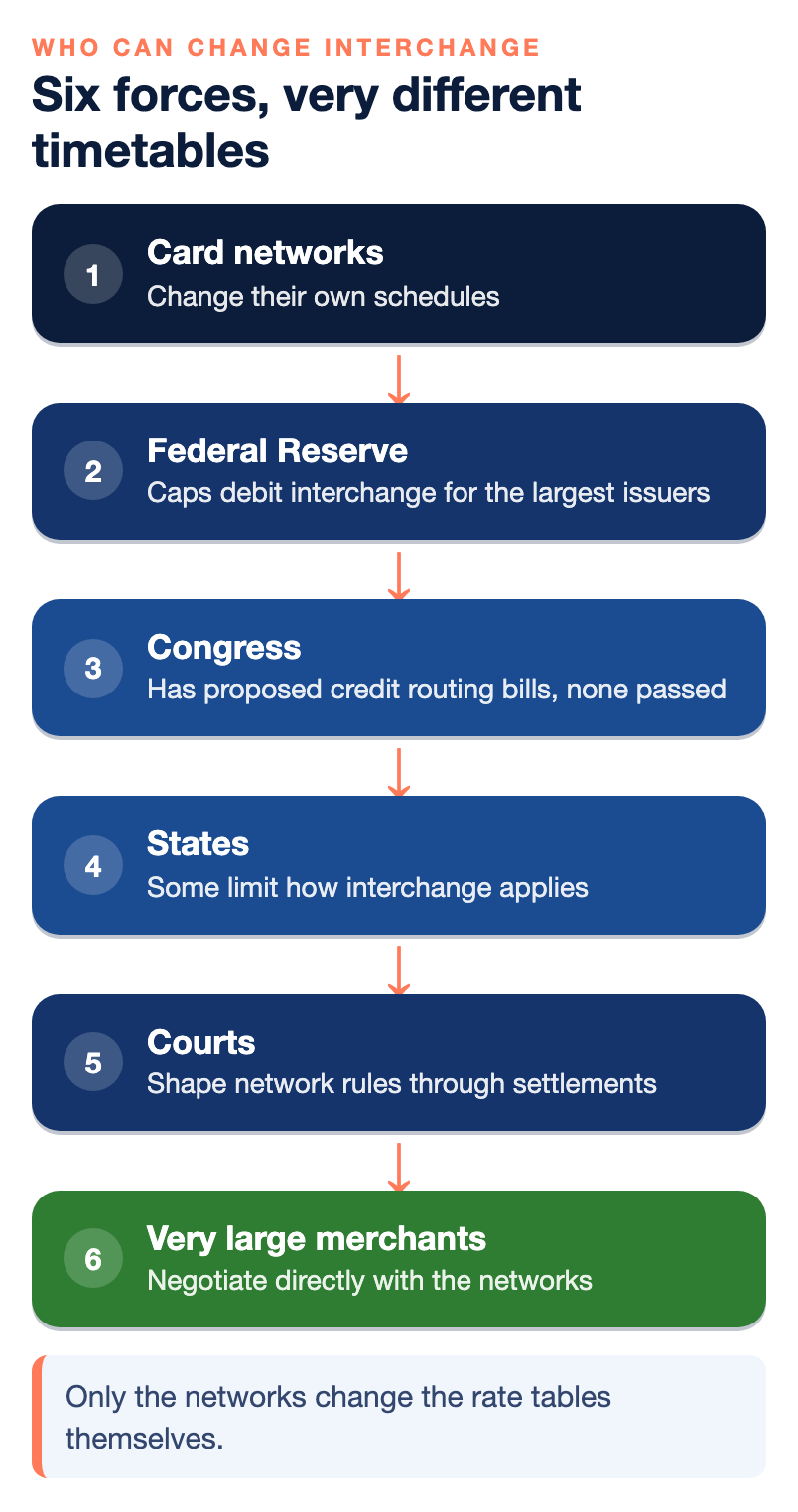
Several groups can move interchange, and they work on very different timetables. Knowing which one is in play tells you whether a headline about “swipe fees” will actually reach your statement.
1. The card networks
The networks can change their own schedules, and they do, adding categories, retiring others and adjusting rates. These changes reach your statement through your processor. On interchange-plus pricing you see them directly, because the interchange line moves. On flat-rate pricing you usually do not, because the processor absorbs the change inside one blended rate, at least until it decides to raise that rate.
2. Federal regulators, for debit cards
In the United States, the Durbin Amendment, part of the Dodd-Frank Act of 2010, directed the Federal Reserve to make debit card interchange reasonable and proportional to the issuer’s cost. The Federal Reserve did that through Regulation II, which caps debit interchange for the largest card issuers. Smaller banks and credit unions are exempt from the cap, so debit cards from those issuers can carry higher interchange than debit cards from the biggest banks. Regulation II also requires debit cards to work on at least two unaffiliated networks, which gives merchants, through their processors, a choice of how a debit transaction is routed. The Federal Reserve can revise the cap, and it has proposed changes in recent years, so check the current rule rather than relying on an older figure. Our article on the Durbin Amendment and card minimums covers what the same law allows merchants to do at the register.
3. Congress, for credit cards
Credit card interchange has no federal cap in the United States. Members of Congress have introduced bills over the years that would change how credit transactions are routed, most often by requiring large issuers to enable a second network on their credit cards, in the hope that competition between networks would push interchange down. Supporters and opponents argue about what such a law would do to costs and rewards. As of this writing, none of these proposals has become law, so treat any claim that credit interchange is about to fall because of federal legislation with care until a bill has actually passed.
4. State legislatures
States cannot set the networks’ rate tables, but some have tried to change how interchange is applied, for example by limiting interchange charged on the sales-tax or tip portion of a purchase. Laws like these have been challenged in court by banks and card networks, and their timing and reach have shifted as the cases proceed. If you operate in a state that has passed one, ask your processor how and when it will be applied to your transactions, and do not assume it applies until your processor confirms it.
5. The courts
Merchants have sued the card networks and large banks over interchange and network rules for decades, and the resulting class-action settlements have changed the rules merchants operate under. Earlier settlements are part of why surcharging on credit cards became permitted under network rules, within limits. Proposed settlements in these cases have sometimes been rejected by the court and renegotiated, so the outcome of any pending case is uncertain until it is final. Settlements tend to change rules and give merchants payments or options, rather than rewriting the rate tables overnight.
6. Very large merchants
The largest retailers have the volume to negotiate directly with the networks and sometimes reach their own agreements. For a small or mid-sized business, that door is effectively closed. Your bargaining power sits with your processor, not with the network.
What your processor does and does not control
A lot of frustration with processing fees comes from blaming the wrong party. Your processor does not set interchange, cannot waive it and does not keep it. What your processor does control is everything around it, and that can be worth a great deal.
| Part of your cost | Who sets it | Can you change it? |
|---|---|---|
| Interchange | The card networks, paid to the issuing bank | Not the rate, but you can change which category your sales qualify for. |
| Card-brand assessments | The card networks | No. Every processor passes them on. |
| Processor markup | Your processor | Yes. This is the part you negotiate. |
| Monthly, gateway and other fees | Your processor or platform | Yes. Ask for them itemized and in writing. |
| Debit routing | Your processor, within network rules | Ask how your debit transactions are routed. |
What a merchant can actually influence
You cannot rewrite the rate tables, and waiting for Congress or the courts is not a plan. Here is where your effort pays off.
Make sure your account is coded correctly
Your merchant category code decides which programs your transactions can reach. An insurance agency, school or property manager coded as generic retail or e-commerce can miss categories it would otherwise qualify for. Ask your processor what code your account carries and whether a more accurate one exists for what you actually do.
Send the data the networks ask for
For card-not-present sales, use address verification and the security code. If you sell to other businesses, ask whether your gateway can pass Level 2 and Level 3 data, such as tax amounts, purchase order numbers and line items, which can move business-card transactions into lower categories. Our guide to Level 2 and Level 3 processing explains which sales qualify and what the data looks like.
Settle promptly and take cards the cheaper way when you can
Close your batches on time, because transactions that settle late can fall out of their best category. Where your business allows it, accepting cards in person with chip or tap costs less than keying in card numbers.
Choose a pricing model that lets savings reach you
On a flat-rate plan, one percentage covers everything, so a sale that qualifies for a lower interchange category does not lower your cost, and the processor keeps the difference. On interchange-plus, you pay the actual interchange and assessments plus a fixed markup, so qualification improvements and lower debit interchange show up on your statement. Flat-rate can still be the simpler choice for a small or new business with low volume. Our comparison of merchant account pricing models walks through when each one tends to make sense.
Use card-acceptance rules that are allowed
Network rules and some state laws let merchants offer dual pricing, apply a compliant surcharge to credit cards or encourage bank payments such as ACH for large invoices. Each has rules, and some states restrict them, so confirm what applies to you before you change how you charge.
Compare markup, not headlines
When you compare processors, the interchange and assessments will be essentially the same for the same transactions. What differs is the markup and the fees. Ask for a written, itemized quote against your real statements, and if you are comparing providers more broadly, our overview of the best payment processing providers for businesses explains how to read quotes side by side.
Where NPS fits, and where it does not
We offer interchange pass-through, or interchange-plus, pricing, so qualified savings such as lower debit interchange can reach the merchant directly rather than disappearing inside a blended rate. We review how accounts are coded and configured, help business-to-business merchants pass Level 2 and Level 3 data through our NPSONE gateway and ClickBillR invoicing, and set up compliant dual pricing, surcharging and ACH options. Accounts come with live, U.S.-based support around the clock and a dedicated account manager.
Here is where we may not be the right choice:
- You process very little each month. For hobby sellers and very low volume, a simple flat-rate app may cost less in time and attention.
- You want one number and never want to read a statement. Interchange-plus is more transparent, but it is also more detailed.
- You are choosing only on the lowest advertised rate. We price each merchant individually and do not publish one universal rate.
- You expect a processor to lower interchange itself. No processor can. We can only help your transactions qualify and keep the markup visible.
Next step
Interchange is set by the networks, kept by the issuers and limited by law only in narrow places. You will not change the rate table, but you can change which categories your sales land in, which pricing model you are on and how much markup you accept.
If you want us to read a recent statement and show you where your costs come from, you can talk with our team. For more on how fees and pricing work, browse our payments guides. If your business is better served by a simple flat-rate plan, we will tell you.
Frequently asked questions
Who sets interchange fees?
The card networks, mainly Visa and Mastercard, set interchange by publishing rate schedules with many categories. Discover runs its own schedule, and American Express sets its merchant fees more directly. Your processor does not set interchange.
Who receives the interchange fee?
The bank that issued your customer’s card. The acquiring side of the transaction pays it to the issuer, which uses it to cover the cost of credit, fraud and rewards. The networks earn their own money through separate assessment fees.
Does the government regulate interchange fees?
In the United States, only partly. The Federal Reserve caps debit card interchange for the largest issuers under Regulation II, which came from the Durbin Amendment. Credit card interchange has no federal cap.
Can my processor lower my interchange rate?
No processor can change the networks’ rates. A processor can help your transactions qualify for lower categories through correct coding, the right transaction data and prompt settlement. It controls its own markup and fees, which is the part you can negotiate.
Will the Credit Card Competition Act lower my fees?
It has not become law as of this writing. Bills like it would require large issuers to enable a second network on credit cards, and supporters expect that competition to reduce interchange. Check its current status before you plan around it.
Why are rewards cards more expensive to accept?
Premium rewards and business cards usually sit in higher interchange categories. The issuer uses that interchange to help pay for the rewards. That is why your effective rate can rise when more of your customers pay with premium cards.
How do I pay less interchange?
Make sure your account is coded correctly, send address verification and, for business cards, Level 2 and Level 3 data, settle batches on time and take cards in person when you can. Then choose a pricing model, such as interchange-plus, that lets those savings reach you. Ask for a written, itemized quote to compare markup.





