AI Overview
Stripe Shut Me Down? High-Risk or Startup Merchant Survival Guide | Nationwide Payment Systems
The Ultimate High-Risk & Startup Merchant Survival Guide — And Why You Should Work With a Payments Advisor Like Nationwide Payment Systems
We’ve Heard This Story for 25 Years
Over the last two decades, dozens of business owners — including startups — have come to us saying:
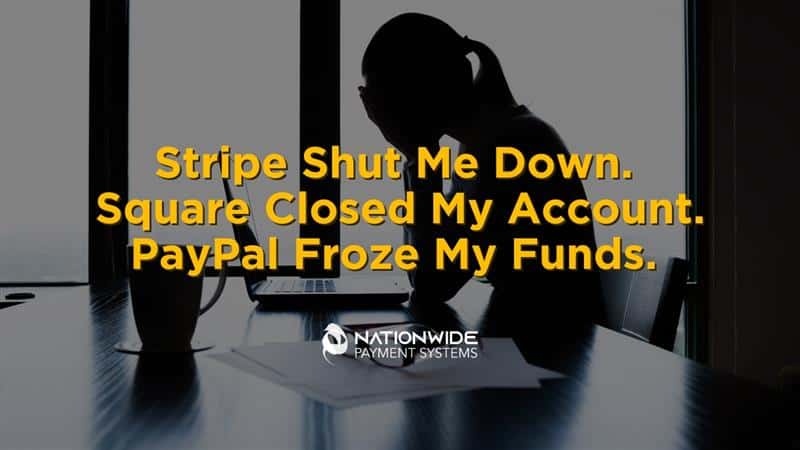
- “Stripe shut me off due to my business type.”
- “Square says I’m prohibited.”
- “PayPal froze my funds.”
- “QuickBooks terminated my account.”
- “I was debanked.”
- “I applied to 20+ merchant companies, and no one can get me approved.”
- “I was approved, processed for two weeks, and then got shut off.”
The pattern is consistent.
And it is rarely random.
sponsored by
Startups: Why You’re More Vulnerable Than You Think
Startups are especially at risk because:
- You need speed.
- You want instant approval.
- You choose the easiest onboarding platform.
- You haven’t built compliance infrastructure yet.
- You don’t fully understand how underwriting works.
Fintech platforms are built for speed — not complexity.
That works fine if you are:
- Selling T-shirts
- Running a simple SaaS
- Operating low-risk retail
It does not work well if you are:
- Launching a supplement brand
- Starting a telemedicine platform
- Building a subscription continuity model
- Selling digital health products
- Operating in regulated industries
Startups often get approved instantly — then shut down once real underwriting catches up.
The Truth: Most Merchants Aren’t Denied by the Bank
One of the biggest misconceptions in payments:
“The bank denied me.”
Often, what really happened:
- An ISO declined your file internally.
- A junior underwriter flagged your website.
- An automated risk model rejected your industry.
- Your compliance exposure looked unclear.
- Your business model wasn’t explained properly.
Banks make risk decisions based on clarity.
Fintech platforms make risk decisions based on automation.
There’s a difference.
Why Stripe, Square, PayPal & QuickBooks Shut Down Accounts
These platforms rely on:
- Automated risk scoring
- Prohibited industry lists.
- Pattern recognition
- Minimal manual review
- After-the-fact risk audits
Common shutdown triggers include:
Business Type Restrictions
Supplements
Peptides
CBD
Telemedicine
GLP-1 programs
ED medications
Testosterone therapy
Subscription continuity
Digital coaching
Compliance Issues
FDA-sensitive claims
FTC marketing exposure
Before-and-after claims
Unsubstantiated health promises.
Website Structure Problems
No clear refund policy
Hidden recurring billing
Poor cancellation process
Missing contact information
No age verification
Improper geo-fencing.
AML (Anti-Money Laundering) Flags
Improper money movement
Revenue splitting
Marketplace-style structures
Handling funds for third parties
Startups often overlook AML structuring early — and that can trigger immediate shutdown.
AML: The Mistake That Gets Many Startups Shut Down
AML laws exist to prevent:
- Money laundering
- Fraud
- Layered payments.
- Illicit transfers
If your startup model involves:
- Acting as intermediary
- Facilitating payments
- Splitting funds
- Managing funds for others
- Marketplace structures
You must structure this legally.
You should never “move money” informally.
There are compliant models to do this — but they must be implemented correctly from day one.
The Hidden Problem: No Real Underwriting
Many startups get:
- Instant approval
- No deep compliance review
- No conversation about risk
- No structured underwriting
Then:
Shutdown.
Because risk review happened after onboarding.
Real underwriting should happen before you go live.
Not after revenue begins.
Compliance Is Industry-Specific
Each vertical carries unique compliance triggers.
Supplements & Nutraceuticals
FDA claim scrutiny
Recurring billing clarity
Refund transparency
Telemedicine & Online Pharmacies
Provider licensing
Prescription verification
HIPAA compliance
Legit Script certification
GLP-1, ED Meds, Testosterone, Medical Peptides
Regulatory oversight
Subscription disclosure
Medical disclaimers
Digital & Coaching
Delivery proof
Refund clarity
Marketing compliance
A generic processor does not evaluate these nuances.
A payments advisor does.
Telemedicine & Legit Script: Critical for Startups in Healthcare
If you are launching a telehealth platform or selling prescription medications online — including:
- GLP-1 weight management programs
- ED medications
- Testosterone therapy
- Hormone replacement
- Prescription-based medical peptides
You are operating in a highly scrutinized category.
Legit Script certification is often required by acquiring banks.
Without it, approval is unlikely.
Nationwide Payment Systems helps startups and established telemedicine businesses:
- Prepare Legit Script documentation.
- Access discounted certification fees
- Align applications with bank expectations.
- Accelerate approval timelines.
Trying to “figure it out later” often leads to denial or termination.
High-Volume Merchants: You Deserve Executive-Level Review
If you are processing significant volume, you should not be:
- Submitting generic applications
- Waiting on automated systems
- Being evaluated by junior underwriters
On scale, underwriting must be strategic.
We arrange:
- Direct underwriting meetings
- Executive-level bank discussions
- Structured risk alignment calls
This avoids unnecessary shutdowns caused by lack of context.
Why Startups Should Work With a Payments Advisor From Day One
Choosing the wrong processor at launch can:
- Freeze your first revenue.
- Disrupt investor confidence.
- Damage brand reputation.
- Trigger compliance investigations.
- Create underwriting history issues.
Choosing the right advisor helps:
✔ Align your business model properly
✔ Structure billing correctly
✔ Prepare compliance documentation
✔ Match you with the right bank
✔ Avoid surprise shutdowns
Processing is infrastructure.
Not an afterthought.
Why Working With Nationwide Payment Systems Is Different
Nationwide Payment Systems has 25 years of experience powering payments.
We:
- Conduct full underwriting before submission.
- Review website compliance.
- Evaluating AML exposure
- Structure recurring billing properly.
- Align you with appropriate bank partners.
- Implement RDR where needed.
- Monitor chargeback ratios.
- Provide real phone support.
- Maintain direct bank relationships.
We are not onboarding merchants.
We are building stable payment infrastructure.
Relationship Over Automation
Mass fintech = email.
Strategic ISO-bank relationship = communication.
No bank wants to shut down a good merchant.
But banks will shut down unknown risk.
Open dialogue reduces unknown risk.
Processing should be a partnership.
Not a guessing game.
The Real Goal: Never Getting Shut Down Again
Whether you are:
- A startup founder launching your first product.
- A high-risk merchant scaling aggressively
- A high-volume operator expanding nationally.
The goal is not just approval.
The goal is stability.
That comes from:
- Compliance
- Proper underwriting
- AML structure
- Regulatory awareness
- Bank alignment
- Ongoing communication
CLICK HERE TO FIND MORE ABOUT OUR PROGRAMS