
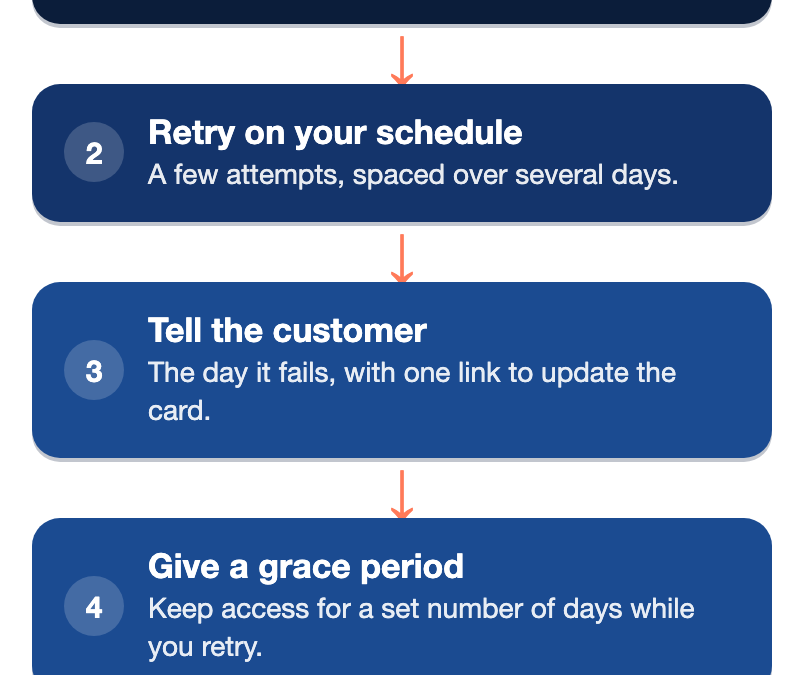
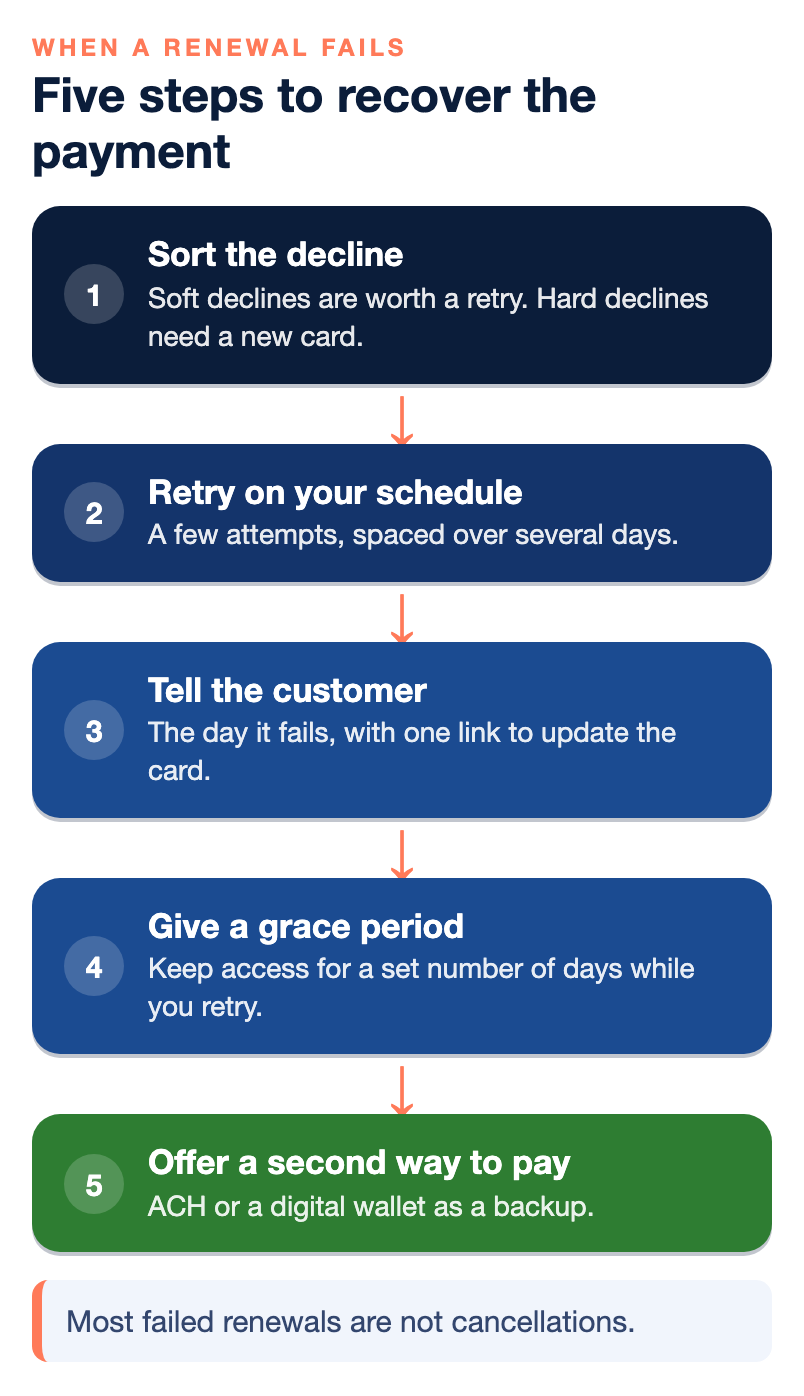
Failed payments kill subscription revenue silently because nobody decides to leave. A card expires, a bank flags a charge, a customer hits a limit for a day, and the subscription quietly stops paying while the customer still thinks they are a member. You stop that leak by treating failed payments as a written policy rather than a software default: sort declines into the ones worth retrying and the ones that are not, retry on a schedule you chose, keep stored cards current, tell customers before and after a problem, give them a short grace period, and offer a second way to pay. This guide walks through each piece, shows what to measure, and says when a small business should keep it simple.
The bottom line
- Most failed renewals are not cancellations. They are customers who still want what you sell and whose payment did not go through. Treat them as customers to recover, not as churn to report.
- Not every decline should be retried. A temporary decline is worth another attempt. A decline that says the card is closed, stolen or invalid is not, and retrying it can hurt you.
- The cheapest fix is the one before the failure. Keeping stored cards current and warning customers before a card expires saves more renewals than any retry schedule.
- Clarity prevents chargebacks. A clear descriptor, a reminder before each charge where it makes sense and an easy way to cancel keep a recovered payment from turning into a dispute.
- Measure it monthly. If you do not know how many renewals failed and how many you recovered, you do not know how much revenue is leaking.
Who wrote this, and what we will not claim
Nationwide Payment Systems (NPS) publishes this guide. We are a payment processing company in South Florida, in business since 2001, and we sell recurring billing and invoicing tools, so we are one of the options here and we are not neutral. We do not quote rates or recovery percentages, because they depend on your customers, your cards and your price point, and anyone who promises you a specific number before seeing your data is guessing. Card-network rules on stored cards and retries change, and processors apply them differently, so confirm the details with your own processor before you change your billing.
Why failed payments are the quiet kind of churn
Subscription businesses usually watch one kind of churn closely: the customer who clicks cancel. That loss is visible, it comes with a reason, and you can try to win the customer back. The other kind is harder to see. It happens when a renewal charge fails and nothing much happens next. The billing system tries again once or twice, the account lapses, and the customer, who never meant to leave, either drifts away or discovers months later that they are no longer a member. People in the subscription business call it involuntary churn, and in many businesses it runs alongside the voluntary kind without anyone owning it.
It stays hidden for three reasons. The failure happens at the bank, out of sight of your team. The default settings of many billing tools do something reasonable but generic, so no one ever made a decision about it. And the revenue does not disappear in one large loss. It leaks a few accounts at a time, every billing cycle, which makes it easy to file under normal attrition. If you run recurring billing at any real scale, the first step is to admit that failed payments are a process you can design, and then to design it.
If you are still choosing how to bill on a schedule in the first place, our overview of recurring payments for business covers the basics of setting up subscriptions, and this guide picks up where that one leaves off.
Step 1: Sort declines before you retry them
When a renewal charge fails, the card issuer sends back a response code that says, roughly, why. Those codes are the most useful information you have, and the most important thing you can do with them is sort them into two groups, because they call for opposite responses.
Soft declines: worth another attempt
A soft decline means the problem may be temporary. The account may not have enough available credit today, the issuer may want to check the charge, or the bank’s system may have had a problem. The card itself is still good, and the same charge can succeed later, sometimes a few days later when the customer has been paid or has paid down the card. These are the declines a retry schedule exists for.
Hard declines: stop and ask for a new payment method
A hard decline means the card will not work no matter how often you try. The account may be closed, the card may be reported lost or stolen, the number may be invalid or the card may have expired. Retrying a hard decline wastes attempts, and repeated attempts on a card the issuer has already refused can look like fraud from the bank’s side. Card networks also discourage merchants from retrying certain declines over and over, and some processors charge for excessive attempts. The right response to a hard decline is to stop charging that card and ask the customer for a new payment method.
Your processor’s code list is the authority on which codes fall where, because code tables differ by network and processor. Our guide to credit card error codes explains the common ones and what a merchant should do with each. Whatever system you use, make sure it does not treat every decline the same way. A billing tool that retries a stolen card on the same schedule as a card that was simply over its limit for a day is a tool that has not been configured.
| Type of decline | What it usually means | What to do |
|---|---|---|
| Soft decline | A temporary problem, such as not enough available credit or an issuer check. | Retry on your schedule and send the customer a notice. |
| Hard decline | The card will not work: closed, lost, stolen, invalid or expired. | Stop retrying and ask the customer for a new payment method. |
| Setup problem | A code that points to your account or terminal setup, not the card. | Call your processor before the next billing run. |
Step 2: Make retry timing a policy you chose
A retry schedule is a set of decisions: how many attempts, how far apart and at what time of the month. Write those decisions down rather than accepting whatever the software happens to do, because each one has a reason behind it.
- How many attempts. A few spaced attempts give a temporary problem time to clear without hammering the issuer. Endless retries do not recover more customers, and they invite the problems described above.
- How far apart. Attempts made minutes apart usually fail for the same reason. Spacing them over several days gives the customer’s account time to change.
- When in the cycle. Many customers have more room on their card shortly after payday. If your customers are businesses, their own billing and payment cycles may matter more than the calendar.
- When to stop. Decide the point at which the account moves from retrying to asking for a new card, and from there to pausing or ending access.
There is no universal right schedule, and we would be wary of anyone who sells one. A monthly software subscription, a quarterly service plan and an annual membership have different customers and different stakes. Start with a simple schedule, look at which attempts actually recover payments after a few months, and adjust.
Step 3: Keep stored cards current before they fail
The renewal that never fails costs nothing to recover. Two habits prevent a large share of failures before they happen.
Use a card updater service where it is available
When a bank reissues a card, because it expired, was replaced after a breach or moved to a new card number, the old card on file stops working. The card networks run updater services that let a merchant’s processor check stored cards against new card details issued by participating banks, so the stored card can be refreshed before the next charge. Not every bank takes part, availability depends on your processor and your account, and some services charge per update. Ask your processor whether updater services are available on your account, how they are turned on and what they cost. For a subscription business with many stored cards, it is one of the most valuable questions on the list.
Warn customers before a card expires
You know the expiration date of every card you store. A short, friendly notice a few weeks before a card expires, with a link to update the payment method, catches the customers an updater service misses. Write it the way you would want to be reminded: what is about to expire, when the next charge is and the one link that fixes it. It should not read like a collections letter.
Store tokens, never card numbers
Keep stored payment methods as tokens held by your gateway rather than card numbers in your own systems. Tokenization keeps sensitive card data out of your hands, which shrinks your security exposure, and it lets you charge the stored card for the next renewal without asking the customer to type it in again. Card-network rules also expect merchants to get the customer’s agreement before storing a card for future charges and to be clear about how it will be used, so put that consent and those terms into your sign-up flow. Ask your processor how it flags recurring charges on stored cards, because that flag tells the issuing bank the charge is part of an agreement the customer already made.
Step 4: Tell the customer, quickly and plainly
A failed payment the customer does not know about is a failed payment you will probably not recover. The notice that follows a failure matters as much as the retry that follows it.
- Send it right away. The first notice should go out the day the payment fails, not after the last retry.
- Make the fix one tap. Include a direct link to update the card or pay another way, ideally to a page that works well on a phone.
- Use more than one channel. Email is the default, but a text message often gets read faster. Use the channels your customers agreed to.
- Keep the tone helpful. Most of these customers did nothing wrong. Say what happened, what they need to do and what will happen if they do nothing.
- Follow up on your schedule. Pair each retry with a reminder, and send a final notice before access changes.
Payment links make this practical, because the customer can pay from the message itself without logging in to anything. We explain how that works for subscription and membership businesses in our guide to payment links and smart invoicing for subscription businesses.
Step 5: Set a grace period and clear access rules
Decide in advance what a customer keeps while a payment is being recovered. Cutting off access the moment a card fails punishes loyal customers for a bank problem and often turns a recoverable account into a lost one. Leaving access open forever gives away the product. The middle ground is a grace period: a set number of days during which the customer keeps the service while you retry and remind, followed by a clear next step.
What comes after the grace period depends on what you sell. Software and memberships can often move to a paused or limited state, so the customer’s history and settings are waiting when they pay. Physical shipments usually stop until payment is resolved. Services delivered on a schedule may need a hold on the next appointment. Whatever you choose, tell the customer in the notice exactly what changes and when, and make reactivation as easy as updating a card. A customer who comes back in a week is a recovered customer, so do not make them sign up again from scratch.
Step 6: Offer a second way to pay
A subscription that depends on a single card has a single point of failure. Offering another payment method gives customers, and especially business customers, a way to stay current when a card is the problem.
ACH, which pulls the payment from a bank account, is the most common backup for recurring billing. Bank accounts change less often than cards, so an ACH payment method on file tends to stay valid longer, and many business customers already prefer to pay invoices by bank transfer. ACH has its own rules and timing. Payments take longer to settle than card payments, returns can arrive days after the payment, and you need the customer’s authorization in the form the ACH rules require, so ask your processor how authorizations, returns and retries work for ACH before you rely on it. Digital wallets such as Apple Pay and Google Pay can also help at checkout and on the update page, because the customer does not have to find and type a card.
The aim is not to push everyone off cards. It is to make sure a customer who cannot pay one way is offered another before the account lapses.
Step 7: Recover payments without creating chargebacks
Recovering a failed payment is only a win if it stays recovered. A customer who sees an unexpected charge, a name they do not recognize or a subscription they thought was over may go straight to their bank and dispute it. A dispute costs you the payment, adds fees and counts against your account, and too many of them can put your merchant account itself at risk.
- Use a billing descriptor customers recognize. The name on the card statement should match the brand they signed up with, ideally with a way to reach you.
- Remind before charges where it makes sense. An annual renewal or a price change deserves a notice before the charge, not after.
- Make cancellation easy. A customer who cannot find the cancel button often calls the bank instead. Several states and federal regulators have rules about how subscriptions are sold and canceled, and those rules change, so check the current ones for where you sell. Our article on subscription cancellation laws covers this in more depth.
- Refund quickly when you are wrong. If a retry charged someone who had already canceled, refund it before they have to ask their bank.
Our guide to chargebacks for e-commerce businesses explains how disputes work and how to keep them down.
Step 8: Measure the leak every month
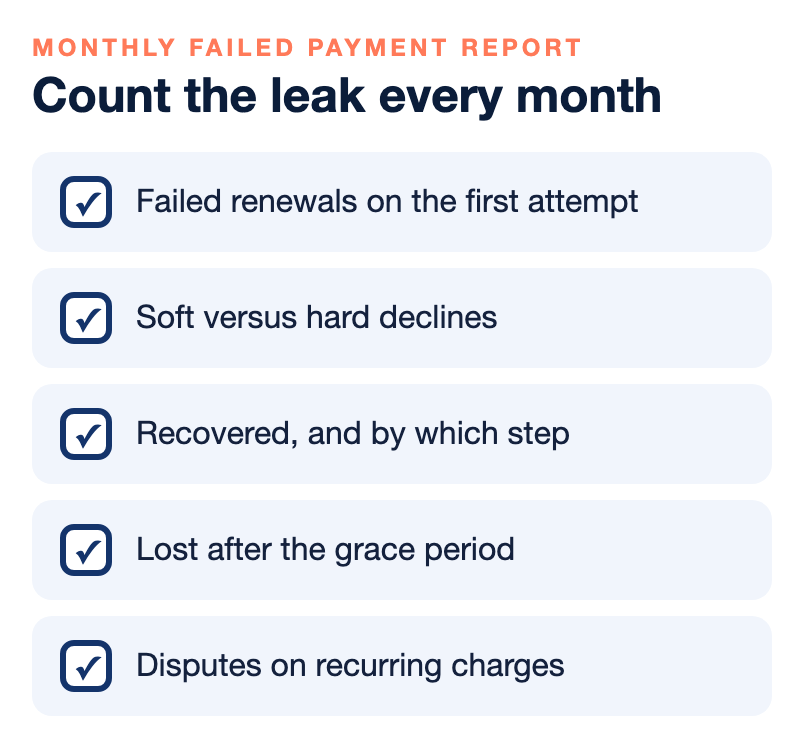
You cannot manage involuntary churn you do not count. A short monthly report is enough for most businesses:
- Failed renewals. How many recurring charges failed on the first attempt.
- Soft versus hard. How the failures split between declines worth retrying and declines that need a new card.
- Recovered. How many failed renewals were eventually paid, and by which step: a retry, a card update, a notice or a second payment method.
- Lost. How many accounts lapsed after the grace period, and the recurring revenue they represented.
- Disputes on recurring charges. How many recurring charges turned into chargebacks, and why.
Watch the trend rather than any single month. If recovered payments rise after you start sending notices before cards expire, keep doing it. If one retry attempt almost never succeeds, drop it. The point of measuring is to let your own customers tell you what works.
Who should not overbuild this
Everything above scales down. A small business with a few dozen recurring customers does not need a dedicated recovery platform, a data team or a complex retry formula. For that business, the whole system can be a sensible retry setting, a notice when a payment fails, a reminder before a card expires and a personal phone call to any customer whose payment is still failing after a week. At that size, the call often works better than any automation.
The time to invest more is when failed renewals are frequent enough that nobody can follow up by hand, when the revenue at stake each month is worth real attention, or when disputes on recurring charges start to climb. Before you buy another tool, make sure the basics are switched on in the one you have.
Where NPS fits, and where it does not
Our NPSONE gateway and ClickBillR smart invoicing support recurring transactions and subscriptions on weekly, monthly, quarterly or annual cycles, scheduled payments, payment links, card and ACH payments, and digital wallets such as Apple Pay and Google Pay. Stored payment methods are kept through tokenization, so card data is never visible to the merchant, and payment notifications can go out by email, in-app alerts and SMS. For businesses that run billing from their own software, NPSONE offers API connectivity and webhooks. Accounts come with live, U.S.-based support around the clock and a dedicated account manager, which matters when a billing run fails at an awkward hour. Ask us which updater and retry options are available on your account before you sign, and get the answer in writing.
Here is where we may not be the right choice:
- You want a dedicated subscription analytics platform. If your main need is deep churn analytics and automated experimentation, a specialist billing platform may suit you better, and you can still process payments through a merchant account.
- You have only a handful of recurring customers. A simple setup and a phone call may be all you need.
- You are choosing only on the lowest advertised rate. We price each merchant individually and do not publish one universal rate.
If you are comparing providers more broadly, our overview of the best payment processing providers for businesses explains how to compare them side by side.
Next step
Pull last month’s failed renewals and sort them into soft and hard declines. Then check four settings in your billing tool: whether it treats the two groups differently, how many retries it makes and how far apart, whether customers get a notice the day a payment fails, and whether they are warned before a card expires. Those four answers will tell you how much of your revenue is leaking and where.
If you want a second opinion on your recurring billing setup or a processing statement, you can talk with our team. For more on how payments work, browse our payments guides.
Frequently asked questions
What is involuntary churn in a subscription business?
It is revenue lost when a customer’s recurring payment fails and the subscription lapses even though the customer did not choose to cancel. Expired cards, temporary declines and reissued cards are common causes. It is often recoverable if you retry sensibly, tell the customer and make it easy to update the payment method.
What is the difference between a soft decline and a hard decline?
A soft decline means a temporary problem, such as not enough available credit or an issuer check, so the same charge may succeed later. A hard decline means the card will not work, for example because it is closed, lost, stolen, invalid or expired. Retry soft declines on a schedule and ask for a new payment method after a hard decline.
How many times should I retry a failed subscription payment?
There is no single right number. A few attempts spaced over several days give a temporary problem time to clear, while endless retries rarely recover more and can trigger fraud flags or processor fees. Start simple, track which attempts actually recover payments, and adjust.
What is a card updater service?
It is a service run by the card networks that lets your processor refresh stored cards when a bank issues new card details, so the next charge does not fail. Not every bank takes part, and availability and cost depend on your processor and account. Ask your processor whether it is available to you.
Should I cut off access as soon as a payment fails?
Usually not. A short grace period, during which you retry and remind the customer, recovers many accounts that would be lost if access stopped right away. Decide in advance what happens after the grace period, tell the customer, and make reactivation easy.
Can ACH help with failed subscription payments?
Yes, as a second payment method. Bank accounts change less often than cards, and many business customers prefer to pay by bank transfer. ACH has its own authorization rules, settlement timing and returns, so ask your processor how they work before you rely on it.
How do I keep recovered payments from turning into chargebacks?
Use a billing descriptor customers recognize, remind them before annual renewals or price changes, and make cancellation easy. If a retry charges someone who already canceled, refund it quickly. Customers who can reach you easily are less likely to dispute a charge with their bank.





