
A referral partner program lets an accounting or bookkeeping firm introduce clients to a payment provider and receive an ongoing share of what the provider earns on those accounts. For many firms it is a sensible fit, because you already see your clients’ processing fees, reconciliation problems and slow-paying customers every month. It only works, though, if the program is clear about how you are paid, if your professional rules allow the fee, and if you tell clients about it before they decide. This guide walks through how these programs actually work, the questions to ask before you join one, how to handle disclosure, how to raise it with clients, and which firms are better off not joining at all.
The bottom line
- Join only if the recommendation would stand on its own. If you would suggest the switch with no fee attached, a referral program can be a fair way to be paid for work you are already doing. If the fee is the main reason, do not join.
- Check your rules before you sign anything. CPA firms in particular should read their state board’s rules and their professional code on commissions and referral fees, because the answer can depend on what other services you provide to that client.
- Disclose in writing, every time. Tell the client you may receive compensation, before they decide, and keep a record that you did.
- Read the partner agreement like a contract, because it is one. How residuals are calculated, when they stop, and whether the provider can change them matter more than the headline offer.
- Stay involved after the introduction. The firms that get the most from these programs check the first statements and the bookkeeping sync themselves, so the client sees the result.
Who wrote this, and what we will not claim
Nationwide Payment Systems (NPS) publishes this guide, and we run a partner program for accountants, CPAs, bookkeepers and QuickBooks ProAdvisors, so we are not neutral here. We have been in payments since 2001. We will not quote residual percentages, bonuses or fees in this article, because program terms change and the only version that counts is the one in your signed agreement. We also cannot tell you what your professional rules allow. We can tell you what to look for and what to ask, including of us.
Nothing here is legal, tax or ethics advice. Rules on commissions and referral fees come from state boards of accountancy, professional bodies and sometimes state law, and they differ from place to place. If you are unsure, ask your state board, your professional association or your own counsel before you accept any fee.
How a payments referral program works
Every business that takes cards or bank payments pays for that service, usually through a combination of card network costs and the provider’s own markup and fees. When a provider signs a new merchant, part of what it earns on that account each month can be shared with whoever brought the account in. That share is usually called a residual, because it keeps arriving for as long as the account stays active, rather than being paid once at signup.
In a referral arrangement, your role is the introduction. You identify a client who might benefit, pass along the contact details with the client’s permission, and the provider does the rest: the sales conversation, the application, underwriting, setup and support. That is different from an agent or reseller arrangement, where the partner sells the service, handles more of the process and often carries more responsibility for the account. Neither model is wrong, but they come with different workloads, different paperwork and sometimes different rules for your firm, so be sure you know which one you are signing.
The path a referral takes
Most programs follow the same basic path, even if the names of the steps change.
- You join the program. You sign a partner agreement and give the provider your details so it can track your referrals and pay you.
- You learn the product. A good provider shows you the platform before you recommend it, so you can answer client questions and know what you are putting your name behind.
- You introduce a client. With the client’s permission, you submit the business and owner details and a short note on what the client needs.
- The provider underwrites the business. The client applies, and the provider and its bank decide whether to approve the account. Not every referral is approved.
- The client goes live, and residuals begin. Your share is calculated on the active account and paid on a regular schedule, usually monthly, for as long as the program terms say.
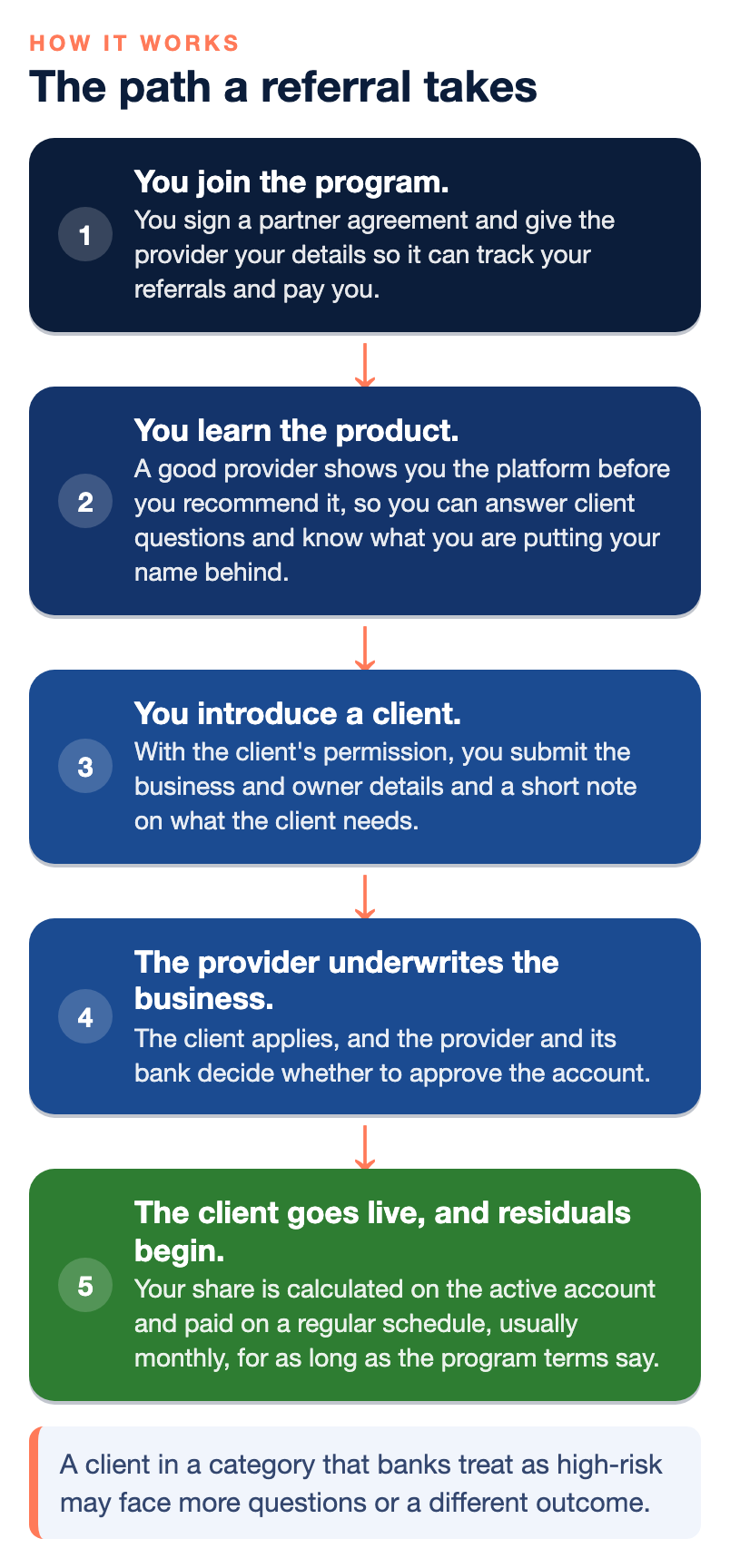
That fourth step is easy to forget. A referral is not a sale you control. The provider still has to approve the business, and a client in a category that banks treat as high-risk may face more questions or a different outcome. Set that expectation with the client up front so nobody feels let down if the answer takes longer than they hoped.
What a residual is actually a share of
This is the single most important detail in any program, and the one most often left vague. A residual can be a share of the provider’s gross revenue on the account, or of its net revenue after card network costs and its own expenses, or a fixed amount per account. Two programs that advertise the same headline share can pay very different amounts depending on which of those numbers the share applies to. Ask the provider to define it in writing, with a sample residual report, before you sign.
It also pays to understand what your clients are paying, because the two are connected. A provider that earns more from your client has more to share with you, which is exactly why the recommendation has to stand on its own merits. Our guide to what a merchant account is explains the basic pieces of what a business pays to accept cards, and the same pieces show up, in some form, on every residual report.
Questions to ask before you join any program
A partner agreement is usually short, friendly and easy to sign. Read it slowly anyway. These are the questions that separate a program you can live with for years from one that will cause problems later.
- What exactly is my share calculated on? Gross revenue, net revenue or a flat amount per account, and which costs come out first.
- How long do residuals last? For the life of the account, for a fixed period, or only while I stay active in the program.
- Can the terms change? Whether the provider can change the split, the bonuses or the eligibility rules, and how much notice I get.
- Are my residuals vested? What happens to payments on accounts I already referred if I stop referring, close my firm or sell my practice.
- Is there a clawback? Whether anything is taken back if a client leaves early or has chargebacks.
- Are there minimums or quotas? Whether I have to refer a certain number of accounts to keep earning or to stay in the program.
- How will I see what I am paid? What the monthly residual report shows, per account, and how disputes about it are handled.
- Who supports my client? Whether my client gets a named contact, and how fast problems get answered.
- What are my client’s terms? Whether the client signs a long contract, whether there is an early termination fee, and how pricing is shown on their statements.
Our own program page lists how we answer several of these, including the fact that there is no quota to hit and no tiered structure, and that partners earn every month a referred client stays active. You can read the details in our overview of the NPS One partner program for accountants, CPAs and QuickBooks pros, and you should still ask for the current terms in writing, from us or anyone else.
Read the residual report before the first check arrives
Residual reports are where small errors live. An account that was never set up correctly in the provider’s system, a billing platform change that drops a few merchants, or a revenue column that shows zero when it should not can each mean you are paid less than you are owed, and you will only find it if you look. Ask to see a sample report before you join, and once you are in, compare each month’s report against your deposits and your list of referred clients. Our article on reading your residual report is written for payments salespeople, but its checklist works just as well for an accounting firm.
Disclosure, ethics and client trust
Your clients pay you for objective advice. The moment you are paid by someone else for a recommendation, that objectivity is a fair question, and the way you answer it decides whether the program helps or hurts your practice. This is where accounting and bookkeeping firms need to be more careful than most referral partners.
What the rules generally cover
For CPAs, professional codes of conduct generally treat commissions and referral fees as a question of disclosure and independence. In broad terms, a firm that receives a fee for recommending a product or service is generally expected to tell the client about it, and some rules prohibit commissions entirely where the firm performs audit, review or certain other attest work for that same client. State boards of accountancy can set their own rules, which may be stricter than the national code, and some states have specific requirements on how a disclosure must be made. Bookkeepers, enrolled agents and other advisors who are not CPAs may answer to different bodies with their own standards, or to none at all, but the client’s trust works the same way either way.
We are not going to tell you what your rules say, because they depend on your license, your state and the services you provide to each client. Before you join any program, look up your state board’s current rules on commissions and referral fees, check your professional association’s code, and keep a copy of what you found. If any of your clients receive attest services from your firm, assume those relationships need extra care until you have confirmed otherwise.
A disclosure that actually protects you
A good disclosure is short, plain and given before the client decides. It names the provider, says that your firm may receive compensation if the client signs up, and makes clear the client is free to choose any provider or none. Put it in writing, in an email or in your engagement letter, and keep a copy in the client file. If the client asks how much you receive, answer honestly. A client who hears about the fee from you, up front, rarely minds. A client who discovers it later almost always does.
It also helps to separate the advice from the referral. Show the client their current costs and the problems you see, explain what a better setup would look like in general terms, and then mention the provider you know as one option. If the client would be better served by staying where they are, say so. That answer costs you a referral and earns you something more valuable.
How to bring it up with clients
The best referrals do not start with a pitch. They start with something you already noticed in the books. Payments touch your work in several places, and each one is a natural opening.
- Processing fees on the statements. You see what clients pay every month. If a client is on flat-rate pricing and runs a lot of debit cards, or processes large business-to-business invoices, the fee line may be worth a closer look.
- Reconciliation work. If you are matching payments from a gateway, a separate invoicing tool and the accounting file every month, a setup that syncs payments with QuickBooks Online can cut that work for you and for the client.
- Slow collections. A client who rebuilds the same invoices every month and chases the same customers may benefit from recurring billing, autopay and payment reminders.
- Software seats. Some clients pay for extra accounting software users only so their staff can send invoices. An invoicing tool with its own users can sometimes reduce that cost.
Our article for QuickBooks advisors and CPAs goes further into these conversations, including ACH for large invoices and the extra card data that can matter on business-to-business sales.
A simple way to run the conversation
Start by asking for two or three recent processing statements. Review them together, or have the provider review them, and get any comparison in writing, itemized, so the client can see the provider’s pricing next to what they pay today. Our list of 12 questions to ask a credit card processor is a useful handout for the client at this stage. Check the client’s current contract for an early termination fee before anyone talks about switching dates. Give your written disclosure. Then let the client decide, and if they go ahead, stay close to the setup: confirm that the bookkeeping sync is mapped the way you want it, and look at the first two statements yourself. That last step is what turns a referral into a result the client credits to you.
Which clients are a good fit, and which are not
The clients who gain the most from a payments review are usually the ones with a lot of invoicing and a lot of manual work around it: professional services firms, contractors and trades, medical and dental offices, property managers, wholesalers and distributors, nonprofits that take donations, and any business that bills the same customers every month. They tend to feel the change in their cash flow and in their bookkeeping, and you will feel it in yours.
Be more cautious with a client who processes very little, because the savings may not justify the change. Be careful with a client locked into a contract with a meaningful termination fee, until you know the numbers. And with a client in a category that banks treat as high-risk, set expectations about underwriting before you make the introduction, because approval is the provider’s and the bank’s decision, not yours.
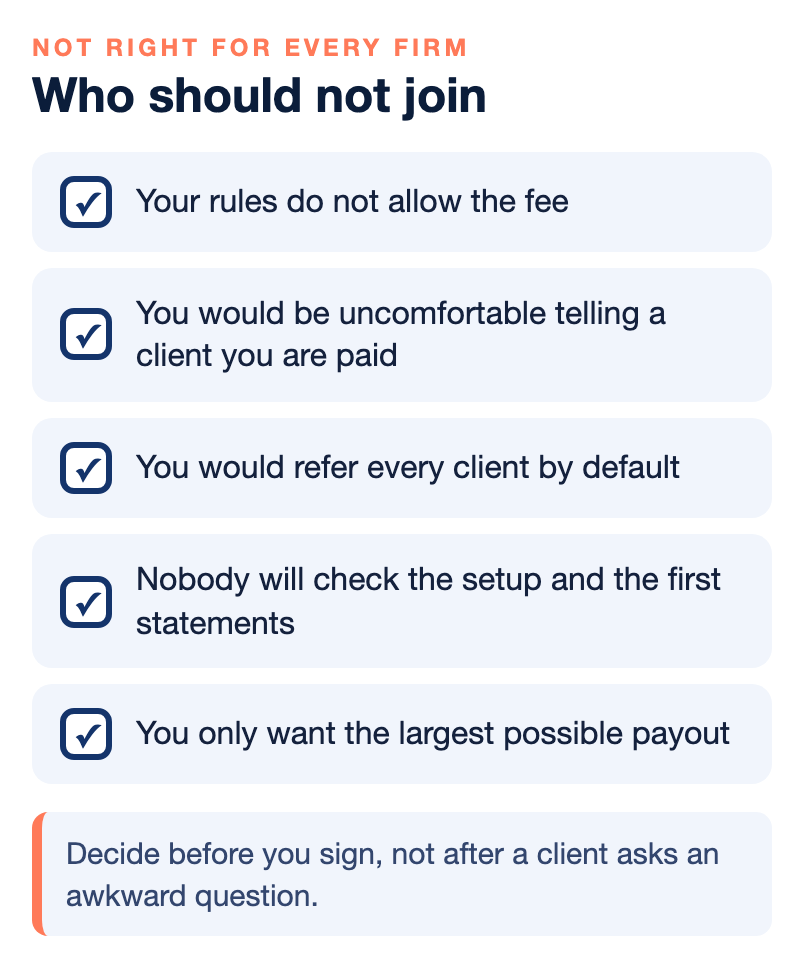
Who should not join a referral program
A referral program is not right for every firm, and it is better to decide that before you sign than after a client asks an awkward question.
- Firms whose rules do not allow the fee. If your state board or professional code prohibits the commission for some or all of your clients, the program is not worth the risk for those clients, whatever the provider says.
- Firms that do not want to disclose. If you would be uncomfortable telling a client you are paid for the referral, that discomfort is the answer.
- Firms that would refer every client by default. A referral program works when you recommend it where it fits. If you would send everyone, the advice stops being advice.
- Firms with no time to follow through. If nobody at the firm will check the setup and the first statements, the client’s experience depends entirely on the provider, and your name is still on it.
- Firms that only want the largest possible payout. A higher share from a provider that serves clients badly is a poor trade, because the client relationship is worth more than any residual.
Where NPS fits, and where it does not
Our partner program is built for accountants, CPAs, bookkeepers, QuickBooks ProAdvisors and business consultants whose clients invoice customers and collect payments. Partners join through the partner program page on our site, and we offer a short demo first so you know what you are recommending. You submit a referral with the client’s details and a note on what they need, and our team takes the conversation from there, so you do not have to manage the sales process unless you want to. There is no quota to start earning and no cap on referrals, and residuals continue every month a referred client stays active. Bonus details and current terms are given when you join, and you should get them in writing.
For your clients, our NPS One platform combines card, ACH and digital wallet payments with smart invoicing, recurring billing and autopay, a branded customer portal, and a two-way sync with QuickBooks Online that keeps customers, invoices and items current in both systems. Invoices and payment links carry the client’s own branding, and staff can be given access to invoicing without needing an accounting software seat. Accounts come with live, U.S.-based support around the clock and a dedicated account manager. If you want the longer argument for why ongoing residuals can matter to a firm, our article on residual income for accountants makes it.
Here is where we may not be the right partner for your firm:
- Your clients mostly do not invoice. NPS One is built around invoicing and recurring billing, so a client base of very small, cash-heavy or low-volume businesses may see little benefit.
- Your clients are not on QuickBooks Online. The sync is one of the main reasons firms recommend it. Clients on other accounting software should confirm what connects before they switch.
- Your rules prohibit the fee. If your professional rules bar commissions for a client, do not refer that client through the program, and talk to us about whether a plain introduction makes sense instead.
- You want a one-time payout and nothing else. Our program is built around ongoing residuals rather than a single signup bonus.
Next step
Before you join any referral program, ours included, do three things: confirm what your professional rules allow, get the partner agreement and a sample residual report in writing, and decide how you will disclose the fee to clients. If all three check out, a referral program can pay you fairly for advice you are already giving.
If you would like a walkthrough of how our partner program and platform work, or want to send us a client’s processing statement for a second opinion, you can talk with our team. For more on fees, invoicing and processing, browse our payments guides.
Frequently asked questions
What is a referral partner program for accounting firms?
It is an arrangement where a payment provider pays an accounting or bookkeeping firm for introducing clients who become customers. The firm makes the introduction, and the provider handles the sale, underwriting, setup and support. Payment is often an ongoing residual based on the referred accounts.
Can CPAs accept referral fees or commissions?
It depends on your state board’s rules, your professional code and the services you provide to that client. In general, CPAs are expected to disclose referral fees and commissions, and some rules prohibit commissions where the firm performs audit, review or other attest work for the client. Check your state board’s current rules before you accept any fee.
How should I disclose a referral fee to a client?
In writing, before the client decides. Name the provider, say your firm may receive compensation if the client signs up, and make clear the client is free to choose any provider or none. Keep a copy in the client file and answer honestly if the client asks for details.
What is the difference between a referral partner and an agent?
A referral partner makes the introduction and the provider does the rest. An agent or reseller usually sells the service, handles more of the process and carries more responsibility for the account. The paperwork, the workload and sometimes the professional rules differ, so confirm which one you are signing.
How are residuals usually calculated?
It varies by program. A residual can be a share of the provider’s gross revenue on an account, a share of its net revenue after costs, or a fixed amount. Ask for the definition and a sample residual report in writing before you join.
Do my clients pay more if I refer them through a partner program?
They should not, and you should check. Ask the provider for an itemized written quote and compare it with the client’s current statements before the client decides. If the client would be better off staying where they are, tell them.
What happens to my residuals if I leave the program or sell my practice?
That depends on whether your residuals are vested and on what the partner agreement says about transfers. Some programs keep paying on existing accounts, and others stop. Get the answer in writing before you refer your first client.
Does a referred client have to be approved?
Yes. The client still applies, and the provider and its bank decide whether to approve the account. Businesses in categories that banks treat as high-risk may face more questions, so set expectations before you make the introduction.





