
An acquirer reads a merchant application by asking one question underneath all the others: if this business stopped operating tomorrow, how much money could the bank be left owing to cardholders, and how likely is that? Every variable on the application, from average ticket and delivery time to chargeback history and the website, feeds that one estimate of exposure. A low, well-explained exposure gets an approval. A real but manageable exposure gets an approval with conditions, such as a reserve or a volume limit. An exposure the bank cannot size or does not want gets a decline. This guide explains the variables, how they combine into those three outcomes, and what you can do to move your application toward the first one.
The short answer
- Underwriting is a measurement of exposure, not a judgment of character. The bank is on the hook for refunds and chargebacks if a merchant cannot pay them, so it estimates how big that risk could get.
- The biggest drivers are time and size. How long between payment and delivery, how large the tickets are and how much volume flows through each month.
- History and consistency come next. Past processing statements, chargebacks, the owners’ background and whether every document tells the same story.
- A reserve is usually a yes with a cushion, not a no. It lets the bank approve a business whose exposure is real but measurable.
- Many declines come from what the underwriter could not understand. Missing, vague or contradictory information pushes the decision toward the cautious answer.
Who wrote this
Nationwide Payment Systems (NPS) publishes this guide. We have worked with merchants since 2001, including many high-risk, startup and hard-to-place businesses, and we help prepare and present merchant applications, so we are a seller here. Every bank and processor sets its own underwriting standards and risk appetite, so treat this as a general picture of how underwriters think, not a promise about any one bank’s decision.
Who is actually reading your application
The company you apply through may be a processor, an independent sales organization or a payments consultant, but the account ultimately sits with an acquiring bank, sometimes called a sponsor bank. The acquirer is the member of the card networks that agrees to settle your card transactions. That is why it underwrites you. If your customers dispute charges and your business cannot cover them, the card networks look to the acquirer to make cardholders whole.
That arrangement explains almost everything about how an application is read. The underwriter is not asking whether your business is a good idea. They are asking how much of your customers’ money is in flight at any moment, how likely it is to come back as refunds or chargebacks, and whether your business can absorb that if things go wrong. Our explainer on the merchant account application process covers what the forms ask for. This article is about what the underwriter does with the answers.
The variables, grouped the way an underwriter thinks about them
1. Time between payment and delivery
This is often the single most important factor. A coffee shop delivers the moment the customer pays, so there is almost nothing in flight. A business that takes payment today and delivers in six months has six months of customer money that could turn into chargebacks if it fails to deliver. Our guide on underwriting for businesses that do not fit the box gives a clear example: two service companies in the same industry, one that collects after the work is done and one that collects a large payment months before the work starts. The second creates far more future-delivery exposure, even though both might share the same merchant category code.
Deposits, prepaid packages, annual subscriptions, event tickets, travel and pre-orders all add time. That does not mean they cannot be approved. It means the underwriter will want to understand the delivery window and may size a reserve to match it.
2. Ticket size and volume
The application asks for estimated monthly volume, average ticket and highest ticket for a reason. Together they show how much money moves through the account and how much a single dispute or a single bad week could cost. A business processing modest volume with small tickets looks very different from one processing large volume with large tickets. Large tickets are not a problem in themselves, since many B2B and professional businesses run them every day, but they need to make sense for the business described.
Realistic estimates matter as much as the numbers themselves. If a business estimates a modest monthly volume and then processes many times that amount, the account may be reviewed, because the activity no longer matches what was approved. Underestimating to look smaller usually backfires later.
3. How customers pay
In-person chip and tap transactions carry less fraud risk than card-not-present sales taken online, over the phone or by keyed entry, because the card and often the cardholder are verified at the moment of sale. Online sales, recurring billing and stored cards for later charges each add questions about fraud tools, cancellation terms and customer consent. None of these are disqualifying. Each one is a variable the underwriter weighs.
4. Processing history and chargebacks
If you already accept cards, recent processing statements are some of the most persuasive documents you can provide. They show real volume, real ticket sizes, refund patterns and chargeback levels, which replace estimates with evidence. A clean history at similar volume is a strong point in your favor. A history of high chargebacks, a recent account closure or an unexplained gap raises questions. Underwriters also check the MATCH file, a shared list of merchants terminated for certain serious reasons, before approving an account. Our article on the 14 reasons merchants end up on the MATCH list explains how that list works.
5. The owners and the business entity
Underwriters verify who owns and controls the business, which is part of the know-your-customer process, and often look at the owners’ personal credit and background along with the business’s age, bank account and financial condition. A newer business with no history is not automatically declined, but the underwriter has less to go on, so other parts of the file have to carry more weight. Identity checks have become more important as application fraud has grown more sophisticated, which is one reason underwriters now look harder for details that do not line up.
6. Industry and regulation
Some industries are reviewed more closely because they tend to have more disputes, heavier regulation or reputational concerns. Examples include subscriptions, travel, nutraceuticals, firearms, CBD and hemp, telemedicine and online alcohol. A business in one of those categories can still be approved, often by a bank whose risk appetite fits it, but the file usually needs licenses, product documentation and compliance details that a general retailer would not. Our page on high-risk merchant services covers how those accounts are placed.
7. The website and the paperwork, and whether they agree
The website is now part of the application. Underwriters look at what is sold, how checkout works, the refund, shipping and cancellation policies, contact information, subscription terms and any product claims. Then they compare it with the application, the contracts, the invoices and the bank activity. All of it should describe the same business. A policy copied from another company with the wrong name still in it, a refund policy that contradicts the checkout page, or products on the website that the application never mentions can make an innocent mistake look like concealment.
8. The flow of funds
For anything more complicated than a simple sale, underwriters want to know where the money goes. Who sells, who accepts the payment, where it settles, whether any of it is passed to another party, who handles refunds and whether cards are stored for later charges. A business that collects money and pays part of it to others can raise questions about marketplaces, payment aggregation and money movement. A simple written explanation, or a flow-of-funds diagram, often answers those questions before they turn into a decline.
How the variables become an approval, a reserve or a decline
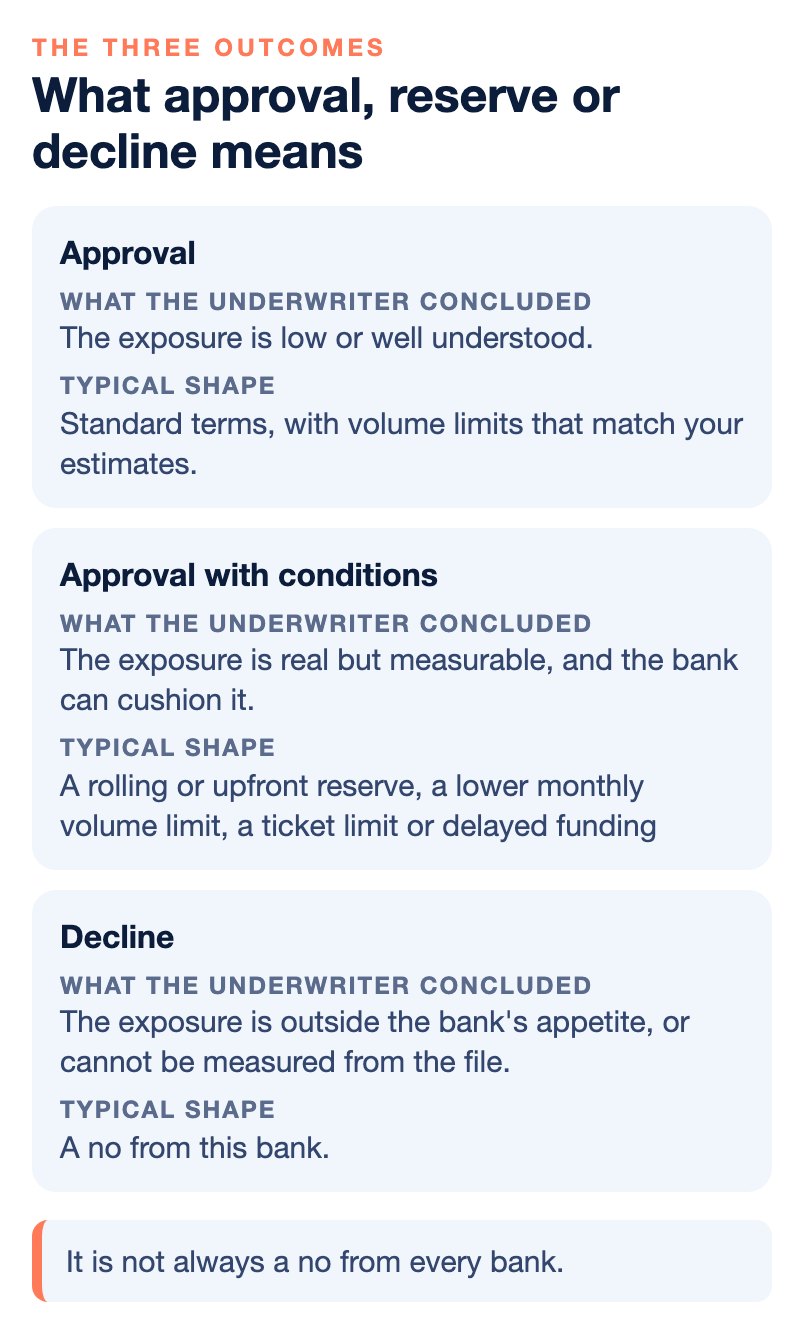
Underwriters do not add up a single score that everyone shares. Each bank weighs these variables against its own appetite. But the logic behind the three outcomes is consistent.
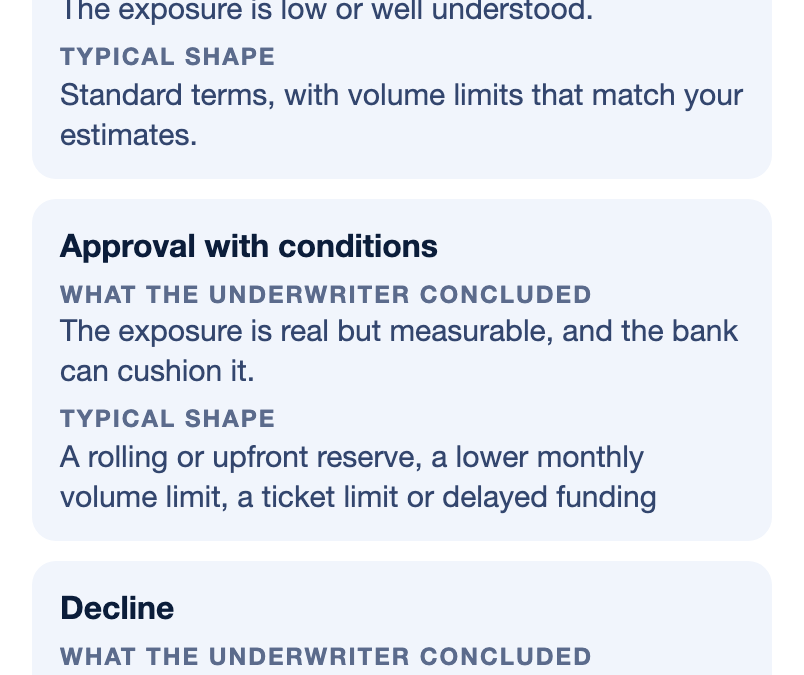
| Outcome | What the underwriter concluded | Typical shape |
|---|---|---|
| Approval | The exposure is low or well understood, and the file is complete and consistent. | Standard terms, with volume limits that match your estimates. |
| Approval with conditions | The exposure is real but measurable, and the bank can cushion it. | A rolling or upfront reserve, a lower monthly volume limit, a ticket limit or delayed funding, often reviewed after a period of clean processing. |
| Decline | The exposure is outside the bank’s appetite, cannot be measured from the file, or something in the file does not add up. | A no from this bank. It is not always a no from every bank. |
What a reserve really is
A reserve is money the bank holds back from your deposits as a cushion against future refunds and chargebacks. In a rolling reserve, the bank temporarily keeps a share of each day’s processing and releases it on a set schedule. Other structures include an upfront amount held at the start or a cap that stops growing once it reaches a set total. Reserves are more common for businesses with significant future delivery, high chargebacks, rapid growth, limited processing history, high average tickets or subscription billing. Not every higher-risk merchant needs one, and the terms depend on the bank and the business. Our guide to rolling reserves and cash flow explains how to plan for one.
The important point is that a reserve is usually how a bank says yes to a business it could not otherwise approve. Ask how the reserve is calculated, when funds are released, and what would allow it to be reduced or removed. Get those answers in writing.
Why declines happen to legitimate businesses
A legitimate business can be declined because of its industry, its fulfillment model, its chargeback exposure, its financial condition, its products, its processing history or its regulatory requirements. Very often, though, the decline comes down to something simpler: the underwriter did not clearly understand the business. When information is missing, inconsistent or vague, the underwriter has to assume, and assumptions lean toward the cautious answer.
A decline from one bank is information, not a final verdict. Different banks have different appetites. Being declined by another processor does not rule out approval elsewhere, but it is wise to find out why before applying again, and to fix what can be fixed first.
Instant approval is not the same as underwriting
Some payment platforms activate an account within minutes from a few basic answers. That can work well for simple businesses. But activation is not always complete underwriting. Some models review more closely once transactions start flowing, and a business whose activity attracts attention can then face document requests, held funds, reserves, restrictions or closure. The time to find out whether your processor supports your business is before you are processing serious volume, not after.
How to move your application toward a clean approval
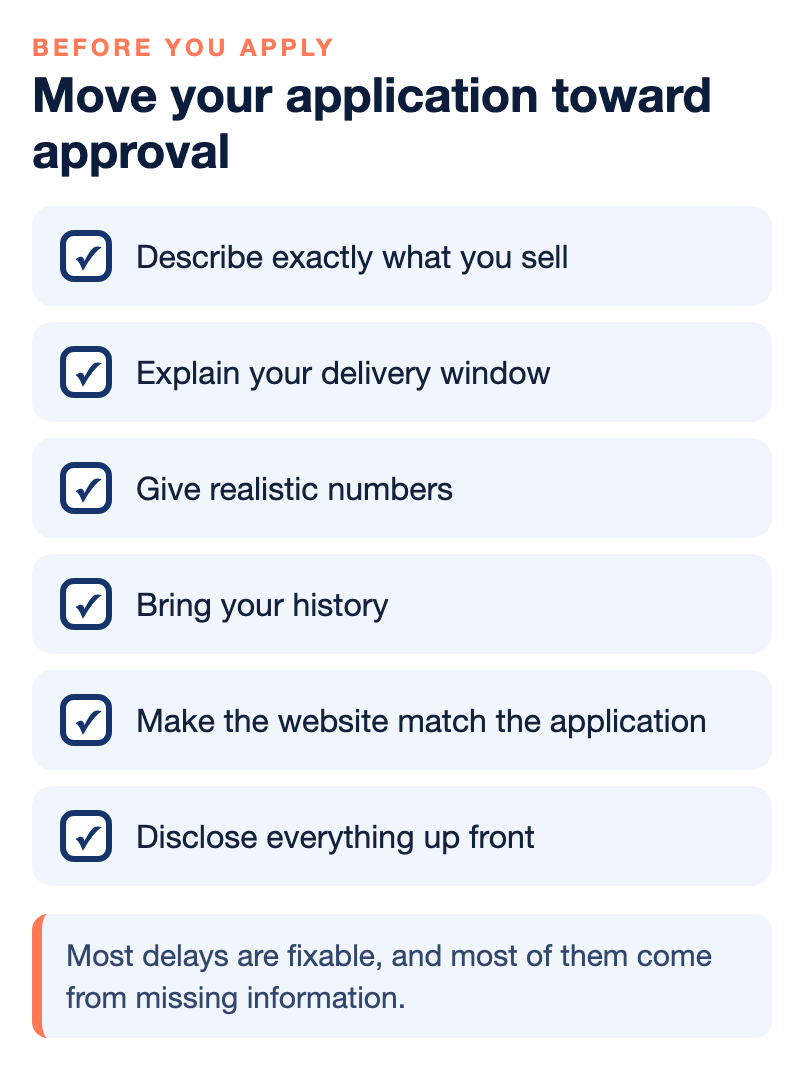
- Describe exactly what you sell. Replace words like “services” or “technology” with what the customer actually buys.
- Explain your delivery window. When customers pay, when they receive what they paid for and what happens if they cancel.
- Give realistic numbers. Monthly volume, average ticket and highest ticket, with a short note if you expect growth or seasonal swings.
- Bring your history. Recent processing statements, if you have them, are often the strongest document in the file.
- Make the website match the application. Clear products, prices, contact details and policies that say the same thing as your contracts and checkout.
- Disclose everything up front. All products, online sales, subscriptions, deposits, related websites, past account closures and chargeback history. Underwriters dislike surprises more than they dislike risk.
- Write down the flow of funds if money moves between more than two parties.
- Answer document requests quickly and completely. Most delays are fixable, and most of them come from missing information.
Where NPS fits, and where it does not
Before an application goes out, we review the business model, website, flow of funds, processing history, products and merchant category code, and we help gather the documents the bank will ask for. We hold direct contracts with multiple banks and processors, and we are not brokers, so we can match a business to a bank whose risk appetite fits it. One application can be pre-qualified across our banking network. When needed, we work directly with processors, sponsor banks and underwriting teams to explain business models that do not fit a standard category. The goal is not to find a loophole. It is to put the right merchant with the right bank.
We may not be the right fit if:
- You want instant, self-service sign-up. We underwrite each account.
- You would rather not provide underwriting documents. A good application depends on them.
- You are a hobby seller with very low volume. A simpler product may suit you better.
- Your products cannot be sold lawfully. No bank should approve that, and we will tell you so.
If you are still weighing providers, our comparison of payment processors by business type lays out the main options.
Bottom line
An acquirer reads your application as a measurement of exposure: how much customer money is in flight, for how long, and how likely it is to come back. Delivery time, ticket size, volume, payment channel, history, ownership, industry, the website and the flow of funds all feed that estimate. Clear, consistent, complete files earn approvals. Real but measurable risk earns approvals with conditions, most often a reserve. Files the underwriter cannot understand earn declines. You cannot change your industry, but you can almost always change how clearly your business is explained, and that is the variable most within your control.
If you would like a second look at your application before it goes out, you can talk with our team. For more guides, see our payments guides.
Frequently asked questions
What does an acquiring bank look for on a merchant application?
It estimates exposure: how much customer money could come back as refunds or chargebacks if the business could not cover them. It weighs delivery time, ticket size, volume, payment channels, processing history, ownership, industry, the website and the flow of funds. Clear and consistent information helps most.
Why would a merchant account be approved with a reserve?
A reserve lets a bank approve a business whose risk is real but measurable. The bank holds back part of your deposits as a cushion against future refunds and chargebacks and releases it on a schedule. Ask how it is calculated, when funds are released and what would reduce it.
What is a rolling reserve?
A rolling reserve is a share of each day’s processing that the bank holds for a set period and then releases. It is common for businesses with future delivery, high tickets, subscriptions, rapid growth or limited history. The exact terms depend on the bank and the business.
Why do legitimate businesses get declined for merchant accounts?
Reasons include the industry, the fulfillment model, chargeback exposure, financial condition, products or processing history. Often the underwriter simply could not understand the business from the file. Missing or inconsistent information pushes decisions toward the cautious answer.
Can I get approved if another processor declined me?
Possibly. Banks have different risk appetites, so a decline from one is not a decline from all. Find out why you were declined and fix what you can before applying again.
Does instant approval mean my business has been fully underwritten?
Not necessarily. Some platforms activate accounts quickly and review more closely once transactions start. That can lead to document requests, holds or closure later, so confirm your business is supported before processing serious volume.
How can I improve my chances of merchant account approval?
Describe exactly what you sell, explain your delivery window and give realistic volume and ticket estimates. Provide recent processing statements if you have them, and make sure your website and documents tell the same story. Disclose everything up front.
Why does my website matter for underwriting?
Underwriters review what you sell, how checkout works, your policies, contact details and any product claims. They compare all of it with your application and contracts. A website that contradicts the application can slow or stop an approval.





