Most B2B buyers do not pay by check because they love checks. They pay by check because their accounts payable process was built around checks years ago, because a check lets them decide exactly when the money leaves, and because nobody on the selling side ever made the alternative easier. That is good news, because it means most of them can be moved, and the way to move them is not to lecture them or slap a fee on checks. It is to understand which reason applies to which customer and remove it: put a pay button on the invoice, offer the bank payment their AP team is comfortable with, give the buyers who want float a card option, and make the change on a date everyone knows about. This guide walks through the real reasons buyers hold on to checks and a step-by-step plan for moving them off.
The bottom line
- Checks persist because of process, timing and habit, not because buyers prefer paper. Fix the process and most of the preference disappears.
- Make the electronic option easier than writing a check. A payment link in the invoice email or text, with no portal login, does more than any letter asking customers to switch.
- Offer more than one way to pay. ACH suits most invoices, cards suit buyers who want float or reward points, and commercial card data can lower the cost of the cards you accept.
- Move in stages, starting with new customers and your largest late payers, and keep a slow lane for the few who truly cannot change yet.
Who wrote this, and what we will not claim
Nationwide Payment Systems (NPS) publishes this guide. We are a payment processing company based in South Florida, in business since 2001, and we sell invoicing, ACH and card processing to B2B companies, so we have a stake in seeing fewer checks in the mail. We do not quote prices, fees or savings here, because they depend on your volume, invoice sizes and how your customers pay. We do say below which businesses are not a fit for us.
Why checks hang on in B2B
Consumer payments moved to cards and phones a long time ago. Business payments did not move as fast, and the reasons are mostly on the buyer’s side of the table. If you know which reason you are up against, you know which fix to offer.
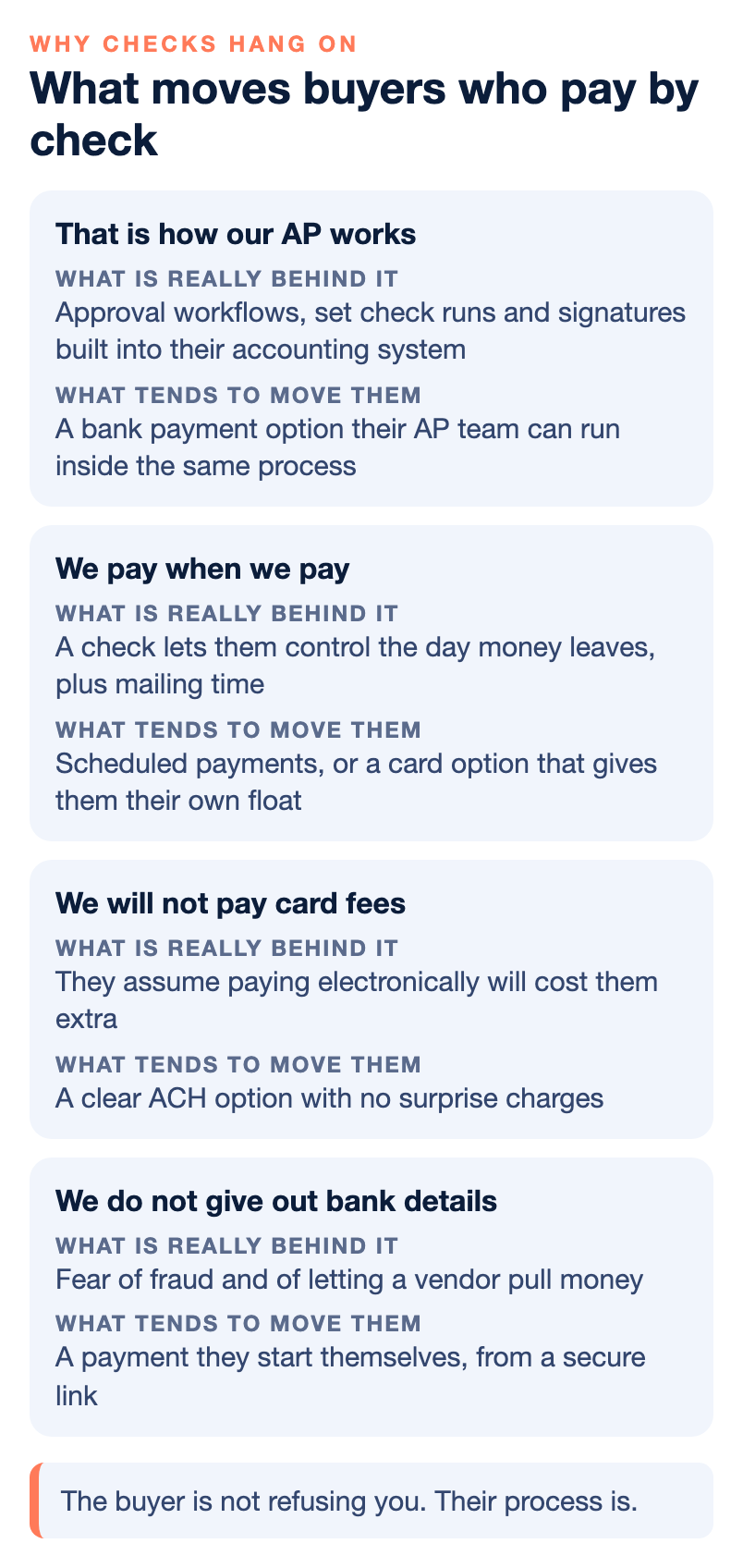
| Why they pay by check | What is really behind it | What tends to move them |
|---|---|---|
| “That is how our AP works” | Approval workflows, set check runs and signatures built into their accounting system | A bank payment option their AP team can run inside the same process |
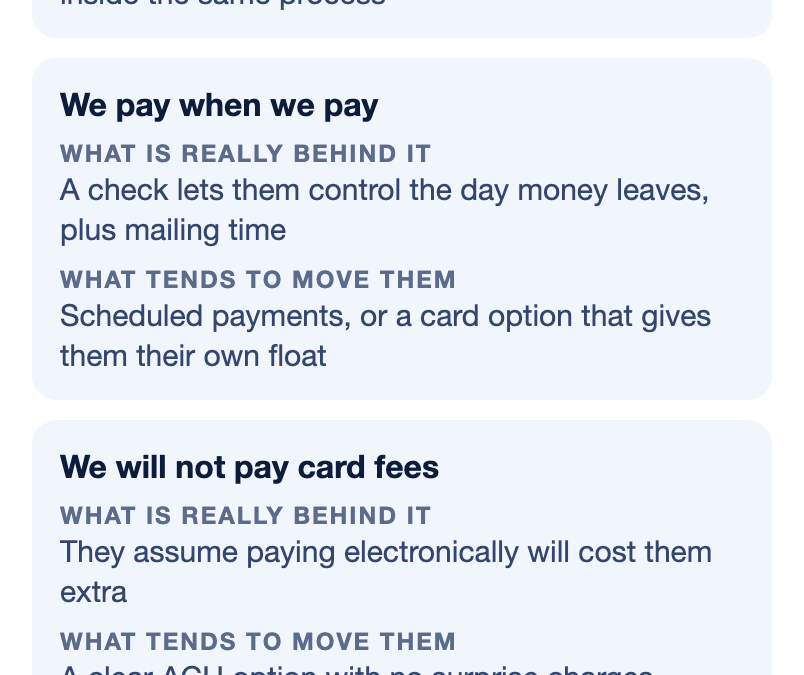
| “We pay when we pay” | A check lets them control the day money leaves, plus mailing time | Scheduled payments, or a card option that gives them their own float |
| “We will not pay card fees” | They assume paying electronically will cost them extra | A clear ACH option with no surprise charges |
| “We do not give out bank details” | Fear of fraud and of letting a vendor pull money | A payment they start themselves, from a secure link |
| “Nobody asked us” | Habit, and a vendor that never offered anything else | A pay button on every invoice and a simple announcement |
Their accounts payable process was built around checks
In many companies the person who orders from you is not the person who pays you. Payment happens in accounts payable, often on a set schedule, with approvals and sometimes two signatures, and the accounting system may print the checks itself. Switching one vendor to electronic payment can mean a new vendor setup, a bank-detail verification and a change to a routine that works for them. The buyer is not refusing you. Their process is.
A check lets them control timing
A check is a quiet form of credit. The buyer decides when to cut it, the mail adds days, and the money does not leave their account until the check clears. For a company managing its own cash flow, that control is worth something, and it is one reason a vendor waiting on checks ends up acting like the bank for its customers. Any alternative you offer has to respect that buyers want to decide when they pay, or they will resist it.
They expect to be charged for paying electronically
Many buyers hear “pay online” and assume a card fee is coming. If the only electronic option you offer is a card with a surcharge, a large share of them will keep mailing checks, and for a big invoice it is hard to blame them. A bank payment option without a surprise charge removes the objection.
They worry about fraud and about giving vendors access
Business email compromise, where a fraudster poses as a vendor and asks for payment to a new account, has made AP teams wary of anyone who emails about changing payment details. Some buyers also dislike the idea of a vendor pulling money from their account. The answer is a payment the buyer starts themselves, through a secure link on your invoice, and a verification process for any bank details that change hands.
Habit, and the fact that nobody asked
Some customers, often long-standing ones, simply like checks, and some have never been offered anything else. In our experience there is still a group of business owners who prefer to write a check because that is how they have always done it. For them the most effective change is the simplest one: an invoice that has a pay button on it.
What checks are really costing you
A check looks free because no one sends you a bill for it. The cost is spread across your business: someone opens the mail, someone matches each check to invoices, someone takes it to the bank or scans it, someone updates the books, and someone chases the customers whose checks are “in the mail.” Payment cycles stretch, cash arrives late and unpredictably, and your staff spends hours on work that an electronic payment does automatically.
Then there is fraud. Checks get stolen from mailboxes, altered, or washed with chemicals and rewritten. On our podcast we talked about a business that had been around for 50 years, whose checks were stolen from the mail and cashed under someone else’s name. It moved to ACH and told its customers it would no longer take paper checks. Our article on check fraud and how to protect your business tells that story and others like it. If you want the cost comparison laid out method by method, our guide to B2B payments covers checks, wires, cards and ACH side by side.
How to move customers off checks, step by step
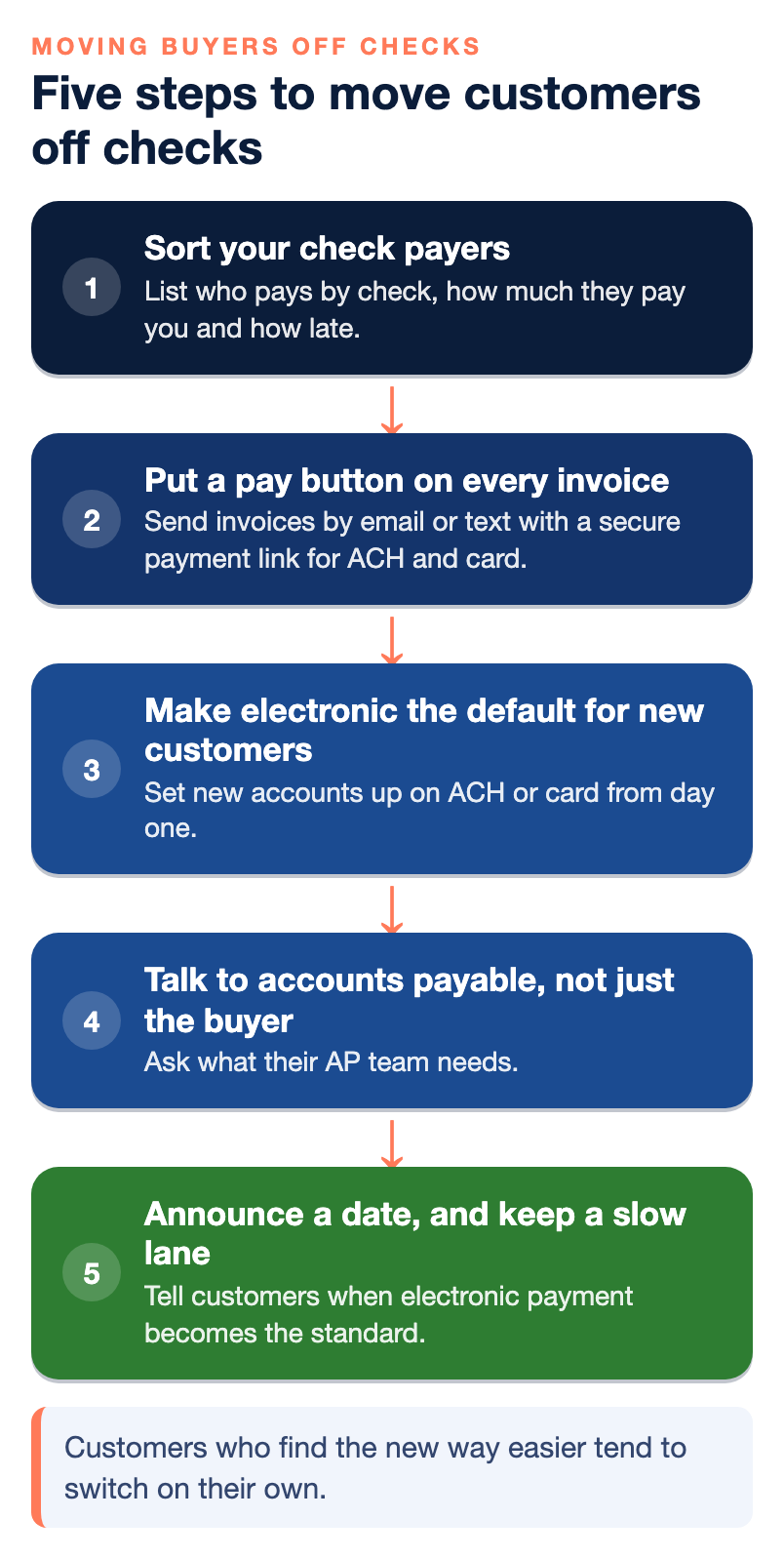
The companies that get this right do not send one stern letter. They make paying electronically the easiest thing a customer can do, and they roll the change out in stages.
- Sort your check payers. List who pays by check, how much they pay you and how late. Your largest and slowest check payers are where the change is worth the most.
- Put a pay button on every invoice. Send invoices by email or text with a secure payment link for ACH and card, with no portal login required.
- Make electronic the default for new customers. Set new accounts up on ACH or card from day one, and put your preferred payment method in your credit terms.
- Talk to accounts payable, not just the buyer. Ask what their AP team needs, send the paperwork securely and confirm any bank details by phone.
- Announce a date, and keep a slow lane. Tell customers when electronic payment becomes the standard, and keep checks available for the few who cannot change yet.
Lead with ACH for most invoices
For most B2B invoices, ACH is the option to put first. It moves money from bank account to bank account, it suits large invoices far better than a card, and it is what many AP teams are already used to sending. A buyer can pay from a link on your invoice without handing over anything beyond what they would write on a check. Our article on whether accepting cards is cheaper than waiting to get paid works through when a faster payment is worth more than the cost of taking it.
Use cards for the buyers who want float
A buyer who holds checks to control timing may be happy to pay by card instead, because a card gives them their own float without delaying you. Many companies also pay with corporate, purchasing or virtual cards and want vendors that accept them. Cards cost more to accept than ACH, so it matters how you run them. When the right data is sent with the transaction, Level 2 and Level 3 processing can lower interchange on qualifying commercial and purchasing cards. Our guide to Level 2 and Level 3 processing explains what qualifies and what data is needed.
Use carrots before sticks
Some businesses add a surcharge to card payments or a fee for paper checks. Card surcharging is allowed in many situations, but it has to follow card-brand rules and state law, and it should be set up properly rather than added as an arbitrary fee. Before you reach for a charge, try the gentler tools: an early-payment discount, automatic reminders, recurring billing for customers you invoice every month and partial payments or deposits for large orders. Customers who feel pushed tend to push back. Customers who find the new way easier tend to switch on their own.
Make it easy for their AP team to say yes
If a customer’s accounts payable department has to set you up for electronic payment, give them what they need without making them ask twice: your bank letter or a verified way to confirm your account details, your tax form and a contact who can answer questions. Tell them you will never change your bank details by email alone, and invite them to call you to confirm any change. That one sentence answers the fraud worry that keeps a lot of AP teams on checks.
What to say to customers
Keep the announcement short, friendly and about them. A good one says what is changing, when, how they can pay, and what to do if they need more time. Something like: “Starting on the first of next quarter, every invoice will include a secure link to pay by bank transfer or card. You can still mail a check while your team sets this up. If your accounts payable department needs anything from us to get started, reply to this email or call us.” Then follow up personally with your largest check payers, because a phone call from someone they know moves more of them than any email.
How to tell it is working
Track two numbers each month: the share of invoice dollars paid electronically, and how many days it takes customers to pay after you invoice them. If both move in the right direction, you are getting paid faster and spending less time on paper. Watch which customers are still on checks, and talk to them one at a time. Expect a small group of holdouts to remain. The goal is to make checks the exception, not to win a fight with your best customers.
Where NPS fits, and where it does not
NPSONE Smart Invoicing lets a business send invoices with secure payment links by email or text, so customers can pay by card, ACH, Apple Pay or Google Pay depending on setup, without logging into a portal or mailing a check. It supports deposits and partial payments, recurring invoices, automatic reminders, early-payment discounts and late-fee rules, and it syncs two ways with QuickBooks Online. For B2B card payments we support Level 2 and Level 3 processing on qualifying transactions, and we offer several pricing models, including interchange-plus. Every account comes with live, U.S.-based support and a dedicated account manager. Our guide to QuickBooks Online smart invoicing shows how the invoice-to-payment flow works, and our guide to B2B payment gateways for manufacturers and distributors covers what larger B2B sellers should look for.
Here is where we may not be the right choice:
- Very low volume or a side project. We may not be the best fit for hobby sellers with very low processing volume.
- You want an instant, self-service account. We review each business, so we are not an instant-signup product.
- You would rather not provide underwriting documents. We ask for them, as any processor that underwrites properly will.
- You only want the lowest advertised flat rate. We price each merchant individually and do not publish one universal rate.
- You do not invoice other businesses or need ACH. If every customer already pays at checkout, invoicing tools will not add much.
Next step
Buyers keep paying by check because the check fits their process and nobody has offered them something that fits better. Offer it, make it the easiest choice on the invoice, give their AP team what it needs, and move one group of customers at a time.
If you want help working out which of your customers to move first, or how electronic invoicing would fit with your accounting, you can talk with our team. More guides on B2B payments are in our payments guides library.
Frequently asked questions
Why do B2B customers still pay by check?
Mostly because their accounts payable process was built around checks, because a check lets them control when money leaves, and because many vendors never offered an easier option. Some also worry about fraud or expect to be charged for paying electronically. Few of them prefer paper for its own sake.
What is the best way to get customers to stop paying by check?
Make the electronic option easier than writing a check. Put a secure payment link for ACH and card on every invoice, make electronic payment the default for new customers, and give accounts payable teams what they need to set you up. Announce a date and follow up personally with your largest check payers.
Should I charge a fee for paying by check or by card?
Try incentives first, such as early-payment discounts, reminders and recurring billing. Card surcharging is allowed in many situations, but it must follow card-brand rules and state law and be set up properly. A fee that feels like a penalty can push customers back to checks.
Is ACH better than credit cards for B2B invoices?
For most invoices, especially large ones, ACH is usually the better default because it moves money bank to bank and costs less to accept than a card. Cards still suit buyers who want float or pay with corporate, purchasing or virtual cards. Offering both covers the most customers.
What is Level 3 processing and does it help B2B sellers?
Level 2 and Level 3 processing send extra transaction data, such as tax amounts and line items, with commercial card payments. When the right data is passed, qualifying corporate, purchasing, fleet and government card transactions may get lower interchange. It helps B2B sellers that accept a meaningful share of those cards.
How do I reassure customers who worry about ACH fraud?
Let them start the payment themselves from a secure link on your invoice, so you are not pulling money from their account. Tell them you will never change your bank details by email alone, and invite them to call to confirm any change. Give their accounts payable team a verified way to confirm your account.
Will some customers never stop paying by check?
A few may not, at least not right away. Keep checks available as the slow lane while you move everyone else, and talk to holdouts one at a time. The goal is to make checks the exception, not to lose a good customer over it.