When your business accepts cryptocurrency, the IRS treats the coins you receive as property, not money, so every crypto sale is reported as income at its U.S. dollar value on the day you were paid, and if you keep the crypto, selling or spending it later is a second taxable event with its own gain or loss. How much of that falls on you depends mostly on one choice: whether you receive the crypto itself or have a payment provider convert it to dollars before it reaches your bank. This guide walks through both setups, the records you need from the first sale, the forms you may see, the parts that trip up owners at tax time, and the questions to ask before you turn crypto on at checkout.
The bottom line
- Every crypto payment is income, measured in U.S. dollars at the moment you receive it. The price on your invoice and the value of the coins that arrive should match, and you need a record of both.
- If you keep the crypto, you take on a second reporting job. When you later sell it, convert it or spend it, you report a gain or loss against the dollar value you recorded when it came in.
- If a provider converts it to dollars for you, your side usually looks much more like an ordinary card or bank sale, and most of the price swings never touch your books. You still need the transaction records.
- Sales tax, payroll and contractor rules still apply in dollars. Accepting crypto changes how you get paid, not what you owe on the sale.
- Talk to your tax professional before your first crypto sale, not in April. The records that make the return easy have to be captured at the time of each payment.
Who wrote this, and what we will not claim
Nationwide Payment Systems (NPS) publishes this guide. We are a payment processing company in South Florida, in business since 2001, and we spend our days helping businesses decide which payment methods make sense for them and what each one really costs to run. We are not tax advisors or accountants, and nothing here is tax advice for your situation. What follows is a plain-language map of how the IRS describes digital asset income on its own pages, and of the paperwork questions we hear from merchants. Tax rules for digital assets have changed several times in the last few years and are still changing, so confirm every point here with a CPA or enrolled agent who handles digital assets before you rely on it.
The first question: do you receive crypto, or do you receive dollars?
Most of the confusion about crypto taxes comes from treating two very different setups as one. In the first, a customer pays in crypto and the coins land in a wallet your business controls. In the second, the customer pays in crypto but a payment provider converts it on the spot, and your business receives U.S. dollars in its bank account, often with a statement that looks a lot like a card processing report. Our guide to payment methods in the USA makes the same point from the payments side: accepting crypto and holding crypto are different decisions, and a business can give customers the option to pay with Bitcoin or a stablecoin without becoming a crypto investor.
| How you are paid | What you report | The extra work |
|---|---|---|
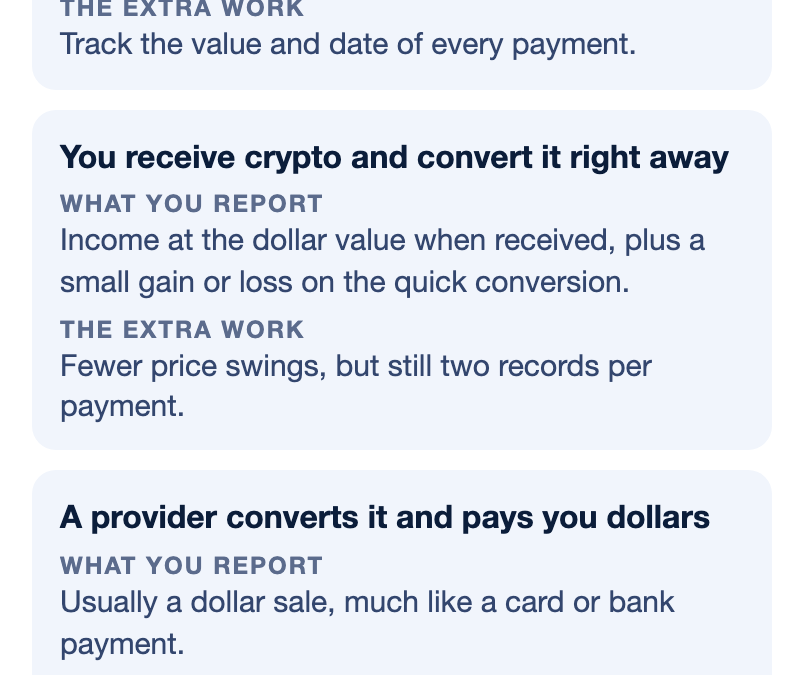
| You receive crypto and keep it | Income at the dollar value when received, then a gain or loss when you sell, convert or spend it. | Track the value and date of every payment, every later sale or swap, and the price swings in between. |
| You receive crypto and convert it right away | Income at the dollar value when received, plus a small gain or loss on the quick conversion. | Fewer price swings, but still two records per payment and a conversion fee to account for. |
| A provider converts it and pays you dollars | Usually a dollar sale, much like a card or bank payment. | Keep the provider’s statements and transaction records, and confirm the treatment with your tax professional. |
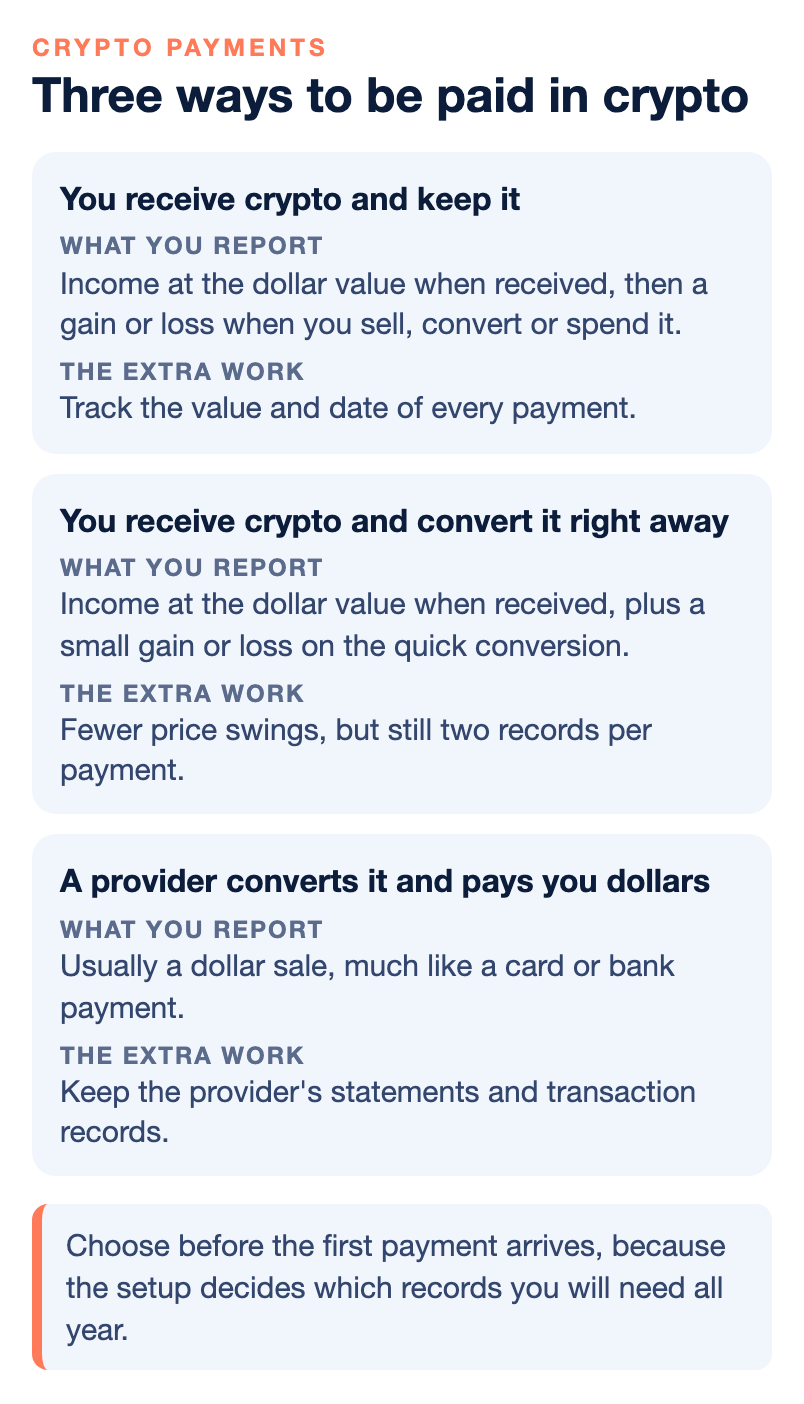
None of these is wrong. A business that already holds digital assets on purpose may be comfortable with the first setup. A shop that simply wants to offer customers one more way to pay usually ends up happiest with the third, because its accountant sees dollars and its daily cash does not move with the market. The point is to choose on purpose, and to choose before the first payment arrives, because the setup decides which records you will need all year.
If you receive and keep the crypto
The IRS says plainly that for U.S. tax purposes digital assets are property, not currency, and that when a business receives a digital asset in exchange for goods or services, that income is taxed as ordinary income. Its frequently asked questions add the measurement rule that matters most to a merchant: the income you recognize is the fair market value of the crypto, in U.S. dollars, at the time you receive it. That value also becomes your basis in those coins, which is the starting point for everything that happens to them afterward.
So a single crypto sale actually creates two separate tax moments. The first is the sale itself, which you report as business income just as you would a card sale, using the dollar value when the payment was recorded. The second comes later, when you sell the coins for dollars, swap them for a different coin, or spend them to pay a supplier. At that point you compare what you got for them, in dollars, against the basis you recorded on the day they came in. If the coin rose in value while you held it, you have a gain to report. If it fell, you have a loss. Each of those later events is its own line in your records, and a business that takes crypto every day can end up with hundreds of them by year end.
That is why the setting that sounds simplest, just keep the coins, is often the one that creates the most bookkeeping. Every payment needs a date, a time, an amount of crypto, a dollar value and a source for that value, and every later disposal needs the same, matched back to the coins it came from. Spending crypto with a vendor is a disposal too, which surprises owners who think of it as simply paying a bill.
How the dollar value is set
The IRS frequently asked questions explain where the dollar value comes from. When a transaction runs through a cryptocurrency exchange, the value is the amount the exchange recorded for that transaction in U.S. dollars. When it happens directly between two parties, the value is set as of the date and time the transaction is recorded on the ledger, and the IRS says it will accept a value from a blockchain explorer as evidence. The practical lesson is to decide which source your business will use, use the same one every time, and save the value at the moment of the sale rather than looking it up months later, when prices and records may have moved.
If a payment provider converts the crypto to dollars
Many merchants who accept crypto never touch a wallet at all. The customer chooses a coin at checkout or clicks a payment link on an invoice, the provider quotes how much crypto covers the dollar price, the customer sends it, and the provider deposits U.S. dollars in the merchant’s bank account. From the business’s side, the money that arrives is dollars, so the sale is usually recorded much like any other electronic payment, and the gain or loss on the customer’s coins is the customer’s matter, not yours.
That does not mean there is nothing to keep. You still want the provider’s transaction report for every sale, showing the order, the dollar amount, the fee and the date the funds settled, because that report is what ties your bank deposits to your sales. You also want to know, in writing, whether the provider ever holds crypto on your behalf, even briefly, and what happens if a conversion fails. If any coins sit in your name, even for a day, the setup starts to look like the first one again, and your tax professional will want to know. Ask, too, how refunds work, because a refund paid in crypto at a different price than the original sale can create its own small gain or loss.
The conversion fee deserves the same scrutiny you would give a card processing statement. Fees in crypto payments can be a percentage of the sale, a network fee, a spread built into the exchange rate, or a mix, and the spread is the one owners tend to miss because it never appears as a line item. Our guide to reading your merchant statement shows the habits that help here, such as comparing the price you charged with the amount that actually landed in the bank.
The records to keep from the first sale
Whichever setup you choose, the records are what make tax time manageable. The IRS reminds taxpayers that the law requires records sufficient to support the positions taken on a return, and for digital assets that means keeping track of what you received, when, what it was worth in dollars and what you later did with it. A good provider or bookkeeping tool can capture most of this automatically, but it is your business that has to produce it if anyone asks.
- The sale. Invoice or order number, the dollar price, the date and time, and the customer’s details as your normal sales records hold them.
- The payment. Which coin, how much of it, the transaction ID on the blockchain and the wallet or provider it went through.
- The dollar value and its source. The value at the moment you received it, and which exchange, provider or explorer that value came from.
- Every later disposal. When you sold, swapped or spent the coins, for how much in dollars, and which earlier payments they came from.
- Fees and refunds. Network fees, conversion fees and spreads, and any refund with its date and value.
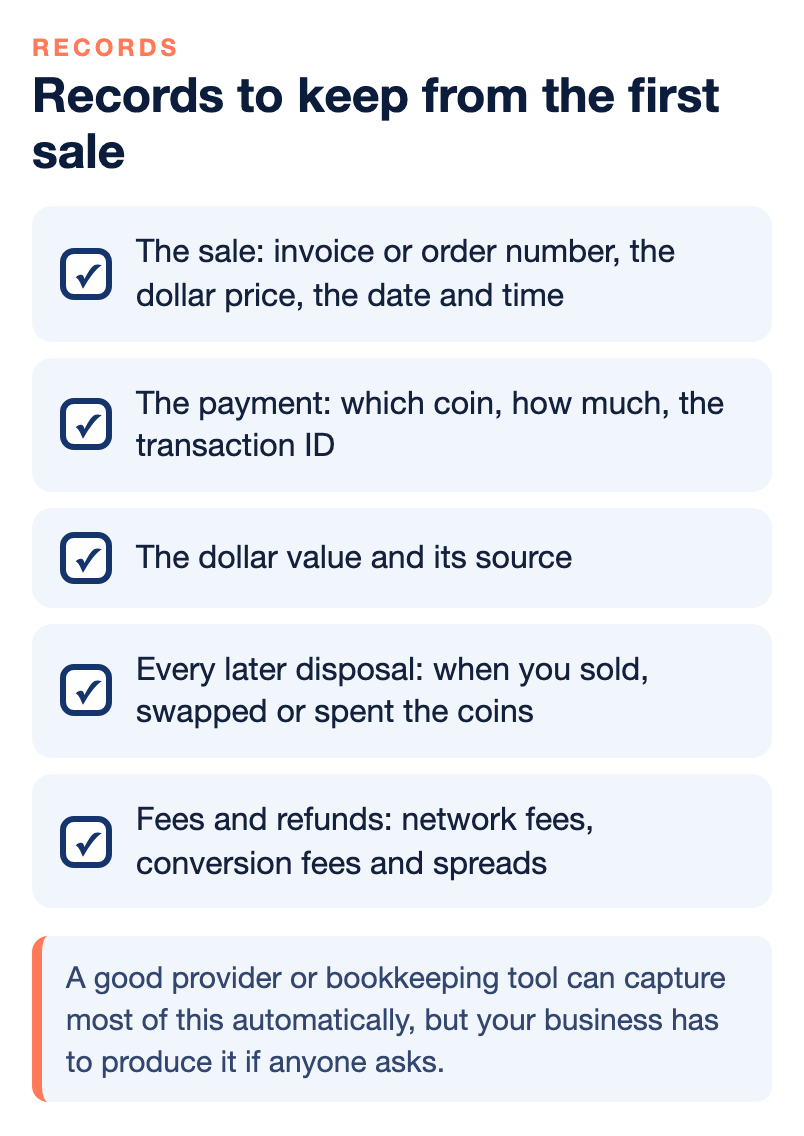
If that list feels heavy, it is a good sign that the provider-converts-to-dollars setup may suit you better. Many owners find that the decision about how to accept crypto is really a decision about how much bookkeeping they want to own.
The forms you may see
Crypto does not come with one special business form, but several existing forms and questions can touch a business that accepts it. Which ones apply depends on your entity, your setup and your volume, so treat this as a list of things to raise with your tax professional rather than a filing checklist.
- Your regular business return. Crypto sales are business income, reported where the rest of your sales are reported. For a sole proprietor, the IRS points to Schedule C.
- The digital asset question. Individual returns ask whether, during the year, you received a digital asset as payment for property or services, or sold, exchanged or otherwise disposed of one. Some business returns ask similar questions, so expect to answer yes in a year when you accepted crypto.
- Form 1099-DA. The IRS says brokers report digital asset sales on Form 1099-DA beginning with transactions on or after January 1, 2025, with cost basis added for certain transactions starting with 2026. If your business sells crypto through a platform that counts as a broker, you may receive one, and the numbers on it should match your records.
- Forms from payment platforms. If a provider pays you dollars, it may issue a tax form for the payments it settled to you, much as card processors and payment apps do. The thresholds for those forms have changed more than once, so ask the provider what it will send and when.
- Large cash-equivalent payments. A 2021 federal law added digital assets to the rule that businesses report cash payments over a set amount on Form 8300, but in 2024 the IRS announced that businesses do not have to count digital assets for that rule until regulations are issued. Check the current status with your tax professional, especially if you sell high-ticket items.
Sales tax, payroll and contractors
Accepting crypto does not change what a sale costs the customer in tax. If a sale is taxable in your state, the sales tax is figured on the dollar price, and you collect and remit it in dollars just as you would for a card or cash sale. States set their own rules and some have issued their own guidance on digital assets, so if you sell in more than one state, ask your tax professional or your state’s revenue department how they want crypto sales recorded.
The same thinking applies when crypto flows the other way. The IRS says virtual currency paid to employees as wages is valued in dollars on the date it is received, is subject to income tax withholding and payroll taxes, and is reported on Form W-2. Crypto paid to an independent contractor is self-employment income to them, and your business may owe the usual information returns. Paying people in crypto adds a layer of valuation and withholding work on top of normal payroll, which is one reason many businesses that accept crypto still pay their staff in dollars. If you pay overseas contractors or creators, our episode on global payouts, compliance and stablecoins covers the compliance side of sending money out.
The parts that catch owners off guard
A few situations come up again and again when we talk with merchants who started taking crypto without a plan for the paperwork.
Refunds are your job, and they can be taxable
Card payments come with a dispute process that the card networks run. Crypto payments generally do not, because a transfer on the blockchain cannot be reversed by a bank. That puts refunds entirely in your hands. If you refund in crypto and the coin has moved in price since the sale, the refund itself can create a small gain or loss, and if you refund in dollars you need a clear record linking it to the original crypto payment. Write a refund policy for crypto sales before you take the first one, and say on your site whether refunds go back in crypto or in dollars.
Stablecoins are steadier, not exempt
Stablecoins are designed to hold a steady dollar value, which makes the price swings much smaller. They are still digital assets, so the same property treatment and the same recordkeeping apply. The difference is mostly that the gains and losses on them tend to be tiny, which makes the books simpler, not optional.
Price swings between the sale and the conversion
If your setup leaves coins in your wallet even for a few hours before you convert them, the value can move in that window. That movement is a gain or loss you report, and on a busy day it can add up. A provider that converts at the moment of payment removes most of this.
Spending crypto is selling crypto
Paying a supplier, a landlord or a contractor with coins you received from customers counts as a disposal. You report the gain or loss on those coins just as if you had sold them for dollars first, and the payment itself is recorded as the expense it is.
Questions to ask a crypto payment provider before you sign
The provider you choose decides a large share of your tax workload, so it is worth asking the same kind of questions you would ask a card processor. Get the answers in writing, and share them with your tax professional before you go live.
- Do we receive crypto, dollars, or a choice, and can we change that setting later?
- If we receive dollars, does the provider ever hold coins in our name, and for how long?
- What fees apply, including network fees and any spread in the exchange rate, and where do they show on our statement?
- What transaction report do we get for each sale, and can it export to our accounting software?
- Which dollar value source does the provider use, and is it recorded with each transaction?
- What tax forms will the provider issue to us, and by when?
- How do refunds work, in crypto or in dollars, and how are they recorded?
- Which coins and networks are accepted, and what happens if a customer sends the wrong one?
If you are comparing payment providers more broadly, our comparison of payment processors by business type covers the pricing models and contract terms worth checking for any payment method, and our plain-language explainer, what a merchant account is, explains how card payments settle, which is a useful contrast when you are deciding how crypto should settle for you.
Where NPS fits, and where it does not
We help businesses look at their whole payment setup, including cards, ACH, invoicing, digital wallets and newer options such as digital assets, and work out which methods make sense for their customers and what each one will cost them to run. When a merchant asks about crypto, our first questions are the ones in this guide: who your customers are, whether they are actually asking to pay that way, and whether you want to receive coins or dollars. Accounts come with live, U.S.-based support around the clock and a dedicated account manager.
Here is where we are not the right call:
- You need tax advice. We are a payments company. For how crypto income should be reported on your return, you need a CPA or enrolled agent who works with digital assets.
- You want to hold crypto as an investment. Treasury and investment decisions about digital assets belong with a financial advisor, not a payment processor.
- Your customers are not asking for it. If nobody wants to pay in crypto, adding it brings bookkeeping without sales, and we will tell you so.
- You want the lowest posted rate and nothing else. We price each merchant individually and do not publish one universal rate.
Next step
Accepting crypto is mostly a recordkeeping decision dressed up as a payments decision. Decide whether you want coins or dollars, set up records that capture the value of every payment the moment it arrives, and walk through the plan with your tax professional before the first sale rather than after the last one.
If you want a second opinion on whether crypto belongs in your payment mix, or on what a provider’s quote really costs, you can talk with our team. More plain-language guides on payment methods, fees and processing are in our payments guides.
Frequently asked questions
Is accepting cryptocurrency as payment taxable for a business?
Yes. The IRS treats digital assets as property, and a business that receives crypto for goods or services reports it as ordinary income. The amount is the fair market value of the crypto in U.S. dollars at the time you received it.
Do I owe tax again when I sell the crypto I was paid?
If you keep the crypto, selling it, swapping it or spending it later is a separate taxable event. You report a gain or loss based on the difference between what you got for it and the dollar value you recorded when it came in. Your tax professional can tell you how that gain or loss is treated for your business.
What if my payment provider converts crypto to dollars for me?
Then your business usually receives dollars, and the sale is often recorded much like a card or bank payment. Keep the provider’s transaction reports and ask in writing whether it ever holds coins in your name. Confirm the treatment with your tax professional before you go live.
How do I figure the dollar value of a crypto payment?
The IRS says the value is the amount an exchange records for the transaction, or, for a direct transfer, the value at the date and time the transaction is recorded on the ledger. Pick one reliable source, use it every time, and save the value at the moment of the sale.
What records should I keep for crypto payments?
For each payment, keep the sale details, the coin and amount, the transaction ID, the dollar value at receipt and where that value came from. For every later sale, swap or spend, keep the date, the dollar amount and which payments the coins came from. Keep fees and refunds too.
Do I charge sales tax on a sale paid in crypto?
If the sale is taxable in your state, sales tax is figured on the dollar price, just as with any other payment method. States set their own rules for digital assets, so check with your tax professional or your state’s revenue department.
Will I get a Form 1099-DA?
Brokers report digital asset sales on Form 1099-DA starting with transactions on or after January 1, 2025. If your business sells crypto through a platform that counts as a broker, you may receive one. Make sure the numbers on it match your own records.
Can NPS give me crypto tax advice?
No. We are a payments company, not tax advisors. We can help you decide whether crypto belongs in your payment mix and what a provider will cost, and a CPA or enrolled agent who handles digital assets should advise you on reporting.