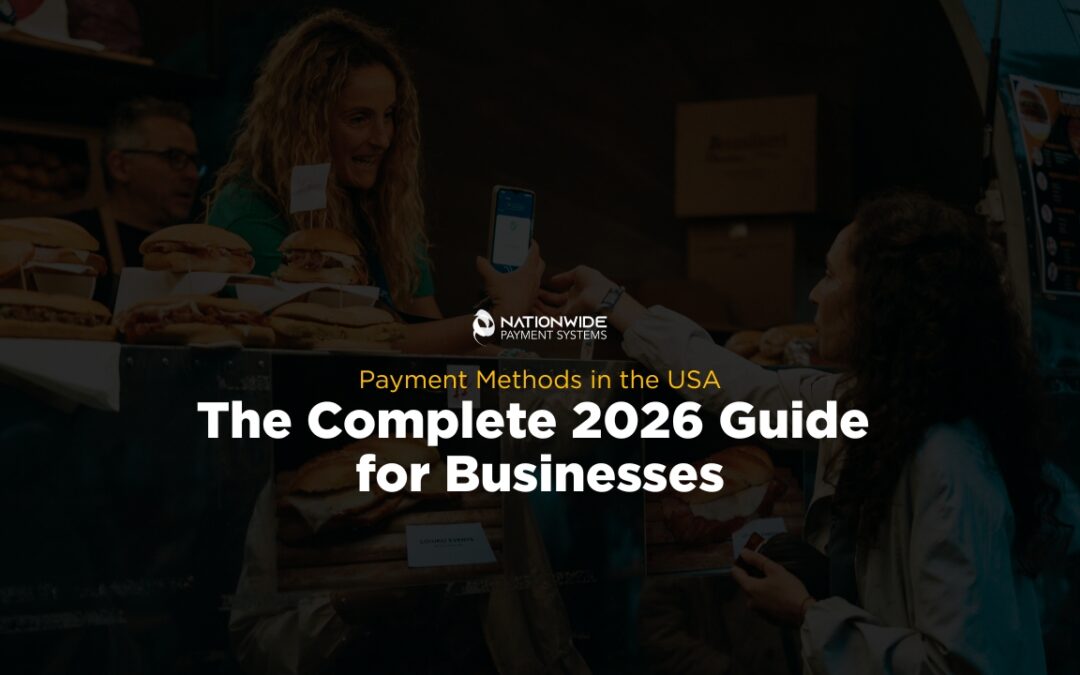
Payment Methods in the USA: The Complete 2026 Guide for Businesses
Explore payment methods available to U.S. businesses, including credit cards, ACH, digital wallets, PayPal, Venmo, Bitcoin, USDC, BNPL, Pay by Bank, Level 3 payments and more.
Presented by Allen Kopelman, CEO — Nationwide Payment Systems-Host of B2B Vault: The Biz2Biz Podcast
AI Overview
A comprehensive 2026 guide to payment methods available to U.S. businesses. It explains how companies can accept payments through cards, bank transfers, digital wallets, Buy Now Pay Later, crypto/digital assets, B2B payment tools, remote payment options, recurring billing, paper checks, and cash.
Main topics covered
- Traditional payments: credit cards, debit cards, ACH, Same Day ACH, eChecks, paper checks, wire transfers, and cash.
- Digital wallets: Apple Pay, Google Pay, PayPal, Venmo, Cash App, Alipay, and WeChat Pay.
- Buy Now, Pay Later: Klarna and other BNPL options for higher-ticket consumer purchases.
- Digital assets: Bitcoin, Bitcoin Lightning, and USDC, with emphasis on the difference between accepting crypto and holding crypto.
- Bank-to-bank payments: Pay by Bank, RTP, and FedNow as faster or lower-cost alternatives to cards.
- B2B payments: commercial cards, purchasing cards, Level 2 and Level 3 processing, virtual cards, and wire transfers.
- Remote payments: payment links, text-to-pay, digital invoices, QR-code payments, and virtual terminals.
- Recurring payments: card-on-file, subscription billing, scheduled payments, partial payments, and deposits.
sponsored by

Customers no longer expect every business to accept payments the same way.
Credit and debit cards remain important, but today's U.S. payment landscape includes ACH, digital wallets, Pay by Bank, payment links, QR codes, Buy Now Pay Later, real-time payments, Bitcoin, stablecoins, international wallets, virtual cards, and many other options.
For businesses, the question is no longer simply:
"Do you accept credit cards?"
The better question is:
"Which payment methods should we offer our customers, and what is the most efficient way to manage them?"
The answer depends on whether you sell B2B or B2C, accept payments in person or remotely, send invoices, process recurring payments, handle large-ticket transactions, or operate an e-commerce business.
This guide explains the major payment methods available to businesses in the United States in 2026, how they work, and where each one may fit.
What Is a Payment Method?
A payment method is the way a customer chooses to pay a business.
Examples include:
Credit cards
Debit cards
ACH
Bank transfers
Digital wallets
Payment links
Buy Now Pay Later
Bitcoin
Stablecoins
Checks
Cash
However, there is an important distinction between a payment method and a payment rail.
For example, Apple Pay is a digital wallet, but the underlying transaction may still travel over a Visa or Mastercard network.
Likewise, a Pay by Bank transaction may use ACH or another bank-payment network behind the scenes.
Understanding these differences can help businesses choose payment options based on convenience, cost, transaction size, speed, risk, and customer preference.
Complete List of Payment Methods Available in the USA
Credit Cards
Credit cards remain one of the most widely accepted payment methods in the United States.
The major card brands include:
Visa
Mastercard
American Express
Discover
Businesses can accept credit cards through:
EMV chip terminals
Contactless terminals
E-commerce websites
Virtual terminals
Mobile applications
Payment links
Digital invoices
Recurring billing
Integrated software
QR-code payments
Credit cards offer convenience and immediate authorization, but merchants should understand how interchange, processing fees and card-not-present risk affect their overall cost.
Debit Cards
Debit cards allow consumers to pay directly from funds available in their bank account.
Debit transactions may be processed through different networks and transaction types, including PIN debit and signature debit.
For businesses with significant consumer payment volume, debit-card optimization can be an important part of the payment strategy.
A business using flat-rate processing may pay essentially the same advertised percentage regardless of whether a customer uses an expensive rewards credit card or a lower-cost regulated debit card.
With an appropriately configured interchange-based merchant account, the economics can be very different.
ACH Payments
ACH, or Automated Clearing House, moves money electronically between U.S. bank accounts.
ACH can be especially attractive for:
B2B invoices
Large-ticket transactions
Recurring payments
Memberships
Property payments
Professional services
Contractors
Manufacturers
Distributors
Wholesalers
Instead of paying with a card, the customer authorizes funds to move from a bank account.
ACH can often be considerably less expensive than accepting a credit card, particularly on larger transactions.
Same Day ACH
Traditional ACH transactions may take time to settle.
Same Day ACH allows qualifying transactions to be processed on an accelerated schedule.
It can be useful when businesses want the economics of bank payments but don't want to wait as long for funds to move through the banking system.
Recurring ACH
ACH can also be used for recurring payments.
Examples include:
Monthly service contracts
Memberships
Insurance-related payments
Commercial accounts
Property management
Subscription services
Equipment leases
Professional retainers
For companies billing the same customer repeatedly, recurring ACH can reduce manual collections and help automate accounts receivable.
eCheck
An eCheck is an electronic form of a checking-account payment.
The term is often used in connection with ACH processing.
Instead of physically depositing a paper check, the business obtains authorization to electronically debit the customer's account.
Digital Wallets
Digital wallets have become an increasingly important part of the payment ecosystem.
They allow customers to store or access payment credentials digitally rather than entering card information manually every time they make a purchase.
Apple Pay
Apple Pay allows customers to make payments through compatible Apple devices.
It can be used in supported:
Retail terminals
Mobile environments
Applications
Websites
Online checkout experiences
For merchants, Apple Pay can make checkout faster and reduce the amount of card information consumers must manually enter.
Google Pay
Google Pay provides a similar payment experience for customers using supported Android devices and online environments.
It can be incorporated into both in-person and online payment experiences.
PayPal
PayPal is one of the best-known alternative digital payment methods in the United States.
Many consumers already maintain PayPal accounts, making it particularly relevant to online commerce.
For some businesses, offering PayPal alongside traditional credit-card acceptance gives customers another familiar checkout choice.
Venmo
Venmo evolved from person-to-person payments into a payment method that can also be used in supported commercial transactions.
Businesses targeting younger or mobile-first consumers may find Venmo particularly relevant.
Commercial transactions should always be processed using an approved business payment configuration rather than personal transfers intended for friends and family.
Cash App
Cash App is another major mobile wallet and money-transfer ecosystem.
Supported merchant implementations can allow customers to use Cash App as a payment option rather than manually entering traditional card information.
Alipay
Alipay is especially relevant for businesses serving international customers and travelers who are already accustomed to using the wallet.
While not as commonly used by the general U.S. consumer population as Apple Pay or PayPal, it can be an important alternative payment method for certain merchants.
WeChat Pay
WeChat Pay is another internationally recognized digital wallet.
It may be useful for U.S. businesses that serve customers accustomed to Chinese mobile-payment ecosystems.
As with other alternative payment methods, merchant availability depends on the payment provider, integration, geography, and underwriting.
Buy Now, Pay Later
Klarna
Klarna is a major Buy Now, Pay Later, or BNPL, payment option.
BNPL gives eligible consumers the ability to break purchases into scheduled payments rather than paying the entire purchase price immediately.
The merchant generally does not become the customer's lender. Under supported BNPL arrangements, the merchant receives payment according to the provider's settlement terms while the BNPL provider manages the consumer repayment arrangement.
BNPL can be attractive for:
Retail
E-commerce
Higher-ticket consumer purchases
Electronics
Furniture
Home improvement
Elective services
Other purchases where payment flexibility may increase conversion
Other Buy Now, Pay Later Options
BNPL is now a payment category rather than a single product.
Businesses considering Buy Now, Pay Later should evaluate:
Merchant fees
Eligible transaction sizes
Consumer approval requirements
Settlement timing
Refund procedures
Chargeback or dispute handling
Industry restrictions
The cheapest payment method isn't necessarily the one that creates the most sales.
A higher-cost payment option can potentially make sense if it materially improves conversion or average ticket size.
Digital Assets and Crypto Payments
Digital assets are another emerging part of the payment landscape.
This does not necessarily mean a business must begin holding cryptocurrency on its balance sheet.
Depending on the payment arrangement, a customer may use a supported digital asset while the merchant ultimately receives settlement in U.S. dollars.
Bitcoin
Bitcoin can be used as a payment method through supported digital-asset payment systems.
A merchant considering Bitcoin payments should determine:
Whether the business receives Bitcoin or dollars
Conversion timing
Transaction fees
Refund procedures
Accounting treatment
Compliance responsibilities
Settlement timing
Integration requirements
The distinction between accepting Bitcoin and holding Bitcoin is important.
A company may want to give customers the option to pay with Bitcoin without becoming a cryptocurrency investor.
Bitcoin Lightning
Bitcoin Lightning is designed to facilitate faster, smaller Bitcoin transactions through a payment layer built around the Bitcoin ecosystem.
For commerce, Lightning can potentially be more practical than waiting for traditional Bitcoin blockchain confirmations for every transaction.
Bitcoin and Bitcoin Lightning should therefore be viewed as related but distinct payment experiences.
USDC
USDC is a U.S. dollar-denominated stablecoin.
That makes it fundamentally different from an asset such as Bitcoin whose market value can fluctuate considerably.
Stablecoins are becoming particularly interesting in:
Online commerce
Cross-border payments
Digital businesses
Software platforms
B2B payments
Global contractor payments
Certain marketplace environments
Again, accepting a stablecoin does not necessarily mean the merchant must retain the stablecoin after the transaction. Payment providers may offer conversion and dollar-settlement capabilities.
Bank-to-Bank and Real-Time Payments
Pay by Bank
Pay by Bank allows a customer to pay directly using a bank account rather than a credit or debit card.
The checkout experience can vary depending on the provider and underlying banking technology.
Pay by Bank is particularly interesting for large purchases because businesses may be able to reduce their dependence on percentage-based card-processing fees.
RTP — Real-Time Payments
The RTP network provides participating financial institutions with infrastructure for real-time bank payments.
This is an important distinction:
RTP is a payment rail, not simply another digital wallet.
As bank connectivity becomes more integrated into software and checkout experiences, real-time account-to-account payments could become increasingly important.
FedNow
FedNow is another instant-payment infrastructure available through participating U.S. financial institutions.
Like RTP, FedNow should be thought of as banking infrastructure rather than a consumer wallet such as Venmo or Apple Pay.
Over time, consumers may interact with applications powered by these networks without necessarily knowing which bank-payment rail operates underneath the transaction.
B2B Payment Methods
B2B companies frequently have very different payment requirements from retailers.
A manufacturer collecting a $75,000 invoice should not necessarily use the same payment strategy as a coffee shop collecting an $8 purchase.
Commercial Credit Cards
Commercial cards are used by companies for business expenses and supplier payments.
Depending on the card and transaction, businesses may be able to qualify transactions for enhanced interchange programs when the appropriate data is submitted.
Purchasing Cards or P-Cards
Purchasing cards are commonly used by corporations and government organizations to purchase goods and services.
Businesses selling B2B should understand how P-Card transactions differ from ordinary consumer credit-card transactions.
Level 2 Payments
Level 2 card processing adds additional transaction information beyond basic payment data.
Examples may include:
Sales-tax information
Customer code
Purchase-order data
Providing enhanced data can improve reporting and, for qualifying transactions, may affect interchange qualification.
Level 3 Payments
Level 3 goes considerably further by transmitting detailed transaction information.
Depending on the transaction, that may include:
Product description
Quantity
Unit cost
Tax information
Freight
Purchase-order number
Additional line-item data
Level 3 processing can be particularly valuable for businesses accepting commercial, corporate, purchasing and government cards.
Manufacturers, distributors, wholesalers, suppliers, and other companies processing high-dollar B2B payments should investigate Level 2 and Level 3 optimization rather than assuming every card transaction costs the same amount.
Virtual Cards
Virtual cards are increasingly used in B2B accounts-payable environments.
Instead of sending a physical card, a payer generates payment credentials electronically.
Suppliers receiving virtual cards need a payment system capable of identifying and efficiently processing these transactions.
Wire Transfers
Wire transfers remain common for large-dollar transactions.
They may be appropriate for:
Very large purchases
Real estate-related transactions
International business
Equipment purchases
Large B2B invoices
Wires can be useful, but they typically do not provide the automated invoice reconciliation and customer-facing experience available through modern integrated payment systems.
Remote Payment Methods
A customer does not need to be standing in front of a terminal for a business to collect payment.
Payment Links
A payment link allows a business to send a customer a secure link to a hosted payment page.
Links can potentially be sent through:
Email
Text message
Invoice
Website
Customer portal
This can be much safer and more convenient than asking customers to send card numbers by email.
Text-to-Pay
Text-to-pay allows businesses to send customers a payment request by SMS.
The customer opens a secure payment page and completes the transaction.
This can be extremely useful for businesses trying to shorten accounts-receivable cycles.
Digital Invoices
Modern invoicing can turn an invoice into a payment experience.
With NPSONE Smart Invoicing, businesses can give customers convenient ways to pay invoices online while automating much of the collection workflow.
Depending on configuration, businesses can offer payment functionality including cards and ACH while supporting features such as:
Email invoices
SMS payment links
Recurring billing
Deposits
Partial payments
Scheduled payments
Automated reminders
Late fees
QR codes
Electronic signatures
Accounting-software synchronization
Smart Invoicing can connect payment acceptance directly with accounting workflows instead of forcing employees to repeatedly enter the same information in multiple systems.
QR-Code Payments
QR codes can direct customers to a secure payment experience using their mobile device.
QR payments can be used for:
Invoices
Events
Restaurants
Service businesses
Donations
Remote payment collection
Self-service environments
Virtual Terminal Payments
A virtual terminal allows an authorized employee to process a payment through a secure browser-based interface.
Virtual terminals are commonly used for:
Telephone orders
Mail orders
B2B payments
Office environments
Accounts receivable
Businesses should follow card-brand and PCI requirements when handling card information and should never treat manually keyed transactions as equivalent to EMV chip transactions.
Recurring and Subscription Payments
Card-on-File Payments
A business can securely maintain a tokenized payment credential for authorized future transactions.
Common applications include:
Memberships
Service contracts
Subscriptions
Repeat customers
Professional services
The actual card number should not simply be stored in an ordinary business database or spreadsheet.
Proper tokenization and PCI-compliant systems are critical.
Subscription Billing
Subscription billing automatically charges customers according to an agreed schedule.
Businesses can establish billing frequencies such as:
Weekly
Monthly
Quarterly
Annually
Custom schedules
Subscription management should include appropriate customer authorization, cancellation procedures, and transaction descriptors.
Scheduled Payments
Scheduled payments allow customers to select or agree to a future payment date.
This can be useful when invoices are issued before payment is actually due.
Partial Payments and Deposits
Not every invoice has to be collected in one transaction.
Businesses may need to collect:
Deposits
Progress payments
Milestone payments
Partial payments
Remaining balances
This is particularly useful for contractors, manufacturers, custom-order businesses, and professional services.
Traditional Payment Methods
Paper Checks
Checks remain surprisingly common in B2B commerce.
For many companies, however, paper checks create administrative work:
Receiving the check
Recording the payment
Depositing it
Reconciling the invoice
Managing returned checks
Moving customers from paper checks to ACH can significantly simplify accounts receivable.
Cash
Cash remains an important payment method for many in-person businesses.
Businesses accepting cash should still consider how cash transactions integrate into their accounting, POS, reporting, and reconciliation processes.
Payment Method Comparison
Payment Method Typical Speed Relative Merchant Cost Common Use Credit Card Immediate authorization Medium–High Retail, e-commerce, B2B Debit Card Immediate authorization Low–Medium Consumer payments ACH Typically, slower than cards Low B2B, invoices, recurring Same Day ACH Same-day capability Low Faster bank payments Apple Pay Immediate Card-dependent Retail, mobile, e-commerce Google Pay Immediate Card-dependent Retail, mobile, e-commerce PayPal Immediate checkout Varies Online commerce Venmo Immediate checkout Varies Consumer/mobile Cash App Immediate checkout Varies Consumer/mobile Klarna/BNPL Immediate merchant purchase flow Varies Higher-ticket consumer sales Bitcoin Network/provider dependent Varies Alternative payments Bitcoin Lightning Fast Varies Digital-asset payments USDC Network/provider dependent Varies Stablecoin/cross-border Pay by Bank Fast/varies Often lower than cards Large-ticket/B2B RTP Real time Varies Bank-to-bank payments FedNow Near real time Varies Bank-to-bank payments Level 2/3 Cards Immediate Optimization possible B2B Virtual Cards Immediate Card-dependent B2B supplier payments Wire Same day/varies Fixed fee Large transactions Check Slow Low direct cost Traditional B2B Cash Immediate Low direct cost In-person Pricing, availability, and settlement vary by processor, financial institution, payment method, merchant category, and transaction.
What Is the Cheapest Payment Method for a Business?
There is no single cheap payment method for every transaction.
For a $10 retail purchase, convenience may matter more than shaving a few cents from processing cost.
For a $100,000 B2B invoice, however, the difference between a percentage-based credit-card fee and a bank-payment option can become significant.
Businesses should evaluate payment cost according to:
Average ticket
Monthly volume
Card mix
Debit-card percentage
B2B versus consumer transactions
Payment channel
Chargeback exposure
Settlement requirements
Customer preferences
Accounting workload
Payment strategy should be based on total cost, not merely the advertised processing rate.
Should Businesses Offer Multiple Ways to Pay?
In many cases, yes.
Customers increasingly expect payment choice.
A business could potentially allow one customer to pay a $500 invoice with a credit card, another to pay $25,000 by ACH and another to use a digital wallet.
The goal isn't to add payment methods simply for the sake of having a longer list.
The goal is to provide the right payment choices for the transaction.
One Payment Strategy Instead of a Patchwork of Providers
One of the biggest payment problems we see isn't the lack of payment technology.
It's fragmentation.
A company may have:
One provider for credit cards
Another for ACH
Another gateway
Separate invoicing software
A separate recurring-billing application
Another system for accounting
Different integrations for online transactions
Additional vendors for alternative payment methods
That can create unnecessary reconciliation, reporting, support, and integration problems.
Nationwide Payment Systems takes a different approach.
NPSONE is designed to give businesses a flexible payment infrastructure that can connect payment acceptance with invoicing, accounting, e-commerce, and software integrations.
For B2B businesses, Smart Invoicing can connect with accounting platforms such as QuickBooks Online, Xero, and Sage Intacct, helping businesses combine accounts receivable with modern payment acceptance.
The objective is simple:
Give customers more ways to pay while making payments easier for the business to manage.
Which Payment Method Is Best for Your Business?
The best payment mix depends on the business.
Retail and Restaurants
Consider:
Credit cards, debit cards, contactless payments, Apple Pay, Google Pay and other supported wallets.
E-Commerce
Consider:
Cards, wallets, PayPal, alternative payment methods, BNPL, and appropriate fraud-management tools.
Manufacturers, Distributors and Wholesalers
Consider:
ACH, commercial cards, Level 2/3 processing, virtual cards, payment links, and integrated invoicing.
Contractors
Consider:
ACH, cards, digital invoices, payment links, deposits, progress payments and text-to-pay.
Professional Services
Consider:
ACH, credit cards, recurring billing, payment links, and stored payment credentials.
SaaS and Software Companies
Consider:
Cards, ACH, recurring billing, wallets, BNPL, embedded payments, and alternative payment-method integrations.
Large-Ticket B2B Businesses
Consider:
ACH, commercial cards with Level 2/3 optimization, Pay by Bank, wire transfers, and other bank-to-bank options.
The Future of Payments Is Payment Choice
Payments are moving away from the idea that every transaction starts and ends with a plastic credit card.
Consumers are using digital wallets.
Businesses are increasingly using ACH and virtual cards.
Banks are implementing faster account-to-account payments.
BNPL is changing how consumers finance purchases.
Stablecoins and digital assets are creating new payment possibilities.
And software companies are embedding payments directly into their platforms.
That does not mean every business needs every payment method.
It means businesses should build a payment strategy flexible enough to adapt as customer preferences change.
Nationwide Payment Systems helps businesses evaluate their existing payment environment, processing costs, accounts-receivable workflow, and technology to determine which payment methods make sense.
The goal isn't simply to accept more payments.
It's to make getting paid easier, faster, and more cost-effective.