
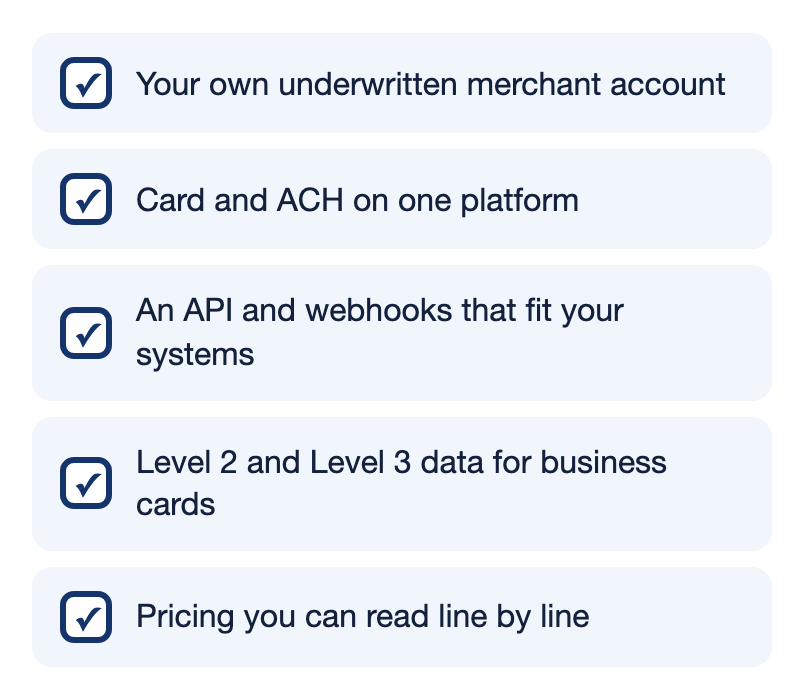
An enterprise payment platform is the setup a business moves to when one simple payment app can no longer carry its volume, its payment types or its accounting. The short answer to what you should look for: your own underwritten merchant account, card and ACH on one platform, an API and webhooks your developers can actually build on, Level 2 and Level 3 data for business cards, reporting that matches your books, and a person you can call when money stops moving. This guide explains the signs that you have outgrown a basic processor, the nine things worth checking before you switch, where Nationwide Payment Systems (NPS) fits, and where we do not.
The short version
- You have probably outgrown a basic processor if your fees, holds, payment types or reconciliation now cost you more time and money than the convenience of the app saves you.
- The biggest single change is moving from a shared, aggregated account to a merchant account underwritten for your business, because it changes how reviews, holds and pricing work.
- The platform matters as much as the rate. Card and ACH together, recurring billing, invoices, an API, webhooks and accounting sync decide how much manual work your team keeps doing.
- Get every term in writing, including pricing, reserves, contract length, equipment and what happens to your stored customer data if you ever leave.
Who we are, and what this guide will not do
Nationwide Payment Systems has worked with merchants since 2001 from South Florida, and we sell a payment platform called NPSONE, so we are one of the options in this guide. We will not quote rates, because we price each business individually and the honest comparison is a written quote against your own statements. We will tell you the kinds of businesses we are not a good fit for, and we suggest you hold every provider, including us, to the questions at the end.
What “enterprise payment platform” actually means
The phrase gets used loosely, so it helps to pin it down. A basic processor is usually built to get a business accepting cards in an afternoon. It shares one large account across many merchants, prices everything at a flat rate, and handles risk by reviewing businesses after they start processing. That model is a genuinely good start for a new or small business, and many companies stay on it for years without trouble.
An enterprise payment platform is built the other way around. The business is reviewed before it processes, it gets its own merchant account, and the platform is expected to fit into the company’s existing systems rather than the company bending around the platform. Instead of one checkout button, it covers every way money comes in: cards in person and online, ACH bank payments, invoices with payment links, recurring and subscription billing, deposits and partial payments, and transactions created by your own software through an API. The word “enterprise” is less about company size and more about complexity. A twenty-person distributor with large invoices and commercial card customers can need an enterprise setup more than a much bigger retailer with simple sales.
Signs you have outgrown a basic processor
Most businesses do not wake up one day and decide to change processors. The decision builds up through a series of small, expensive annoyances. If several of these sound familiar, it is worth a closer look.
Your fees grew faster than your sales
A flat rate is easy to understand, but it charges the same percentage on a low-cost debit card as on a premium rewards card, and the same on a small sale as on a large invoice. As volume grows, the gap between what the card networks actually charge and what a flat rate charges can become a real line item. Our comparison of payment processors by business type explains how flat-rate and cost-plus pricing differ and which kinds of business each one tends to suit.
Large payments get held or declined
A sudden large sale, a spike after a promotion or a change in what you sell can trigger an automated review on a shared account. The funds may be paused while the provider looks, and the business often cannot reach a person who can explain why. If a held deposit has ever forced you to delay payroll or a supplier payment, the structure of your account is now a business risk, not just a payments question.
Your customers want to pay in ways your setup handles badly
Business customers often want to pay large invoices by ACH, use a purchasing card, pay a deposit now and the balance later, or set up automatic monthly payments. When each of those needs a separate tool, a separate login and a separate report, your team ends up stitching them together by hand.
Reconciliation eats hours every week
If someone on your team spends part of every week matching deposits to invoices, chasing which payment belonged to which customer, or exporting spreadsheets so the accounting system makes sense, the payment platform is not doing its job. Payment data should flow into your books with enough detail that matching is mostly automatic.
Your developers have hit the limits of the integration
Software companies and businesses with custom systems often discover that a basic integration works for a standard checkout but not for their real workflow. They need payment events sent to their own systems, stored payment methods for repeat customers, their own branding on payment pages, and someone who will answer when an integration does not behave as the documentation says.
Nobody picks up the phone
Payments are infrastructure. When funding stops, when a large transaction declines, or when a chargeback arrives on your biggest customer, a help article is not enough. At some size, being able to call a person who knows your account becomes worth more than a slightly lower advertised rate.
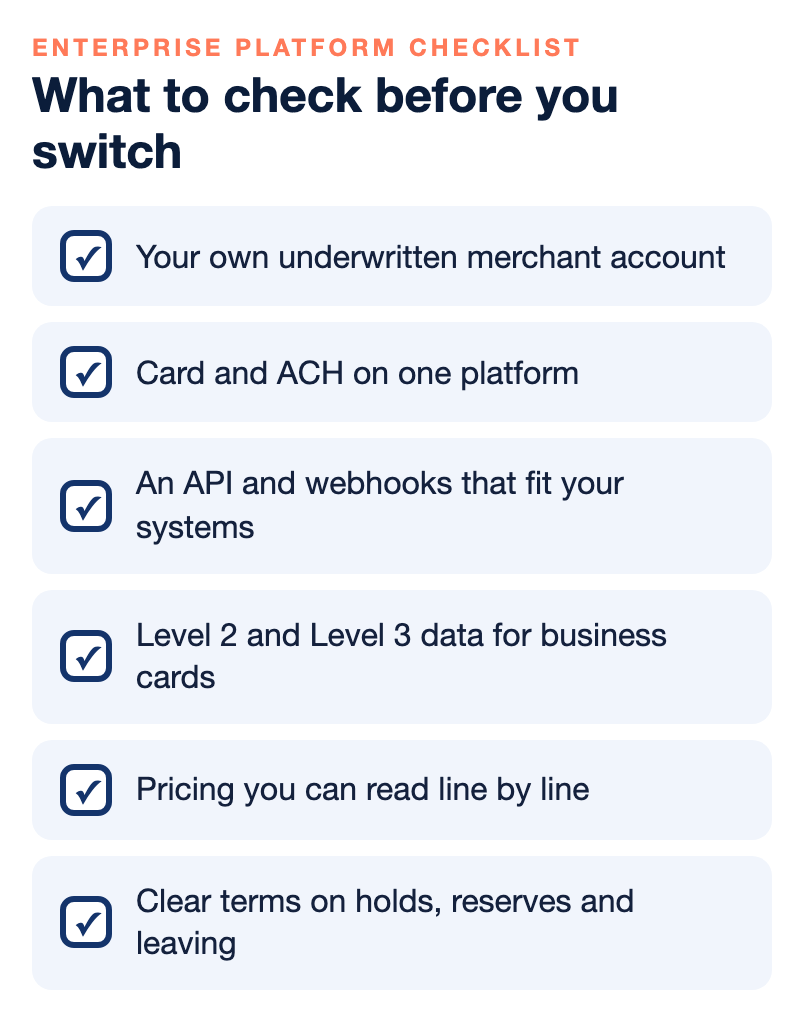
Nine things to look for in an enterprise payment platform
Every provider describes itself as flexible and supportive, so judge them on specifics. These nine areas separate a platform that fits a growing business from one that only looks good in a demo.
1. Your own underwritten merchant account
The most important difference is structural. With a dedicated merchant account, the acquiring bank and processor review your business up front, including what you sell, how you sell it, your processing history and your chargeback exposure. That review takes longer than an instant signup, but it means the account was approved for the business you actually run. Ask whether the account is in your company’s name, who the acquiring bank is, and what would cause the account to be reviewed or closed.
2. Card and ACH on one platform
For large invoices, ACH bank payments are often the more practical way for a business customer to pay, while cards still suit smaller and consumer purchases. A platform that supports both, with one login and one set of reports, removes a whole category of reconciliation work. Our ACH optimization guide explains how businesses decide which payments to steer toward ACH.
3. Invoicing, recurring billing and payment links
Many growing businesses collect most of their money after the work is done. Look for invoices that carry a secure payment link by email or text, partial payments and deposits, scheduled and recurring payments, and automatic reminders. The less your team has to chase a payment, the faster it tends to arrive.
4. An API and webhooks that fit your systems
An API lets your software create and manage payments. Webhooks let the payment platform tell your other systems when something happens, such as an approved payment, a declined card, a paid invoice or a failed recurring charge. Together they let a business mark an invoice paid, update a customer record or start fulfillment automatically. Ask to see the documentation, ask how testing works, and ask who helps your developers when something breaks.
5. Level 2 and Level 3 data for business cards
When your customers pay with corporate, purchasing, fleet or government cards, the amount of transaction detail you send can affect the underlying card cost. Level 2 and Level 3 processing pass extra information, such as tax amounts, purchase order numbers and line items, to the card networks. Not every transaction qualifies, and the platform has to send the data correctly. Our guide to Level 2 and Level 3 processing explains how qualification works.
6. Reporting and accounting sync that matches your books
Ask how deposits are grouped, whether fees are shown per transaction or netted out, and how payments connect to invoices in your accounting software. A platform that syncs with the system your accountant already uses saves more time than almost any feature on a sales sheet.
7. Pricing you can read line by line
Ask for a written quote based on your own recent statements, and ask to see a sample monthly statement. You should be able to see what the card networks charged, what the processor charged, and every monthly or annual fee. If a provider will only give you one blended number, ask why.
8. Clear terms on holds, reserves and leaving
Even a well-run business can be asked for a reserve, especially after rapid growth or a change in products. Ask how a reserve would be set, how long funds can be held, and how you will be notified. Ask how long the contract runs, whether there is a fee to leave, and whether you can take your stored customer payment data with you if you move. Portability rarely comes up in a sales call and matters a great deal later.
9. Support from people who know your account
Ask whether you get a named account manager, what the support hours are, and whether you can reach someone by phone. Ask who handles chargebacks, gateway problems and funding questions, and whether they are the same people or three different queues.
Basic processor or enterprise platform: how the two compare
Neither model is better for everyone. This table shows where each one usually fits, so you can see which side of the line your business sits on today.
| Question | Basic processor | Enterprise payment platform |
|---|---|---|
| When is the business reviewed? | Usually after it starts processing. | Before approval, with underwriting. |
| Whose account is it? | Often a shared, aggregated account. | A merchant account for your business. |
| How is it priced? | Usually one flat rate. | Usually quoted for your volume and card mix. |
| What payment types? | Strong on cards, other types vary. | Cards, ACH, invoices, recurring and API payments together. |
| Who do you call? | Often help articles and tickets. | Often a named contact and phone support. |
| How fast can you start? | Same day, in many cases. | Days to weeks, depending on the review. |
If most of your answers sit in the left column and nothing hurts, stay where you are. If your business keeps running into the right-hand questions, it is time to compare platforms.
How to switch without disrupting your sales
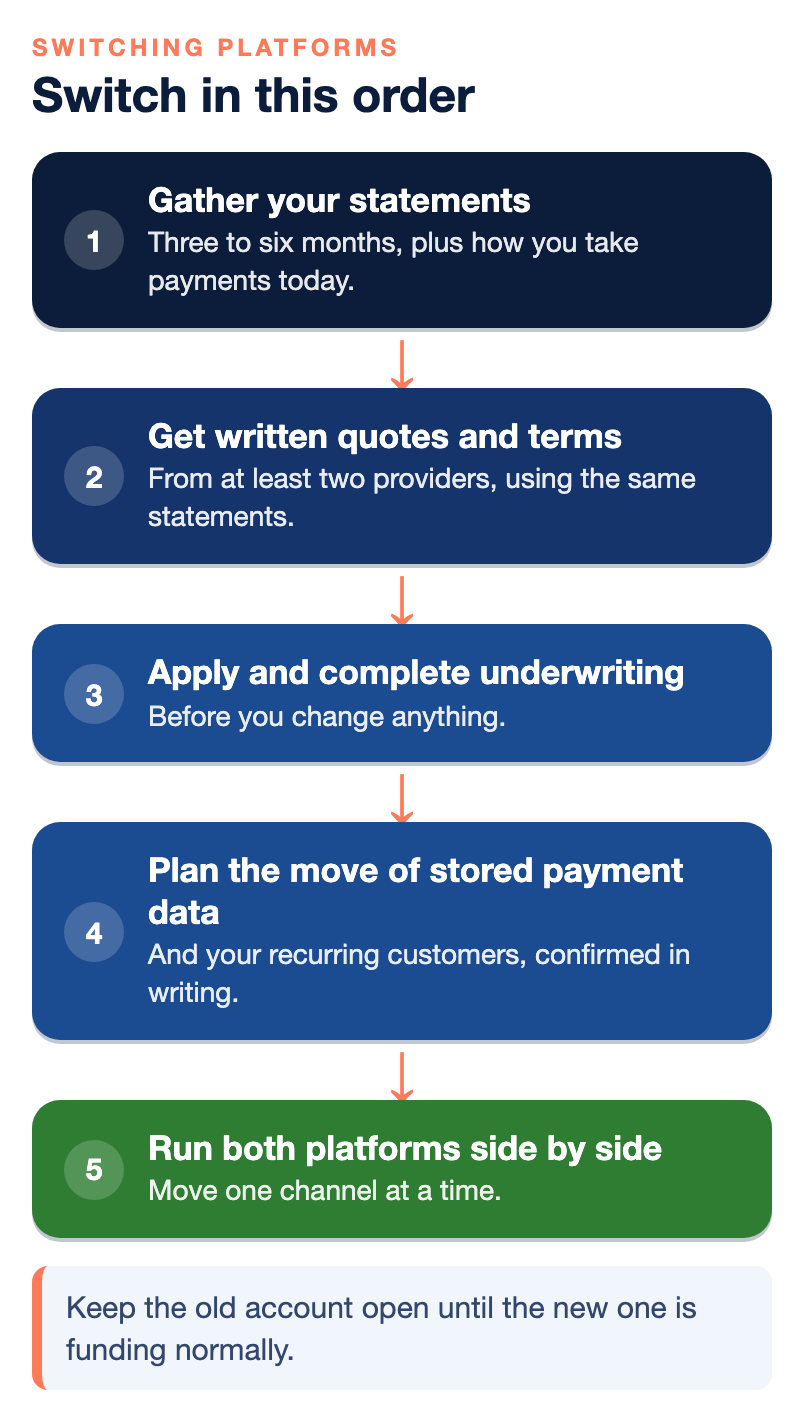
The fear that keeps many businesses on a platform they have outgrown is the switch itself. Done in the right order, it is usually far less disruptive than people expect.
- Gather your last three to six months of statements and a short description of how you take payments today, including every channel and every recurring customer.
- Get written quotes and terms from at least two providers, using the same statements so the comparison is fair.
- Apply and complete underwriting before you change anything, so the new account is approved for exactly what you sell.
- Plan the move of stored payment data and recurring customers, and confirm in writing how that transfer will work.
- Run both platforms side by side for a short period, moving one channel at a time, and keep the old account open until the new one is funding normally.
We wrote a separate guide on moving your payment processing without disruption that walks through this in more detail.
Where NPS fits, and where it does not
NPSONE is our payment platform. It accepts credit cards, debit cards and ACH, and it includes Smart Invoicing with payment links by email, text or QR code, recurring and subscription billing, deposits, partial and scheduled payments, hosted payment pages, a RESTful API, webhooks, a WooCommerce plugin and accounting software integrations. It can be white-labeled so the payment experience carries your brand. We support Level 2 and Level 3 processing for qualifying business transactions, and we work with businesses that need help with underwriting, including high-risk categories. For merchants processing more than $1 million a month, we offer a concierge program with direct access to our executive and risk teams. You can see more about the platform on our NPSONE page, and if your situation is unusual, such as an acquisition, a software platform or a processor shutdown, our payment consulting team works on exactly those projects.
Here is where we may not be the right choice:
- You process very little. We may not be the best fit for hobby sellers or businesses with very low volume.
- You want to be live in the next hour. We underwrite every account, so we are not an instant self-service signup.
- You would rather not provide documents. Any provider that underwrites properly will ask for statements and business details.
- You are choosing only on the lowest advertised flat rate. We do not publish one universal rate, because a distributor, a restaurant and a software company have very different costs.
- You need none of the extras. If you do not need support, integrations, invoicing, ACH or custom payment options, a simple processor may serve you well.
Questions to ask every provider before you sign
Ask each platform the same questions, ourselves included, and compare the answers side by side.
- Is the merchant account in my company’s name, and who is the acquiring bank?
- Can you show me a written quote and a sample statement based on my real volume?
- Do you support card and ACH on one platform, with one set of reports?
- Can my developers see your API documentation and test environment before we sign?
- Do you support Level 2 and Level 3 data, and how do you confirm it is being sent?
- How would a reserve or hold be set, and how will I be notified?
- How long is the contract, what does it cost to leave, and can I take my stored payment data with me?
- Who do I call when funding stops, and is there a named person on my account?
A provider that answers all eight plainly and in writing is worth a serious look. One that avoids two or three of them has told you something important.
Bottom line
Outgrowing a basic processor is a sign of a healthy business, not a failure of the processor. The right enterprise payment platform is the one built for how your money actually comes in, with your own merchant account, card and ACH together, real integrations and terms you have read before you sign. Start with your statements, compare written quotes, and switch one channel at a time.
If you would like a second opinion on your current setup, you can talk with our team, or browse more topics in our payments guides. If a simpler setup fits you better, we will tell you so.
Frequently asked questions
What is an enterprise payment platform?
It is a payment setup built for businesses with more volume or more complexity than a simple payment app handles well. It usually includes your own underwritten merchant account, card and ACH payments together, invoicing and recurring billing, an API and webhooks, and reporting that connects to your accounting software. The word is more about complexity than company size.
How do I know my business has outgrown a basic processor?
Common signs are fees growing faster than sales, large payments being held or declined, customers asking to pay by ACH or purchasing card, and hours spent every week matching deposits to invoices. Another sign is needing to reach a person quickly when money stops moving. If several of these apply, compare written quotes from at least two providers.
What is the difference between an aggregator and a dedicated merchant account?
An aggregator places many businesses under one shared account and usually reviews them after they start processing. A dedicated merchant account is underwritten for your business before you process, which takes longer but means the account was approved for what you actually sell. The difference shows up most when a large payment or a sudden spike triggers a review.
Is an enterprise payment platform more expensive?
Not necessarily. The cost depends on your volume, average sale, card mix and how many payments can move to ACH or qualify for Level 2 and Level 3 data. The only reliable comparison is a written quote based on your own recent statements, with every fee listed.
How long does it take to switch payment platforms?
Underwriting can take days to weeks, depending on your business and how complete your documents are. Plan the switch so the new account is approved before you change anything, move one channel at a time, and keep the old account open until the new one is funding normally.
Can I keep my stored customer cards when I switch?
Often, but it is not automatic. Moving stored payment data depends on both the old and the new provider, so ask each one in writing how a transfer would work before you sign. Plan your recurring customers carefully so nobody is charged twice or missed.
What is Level 3 processing and do I need it?
Level 3 processing sends extra transaction detail, such as line items and purchase order numbers, along with payments made on qualifying business, purchasing, fleet or government cards. It matters most to businesses that sell to other businesses or to government buyers. Ask whether your platform supports it and how it confirms the data is being sent.
Does NPS offer an enterprise payment platform?
Our platform, NPSONE, accepts cards and ACH and includes Smart Invoicing, recurring billing, an API, webhooks, a WooCommerce plugin and accounting integrations, backed by an underwritten merchant account and phone support. It is not an instant self-service signup, and it may not suit very low-volume sellers. We quote each business individually.





