An online retail store can accept cryptocurrency without ever holding any, and for most stores that is the right way to do it. A crypto payment processor shows the customer a price in the coin they choose, takes the payment, and settles to your store in U.S. dollars, so your prices, margins and accounting stay in dollars. The harder questions are not technical. They are whether enough of your customers actually want to pay this way, how you will handle refunds when there are no chargebacks, and how the payments are taxed. This guide walks through each one, says who crypto suits and who it does not, and explains where Nationwide Payment Systems (NPS) fits.
The short version
- Accepting crypto is not the same as holding crypto. Most stores should settle in dollars and let the processor take the price risk.
- Stablecoins and bitcoin behave very differently. A dollar-based stablecoin keeps the same value, while bitcoin’s price can move a lot between checkout and settlement.
- There are no chargebacks, and that cuts both ways. You avoid card disputes, but you need your own clear refund policy and process.
- The IRS treats digital assets as property, and crypto you receive for goods counts as income at its dollar value. Talk to your accountant before you start.
- Crypto is an extra option, not a replacement. Keep card and wallet payments, which most of your customers will still use.
Who wrote this
Nationwide Payment Systems has handled payments for businesses since 2001. We have watched the crypto payments market closely, including the boom years when many luxury and online sellers began accepting it and the hard stretch that followed when exchanges failed and prices fell. We would rather help a store decide carefully than talk it into something it does not need. Nothing here is tax, legal or investment advice, and crypto rules change, so check current guidance with your accountant and your payment provider.
How crypto payments work at an online checkout
For an online store, the flow is simpler than most people expect. The customer chooses to pay with crypto at checkout, picks a coin such as bitcoin or a dollar-based stablecoin, and sees exactly how much of that coin equals the order total. They send the payment from their digital wallet, often by scanning a QR code or connecting the wallet directly. The crypto payment processor confirms the payment and then, depending on how you set it up, either converts it to U.S. dollars and deposits it in your bank account or passes the coin through to a wallet you control.
Our own guide to payment methods in the USA makes the key distinction plainly: a store can give customers the option to pay with bitcoin without becoming a cryptocurrency investor. That single choice, dollars or coins, shapes almost everything else in this guide.
Settling in dollars or holding coins
Settling in dollars
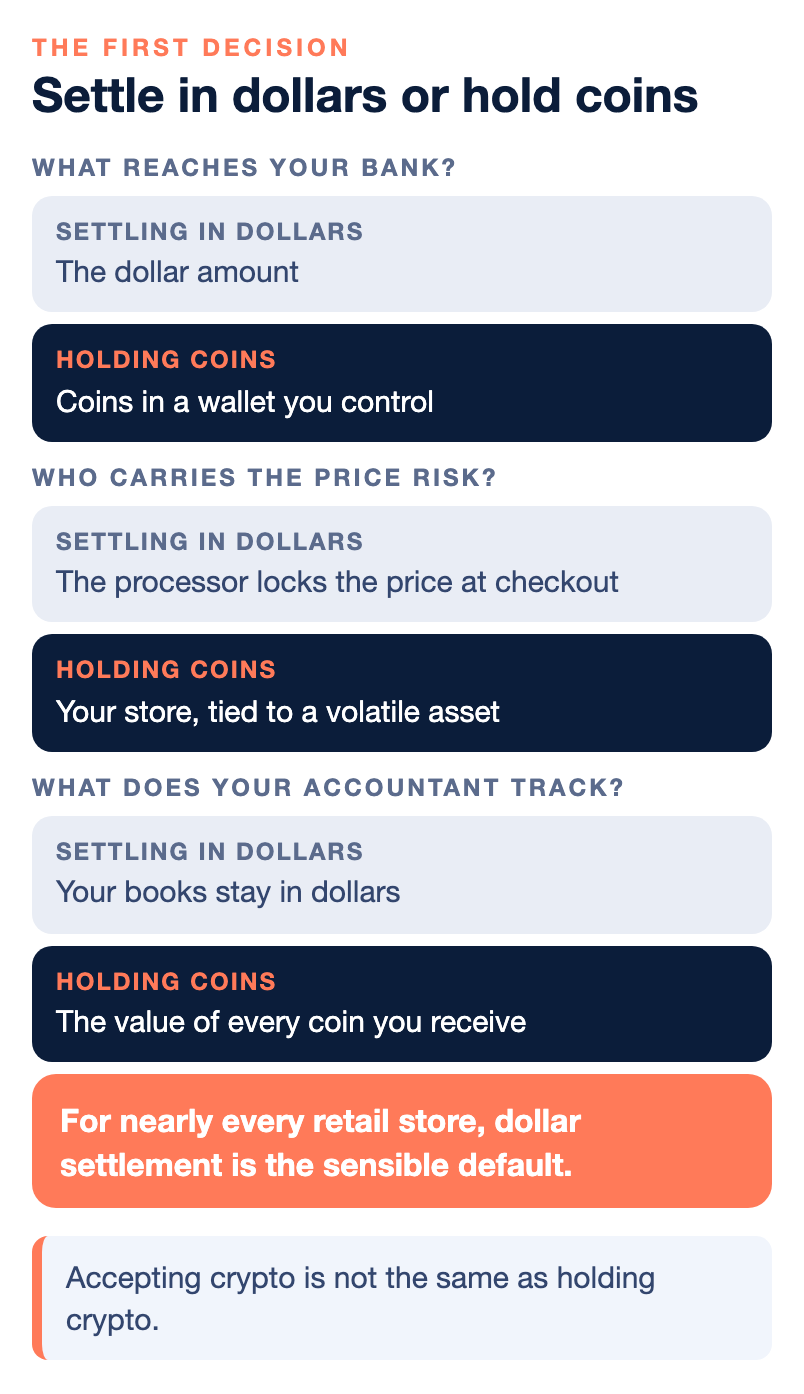
With dollar settlement, the processor locks the price for a short window at checkout, takes the coin, and pays you the dollar amount. Your store never holds crypto, your books stay in dollars, and a drop in bitcoin’s price the next morning does not touch your margin. For nearly every retail store, this is the sensible default. You get a new way for customers to pay without taking on a new kind of financial risk.
Holding coins
Some business owners choose to keep part or all of their crypto receipts because they believe the coin will rise in value. That is an investment decision, not a payments decision, and it comes with real consequences. Your store’s cash flow becomes tied to a volatile asset, your accountant has to track the value of every coin you receive and every coin you later spend or sell, and a fall in price can turn a profitable month into a loss. If you go this way, keep it separate from operating cash, and decide in advance how much you are willing to hold.
Bitcoin, stablecoins and faster networks
“Crypto” covers very different assets, and the choice of which ones to accept matters.
- Bitcoin is the best known, and the one customers ask for most by name. Its price can move considerably, and payments on its main network can take longer to confirm than a card payment, which matters at checkout.
- Bitcoin Lightning is a payment layer built around bitcoin and designed for faster, smaller payments. For everyday online purchases it can be more practical than waiting for main network confirmations, if your processor supports it.
- Dollar-based stablecoins, such as USDC, are designed to hold the same value as the U.S. dollar. That makes them behave much more like a bank payment, and they are increasingly used in online commerce and cross-border payments.
Most stores that accept crypto start with bitcoin and one or two stablecoins, because that covers most of the customers who want to pay this way without complicating the checkout.
Refunds, disputes and why there are no chargebacks
A crypto payment, once confirmed, cannot be pulled back by the customer’s bank the way a card payment can. There is no chargeback process. For a store that loses money to friendly fraud on cards, that sounds like good news, and in part it is.
The other side is that your customers lose the protection a card dispute gives them, and they know it. A store that accepts crypto needs a refund policy that is just as clear and just as fair as its card policy, written down before the first sale. Decide two things in advance:
- What amount you refund. Most stores refund the original dollar value of the order, not the same number of coins, because the coin’s price may have changed. Say so in your policy.
- How you refund. Some crypto processors can send refunds back to the customer’s wallet, and some stores refund by store credit or another method. Confirm what your processor supports and how it verifies the customer’s wallet address, since a payment sent to the wrong address cannot be recovered.
Because crypto payments are final, mistakes are expensive. Make sure your checkout shows the exact amount and the coin clearly, and that an order is only marked paid after the processor confirms the payment.
Taxes and accounting
The IRS says that for U.S. tax purposes, digital assets are considered property, not currency. When your business receives crypto as payment for goods, that income is taxed as ordinary income, and the IRS expects you to track the dollar value of the digital assets you receive in the ordinary course of business. If you hold the coins and later sell or spend them, that is another taxable event to record.
Dollar settlement makes this much simpler, because the processor’s records show the dollar amount of each sale and your deposits arrive in dollars. Holding coins means tracking each one from the day it arrived. Either way, talk to your accountant before you switch crypto on, and make sure your payment records export cleanly into your accounting software.
Is crypto worth it for your store?
This is the question most guides skip. Crypto payments are worth adding when they bring in sales you would not otherwise get, and not worth it when they only add complexity. A few honest tests:
Do your customers actually ask for it?
Look at your support messages, your social comments and your abandoned checkouts. If customers have asked to pay with crypto, or if your audience overlaps heavily with people who hold it, there is real demand. If nobody has ever asked, a crypto button is unlikely to change your sales much.
Do you sell higher-priced items?
When crypto payments were booming, many of the businesses accepting them sold luxury goods, such as jewelry, watches, cars, boats and high-end rentals. Higher-priced items and buyers who already hold digital assets tend to go together, and the savings on card costs matter more on a large order.
Do you sell internationally?
Stablecoins are becoming particularly interesting for cross-border payments, because they can move between countries without the conversion and acceptance problems some international cards bring. A store with a large share of overseas customers may get more from crypto than a store that ships only within the United States.
Can you support it properly?
Someone on your team needs to understand the checkout, the refund process and the reporting. If that is not realistic right now, it is better to wait than to launch a payment option you cannot support.
Think about the customer who pays the wrong amount, the one who sends a payment after the locked price has expired, and the one who wants a refund three weeks later when the coin is worth less than it was. Each of those will happen sooner or later. If your team knows what the processor does in each case and what your policy says, crypto runs quietly in the background. If nobody knows, those customers end up waiting while someone reads the processor’s help pages, and a payment option meant to win sales starts losing goodwill instead.
Accepting crypto is different from selling crypto
One distinction matters for compliance. A store that accepts crypto as payment for its own products is using a payment method. A business whose product is crypto itself, such as an exchange, a wallet service or a marketplace that holds and moves customers’ coins, is a regulated financial business with its own registration and compliance obligations. Our decentralized finance page explains that we only work with companies in that space that are registered with FinCEN, compliant with SOC 2 and following current IRS rules. If your store sells digital assets, gift cards for crypto or anything that looks like money movement, treat it as a separate conversation with your processor, because it is often reviewed as a high-risk category.
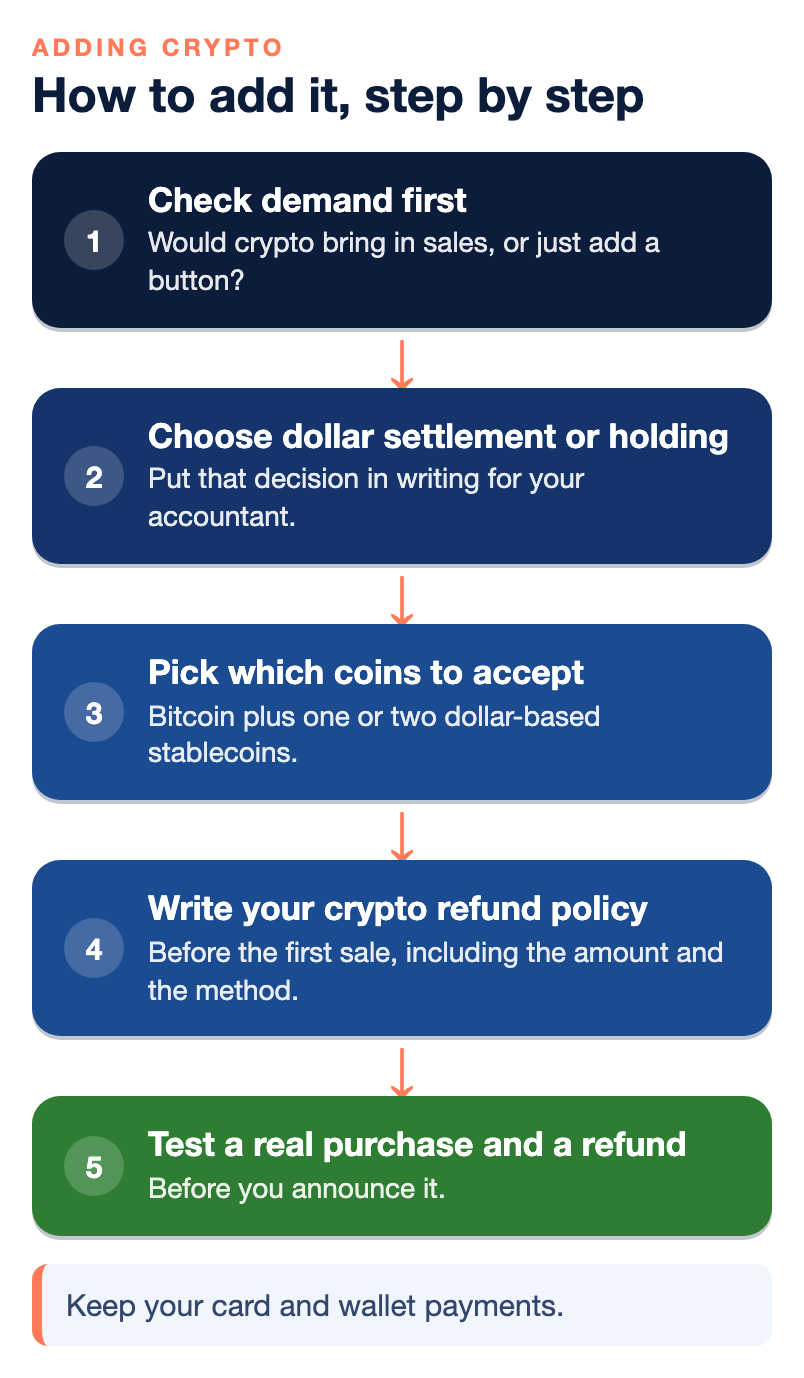
How to add crypto to your online store, step by step
- Check demand first. Review customer requests and decide whether crypto would bring in sales or just add a button.
- Choose dollar settlement or holding, and put that decision in writing for your accountant.
- Pick which coins to accept. Bitcoin plus one or two dollar-based stablecoins covers most customers.
- Choose a crypto payment processor that works with your store platform, explains its fees in writing and supports refunds.
- Write your crypto refund policy before the first sale, including the amount and the method.
- Test a real purchase and a refund before you announce it, and make sure orders are only marked paid after confirmation.
- Keep your card and wallet payments. Crypto is an extra option, and most customers will still pay the way they always have.
Questions to ask any crypto payment processor
- Do you settle in U.S. dollars, in coins, or a mix I choose?
- How long is the price locked at checkout, and what happens if the customer pays late or pays the wrong amount?
- Which coins and networks do you support, including stablecoins and Lightning?
- How do refunds work, and who carries the cost if a coin’s price moves before a refund?
- What are all of your fees, in writing, including conversion and payout fees?
- How do your reports export to my accounting software for taxes?
- What identity checks do you run on my business, and are you registered where you need to be?
Where NPS fits, and where it does not
For most online stores, card and digital wallet payments will still carry nearly all of the sales, and that is where we do most of our work: merchant accounts for online stores, e-commerce gateways, hosted checkout, a WooCommerce plugin and support from people you can call. You can see more on our online store payment processing page. Our decentralized finance page also describes a solution for accepting cryptocurrency in person, by invoice or on a website, and we can talk through whether a crypto option makes sense alongside your card processing.
We may not be the right fit if you want an instant self-service signup without underwriting, if you process very low volume, or if your business is itself a crypto exchange or wallet service that is not registered and compliant. We would also tell a store with no customer demand for crypto to put its effort elsewhere.
Bottom line
Accepting cryptocurrency in an online store is easier than it sounds and riskier than it looks only if you choose to hold the coins. Settle in dollars, start with bitcoin and a stablecoin, write a clear refund policy, and get your accountant involved before the first sale. Above all, add it because your customers want it, not because it is new.
If you want to talk through crypto alongside your card processing, you can contact our team, or browse more topics in our payments guides.
Frequently asked questions
Can an online store accept cryptocurrency without holding it?
Yes. Most crypto payment processors can convert the payment and settle to your bank account in U.S. dollars. The customer pays in crypto, and your store receives dollars, so your prices and accounting stay in dollars. For most retail stores, this is the sensible default.
Which cryptocurrencies should an online store accept?
Most stores start with bitcoin, because customers ask for it by name, plus one or two dollar-based stablecoins such as USDC. Stablecoins hold the same value as the dollar, which makes them behave more like a bank payment. Adding many coins usually complicates checkout without adding many sales.
Are there chargebacks on crypto payments?
No. Once a crypto payment is confirmed, the customer’s bank cannot pull it back the way it can with a card. That protects you from card disputes, but it means your own refund policy has to be clear and fair, and it should be written before the first sale.
How do refunds work for crypto payments?
Decide in advance whether you refund the original dollar value or the same number of coins, and say so in your policy. Most stores refund the dollar value. Confirm what refund methods your processor supports, because a payment sent to the wrong wallet address cannot be recovered.
How are crypto payments taxed for a business?
The IRS says digital assets are treated as property, not currency, and crypto received as payment for goods is taxed as ordinary income at its dollar value. If you hold the coins and later sell or spend them, that is another event to record. Talk to your accountant before you start accepting crypto.
Is accepting crypto worth it for a small online store?
It depends on demand. If customers have asked to pay with crypto, if you sell higher-priced items, or if you sell internationally, it may bring in sales you would not otherwise get. If nobody has ever asked, it is unlikely to change your sales much.
Does accepting crypto make my store high-risk?
Accepting crypto as payment for your own products is a payment method, not usually a high-risk business by itself. Selling crypto, running an exchange or wallet, or moving customers’ coins is a regulated financial business with its own compliance obligations. Tell your processor exactly what you do.
Can NPS help my store accept cryptocurrency?
We focus on the card and wallet payments that carry most online sales, with merchant accounts, gateways, hosted checkout and a WooCommerce plugin. Our decentralized finance page describes a solution for accepting crypto in person, by invoice or online, and we can talk through whether it fits alongside your card processing.