
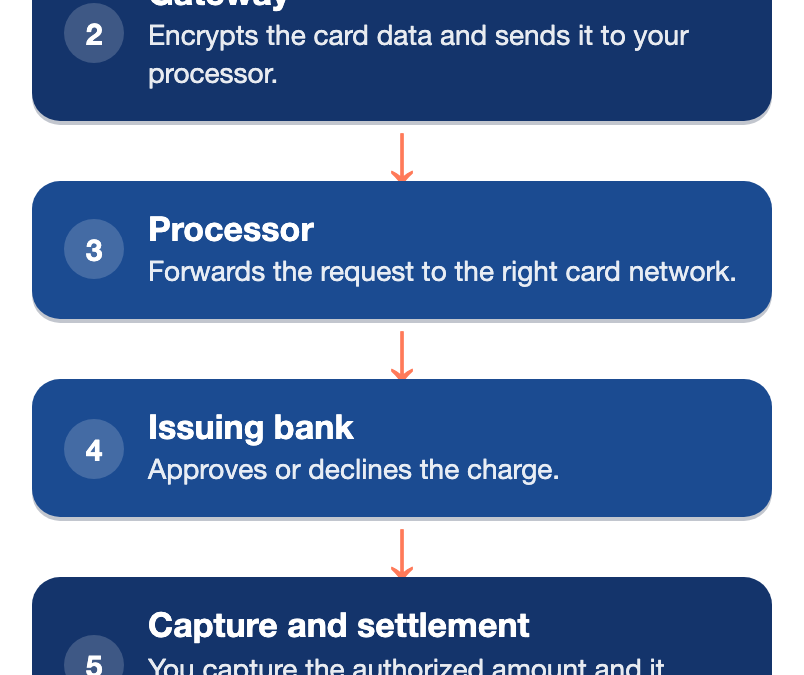
E-commerce payment processing for an online pharmacy is the chain of companies and steps that moves a patient’s card payment from your checkout page to your bank account, with extra checks layered on because the product is a prescription. The basic flow is the same one every online store uses: a gateway takes the card details, a processor routes them, the card network asks the patient’s bank for approval, and the acquiring bank that holds your merchant account pays you. What makes a pharmacy different is everything around that flow, from certification and card-brand registration to when you capture the charge and how you handle refunds for orders that never ship. This guide walks through each step, shows where the pharmacy-specific checks sit, and ends with the questions to ask before you pick a processor.
The bottom line
- The plumbing is ordinary. Gateway, processor, card network, issuing bank and acquiring bank work the same way for a pharmacy as for a clothing store.
- The approval is not ordinary. Selling prescription products online is treated as a regulated, higher-risk category, so expect deeper underwriting, a review of your pharmacy and prescriber relationships, and often an independent healthcare certification such as LegitScript.
- Timing matters more than usual. An order can fail after checkout because a prescription is not verified, so how and when you capture the charge affects refunds, disputes and your standing with the bank.
- Start the payment conversation early. The most expensive version of this is building the whole business, launching on a generic payment app, and finding out afterward that your model was never approved.
Who wrote this, and what we will not claim
Nationwide Payment Systems (NPS) publishes this guide. We are a payment processing company in South Florida, in business since 2001, and we work with telemedicine, pharmacy and other regulated healthcare merchants, so we are one of the options a pharmacy owner might consider and we are not neutral. We do not quote rates here, we do not promise that any business will be approved, and we say below which pharmacies we are the wrong fit for. Nothing here is legal or pharmacy-licensing advice. Pharmacy law, card-brand rules and processor policies change, so confirm anything here with your own counsel and processor before you act on it.
How an online card payment moves, step by step
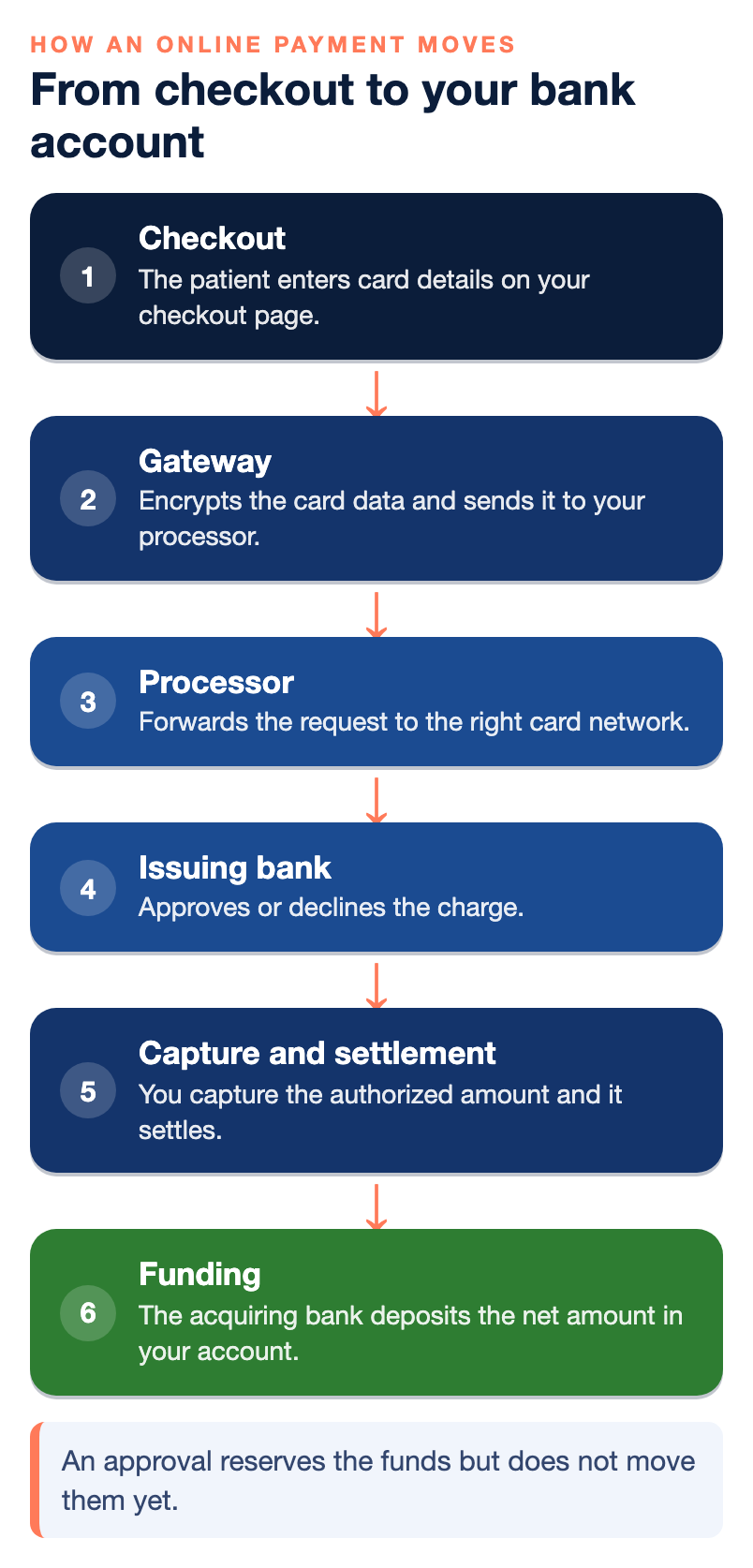
It helps to see the whole path once before looking at what a pharmacy adds to it. When a patient pays on your website, the payment is card-not-present, which means the card is never physically swiped or tapped, and that single fact shapes how banks look at the risk. Here is what happens between the moment the patient clicks pay and the moment the money lands in your account.
- Checkout. The patient enters card details on your checkout page or a hosted payment page.
- Gateway. The payment gateway encrypts the card data and sends the request to your processor. A good gateway also tokenizes the card, so your systems store a token instead of the card number.
- Processor. The processor forwards the request to the right card network, such as Visa or Mastercard.
- Issuing bank. The network passes it to the bank that issued the patient’s card, which approves or declines it based on available credit, fraud signals and its own rules.
- Authorization. The answer travels back through the network, processor and gateway to your checkout in a few seconds. An approval reserves the funds but does not move them yet.
- Capture and settlement. When you capture the authorized amount, it goes into a batch that settles through the networks.
- Funding. The acquiring bank that holds your merchant account deposits the net amount into your business bank account, after fees and any reserve.
If the term merchant account is new to you, start with our explainer on what a merchant account is, which covers how the account holds approved card funds until they settle into your business bank account.
The parts of the stack, and who decides what
Most of the confusion in pharmacy payments comes from treating these companies as one. They are separate, they each make their own decision about your business, and a yes from one does not carry over to the others.
| Part | What it does | What it decides about a pharmacy |
|---|---|---|
| Acquiring bank | Holds your merchant account and takes on the financial exposure for your transactions. | Whether it will underwrite your pharmacy model at all, and on what terms. |
| Processor | Routes transactions and runs the program your account sits in. | Whether its program supports prescription sales, and what it monitors after approval. |
| Gateway | Connects your checkout to the processor, handles encryption, tokens and recurring billing. | Mostly technical, but it has to work with your pharmacy software and checkout. |
| Card networks | Set the rules every bank and merchant on their network must follow. | Whether your category needs registration or extra monitoring. |
| Issuing bank | The patient’s bank, which approves or declines each charge. | Whether a single patient’s card goes through, and how a dispute is first handled. |
Behind all of them sit the parts that have nothing to do with payments but decide whether payments are possible: state pharmacy licensing, prescriber licensing in the states where your patients live, federal drug rules, and the advertising platforms you plan to market on. Each of these is its own approval.
What changes when the product is a prescription
An online store selling candles and an online pharmacy can use the same gateway. What they cannot share is the risk picture, and that picture drives almost every difference you will notice, from the length of the application to the questions your processor keeps asking after you go live.
Underwriting goes deeper
When a transaction involves prescription medication, the acquiring bank and processor carry far more compliance exposure than they do with ordinary retail, so the underwriting goes further. Expect questions about ownership, licenses, which pharmacy fills the prescriptions, which states you serve, who your prescribers are, what your website says, your expected monthly volume, your average order, your refund policy and whether patients are billed on a recurring basis. The bank is trying to answer one question: if something goes wrong with these orders, will it be left holding the loss? Banks also have different appetites. One may approve a model that another declines because of the medications involved, the marketing, the fulfillment structure or the chargeback exposure, which is why we explain high-risk merchant services as a matter of matching a business to the right bank rather than finding any bank that says yes.
Independent certification is often part of the file
For many online pharmacies, a key part of the approval is an independent healthcare certification. LegitScript Healthcare Merchant Certification is the one most often discussed, and online pharmacies, mail-order pharmacies and compounding pharmacies are among the businesses it covers. Certification means an outside reviewer has examined your business model, website, licenses, providers, pharmacy relationships, products and affiliations against defined standards, which gives a processor verified information before it decides. It does not guarantee an account. The bank and processor still run their own underwriting, and they can still say no. We cover the process in detail in our LegitScript certification guide, including why you can often start the review before your website is finished.
The card networks care about your category
Every merchant account carries a merchant category code that tells the networks what kind of business is charging the card. Drug stores and pharmacies have their own code, and prescription sales made online, without the card present, draw closer attention from the networks than the same sale at a counter. Some regulated categories must be registered with the card brands before they can process at all, and the processor normally handles that registration with you. The practical rule is simple: describe your pharmacy exactly as it operates so it is coded and registered correctly from the start. A pharmacy coded as general retail is an account waiting to be closed.
Prescription checks change when you should capture
Here is where pharmacy checkout differs from a normal store in a way that affects your money directly. A patient can pay for an order that you later cannot fill, because the prescription cannot be verified, the prescriber does not respond or the medication is out of stock. If you captured the full charge at checkout, every one of those orders becomes a refund, and refunds that arrive late or not at all become disputes. Many online sellers authorize the card at checkout and capture the charge when the order is approved and ships, which keeps a failed prescription from turning into money you have to send back. Ask your processor how long an authorization stays valid on your account, what happens if you capture after it expires, and how partial captures work when only part of an order can be filled.
Refills and subscriptions bring their own risk
Refill programs and memberships are attractive because they make revenue predictable. They are also where disputes come from, because a patient who forgot about a recurring charge often calls the bank before calling you. If you bill on a schedule, tell patients clearly what they are signing up for, how often they will be charged and how to stop, send a reminder before each charge where it makes sense, and use a billing descriptor that patients will recognize on their statement. Store cards as gateway tokens rather than card numbers, and make cancellation as easy as sign-up.
Your website is part of the underwriting file
For a pharmacy, the website does more than sell. Underwriters and certification reviewers read it, often before they read your application. It should describe your services, medications, pharmacy and prescriber relationships and the states you serve accurately, show your real business name and contact details, and include clear privacy, refund, shipping and cancellation terms. Remove claims you cannot support. Promises of guaranteed results, comparisons to brand-name drugs and anything labeled approved that is not approved are common reasons for delays and remediation.
Your partners count as part of your business
If another pharmacy fills your prescriptions, or a provider network writes them, expect that relationship to be reviewed too. Their licenses, their agreements with you and the states they serve all become part of your file, and a problem with a partner can become a problem for your merchant account. Know who you work with, keep the agreements on hand, and tell your processor when a partner changes.
Why a generic payment app is risky for a pharmacy
Instant-approval payment platforms are built for speed. You can usually open an account in minutes and start charging cards the same day, and the platform does most of its risk review later, once transactions are flowing. That works well for many simple online stores. For an online pharmacy it can be a trap, because healthcare and pharmaceutical products often sit on these platforms’ restricted or prohibited business lists, and the review that should have happened before your first sale happens after you already depend on the deposits.
The worst moment to learn that your model does not fit a processor’s policy is after you have hundreds of patients on recurring refills, funds being held, an advertising campaign running and payroll due. Read any platform’s terms, restricted business list and healthcare or pharmaceutical policies before you process a single prescription through it. If an account is closed for certain reasons, the acquiring bank can also add the business to MATCH, the database banks check on new applications, which can make the next account much harder to get. We explain how that happens in 14 reasons merchants end up on the MATCH list.
What drives the cost of processing for a pharmacy
We do not publish one rate for pharmacies, and you should be cautious of anyone who quotes one before seeing your business. Pricing for regulated healthcare usually reflects the extra risk and monitoring the bank takes on, and it depends on factors that differ from one pharmacy to the next:
- Your model. Prescription only, over-the-counter products, compounded medications, or a mix.
- Your volume and average order. How much you process each month and how large a typical order is.
- Your dispute and refund history. A clean history and good controls usually mean better terms.
- Recurring billing. Subscription and refill programs carry more dispute exposure than one-time orders.
- Reserves. Whether the bank holds back part of each day’s sales for a period, and for how long.
- The pricing model. Flat-rate pricing and interchange-plus pricing split costs differently.
The only reliable comparison is a written, itemized quote against your real or projected volume, with reserve terms, monthly fees and any early termination terms spelled out. If you are comparing providers more broadly, our overview of the best payment processing providers for businesses explains how to read those quotes side by side.
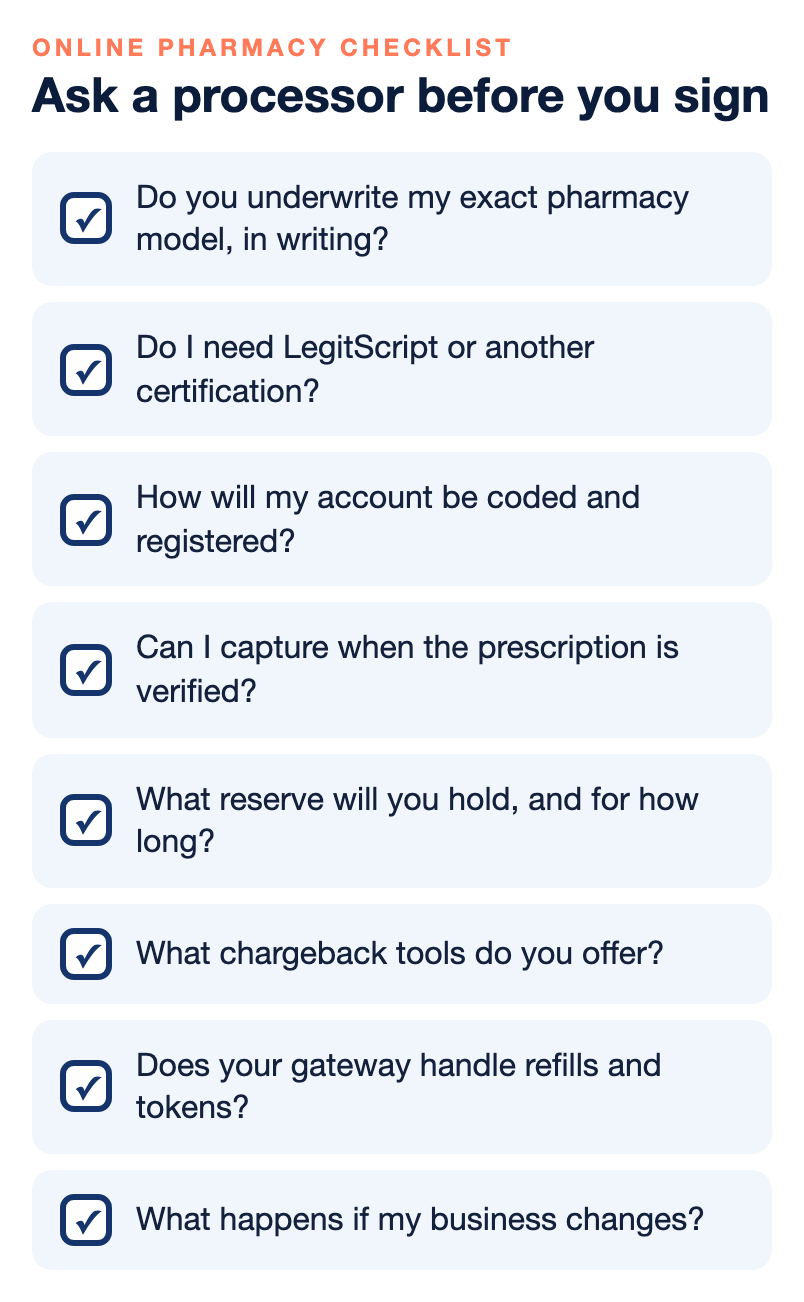
Questions to ask before you choose a processor
These questions separate a processor that understands pharmacy from one that will approve you today and review you next month. Ask them in writing and keep the answers.
- Do you underwrite online pharmacies with my exact model, and will you say so in writing? Name your medications, your fulfilling pharmacy and the states you serve.
- Do I need LegitScript or another certification for your program, and can you help me get it?
- How will my account be coded and registered with the card brands?
- Can I authorize at checkout and capture when the prescription is verified, and how long does an authorization last?
- What reserve, if any, will you hold, for how long, and how will I be told if it changes?
- What tools do you offer to prevent and respond to chargebacks? Address and CVV checks, 3D Secure on online orders, and help with disputes.
- Does your gateway handle recurring refills, tokens and my pharmacy software?
- What happens if my products, pharmacy partner or website change after approval?
Where NPS fits, and where it does not
We work with telemedicine providers, online pharmacies, digital health platforms and other regulated healthcare merchants, through banks and processing partners that understand the category. Before anything goes to a bank, we review the business model, the website and the pharmacy relationship so the file goes to underwriting complete, and through our processing relationships some eligible merchants can reach an expedited LegitScript certification pathway. Depending on the program, accounts can include card and ACH processing, recurring and subscription billing, payment links, a virtual terminal, tokenization, API connections, reporting, fraud controls, chargeback tools and our NPSONE payment gateway, with live, U.S.-based support around the clock and a dedicated account manager. Our existing guide to payment processing for telemedicine and online pharmacy businesses goes further into those programs.
Here is where we may not be the right choice:
- You want to be live tomorrow. We underwrite each pharmacy account, and certification and bank review take time. We are not an instant-approval product.
- You would rather not share licenses, agreements and pharmacy details. Any processor that underwrites pharmacy properly will ask for them.
- You are choosing only on the lowest advertised rate. We price each merchant individually and do not publish one universal rate.
- Your products cannot be sold lawfully, or are labeled for research while marketed for human use. No processor can fix that, and we do not help merchants disguise products or business models.
- You are a hobby seller with very low volume. A simpler setup may suit you better.
Next step
An online pharmacy’s payment setup should be designed while the business is being built, not bolted on days before launch. Map the payment path, decide when you capture, get your website and partner paperwork in order, and choose a processor that has said yes to your exact model in writing.
If you want us to look at your model, website and pharmacy relationship before you apply anywhere, you can talk with our team. For more on how payments work, browse our payments guides. If your pharmacy is a better fit somewhere else, we will tell you.
Frequently asked questions
What is e-commerce payment processing for an online pharmacy?
It is the system that moves a patient’s online card payment from your checkout to your bank account. A gateway takes the card details, a processor routes them, the card network asks the patient’s bank for approval, and your acquiring bank funds you. For a pharmacy, extra checks sit around that flow, including deeper underwriting, card-brand registration and often an independent healthcare certification.
Do online pharmacies need a high-risk merchant account?
Usually, yes. Selling prescription products online is treated as a regulated, higher-risk category because the bank takes on more compliance exposure. That label does not mean you are doing anything wrong. It means you need a bank and processor that underwrite pharmacy on purpose.
Does an online pharmacy need LegitScript certification?
Many do. Online pharmacies are one of the main categories LegitScript Healthcare Merchant Certification covers, and many banks and payment programs that handle card-not-present prescription sales require or recognize it. Certification does not guarantee a merchant account, because the bank and processor still run their own underwriting.
Can I use a regular payment app for my online pharmacy?
It is risky. Many instant-approval payment platforms restrict or prohibit pharmaceutical and healthcare sales and review accounts after they start processing. Read the platform’s restricted business list and healthcare policies before you process any prescription through it.
When should an online pharmacy capture a card payment?
Many online sellers authorize the card at checkout and capture the charge once the order is approved and ready to ship. For a pharmacy, that can keep an unverified prescription from turning into a refund or a dispute. Ask your processor how long an authorization stays valid on your account.
How much does payment processing cost for an online pharmacy?
It depends on your model, monthly volume, average order, refund and dispute history, recurring billing and any reserve the bank requires. Regulated healthcare usually costs more than ordinary retail because the bank takes on more risk. Ask for a written, itemized quote rather than relying on an advertised rate.
Why do online pharmacy accounts get frozen or closed?
Common reasons include products the processor did not approve, website claims that cannot be supported, changes to the pharmacy partner or business model that were not disclosed, and rising disputes or refunds. Telling your processor about changes before they happen is the best protection. Hiding a product or describing the business as something else usually makes the outcome worse.





